
Thinking out loud
Where we share the insights, questions, and observations that shape our approach.
Kubernetes as a solution to container orchestration
Containerization
Kubernetes has become a synonym for containerization. Containerization, also known as operating-system-level virtualization provides the ability to run multiple isolated containers on the same Kernel. That is, on the same operating system that controls everything inside the system. It brings a lot of flexibility in terms of managing application deployment.
Deploying a few containers is not a difficult task. It can be done by means of a simple tool for defining and running multi-container Docker applications like Docker Compose. Doing it manually via command line interface is also a solution.
Challenges in the container environment
Since the container ecosystem moves fast it is challenging for developers to stay up-to-date with what is possible in the container environment. It’s usually in the production system where things get more complicated as mature architecture can consist of hundreds or thousands of containers. But then again, it’s not the deployment of such swarm that’s the biggest challenge.
What’s even more confusing is the quality of our system called High Availability. In other words, it is when multiple instances of the same container must be distributed across nodes available in the cluster. The type of the application that lives in a particular container that dictates the distribution algorithm that should be applied. Once the containers are deployed and distributed across the cluster, we encounter another problem: the system behavior in the presence of node failure.
Luckily enough, modern solutions provide a self-healing mechanism. Therefore, if a node hits the capacity limits or its down issues, the container will be redeployed on a different node to ensure stability. With that said, managing multiple containers without a sophisticated tool is almost impossible. This sophisticated tool is known as a container orchestrator. Companies have many options when it comes to platforms for running containers. Deciding which one is the best for a particular organization can be a challenging task itself. There are plenty of solutions on the market among which the most popular one is Kubernetes [1].
Kubernetes
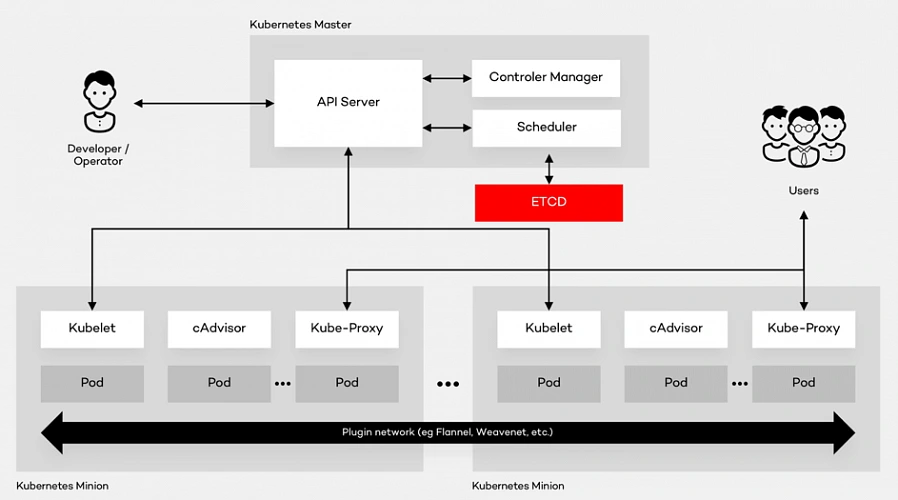
Kubernetes is the open source container platform first released by Google in 2014. The name Kubernetes, translated from Ancient Greek and means “Helmsman”. The whole idea behind this open-source project was based on Google’s experience of running containers at an enormous scale. The company uses Kubernetes for the Google Container Engine (GKE), their own Container as a Service (CaaS). And it shouldn’t be a surprise to anyone that numerous other platforms out there such as IBM Cloud, AWS or Microsoft Azure support Kubernetes. The tool can manage the two most popular types of containers – Docker & Rocket. Moreover, it helps organize networking, computing and storage – three nightmares of the microservice world. Its architecture is based on two types of nodes – Master and Minion as shown below:
Architecture glossary
- PI Server – entry point for REST commands. It processes and validates the requests and executes the logic.
- Scheduler – it supports the deployment of configured pods and services onto the nodes.
- Controller Manager – uses an apiserver to control the shared state of the cluster and makes changes if necessary.
- ETCD Storage – key-value store used mainly for shared configuration and service discovery.
- Kubelet – receives the configuration of a pod from the apiserver and makes sure that the right containers are running. It also communicates with the master node.
- cAdvisor – (Container Advisor) it collects and processes information about each running container. Most importantly, it helps container users understand the resource usage and performance characteristics of their containers.
- Kube - Proxy – runs on each node. It manages the networking routing for TCP (Transmission Control Protocol) and UDP (User Datagram Protocol) packets which are used for sending bits of data.
- Pod – the fundamental element of the architecture, a group of containers that, in a non-containerized setup, would all run on a single server.
Architecture description
A Pod provides abstraction of the container and makes it possible to group them and deploy on the same host. The containers that are in the same Pod share a network, storage and a run specification. Every single Minion Node runs a kubelet agent process which connects it to the Master Node as well as a kube-proxy which can do simple TCP and UDP stream forwarding. The Kubernetes architecture model assumes that Pods can communicate with other Pods, regardless of which host they land on. Besides, they also have a short lifetime: they’re created, destroyed and then created again depending on the server. Connectivity can be implemented in various methods (kube-router, L2 network etc.). In many cases, a simple overlay network based on a Flannel is a sufficient solution.
Summary
As a company with years of experience in the cloud evolution, we advise enterprises to think even up to ten years into the future when choosing the right platform . It all depends on where they see technology heading. Hopefully, this summary will help you understand the fundamentals of component containerization, the Kubernetes architecture and, in the end, make the right decision.