
Unlock revenue from every connected asset
Convert vehicle, machine, and device telemetry into commercial data products, partner offerings, and premium digital services.

Monetize the data you already own
Create new revenue streams from existing data assets
Databoostr gives OEMs a clear path to monetizing the data their products already generate by enabling them to turn raw and enriched telemetry into commercial data products and digital services.
Identify and shape your data monetization opportunities
Databoostr helps OEMs define viable data offerings — whether direct data sales, partner-facing insights, or subscription-based services — across mobility, manufacturing, IoT, and other verticals.
Launch data monetization without internal complexity
As integration overhead, fragmented systems, and limited in-house expertise frequently slow data commercialization, Databoostr delivers a ready-to-use environment for exposing data products.
Databoostr: A platform for data monetization
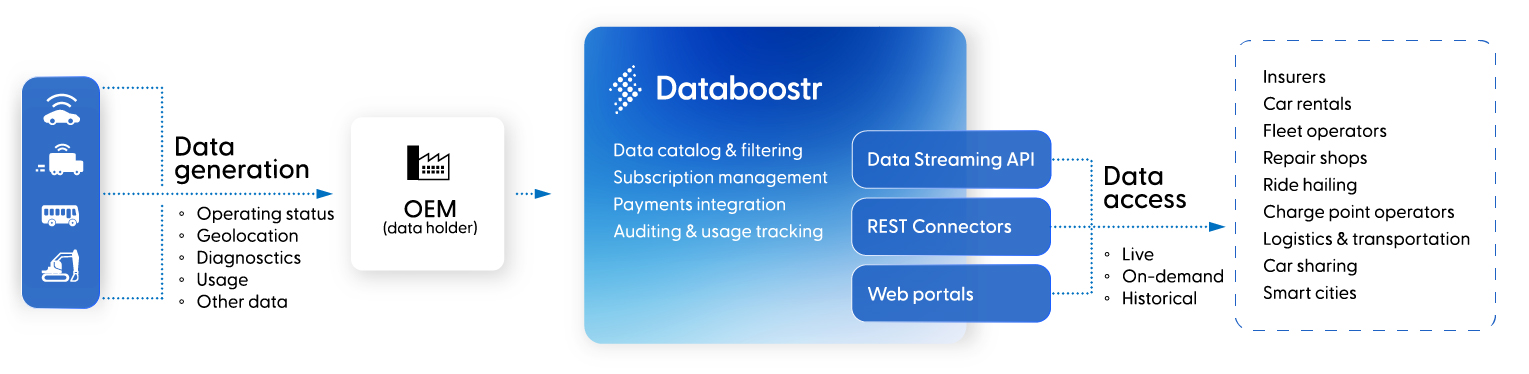
Databoostr retrieves telematics data already available in OEM systems and delivers it to B2B partners, enabling monetization through subscriptions and data-driven services.
Comprehensive data management
Ingest data from existing sources, organize it into catalogued sellable assets, and enrich telemetry to create targeted, high-value data products.
Flexible data delivery channels
Deliver data through streaming APIs for subscription services, REST APIs for direct data sales, and self-service web portals for customer and partner access.
Diverse payment models
Support tiered pricing, subscriptions, pay-per-use, and custom partner agreements, enabling a flexible approach tailored to different business relationships.
Complete monetization control
Apply granular access permissions, monitor usage, and track consumption for accurate billing and full operational oversight.
Capabilities that power data monetization
Data streaming endpoints
Deliver live telemetry data to partners and customers in near-real time.
Data access APIs
Provide on-demand access to historical data records, from full datasets to single data points.
Data catalog management
Organize data assets with rich metadata to simplify discovery and reuse.
Data ingestion and filtering
Provide granular and controlled access to relevant subsets of data.
Predefined integration cut points
Accelerate deployment with ready integration touchpoints for identity, billing, custom analytics, and other OEM infrastructure.
Remote commands
Allow authorized clients to trigger actions or control connected assets via OEM-provided APIs.
Auditing and usage tracking
Gain transparency into data access patterns and consumption metrics.
Enriched data support
Offer enhanced datasets as premium products, leveraging add-on enrichment pipelines external to Databoostr.
B2B customer portal
Empower partners with a self-service portal to browse and purchase data products, manage API keys, and access documentation.
Discover diverse paths to data-driven revenue
There's no single way to monetize connected product data. Whether you sell raw telemetry, deliver analytics, or offer premium features - Databoostr gives you the flexibility to pursue them all.
Data-as-a-Product
Offer structured signals through real-time and on-demand APIs, including:
- Raw vehicle, machine and device machine telemetry data
- Diagnostic and fault information
- Operating parameters and health metrics
- Event and status logs
Insights-as-a-Service
Provide analytics-derived products and operational intelligence, such as:
- Maintenance insights
- Component lifecycle intelligence
- Usage patterns and driver/operator behavior analytics
Premium digital features
Offer paid digital features and value-add services to customers, including:
- Advanced dashboards
- Performance monitoring
- Personalized usage recommendations
- Remote device or vehicle insights
Built for OEMs across industries
Designed for cross-industry OEM needs, Databoostr supports data monetization and digital data products delivery across a broad spectrum of connected-product segments.
Robotics & automation
Deliver performance analytics to integrators and maintenance providers.
Automotive
Partner with insurers, fleet operators, and aftermarket providers.

Consumer IoT
Share usage and device health data with service partners.
Manufacturing & industrial machinery
Enable predictive maintenance and operational benchmarking.

Energy & utilities
Support grid monitoring, demand forecasting, and consumption analytics.
Heavy equipment
Support fleet management and asset utilization planning.
Home appliances
Power services for retailers, warranty providers, and smart home partners.
Smart mobility and fleet solutions
Provide real-time data for routing, maintenance, and driver performance.

Discover how we activate secure data sharing
Business meets technology through engineering excellence.
How two automotive OEMs turned regulatory pressure into business opportunity.
Insights on data sharing challenges
Learn more about how we activate data sharing
Is rise of data and AI regulations a challenge or an opportunity?
Right To Repair and EU Data Act as a step towards data monetization.
Legislators try to shape the future
In recent years the automotive market has witnessed a growing amount of laws and regulations protecting customers across various markets. At the forefront of such legislation is the European Union, where the most significant disruption for modern software-defined vehicles come from the EU Data Act and EU AI Act. The legislation aims to control the use of AI and to make sure that the equipment/vehicle owner is also the owner of the data generated by using the device. The vehicle owner can decide to share the data with any 3rd party he wants, effectively opening the data market for repair shops, custom applications, usage-based insurance or fleet management.
Across the Atlantic, in the United States, there is a strong movement called “Right to Repair”, which effectively tries to open the market of 3rd party repair of all customer devices and appliances. This also includes access to the data generated by the vehicle. While the federal legislation is not there, there are two states that that stand out in terms of their approach to Right to Repair in the automotive industry – Massachusetts and Maine.
Both states have a very different approach, with Maine leaning towards an independent entity and platform for sharing information (which as of now does not exist) and Massachusets towards OEMs creating their own platforms. With numerous active litigations, including lawsuits OEMs vs State, it’s hard to judge what will be the final enforceable version of the legislation.
The current situation
Both pieces of legislation impose a penalty when it’s not fulfilled – severe in the case of EDA (while not final, the fines are expected to be substantial, potentially reaching up to €20 million or 4% of total worldwide annual turnover!), and slightly lower for state Right to Repair (for civil law suits it may be around $1000 per VIN per day, or in Massachusets $10.000 per violation).
The approach taken by the OEMs to tackle this fact varies greatly. In the EU most of the OEMs either reused existing software or build/procured new systems to fulfill the new regulation. In the USA, because of the smaller impact, there are two approaches: Subaru and Kia in 2022 decided to just disable their connected services (Starlink and Kia Connect respectively) in states with strict legislation. Others decided to either take part in litigation, or just ignore the law and wait. Lately federal judges decided in favor of the state, making the situation of OEMs even harder.
Data is a crucial asset in today’s world
Digital services, telematics, and in general data are extremely important assets. This has been true for years in e-commerce, where we have seen years of tracking, cookies and other means to identify customers behavior. The same applies to telemetry data from the vehicle. Telemetry data is used to repair vehicles, to design better features and services offering for existing and new models, identify market trends, support upselling, lay out and optimize charging network, train AI models, and more. The list never ends.
Data is collected everywhere. And in a lot of cases stored everywhere. The sales department has its own CRM, telemetry data is stored in a data lake, the mobile app has its own database. Data is siloed and dispersed, making it difficult to locate and use effectively.
Data platform importance
To solve the problem with both mentioned legislations you need a data sharing platform. The platform is required to manage the data owner consent, enable collection of data in single place and sharing with either data owner, or 3rd party. While allowing to be compliant with upcoming legislation, it also helps with identifying the location of different data points, describing it and making available in single place – allowing to have a better use of existing datasets.
A data platform like Grape Up Databoostr helps you quickly become compliant, while our experienced team can help you find, analyze, prepare and integrate various data sources into the systems, and at the same time navigate the legal and business requirements of the system.
Cost of becoming compliant
Building a data streaming platform comes at the cost. Although not terribly expensive, platform requires investment which does not immediately seem useful from a business perspective. Let’s then now explore the possibilities of recouping the investment.
- You can use the same data sharing platform to sell the data, even reusing the mechanism used to get user consent for sharing the data. For B2B use cases, the mechanism is not required.
- Legislation mainly mandates to share data “as is”, which means raw, unprocessed data. Any derived data, like predictive maintenance calculation from AI algorithms, proprietary incident detection systems, or any data that is processed by OEM. This allows not just to put a price tag on data point, but also to charge more due to additional work required to build analytics models.
- You can share the anonymized datasets, which then can be used to train AI models, identify EVs charging patterns, or plan marketing campaigns.
- And lastly, EU Data Act allows to charge fair amount for sharing the data, to recoup the cost of building and maintaining the platform. The allowed price depends on the requestor, where enterprises can be charged with a margin, and the data owner should be able to get data for free.
We can see that there are numerous ways to recoup the cost of building the platform. This is especially important as the platform might be required to fulfill certain regulations, and procuring the system is required, not optional.
The power of scale in data monetization
As we now know, building a data streaming platform is more of a necessity, than an option, but there is a way to change the problem into an opportunity. Let’s see if the opportunity is worth the struggle.
We can begin with dividing the data into two types – raw and derived. And let’s put a price tag on both to make the calculation easier. To further make our case easier to calculate and visualize, I went to high-mobility and checked current pricing for various brands, and took the average of lower prices.
The raw data in our example will be $3 per VIN per month, and derived data will be $5 per VIN per month. In reality the prices can be higher and associated with selected data package (the data from powertrain will be different from chassis data).
Now let’s assume we start the first year with a very small fleet, like the one purchased for sales representatives by two or three enterprises – 30k of vehicles. Next year we will add a leasing company which will increase the number to 80k of vehicles, and in 5 years we will have 200k VINs/month with subscription.

Of course, this represents just a conservative projection, which assumes rather small usage of the system and slow growth, and exclusive subscription to VIN (in reality the same VIN data can be shared to an insurance company, leasing company, and rental company).
This is constant additional revenue stream, which can be created along the way of fulfilling the data privacy and sharing regulations.
Factors influencing the value
$3 per VIN per month may initially appear modest. Of course with the effect of scale we have seen before, it becomes significant, but what are the factors which influence the price tag you can put on your data?
- Data quality and veracity – the better quality of data you have, the less data engineering is required on the customer side to integrate it into their systems.
- Data availability (real-time versus historical datasets) – in most cases real-time data will be more valuable – especially when the location of the vehicle is important.
- Data variety – more variety of data can be a factor influencing the value, but more importantly is to have the core data (like location and lock state). Missing core data will reduce the value greatly.
- Legality and ethics – the data can only be made available with the owner consent. That’s why consent management systems like the ones required by EDA are important.
What is required
To monetize the data you need a platform, like Grape Up’s Databoostr. This platform should be integrated into various data sources in the company, making sure that data is streamed in a close to real-time way. This aspect is important, as quite a lot of modern use cases (like Fleet Management System) requires data to be fresh.
Next step is to create pricing strategy and identify customers, who are willing to pay for the data. It is a good start to ask the business development department if there are customers who already asked for data access, or even required to have this feature before they invest in bigger fleet.
The final step would be to identify the opportunities to further increase revenue, by adding additional data points for which customers are willing to pay extra.
Summary
Ultimately, data is no longer a byproduct of connected vehicles – it is a strategic asset. By adopting platforms like Grape Up’s Databoostr, OEMs can not only meet regulatory requirements but also position themselves to capitalize on the growing market for automotive data. With the right strategy, what begins as a compliance necessity can evolve into a long-term competitive advantage.
EU Data regulations decoded: Expert solutions for IoT compliance and growth
IoT manufacturers are continuously advancing the potential of connected devices. By 2025, the global expansion of IoT is projected to generate nearly 80 zettabytes of data annually (1), highlighting the immense scale and complexity of managing this volume.
However, with innovation comes the challenge of navigating Europe’s regulatory landscape .
Three key EU data regulations – the Data Governance Act (DGA) (2), the EU Data Act (3), and the General Data Protection Regulation (GDPR) (4) – outline how businesses must handle, share, and protect both personal and non-personal data.
This article explains how these regulations work together and how IoT manufacturers can comply while opening new business opportunities within this legal framework.
Explaining the EU Data Act
The EU Data Act, set to be fully implemented in 2025, seeks to ensure fairness and transparency in the data economy. It gives users and businesses the right to access and control data generated by IoT devices , promoting innovation and fair competition.
- User control over data : The EU Data Act allows users (and businesses) to authorize the sharing of their device-generated data with third-party service providers. This requires IoT manufacturers to build systems that enable users to easily request and manage access to their data.
- Mandatory data sharing : In certain cases, IoT manufacturers will be required to share data with other businesses when authorized by the user. For example, third-party service providers may need access to this data. In B2B scenarios, manufacturers can request reasonable compensation for providing the data.
This regulation is particularly relevant in industries like automotive and smart cities, where multiple stakeholders rely on shared data. A connected car manufacturer, for instance, must ensure users can authorize access to their vehicle data for services like maintenance or insurance.
Introduction to the Data Governance Act
The DGA, effective since September 2023, is all about creating a trustworthy, neutral data-sharing system. It focuses on two key areas: data intermediation services and data altruism .
- Access to public sector data: The DGA allows businesses to reuse data from public sector bodies, such as healthcare, transportation, and environmental data. This provides access to high-quality data that can be used to develop new products, services, and innovations.
Example: A company developing AI-based healthcare solutions can use anonymized public health data to create more accurate models or treatments.
- Data intermediation services : Intermediaries are neutral third parties that help exchange data between IoT manufacturers and other data users (like third-party service providers) under B2B, C2B, and data cooperative models.
The idea emerged as an alternative to big tech platforms monopolizing data-sharing. The goal? To provide a secure and transparent space where personal and non-personal data can be shared safely.
Example: A smart home manufacturer might team up with a data intermediary to help users share energy data with utility companies or researchers looking into energy efficiency.
Manufacturers cannot act as intermediaries directly, but they can partner with or establish separate entities to manage data exchanges. If they create these intermediaries, the entities must function independently from the core business. This separation ensures data is handled fairly and transparently without commercial bias.
The goal is to build trust - intermediaries are only there to facilitate secure, neutral connections between data holders and users without using the data for their own benefit.
- Data altruism : This is all about voluntary data sharing for the public good. Think research or environmental projects. IoT manufacturers can give users the option to donate their data, opening the door to collaborations with research bodies or public organizations.
The DGA's core focus is building user trust by ensuring data transparency, security, and fairness, whether through neutral intermediaries or data shared for a greater cause.
Key GDPR rules every business should know
The GDPR, in effect since 2018, sets strict rules for how businesses collect, store, and process personal data, including data from IoT devices.
- User consent and transparency : IoT manufacturers must obtain explicit user consent before collecting or processing personal data, such as health data from wearable devices or location data from connected cars. Transparency about how this data is used is also required.
- Data security and privacy : Manufacturers must implement robust security measures to protect personal data and adhere to data minimization principles - only collecting what’s necessary. Additionally, they must uphold user rights, such as providing access to their data, supporting data portability, and allowing users to request erasure (the right to be forgotten).
For example, wearable device manufacturers need to ensure the security of personal data and offer users the ability to request the deletion of their data if they no longer wish for it to be stored.
How the DGA, EU Data Act, and GDPR work together
These three EU data regulations create a well-rounded framework for managing both personal and non-personal data in the IoT space.
- The DGA : The Data Governance Act creates neutral, secure data-sharing ecosystems, promoting transparency and fairness when multiple parties exchange data through trusted intermediaries.
- The EU Data Act : This regulation complements the DGA by giving users control over the data generated by their devices, allowing them to request that it be shared with third-party service providers. In certain B2B cases, the data holder may request fair compensation for providing access to the data.
- The GDPR : The GDPR adds strong protections for personal data. When personal information is involved, it ensures that users’ privacy and rights are respected.
Example:
Imagine a smart agriculture company that manufactures sensors to monitor soil and weather conditions.
Under the DGA, the company can work with neutral intermediaries to securely share aggregated environmental data with researchers studying climate change, maintaining transparency and fairness in the exchange.
At the same time, the EU Data Act allows farmers who use these sensors to maintain control over their data and request that it be shared with third-party services like equipment manufacturers or crop analytics firms. In certain B2B cases, the smart agriculture company can ask for fair compensation for sharing aggregated data insights.
If personal data is involved - such as specific information about a farm or farmer - the GDPR governs how this data is processed and shared, requiring user consent and protecting the farmer’s privacy throughout the process.
How IoT manufacturers adapt to EU data regulations
Implement robust data protection measures: Secure personal data with strong encryption, access controls, and anonymization. Obtain explicit user consent, ensure compliance with access and erasure requests, and support data portability. Processes for timely responses to data requests and identity verification are crucial.
Build systems for data access and sharing: Create mechanisms for users to easily share or revoke access to their data and establish clear frameworks for data sharing with third parties, including compensation rules where appropriate. Ensure these practices align with competition laws.
Partner with or create independent data intermediaries: Collaborate with neutral data intermediaries to handle data exchanges between parties securely and without bias or create an independent entity within your organization to fulfill this role, following the EU Data Governance Act’s guidelines.
Adopt privacy-by-design principles : Integrate privacy and security measures into the design phase of your products and services. This means designing IoT devices and platforms with built-in security and privacy features, such as anonymization, data minimization, and encryption, from the outset rather than adding these measures later.
Focus on data interoperability and standardization: Adopt standardized data formats to ensure that your IoT devices and platforms can communicate and exchange data seamlessly with other systems. This not only helps with regulatory compliance but also avoids vendor lock-in and enhances competitiveness by allowing your products to integrate more easily with third-party services.
The role of an IT enabler in navigating EU data regulatory landscape
Given today’s complex regulatory landscape, IoT manufacturers need a technology partner to stay compliant and create business opportunities. An IT enabler provides the tools, expertise, and infrastructure to help companies meet legal and compliance EU data regulations requirements efficiently. Here are the key areas where you’ll need support:
- Regulatory compliance : Navigating complex frameworks requires a deep understanding of these regulations to ensure legal obligations are met. An IT enabler helps interpret laws, builds compliance-focused solutions, and keeps your business up to date with evolving regulations.
- Technology solutions : To comply with privacy laws, businesses must implement secure data handling, processing, and sharing systems. Your IT partner offers scalable technology solutions to manage and protect personal and non-personal data.
- Data exchanges : IoT manufacturers must enable secure, compliant data exchanges with external partners, including neutral data intermediaries and third-party services. An IT enabler designs and implements systems to facilitate these data exchanges while also ensuring transparency and fairness.
- Operational simplicity : Compliance with regulations should not burden your core operations. An IT partner simplifies regulatory processes through automation, effective governance, and streamlined workflows.
- Ongoing maintenance and updates : Once solutions are built and implemented, they require ongoing maintenance to comply with new laws and standards. A software development consultancy provides long-term support and regular updates to ensure your systems evolve alongside regulatory changes.
- Customizable solutions : Every IoT manufacturer has unique business needs, and regulatory compliance often depends on industry-specific nuances. An sofwtare development consulting partner can develop custom-built solutions that not only meet legal standards but also align with your specific operational and business goals.
- Integration with existing systems : Rather than replacing your entire IT infrastructure, an IT enabler integrates new compliance solutions with your existing systems, ensuring a smooth transition with minimal disruption.
At Grape Up , we provide the solutions, expertise, and long-term support to help you navigate these challenges and stay ahead in the regulatory landscape.
Need guidance on complex EU data regulations? We offer expert consulting to guide you.
Looking for secure data-sharing platforms? Our products ensure safe exchanges with third parties while keeping your business compliant.
Whether it’s managing compliance, data security, or third-party integrations, we provide the tools and expertise to support your needs.
.......................
Source:
- https://www.researchgate.net/figure/nternet-of-Things-IoT-connected-devices-from-2015-to-2025-in-billions_fig1_325645304#:~:text=1%2C%20By%20the%20year%202025,of%2079%20zettabytes%20%5B12%5D%20.
- https://digital-strategy.ec.europa.eu/en/policies/data-governance-act
- https://digital-strategy.ec.europa.eu/en/policies/data-act
- https://gdpr-info.eu/
Building EU-compliant connected car software under the EU Data Act
The EU Data Act is about to change the rules of the game for many industries, and automotive OEMs are no exception. With new regulations aimed at making data generated by connected vehicles more accessible to consumers and third parties, OEMs are experiencing a major shift. So, what does this mean for the automotive space?
First, it means rethinking how data is managed, shared, and protected . OEMs must now meet new requirements for data portability, security, and privacy, using software compliant with the EU Data Act.
This guide will walk you through how they can prepare to not just survive but thrive under the new regulations.
The EU Data Act deadlines OEMs can’t miss
- Chapter II (B2B and B2C data sharing) has a deadline of September 2025.
- Article 3 (accessibility by design) has a deadline of September 2026.
- Chapter IV (contractual terms between businesses) has a deadline of September 2027.
Compliance requirements for automotive OEMs
The EU Data Act establishes specific obligations for automotive OEMs to ensure secure, transparent, and fair data sharing with both consumers (B2C) and third-party businesses (B2B). The following key provisions outline the requirements that OEMs must fulfill to comply with the Act.
B2C obligations
- Data accessibility for users:
- Connected products, such as vehicles, must be built in a way that makes data generated by their use accessible in a structured, machine-readable format. This requirement applies from the manufacturing stage, meaning the design process must incorporate data accessibility features.
- User control over data:
- Users should have the ability to control how their data is used, including the right to share it with third parties of their choice. This requires OEMs to implement systems that allow consumers to grant and revoke access to their data seamlessly.
- Transparency in data practices:
- OEMs are required to provide clear and transparent information about the nature and volume of collected data and the way to access it.
- When a user requests to make data available to a third party, the OEM must inform them about:
a) The identity of the third party
b) The purpose of data use
c) The type of data that will be shared
d) The right of the user to withdraw consent for the third party to access the data
B2B obligations
1. Fair access to data:
- OEMs must ensure that data generated by connected products is accessible to third parties at the user’s request under fair, reasonable, and non-discriminatory conditions.
- This means that data sharing cannot be restricted to certain partners or proprietary platforms; it must be available to a broad range of businesses, including independent repair shops, insurers, and fleet managers.
2. Compliance with security and privacy regulations:
- While sharing non-personal data, OEMs must still comply with relevant data security and privacy regulations. This means that data must be protected from unauthorized access and that any data-sharing agreements are in line with the EU Data Act and GDPR.
3. Protection of trade secrets
- OEMs have a right and obligation to protect their trade secrets and should only disclose them when necessary to meet the agreed purpose. This means identifying protected data, agreeing on confidentiality measures with third parties, and suspending data sharing if these measures are not properly followed or if sharing would cause significant economic harm.
Understanding the specific obligations is only the first step for automotive OEMs. Based on this information, they can build software compliant with the EU Data Act. To navigate these new requirements effectively, OEMs need to adopt an approach that not only meets regulatory demands but also strengthens their competitive edge.
Thriving under the EU Data Act: smart investments and privacy-first strategies
Automotive OEMs must take a strategic approach to both their software and operational frameworks, balancing compliance requirements with innovation and customer trust. The key is to prioritize solutions that improve data accessibility and governance while minimizing costs. This starts with redesigning connected products and services to align with the Act’s data-sharing mandates and creating solutions to handle data requests efficiently.
Another critical focus is balancing privacy concerns with data-sharing obligations . OEMs must handle non-personal data responsibly under the EU Data Act while managing personal data in accordance with GDPR. This includes providing transparency about data usage and giving customers control over their data.
To achieve this balance, OEMs should identify which data needs to be shared with third parties and integrate privacy considerations across all stages of product development and data management. Transparent communication about data use, supported by clear policies and customer controls, helps to reinforce this trust.
Opportunities under the EU Data Act
The EU Data Act presents compliance challenges, but it also offers significant opportunities for OEMs that are prepared to adapt. By meeting the Act’s requirements for fair data sharing, OEMs can expand their services and build new partnerships. While direct monetization from data access fees is limited, there are numerous opportunities to leverage shared data to develop new value-added services and improve operational efficiency.
Next steps for automotive OEMs
To move to implementation, OEMs must take targeted actions that address the compliance requirements outlined earlier. These steps lay the groundwork for integrating broader strategies and turning compliance efforts into opportunities for operational improvement and future growth.
Integrate data accessibility into vehicle design
Start integrating data accessibility into vehicle design now to comply by 2026. This involves adapting both front and back-end components of products and services to enable secure and seamless data access and transfer according to the EU Data Act.
Provide user and third-party access to generated data
Introduce easy-to-use mechanisms that let users request access to their data or share it with chosen third parties. Access control should be straightforward, involving simple user identification and making data accessible to authorized users upon request. Develop dedicated data-sharing solutions, applications, or portals that enable third parties to request access to data with user consent.
Implement trade secret protection measures
OEMs should protect their trade secrets by identifying which vehicle data is commercially sensitive. Implement measures like data encryption and access controls to safeguard this information when sharing data. Clearly communicate your approach to protecting trade secrets without disclosing the sensitive information itself.
Implement transparent and secure data handling
Provide clear information to users about what data is collected, how it is used, and with whom it is shared. Transparent data practices help build trust and align with users' data rights under the EU Data Act.
Remember about the non-personal data that is being collected, too. Apply appropriate measures to preserve data quality and prevent its unauthorized access, transfer, or use.
Enable data interoperability and portability
The Act sets out essential requirements to facilitate the interoperability of data and data-sharing mechanisms, with a strong emphasis on data portability. OEMs need to make their data systems compatible with third-party services, allowing data to be easily transferred between platforms.
For example, if a car owner wants to switch from an OEM-provided app to a third-party app for vehicle diagnostics, OEMs must not create technical, contractual, or organizational barriers that would make this switch difficult.
Prepare the data
Choose a data format that fulfills the EU Data Act’s requirement for data to be shared in a “commonly used and machine-readable format.” This approach supports data accessibility and usability across different platforms and services.
Moving forward with confidence
The EU Data Act is bringing new obligations but also offering valuable opportunities. Navigating these changes may seem challenging, but with the right approach, they can become a catalyst for growth.
Turn your data into revenue.
Reach out for tailored consultancy.
FAQ
Databoostr for connected product data monetization
Connected product data monetization is the process by which OEMs convert data generated by their vehicles, machines, and devices into revenue-generating products and services. For OEMs, it works by ingesting telemetry already flowing through existing systems, packaging it into structured data products, and delivering it to B2B partners — insurers, fleet operators, repair providers, service integrators — through subscription models, pay-per-use access, or direct data sales. Databoostr provides the platform infrastructure to manage data ingestion, packaging, access control, and billing in one environment.
Revenue scales with fleet size, data richness, and pricing strategy. Based on Grape Up's research using conservative market benchmarks, raw telemetry is priced at around $3 per VIN per month and analytics-enriched data at $5 per VIN per month. The same VIN can also be monetized across multiple buyers simultaneously — an insurer, a leasing company, and a fleet operator can each subscribe independently, which multiplies revenue potential significantly. Actual pricing depends on data quality, availability (real-time vs. historical), signal variety, and regulatory context.
Databoostr integrates with an OEM's existing telematics and connected-product ecosystem without requiring replacement of underlying systems. The platform ingests data from existing sources through predefined integration cut points — ready-made touchpoints for identity management, billing, analytics infrastructure, and other OEM systems. Data is then filtered, catalogued, and delivered to authorized partners via streaming APIs for real-time use cases and REST APIsfor historical data access. The design prioritizes overlay integration rather than infrastructure replacement.
Databoostr is built for OEM use cases across multiple industries: automotive (connected vehicles, fleet, telematics partnerships), manufacturing and industrial machinery (predictive maintenance, operational benchmarking for integrators and service providers), robotics and automation (performance analytics delivery to maintenance providers), consumer IoT and home appliances (usage and device health data for retailers and warranty providers), heavy equipment (fleet management, asset utilization planning), and energy and utilities (grid monitoring and consumption analytics). The platform's modular architecture is designed to adapt across connected-product verticals with different data types and partner ecosystems.
Yes. Databoostr includes a B2B customer portal that allows partners to browse available data products, manage API keys, purchase access, and retrieve documentation independently — without requiring OEM involvement in each transaction. This reduces operational overhead for OEMs at scale and gives data buyers the autonomous access experience expected in modern B2B data markets. For OEMs managing large partner ecosystems, the portal is the primary interface through which commercial data access is provisioned and managed.
Databoostr supports monetization across three product categories. Data-as-a-Product covers raw telemetry: vehicle and machine diagnostics, operating parameters, fault information, and event logs delivered through real-time and on-demand APIs. Insights-as-a-Service covers analytics-derived products such as maintenance predictions, component lifecycle intelligence, and operator behavior analytics. Premium digital features include advanced dashboards, performance monitoring, and personalized recommendations offered as paid add-ons to end customers. OEMs can pursue one or all three depending on their data maturity and market strategy.
Databoostr supports tiered pricing, recurring subscriptions, pay-per-use billing, and custom partner agreements. This allows OEMs to apply different commercial models to different customer segments — a fixed monthly subscription for fleet operators, usage-based access for independent repair shops, and negotiated enterprise agreements for large B2B partners. The platform handles usage tracking, consumption monitoring, and billing support within a single operational environment.
Data-as-a-Product refers to the direct commercial delivery of raw or lightly processed telemetry— diagnostics, operational signals, event logs — to partners who process it within their own systems. Insights-as-a-Service refers to analytics-derived outputs that the OEM produces from that data before delivery: maintenance predictions, component health scores, usage patterns. Insights-as-a-Service commands higher pricing because it incorporates the OEM's proprietary analytical work on top of the underlying data. Databoostr supports both models, and the EU Data Act specifically permits OEMs to charge more for derived datathan for raw mandatory data sharing.
The EU Data Act mandates that OEMs share data generated by connected products with authorized third parties — but it only requires raw, unprocessed data to be shared at regulated pricing. Any derived data — analytics outputs, AI-enrichedd atasets, predictive intelligence — falls outside mandatory sharing and can be priced commercially. The Act also permits OEMs to charge enterprises a fair margin for mandatory data access to recover platform costs. This means the compliance infrastructure OEMs must build to meet the regulation is the same infrastructure that enables paid data products. What begins as a regulatory obligation becomes a revenue-generating capability.
Platform implementation is backed by three consulting tracks. Data monetization strategy consulting helps OEMs define which data products to build, how to price them, and how to sequence go-to-market across partner segments. Legal and process consulting addresses regulatory compliance — EU Data Act obligations, GDPR alignment, consent management, and trade secret protection in data-sharing agreements. Technology consulting reduces integration complexity and maps Databoostr's architecture to the OEM's existing connected-product and IT infrastructure. This makes Databoostr appropriate for organizations building a data monetization capability for the first time, not only for those with an established data product function.