5 tips for transferring legacy apps to the cloud

With the growing popularity of cloud computing, legacy apps are driving toward an impending demise, and transferring legacy apps is becoming a must. Gartner forecasts that the worldwide public cloud revenue will grow 21.4 % in 2018 to a total of $186.4 billion, up from $153.5 billion in 2017. These staggering numbers are mainly due to the companies that take advantage of the unbeatable benefits that PaaS, SaaS or IaaS provide on a regular basis for businesses in this crazy world of change.
You may not be fully aware of this yet, but the time will come when your system starts playing tricks on you and you will have to transfer your business to a cloud platform. Are you ready for transferring legacy apps ?
As a company that specializes in cloud consulting, we have led many cloud platform implementation projects from start to finish. Most of them involved migrating data and supporting client teams throughout the entire process. We know how important it is to understand what comes along with such change and how to prepare for it in advance.
Choose the right platform
When shopping for the right solution, keep in mind that there are fake cloud providers that only claim to be „cloud”. This phenomenon is so common that it has its own name: „cloud-washing”. It stands for adding the „cloud” part to a product mainly for marketing reasons. Always make sure to carefully examine the product and see if it really supports cloud computing. Going for a fake provider can backfire and result in:
- Delayed and
painful product upgrades, - Expensive integrations,
- A lot of unplanned downtime,
- Poor security.
At Grape Up, we perform migrations to the Cloud Foundry platform, an open source, multi cloud application PaaS.
Motivate and engage your team
Not 100% of your team members will be super enthusiastic about the change at first. Most of them can perceive it as a challenge of learning a new tool or even fear dropping behind the new technology. Which is why it is crucial to assure them that proper support and traning will be there for them. A good idea is to involve managers to speak with their teams ahead of time. An alternative to this would be to delegate staff members to be project managers during the migration.
Prepare for deployment
There are companies out there that delay the date of going live out of pure fear of doing it. The system might be ready, and so can be 90% of staff, but still. There will always be someone who won’t feel at ease about the change. Keep in mind that it’s a much better idea to go live even if you’re not fully ready than put it off for another month or two.
Teach, explain, mentor
Train your staff and ensure that everyone is familiar with their responsibilities before the big day. Companies like Cloud Foundry or Pivotal offer cloud platform training courses and certification programs. Some of them are self-training programs as well.
Invest carefully
You’ve made the decision that you don’t want to maintain your own infrastructure in-house. Which is great! Just be careful with your expenses. Plan them out over a longer period of time and try to cover necessities first. Then, splurge a little on things that are nice-to-haves, but not must-haves.
Transferring legacy apps - summary
If there’s a will, there’s a way – everyone can find a solution that meets their expectations. Whether you go for a full PaaS implementation or only need post integration assistance, Grape Up offers full support, from platform enablement to the replatforming of exisiting apps, to helping you build your own lab and scale. We will walk you through the steps above and make sure that your journey to the cloud goes nice and smooth.

Grape Up guides enterprises on their data-driven transformation journey
Ready to ship? Let's talk.
Check related articles
Read our blog and stay informed about the industry's latest trends and solutions.
LLM comparison: Find the best fit for legacy system rewrites
Legacy systems often struggle with performance, are vulnerable to security issues, and are expensive to maintain. Despite these challenges, over 65% of enterprises still rely on them for critical operations.
At the same time, modernization is becoming a pressing business need, with the application modernization services market valued at $17.8 billion in 2023 and expected to grow at a CAGR of 16.7%.
This growth highlights a clear trend: businesses recognize the need to update outdated systems to keep pace with industry demands.
The journey toward modernization varies widely. While 75% of organizations have started modernization projects, only 18% have reached a state of continuous improvement.
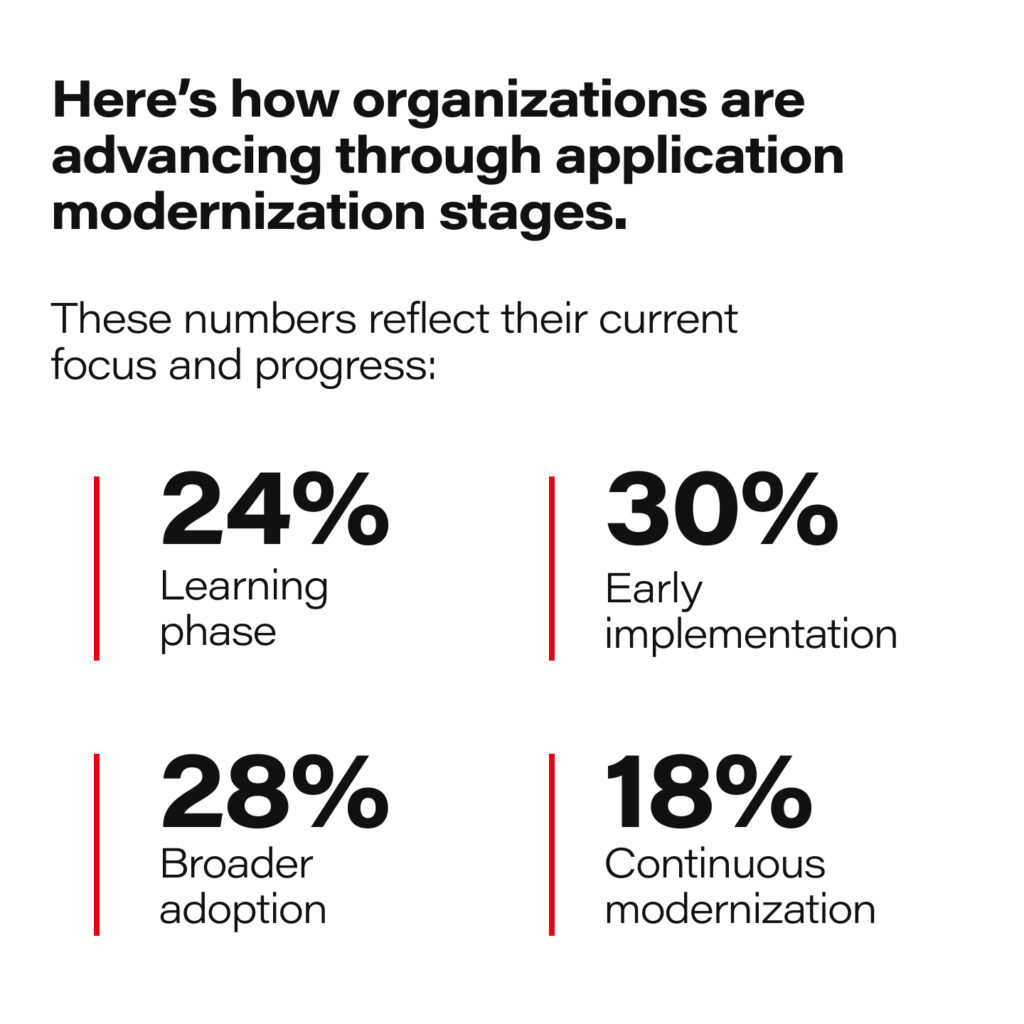
Data source: https://www.redhat.com/en/resources/app-modernization-report
For many, the process remains challenging, with a staggering 74% of companies failing to complete their legacy modernization efforts. Security and efficiency are the primary drivers, with over half of surveyed companies citing these as key motivators.
Given these complexities, the question arises: Could Generative AI simplify and accelerate this process?
With the surging adoption rates of AI technology, it’s worth exploring if Generative AI has a role in rewriting legacy systems.
This article explores LLM comparison, evaluating GenAI tools' strengths, weaknesses, and potential risks. The decision to use them ultimately lies with you.
Here's what we'll discuss:
- Why Generative AI?
- The research methodology
- Generative AI tools: six contenders for LLM comparison
- OpenAI backed by ChatGPT-4o
- Claude-3-sonnet
- Claude-3-opus
- Claude-3-haiku
- Gemini 1.5 Flash
- Gemini 1.5 Pro
- Comparison summary
Why Generative AI?
Traditionally, updating outdated systems has been a labor-intensive and error-prone process. Generative AI offers a solution by automating code translation, ensuring consistency and efficiency. This accelerates the modernization of legacy systems and supports cross-platform development and refactoring.
As businesses aim to remain competitive, using Generative AI for code transformation is crucial, allowing them to fully use modern technologies while reducing manual rewrite risks.
Here are key reasons to consider its use:
- Uncovering dependencies and business logic - Generative AI can dissect legacy code to reveal dependencies and embedded business logic, ensuring essential functionalities are retained and improved in the updated system.
- Decreased development time and expenses - automation drastically reduces the time and resources required for system re-writing. Quicker development cycles and fewer human hours needed for coding and testing decrease the overall project cost.
- Consistency and accuracy - manual code translation is prone to human error. AI models ensure consistent and accurate code conversion, minimizing bugs and enhancing reliability.
- Optimized performance - Generative AI facilitates the creation of optimized code from the beginning, incorporating advanced algorithms that enhance efficiency and adaptability, often lacking in older systems.
The LLM comparison research methodology
It could be tough to compare different Generative AI models to each other. It’s hard to find the same criteria for available tools. Some are web-based, some are restricted to a specific IDE, some offer a “chat” feature, and others only propose a code.
As our goal was the re-writing of existing projects , we aimed to create an LLM comparison based on the following six main challenges while working with existing code:
- Analyzing project architecture - understanding the architecture is crucial for maintaining the system's integrity during re-writing. It ensures the new code aligns with the original design principles and system structure.
- Analyzing data flows - proper analysis of data flows is essential to ensure that data is processed correctly and efficiently in the re-written application. This helps maintain functionality and performance.
- Generating historical b acklog - this involves querying the Generative AI to create Jira (or any other tracking system) tickets that could potentially be used to rebuild the system from scratch. The aim is to replicate the workflow of the initial project implementation. These "tickets" should include component descriptions and acceptance criteria.
- Converting code from one programming language to another - language conversion is often necessary to leverage modern technologies. Accurate translation preserves functionality and enables integration with contemporary systems.
- Generating new code - the ability to generate new code, such as test cases or additional features, is important for enhancing the application's capabilities and ensuring comprehensive testing.
- Privacy and security of a Generative AI tool - businesses are concerned about sharing their source codebase with the public internet. Therefore, work with Generative AI must occur in an isolated environment to protect sensitive data.
Source projects overview
To test the capabilities of Generative AI, we used two projects:
- Simple CRUD application - The project utilizes .Net Core as its framework, with Entity Framework Core serving as the ORM and SQL Server as the relational database. The target application is a backend system built with Java 17 and Spring Boot 3.
- Microservice-based application - The application is developed with .Net Core as its framework, Entity Framework Core as the ORM, and the Command Query Responsibility Segregation (CQRS) pattern for handling entity operations. The target system includes a microservice-based backend built with Java 17 and Spring Boot 3, alongside a frontend developed using the React framework

Generative AI tools: six contenders for LLM comparison
In this article, we will compare six different Generative AI tools used in these example projects:
- OpenAI backed by ChatGPT-4o with a context of 128k tokens
- Claude-3-sonnet - context of 200k tokens
- Claude-3-opus - context of 200k tokens
- Claude-3-haiku - context of 200k tokens
- Gemini 1.5 Flash - context of 1M tokens
- Gemini 1.5 Pro - context of 2M tokens
OpenAI
OpenAI's ChatGPT-4o represents an advanced language model that showcases the leading edge of artificial intelligence technology. Known for its conversational prowess and ability to manage extensive contexts, it offers great potential for explaining and generating code.
- Analyzing project architecture
ChatGPT faces challenges in analyzing project architecture due to its abstract nature and the high-level understanding required. The model struggles with grasping the full context and intricacies of architectural design, as it lacks the ability to comprehend abstract concepts and relationships not explicitly defined in the code.
- Analyzing data flows
ChatGPT performs better at analyzing data flows within a program. It can effectively trace how data moves through a program by examining function calls, variable assignments, and other code structures. This task aligns well with ChatGPT's pattern recognition capabilities, making it a suitable application for the model.
- Generating historical backlog
When given a project architecture as input, OpenAI can generate high-level epics that capture the project's overall goals and objectives. However, it struggles to produce detailed user stories suitable for project management tools like Jira, often lacking the necessary detail and precision for effective use.
- Converting code from one programming language to another
ChatGPT performs reasonably well in converting code, such as from C# to Java Spring Boot, by mapping similar constructs and generating syntactically correct code. However, it encounters limitations when there is no direct mapping between frameworks, as it lacks the deep semantic understanding needed to translate unique framework-specific features.
- Generating new code
ChatGPT excels in generating new code, particularly for unit tests and integration tests. Given a piece of code and a prompt, it can generate tests that accurately verify the code's functionality, showcasing its strength in this area.
- Privacy and security of the Generative AI tool
OpenAI's ChatGPT, like many cloud-based AI services, typically operates over the internet. However, there are solutions to using it in an isolated private environment without sharing code or sensitive data on the public internet. To achieve this, on-premise deployments such as Azure OpenAI can be used, a service offered by Microsoft where OpenAI models can be accessed within Azure's secure cloud environment.
Best tip
Use Reinforcement Learning from Human Feedback (RLHF): If possible, use RLHF to fine-tune GPT-4. This involves providing feedback on the AI's outputs, which it can then use to improve future outputs. This can be particularly useful for complex tasks like code migration.
Overall
OpenAI's ChatGPT-4o is a mature and robust language model that provides substantial support to developers in complex scenarios. It excels in tasks like code conversion between programming languages, ensuring accurate translation while maintaining functionality.
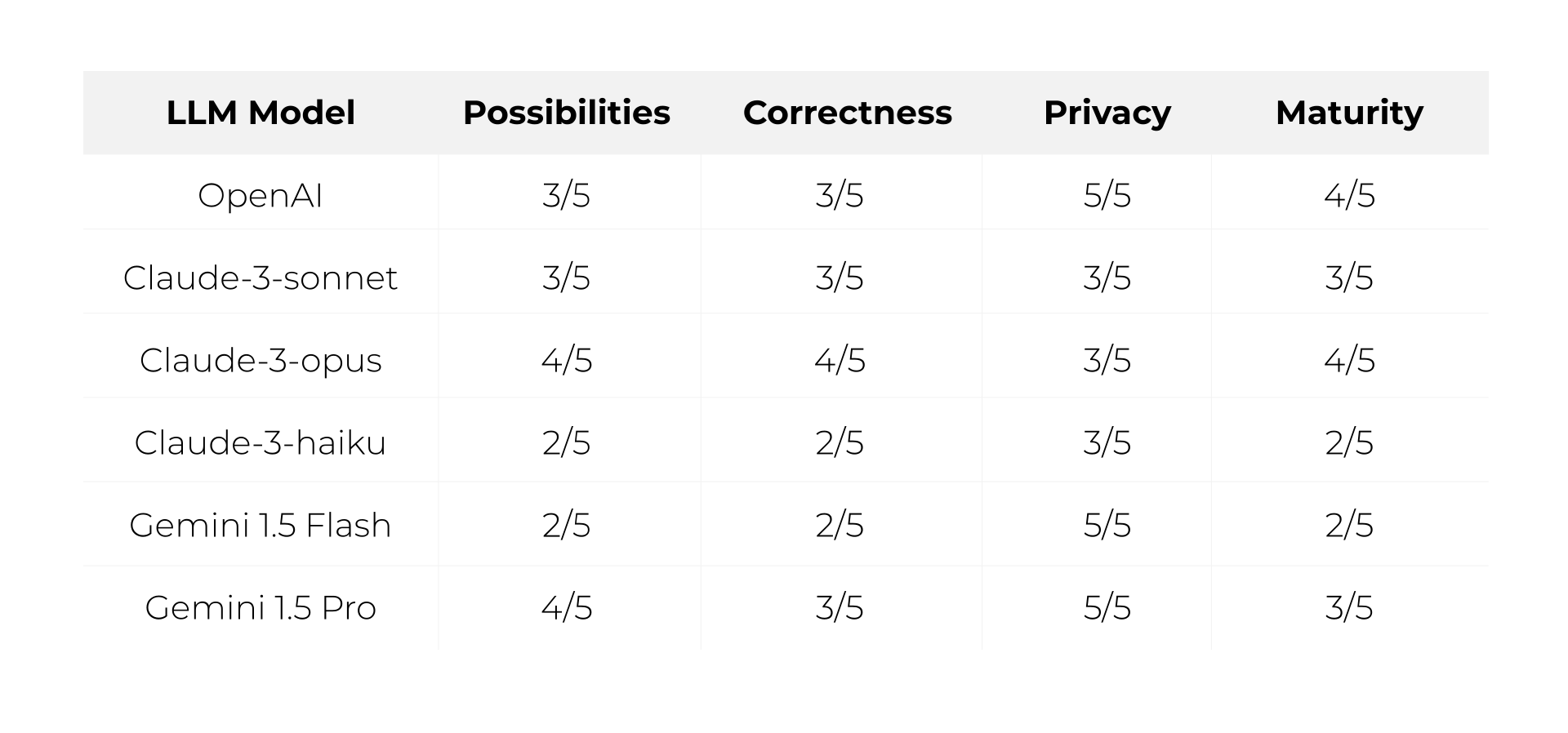
- Possibilities 3/5
- Correctness 3/5
- Privacy 5/5
- Maturity 4/5
Overall score: 4/5
Claude-3-sonnet
Claude-3-Sonnet is a language model developed by Anthropic, designed to provide advanced natural language processing capabilities. Its architecture is optimized for maintaining context over extended interactions, offering a balance of intelligence and speed.
- Analyzing project architecture
Claude-3-Sonnet excels in analyzing and comprehending the architecture of existing projects. When presented with a codebase, it provides detailed insights into the project's structure, identifying components, modules, and their interdependencies. Claude-3-Sonnet offers a comprehensive breakdown of project architecture, including class hierarchies, design patterns, and architectural principles employed.
- Analyzing data flows
It struggles to grasp the full context and nuances of data flows, particularly in complex systems with sophisticated data transformations and conditional logic. This limitation can pose challenges when rewriting projects that heavily rely on intricate data flows or involve sophisticated data processing pipelines, necessitating manual intervention and verification by human developers.
- Generating historical backlog
Claude-3-Sonnet can provide high-level epics that cover main functions and components when prompted with a project's architecture. However, they lack detailed acceptance criteria and business requirements. While it may propose user stories to map to the epics, these stories will also lack the details needed to create backlog items. It can help capture some user goals without clear confirmation points for completion.
- Converting code from one programming language to another
Claude-3-Sonnet showcases impressive capabilities in converting code, such as translating C# code to Java Spring Boot applications. It effectively translates the logic and functionality of the original codebase into a new implementation, leveraging framework conventions and best practices. However, limitations arise when there is no direct mapping between frameworks, requiring additional manual adjustments and optimizations by developers.
- Generating new code
Claude-3-Sonnet demonstrates remarkable proficiency in generating new code, particularly in unit and integration tests. The AI tool can analyze existing codebases and automatically generate comprehensive test suites covering various scenarios and edge cases.
- Privacy and security of the Generative AI tool
Unfortunately, Anthropic's privacy policy is quite confusing. Before January 2024, they used clients’ data to train their models. The updated legal document ostensibly provides protections and transparency for Anthropic's commercial clients, but it’s recommended to consider the privacy of your data while using Claude.
Best tip
Be specific and detailed : provide the GenerativeAI with specific and detailed prompts to ensure it understands the task accurately. This includes clear descriptions of what needs to be rewritten, any constraints, and desired outcomes.
Overall
The model's ability to generate coherent and contextually relevant content makes it a valuable tool for developers and businesses seeking to enhance their AI-driven solutions. However, the model might have difficulty fully grasping intricate data flows, especially in systems with complex transformations and conditional logic.
- Possibilities 3/5
- Correctness 3/5
- Privacy 3/5
- Maturity 3/5
Overall score: 3/5
Claude-3-opus
Claude-3-Opus is another language model by Anthropic, designed for handling more extensive and complex interactions. This version of Claude models focuses on delivering high-quality code generation and analysis with high precision.
- Analyzing project architecture
With its advanced natural language processing capabilities, it thoroughly examines the codebase, identifying various components, their relationships, and the overall structure. This analysis provides valuable insights into the project's design, enabling developers to understand the system's organization better and make decisions about potential refactoring or optimization efforts.
- Analyzing data flows
While Claude-3-Opus performs reasonably well in analyzing data flows within a project, it may lack the context necessary to fully comprehend all possible scenarios. However, compared to Claude-3-sonnet, it demonstrates improved capabilities in this area. By examining the flow of data through the application, it can identify potential bottlenecks, inefficiencies, or areas where data integrity might be compromised.
- Generating historical backlog
By providing the project architecture as an input prompt, it effectively creates high-level epics that encapsulate essential features and functionalities. One of its key strengths is generating detailed and precise acceptance criteria for each epic. However, it may struggle to create granular Jira user stories. Compared to other Claude models, Claude-3-Opus demonstrates superior performance in generating historical backlog based on project architecture.
- Converting code from one programming language to another
Claude-3-Opus shows promising capabilities in converting code from one programming language to another, particularly in converting C# code to Java Spring Boot, a popular Java framework for building web applications. However, it has limitations when there is no direct mapping between frameworks in different programming languages.
- Generating new code
The AI tool demonstrates proficiency in generating both unit tests and integration tests for existing codebases. By leveraging its understanding of the project's architecture and data flows, Claude-3-Opus generates comprehensive test suites, ensuring thorough coverage and improving the overall quality of the codebase.
- Privacy and security of the Generative AI tool
Like other Anthropic models, you need to consider the privacy of your data. For specific details about Anthropic's data privacy and security practices, it would be better to contact them directly.
Best tip
Break down the existing project into components and functionality that need to be recreated. Reducing input complexity minimizes the risk of errors in output.
Overall
Claude-3-Opus's strengths are analyzing project architecture and data flows, converting code between languages, and generating new code, which makes the development process easier and improves code quality. This tool empowers developers to quickly deliver high-quality software solutions.
- Possibilities 4/5
- Correctness 4/5
- Privacy 3/5
- Maturity 4/5
Overall score: 4/5
Claude-3-haiku
Claude-3-Haiku is part of Anthropic's suite of Generative AI models, declared as the fastest and most compact model in the Claude family for near-instant responsiveness. It excels in answering simple queries and requests with exceptional speed.
- Analyzing project architecture
Claude-3-Haiku struggles with analyzing project architecture. The model tends to generate overly general responses that closely resemble the input data, limiting its ability to provide meaningful insights into a project's overall structure and organization.
- Analyzing data flows
Similar to its limitations in project architecture analysis, Claude-3-Haiku fails to effectively group components based on their data flow relationships. This lack of precision makes it difficult to clearly understand how data moves throughout the system.
- Generating historical backlog
Claude-3-Haiku is unable to generate Jira user stories effectively. It struggles to produce user stories that meet the standard format and detail required for project management. Additionally, its performance generating high-level epics is unsatisfactory, lacking detailed acceptance criteria and business requirements. These limitations likely stem from its training data, which focused on short forms and concise prompts, restricting its ability to handle more extensive and detailed inputs.
- Converting code from one programming language to another
Claude-3-Haiku proved good at converting code between programming languages, demonstrating an impressive ability to accurately translate code snippets while preserving original functionality and structure.
- Generating new code
Claude-3-Haiku performs well in generating new code, comparable to other Claude-3 models. It can produce code snippets based on given requirements or specifications, providing a useful starting point for developers.
- Privacy and security of the Generative AI tool
Similar to other Anthropic models, you need to consider the privacy of your data, although according to official documentation, Claude 3 Haiku prioritizes enterprise-grade security and robustness. Also, keep in mind that security policies may vary for different Anthropic models.
Best tip
Be aware of Claude-3-haiku capabilities : Claude-3-haiku is a natural language processing model trained on short form. It is not designed for complex tasks like converting a project from one programming language to another.
Overall
Its fast response time is a notable advantage, but its performance suffers when dealing with larger prompts and more intricate tasks. Other tools or manual analysis may prove more effective in analyzing project architecture and data flows. However, Claude-3-Haiku can be a valuable asset in a developer's toolkit for straightforward code conversion and generation tasks.
- Possibilities 2/5
- Correctness 2/5
- Privacy 3/5
- Maturity 2/5
Overall score: 2/5
Gemini 1.5 Flash
Gemini 1.5 Flash represents Google's commitment to advancing AI technology; it is designed to handle a wide range of natural language processing tasks, from text generation to complex data analysis. Google presents Gemini Flash as a lightweight, fast, and cost-efficient model featuring multimodal reasoning and a breakthrough long context window of up to one million tokens.
- Analyzing project architecture
Gemini Flash's performance in analyzing project architecture was found to be suboptimal. The AI tool struggled to provide concrete and actionable insights, often generating abstract and high-level observations instead.
- Analyzing data flows
It effectively identified and traced the flow of data between different components and modules, offering developers valuable insights into how information is processed and transformed throughout the system. This capability aids in understanding the existing codebase and identifying potential bottlenecks or inefficiencies. However, the effectiveness of data flow analysis may vary depending on the project's complexity and size.
- Generating historical backlog
Gemini Flash can synthesize meaningful epics that capture overarching goals and functionalities required for the project by analyzing architectural components, dependencies, and interactions within a software system. However, it may fall short of providing granular acceptance criteria and detailed business requirements. The generated epics often lack the precision and specificity needed for effective backlog management and task execution, and it struggles to generate Jira user stories.
- Converting code from one programming language to another
Gemini Flash showed promising results in converting code from one programming language to another, particularly when translating from C# to Java Spring Boot. It successfully mapped and transformed language-specific constructs, such as syntax, data types, and control structures. However, limitations exist, especially when dealing with frameworks or libraries that do not have direct equivalents in the target language.
- Generating new code
Gemini Flash excels in generating new code, including test cases and additional features, enhancing application reliability and functionality. It analyzed the existing codebase and generated test cases that cover various scenarios and edge cases.
- Privacy and security of the Generative AI tool
Google was one of the first in the industry to publish an AI/ML privacy commitment , which outlines our belief that customers should have the highest level of security and control over their data stored in the cloud. That commitment extends to Google Cloud Generative AI products. You can set up a Gemini AI model in Google Cloud and use an encrypted TLS connection over the internet to connect from your on-premises environment to Google Cloud.
Best tip
Use prompt engineering: Starting by providing necessary background information or context within the prompt helps the model understand the task's scope and nuances. It's beneficial to experiment with different phrasing and structures; refining prompts iteratively based on the quality of the outputs. Specifying any constraints or requirements directly in the prompt can further tailor the model's output to meet your needs.
Overall
By using its AI capabilities in data flow analysis, code translation, and test creation, developers can optimize their workflow and concentrate on strategic tasks. However, it is important to remember that Gemini Flash is optimized for high-speed processing, which makes it less effective for complex tasks.
- Possibilities 2/5
- Correctness 2/5
- Privacy 5/5
- Maturity 2/5
Overall score: 2/5
Gemini 1.5 Pro
Gemini 1.5 Pro is the largest and most capable model created by Google, designed for handling highly complex tasks. While it is the slowest among its counterparts, it offers significant capabilities. The model targets professionals and developers needing a reliable assistant for intricate tasks.
- Analyzing project architecture
Gemini Pro is highly effective in analyzing and understanding the architecture of existing programming projects, surpassing Gemini Flash in this area. It provides detailed insights into project structure and component relationships.
- Analyzing data flows
The model demonstrates proficiency in analyzing data flows, similar to its performance in project architecture analysis. It accurately traces and understands data movement throughout the codebase, identifying how information is processed and exchanged between modules.
- Generating historical backlog
By using project architecture as an input, it creates high-level epics that encapsulate main features and functionalities. While it may not generate specific Jira user stories, it excels at providing detailed acceptance criteria and precise details for each epic.
- Converting code from one programming language to another
The model shows impressive results in code conversion, particularly from C# to Java Spring Boot. It effectively maps and transforms syntax, data structures, and constructs between languages. However, limitations exist when there is no direct mapping between frameworks or libraries.
- Generating now code
Gemini Pro excels in generating new code, especially for unit and integration tests. It analyzes the existing codebase, understands functionality and requirements, and automatically generates comprehensive test cases.
- Privacy and security of the Generative AI tool
Similarly to other Gemini models, Gemini Pro is packed with advanced security and data governance features, making it ideal for organizations with strict data security requirements.
Best tip
Manage context: Gemini Pro incorporates previous prompts into its input when generating responses. This use of historical context can significantly influence the model's output and lead to different responses. Include only the necessary information in your input to avoid overwhelming the model with irrelevant details.
Overall
Gemini Pro shows remarkable capabilities in areas such as project architecture analysis, data flow understanding, code conversion, and new code generation. However, there may be instances where the AI encounters challenges or limitations, especially with complex or highly specialized codebases. As such, while Gemini Pro offers significant advantages, developers should remain mindful of its current boundaries and use human expertise when necessary.
- Possibilities 4/5
- Correctness 3/5
- Privacy 5/5
- Maturity 3/5
Overall score: 4/5
LLM comparison summary
Embrace AI-driven approach to legacy code modernization
Generative AI offers practical support for rewriting legacy systems. While tools like GPT-4o and Claude-3-opus can’t fully automate the process, they excel in tasks like analyzing codebases and refining requirements. Combined with advanced platforms for data analysis and workflows, they help create a more efficient and precise redevelopment process.
This synergy allows developers to focus on essential tasks, reducing project timelines and improving outcomes.
Choosing the right approach: How generative AI powers legacy system modernization
In today's rapidly evolving digital landscape, the need to modernize legacy systems and applications is becoming increasingly critical for organizations aiming to stay competitive. Once the backbone of business operations, legacy systems are now potential barriers to efficiency, innovation, and security.
As technology progresses, the gap between outdated systems and modern requirements widens, making modernization not just beneficial but essential.
This article provides an overview of different legacy system modernization approaches, including the emerging role of generative AI (GenAI). We will explore how GenAI can enhance this process, making it not only faster and more cost-effective but also better aligned with current and future business needs.
Understanding legacy systems
Legacy systems are typically maintained due to their critical role in existing business operations. They often feature:
- Outdated technology stacks and programming languages.
- Inefficient and unstable performance.
- High susceptibility to security vulnerabilities due to outdated security measures.
- Significant maintenance costs and challenges in sourcing skilled personnel.
- Difficulty integrating with newer technologies and systems.
Currently, almost 66% of enterprises continue to rely on outdated applications to run their key operations, and 60% use them for customer-facing tasks.
Why is this the case?
Primarily because of a lack of understanding of the older technology infrastructure and the technological difficulties associated with modernizing legacy systems. However, legacy application modernization is often essential. In fact, 70% of global CXOs consider mainframe and legacy modernization a top business priority.
The necessity of legacy software modernization
As technology rapidly evolves, businesses find it increasingly vital to update their aging infrastructure to keep pace with industry standards and consumer expectations. Legacy systems modernization is crucial for several reasons:
- Security Improvements : Outdated software dependencies in older systems often lack updates, leaving critical bugs and security vulnerabilities unaddressed.
- Operational Efficiency : Legacy systems can slow down operations with their inefficiencies and frequent maintenance needs.
- Cost Reduction : Although initially costly, the long-term maintenance of outdated systems is often more expensive than modernizing them.
- Scalability and Flexibility : Modern systems are better equipped to handle increasing loads and adapt to changing business needs.
- Innovation Enablement : Modernized systems can support new technologies and innovations, allowing businesses to stay ahead in competitive markets.
Modernizing legacy code presents an opportunity to address multiple challenges from both a business and an IT standpoint, improving overall organizational performance and agility.
Different approaches to legacy modernization
When it comes to modernizing legacy systems, there are various approaches available to meet different organizational needs and objectives. These strategies can vary greatly depending on factors such as the current state of the legacy systems, business goals, budget constraints, and desired outcomes.
Some modernization efforts might focus on minimal disruption and cost, opting to integrate existing systems with new functionalities through APIs or lightly tweaking the system to fit a new operating environment. Other approaches might involve more extensive changes, such as completely redesigning the system architecture to incorporate advanced technologies like microservices or even rebuilding the system from scratch to meet modern standards and capabilities.
Each approach has its own set of advantages, challenges, and implications for the business processes and IT landscape. The choice of strategy depends on balancing these factors with the long-term vision and immediate needs of the organization.
Rewriting legacy systems with generative AI
One of the approaches to legacy system modernization involves rewriting the system's codebase from scratch while aiming to maintain or enhance its existing functionalities. This method is especially useful when the current system no longer meets the evolving standards of technology, efficiency, or security required by modern business environments.
By starting anew, organizations can leverage the latest technologies and architectures, making the system more adaptable and scalable to future needs.
Generative AI is particularly valuable in this context for several reasons:
- Uncovering hidden relations and understanding embedded business rules : GenAI supports the analysis of legacy code to identify complex relationships and dependencies crucial for maintaining system interactions during modernization. It also deciphers embedded business rules, ensuring that vital functionalities are preserved and enhanced in the updated system.
- Improved accuracy : GenAI enhances the accuracy of the modernization process by automating tasks such as code analysis and documentation, which reduces human errors and ensures a more precise translation of legacy functionalities to the new system.
- Optimization and performance : With GenAI, the new code can be optimized for performance from the outset. It can integrate advanced algorithms that improve efficiency and adaptability, which are often lacking in older systems.
- Reducing development time and cost : The automation capabilities of GenAI significantly reduce the time and resources needed for rewriting systems. Faster development cycles and fewer human hours needed for coding and testing lower the overall cost of the modernization project.
- Increasing security measures: GenAI can help implement advanced security protocols in the new system, reducing the risk of data breaches and associated costs. This is crucial in today's digital environment, where security threats are increasingly sophisticated.
By integrating GenAI in this modernization approach, organizations can achieve a more streamlined transition to a modern system architecture, which is well-aligned with current and future business requirements. This ensures that the investment in modernization delivers substantial returns in terms of system performance, scalability, and maintenance costs.
How generative AI fits in legacy system modernization process
Generative AI enables faster speeds and provides a deeper understanding of the business context, which significantly boosts development across all phases, from design and business analysis to code generation , testing, and verification.
Here's how GenAI transforms the modernization process:
1. Analysis Phase
Automated documentation and in-depth code analysis : GenAI's ability to assist in automatic documenting, reverse engineering, and extracting business logic from legacy codebases is a powerful capability for modernization projects. It overcomes the limitations of human memory and outdated documentation to help ensure a comprehensive understanding of existing systems before attempting to upgrade or replace them.
Business-context awareness : By analyzing the production source code directly, GenAI helps comprehend the embedded business logic, which speeds up the migration process and improves the safety and accuracy of the transition.
2 . Preparatory Phase
Tool compatibility and integration: GenAI tools can identify and integrate with many compatible development tools, recommend necessary plugins or extensions within supported environments, and enhance the existing development environment by automating routine tasks and providing intelligent code suggestions to support effective modernization efforts.
LLM-assisted knowledge discovery : Large Language Models (LLMs) can be used to delve deep into a legacy system’s data and codebase to uncover critical insights and hidden patterns. This knowledge discovery process aids in understanding complex dependencies, business logic, and operational workflows embedded within the legacy system. This step is crucial for ensuring that all relevant data and functionalities are considered before beginning the migration, thereby reducing the risk of overlooking critical components.
3. Migration/Implementation Phase
Code generation and conversion : Using LLMs, GenAI aids in the design process by transforming outdated code into contemporary languages and frameworks, thereby improving the functionality and maintainability of applications.
Automated testing and validation : GenAI supports the generation of comprehensive test cases to ensure that all new functionalities are verified against specified requirements and that the migrated system operates as intended. It helps identify and resolve potential issues early, ensuring a high level of accuracy and functionality before full deployment.
Modularization and refactoring : GenAI can also help break down complex, monolithic applications into manageable modules, enhancing system maintainability and scalability. It identifies and suggests strategic refactoring for areas with excessive dependencies and scattered functionalities.
4. Operations and Optimization Phase
AI-driven monitoring and optimization : Once the system is live, GenAI continues to monitor its performance, optimizing operations and predicting potential failures before they occur. This proactive maintenance helps minimize downtime and improve system reliability.
Continuous improvement and DevOps automation : GenAI facilitates continuous integration and deployment practices, automatically updating and refining the system to meet evolving business needs. It ensures that the modernized system is not only stable but also continually evolving with minimal manual intervention.
Across All Phases
- Sprint execution support : GenAI enhances agile sprint executions by providing tools for rapid feature development, bug fixes, and performance optimizations, ensuring that each sprint delivers maximum value.
- Security enhancements and compliance testing : It identifies security vulnerabilities and compliance issues early in the development cycle, allowing for immediate remediation that aligns with industry standards.
- Predictive analytics for maintenance and monitoring : It also helps anticipate potential system failures and performance bottlenecks using predictive analytics, suggesting proactive maintenance and optimizations to minimize downtime and improve system reliability.
Should enterprises use genAI in legacy system modernization?
To determine if GenAI is necessary for a specific modernization project, organizations should consider the complexity and scale of their legacy systems, the need for improved accuracy in the modernization process, and the strategic value of faster project execution.
If the existing systems are cumbersome and deeply intertwined with critical business operations, or if security, speed, and accuracy are priorities, then GenAI is likely an indispensable tool for ensuring successful modernization with optimal outcomes.
Conclusion
Generative AI significantly boosts the legacy system modernization process by introducing advanced capabilities that address a broad range of challenges. From automating documentation and code analysis in the analysis phase to supporting modularization and system integration during implementation, this technology provides critical support that speeds up modernization, ensures high system performance, and aligns with modern technological standards.
GenAI integration not only streamlines processes but also equips organizations to meet future challenges effectively, driving innovation and competitive advantage in a rapidly evolving digital landscape.
Interested in our services?
Reach out for tailored solutions and expert guidance.