
Connected Car & Mobility
The shift from ownership to access is rewriting mobility economics. The challenge isn't technology—it's building platforms that make shared, connected mobility as convenient as ownership once was.
.jpg)
We help OEMs move beyond vehicles into mobility ecosystems.
Our solutions enable MaaS integration, vehicle sharing, multi-modal coordination, and data monetization - giving you the infrastructure to shift from selling cars to orchestrating mobility experiences that scale profitably.
Seamlessly integrate vehicles into MaaS ecosystems, from public transit to shared mobility.
Deliver platforms for vehicle access, scheduling, and usage optimization.
Create mobility solutions that combine cars, bikes, scooters, and public transport into unified experiences.
Enhance utilization, cut costs, and improve customer satisfaction with data-driven fleet tools.
Build scalable booking and rental platforms with integrated payments.
Enable OEMs to monetize data responsibly, with compliance and customer trust at the core.
Learn how we help our customers tackle their challenges
Explore how we redefine industry standards through innovation.

.jpg)
.jpg)


Discover the essentials driving your data journey.
Gain a clear understanding of the key concepts that are fueling the automotive development.
OEMs telemetry APIs
OEMs telemetry APIs
Integrating OEMs telemetry APIs for shared mobility purposes
Integrating OEM’s Telemetry is one of the crucial aspects allowing to unlock new revenue streams as well as reducing operational costs for the mobility providers. One of the key unlocked features is to allow for the bi-directional communication between the car and the user. Locating the car in the parking lot, opening/closing the car from the mobile application, or checking the fuel level significantly increases user satisfaction. On the other hand, analyzing the behavioral data of the driver or the car telemetry itself allows insurance providers to create pay-per-use insurance or discounts for safe drivers.Grape Up has a proven track record of designing and developing complete telemetry platforms, creating APIs for OEMs that can later be exposed for 3rd parties but also consuming APIs of different OEMs and integrating these data with internal systems.
Location-based services
Location-based services
Geofencing for theft prevention and location-based services
Geofencing increases the safety of fleet companies’ operations by adding the ability to track the location and alert on breaking the agreed boundaries. This is most often a case when a vehicle gets stolen, or a customer tries to avoid higher charges for going abroad. With location-based services, the rental or fleet company is immediately notified of such violation and can act appropriately.
One of Grape Up’s customers – a rental car company, developed a Stolen Vehicle Identification system based on OEM’s Telemetry and Geofencing. During just 6 months from launching this feature and integrating it with its internal fleet management system, the company was able to locate 356 missing (stolen or impounded) cars, thus saving hundreds of thousands of dollars by recovering cars, as well as administration costs.
Touchless mobile apps
Touchless mobile apps
Reduce manual labor and improve customer experience with touchless mobile apps
Breakthrough of the COVID-19 pandemic completely changed the way we work and live thus also changing the way we travel, rent, buy or lease cars. It is now crucial for mobility providers to allow their customers for a counter-less rental experience allowing them to avoid queues, but also unnecessary contact.
For one of its customers, Grape Up has designed and developed a touchless system allowing clients to rent a car directly from a mobile phone. Complete customer journey comes to selecting a car, buying insurance and additional features, paying through mobile phone then locating and opening/closing the car – all from the mobile device. The platform is integrated with OEMs Connected Car platform APIs and an internal telematics system, making the system robust and responsive.
Not sure how to turn vehicle data into business value? Let's map out your options.
Get in touch for tailored solutions and expert guidance.
Insights on automotive innovation
Exploring the future of automotive technology
How to build software architecture for new mobility services - connected vehicle remote control
Remote control over a vehicle is not a new idea; it has become a trend in the modern world. The idea of vehicle remote control is highly connected with vehicle telematics , which is used to gather data using GPS technology, sensors, and onboard diagnostics codes. Managed data can include vehicle location, driver behavior, vehicle activity, and real-time engine diagnostics. Further, the technology is managed on software platforms that help fleet owners manage their assets remotely.
The data collected often includes vehicle location, fuel consumption, speeding, and maintenance information. But what if a car got stolen? It would be helpful not only to have the current location but also to send a command to a vehicle to turn the engine off or enable signalization. A huge problem in this case is to have a platform that will be independent of the Original Equipment Manufacturer (OEM). The best option here is to move the solution to the Cloud and introduce a single point of work with vehicles and integration with different OEMs.
Such telematics remote control gives a powerful opportunity to car-rental or car-sharing services like CityBee or SnapCar. They now can track their cars and also offer customers a no-human way to reserve a car using just a mobile application and know the current vehicle state when it is in use.
Vehicle connection
To establish connection to a car it’s necessary to equip the vehicle with an Internet-connected telemetry device. Some companies provide such a device as part of machine installation, but third-party tools like Geotab can be used for custom installation as well. It is important to have a device intended for two-way connection with a vehicle, as some solutions were created only for tracking purposes. Remote vehicle controllers like Mobokey offer the following commands on a vehicle:
- Lock/Unlock
- Turn engines on/off
- Klaxon sound
- Turn flash-lights on/off
- Wake up/sleep
- Connect/Disconnect the vehicle
Some manufacturers require their cars to be woken up explicitly before executing actual commands. It is intended to prevent the continuous connection or in case of low battery level.
Software solution
Once the two-way connection with a vehicle is established, we need a solution to track the actual status of a car and send commands. To do that, it is required:
- To make sure integration with a vehicle is completed successfully
- That the connection is secure
- That the command can be sent by us – it may differ depending on the manufacturer and model
and that we prepared:
- Dashboard to send commands
- Response handling - to be aware if command execution was successful
The damage caused by a successful attack on a vehicular telematics system because of an unsecured connection may range from mild to disastrous - to the extent of serious casualties and property losses. To enforce the security objectives for deployed and developing vehicular monitoring systems, embodiments of the disclosed technology include a stack of security approaches, both on physical and software levels.
As vehicle commands are sent over the Internet, it is important to have a network and infrastructure security built. The software solution stack must be enclosed in a Virtual Private Cloud (VPC). Apart from that, it is highly recommended to apply some best practices such as Static Application Security Testing (SAST), Interactive Application Security Testing (IAST), and Software Composition Analysis (SCA) to find vulnerabilities.
Another challenge in software solutions relates to the need for integration with different OEMs . Each OEM provides an API to integrate with and different ways of communication with vehicles - it may be a synchronous way, for example, HTTP request to REST API, or an asynchronous way, for instance, using queue-based protocols like MQTT.
Another issue is handling command execution responses or callbacks . The easiest way to implement this is when the OEM API synchronously responds with a command execution result, but in most cases, the OEM system may notify us about the execution result eventually in some time.
In this case, it is necessary to find a way to map a command request to a vehicle via OEM API and an execution response as it is used for retry policy, error handling, and troubleshooting.
Software architecture
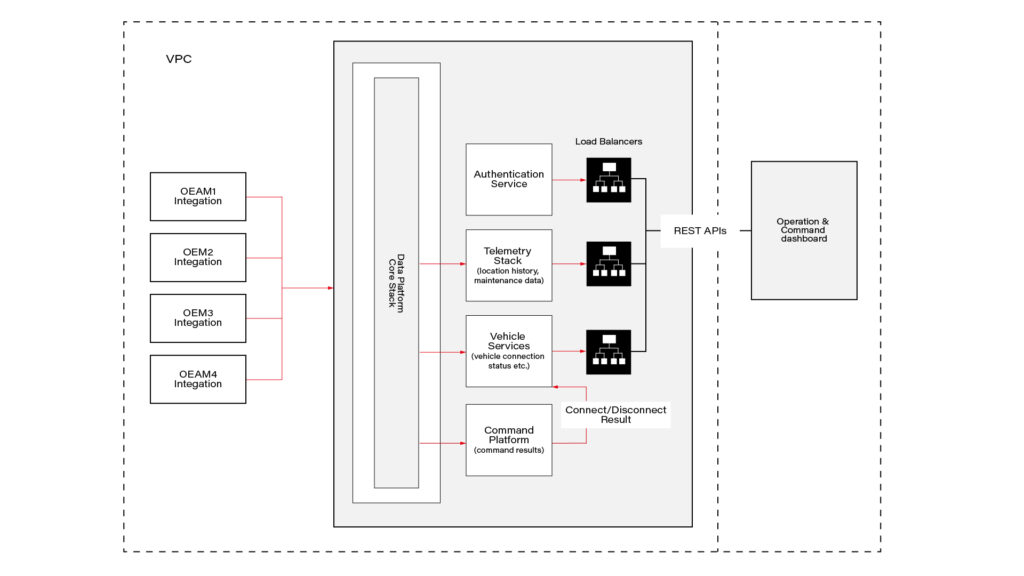
This connected vehicle solution uses the IoT platform, which authenticates messages from connected vehicles and processes data according to business rules. It leverages a set of main services, including Vehicle Services to connect vehicles and store vehicle-related data, a Telemetry stack to collect a delivery stream of input events and write them into Database, Command Services to send commands to the car and combine execution responses; and a queue-based topic which is intended for inter-communication between different parts of the system.
The solution also includes integration with OEM APIs. When IoT receives a message, it authenticates and authorizes the message, and the Command Platform executes the appropriate rule on the message, which routes the message to the appropriate OEM integration.
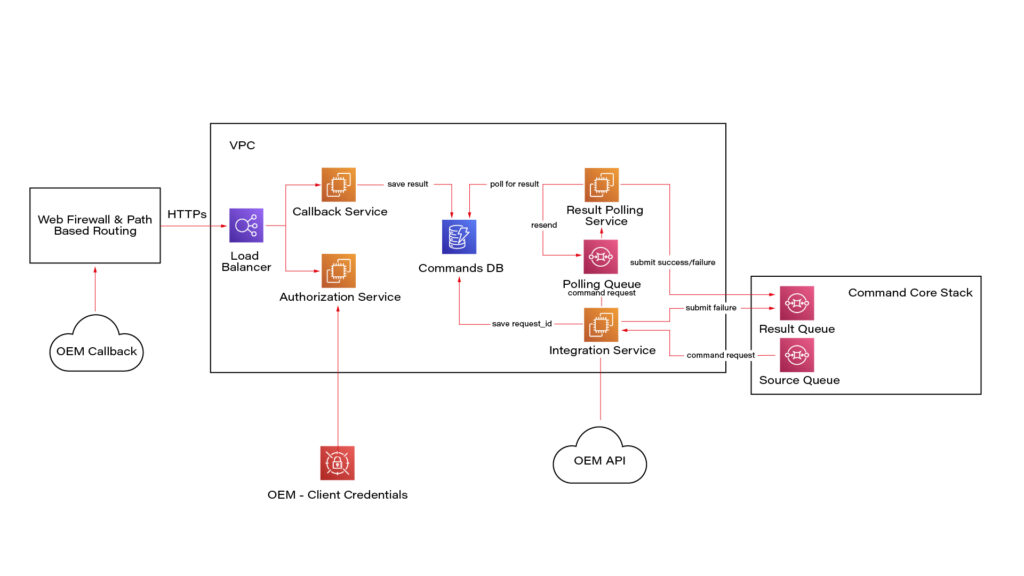
Here we see a potential OEM integration with the IoT Platform. It has authorization integration to allow us to send request OEM API securely; Callback integration to keep OEM response data regarding command execution; Database to keep mapping and consistent result - command request vs response; retry mechanism implementation using polling results from the database.
Once the system is authenticated, requests can be submitted to the connected vehicle solution’s OEM APIs. Based on the request identification data, the system eventually waits for the command result using a callback mechanism.
Conclusion
As highly-equipped connected vehicles increasingly rely on data exchanged with the infrastructure, it is required to have sustainable infrastructure, well-built cyber-security, privacy, and safety taken into account. The proposed solution also pays respect to the need to enroll in this process vehicle from different manufacturers.
This solution with remote vehicle control may be extremely useful for car-sharing systems, and apart from that, it can cover a solution for such use cases as autonomous and semi-autonomous vehicle driving, usage-based insurance, and customized in-vehicle experience . The solution also includes two-way communication.
Building EU-compliant connected car software under the EU Data Act
The EU Data Act is about to change the rules of the game for many industries, and automotive OEMs are no exception. With new regulations aimed at making data generated by connected vehicles more accessible to consumers and third parties, OEMs are experiencing a major shift. So, what does this mean for the automotive space?
First, it means rethinking how data is managed, shared, and protected . OEMs must now meet new requirements for data portability, security, and privacy, using software compliant with the EU Data Act.
This guide will walk you through how they can prepare to not just survive but thrive under the new regulations.
The EU Data Act deadlines OEMs can’t miss
- Chapter II (B2B and B2C data sharing) has a deadline of September 2025.
- Article 3 (accessibility by design) has a deadline of September 2026.
- Chapter IV (contractual terms between businesses) has a deadline of September 2027.
Compliance requirements for automotive OEMs
The EU Data Act establishes specific obligations for automotive OEMs to ensure secure, transparent, and fair data sharing with both consumers (B2C) and third-party businesses (B2B). The following key provisions outline the requirements that OEMs must fulfill to comply with the Act.
B2C obligations
- Data accessibility for users:
- Connected products, such as vehicles, must be built in a way that makes data generated by their use accessible in a structured, machine-readable format. This requirement applies from the manufacturing stage, meaning the design process must incorporate data accessibility features.
- User control over data:
- Users should have the ability to control how their data is used, including the right to share it with third parties of their choice. This requires OEMs to implement systems that allow consumers to grant and revoke access to their data seamlessly.
- Transparency in data practices:
- OEMs are required to provide clear and transparent information about the nature and volume of collected data and the way to access it.
- When a user requests to make data available to a third party, the OEM must inform them about:
a) The identity of the third party
b) The purpose of data use
c) The type of data that will be shared
d) The right of the user to withdraw consent for the third party to access the data
B2B obligations
1. Fair access to data:
- OEMs must ensure that data generated by connected products is accessible to third parties at the user’s request under fair, reasonable, and non-discriminatory conditions.
- This means that data sharing cannot be restricted to certain partners or proprietary platforms; it must be available to a broad range of businesses, including independent repair shops, insurers, and fleet managers.
2. Compliance with security and privacy regulations:
- While sharing non-personal data, OEMs must still comply with relevant data security and privacy regulations. This means that data must be protected from unauthorized access and that any data-sharing agreements are in line with the EU Data Act and GDPR.
3. Protection of trade secrets
- OEMs have a right and obligation to protect their trade secrets and should only disclose them when necessary to meet the agreed purpose. This means identifying protected data, agreeing on confidentiality measures with third parties, and suspending data sharing if these measures are not properly followed or if sharing would cause significant economic harm.
Understanding the specific obligations is only the first step for automotive OEMs. Based on this information, they can build software compliant with the EU Data Act. To navigate these new requirements effectively, OEMs need to adopt an approach that not only meets regulatory demands but also strengthens their competitive edge.
Thriving under the EU Data Act: smart investments and privacy-first strategies
Automotive OEMs must take a strategic approach to both their software and operational frameworks, balancing compliance requirements with innovation and customer trust. The key is to prioritize solutions that improve data accessibility and governance while minimizing costs. This starts with redesigning connected products and services to align with the Act’s data-sharing mandates and creating solutions to handle data requests efficiently.
Another critical focus is balancing privacy concerns with data-sharing obligations . OEMs must handle non-personal data responsibly under the EU Data Act while managing personal data in accordance with GDPR. This includes providing transparency about data usage and giving customers control over their data.
To achieve this balance, OEMs should identify which data needs to be shared with third parties and integrate privacy considerations across all stages of product development and data management. Transparent communication about data use, supported by clear policies and customer controls, helps to reinforce this trust.
Opportunities under the EU Data Act
The EU Data Act presents compliance challenges, but it also offers significant opportunities for OEMs that are prepared to adapt. By meeting the Act’s requirements for fair data sharing, OEMs can expand their services and build new partnerships. While direct monetization from data access fees is limited, there are numerous opportunities to leverage shared data to develop new value-added services and improve operational efficiency.
Next steps for automotive OEMs
To move to implementation, OEMs must take targeted actions that address the compliance requirements outlined earlier. These steps lay the groundwork for integrating broader strategies and turning compliance efforts into opportunities for operational improvement and future growth.
Integrate data accessibility into vehicle design
Start integrating data accessibility into vehicle design now to comply by 2026. This involves adapting both front and back-end components of products and services to enable secure and seamless data access and transfer according to the EU Data Act.
Provide user and third-party access to generated data
Introduce easy-to-use mechanisms that let users request access to their data or share it with chosen third parties. Access control should be straightforward, involving simple user identification and making data accessible to authorized users upon request. Develop dedicated data-sharing solutions, applications, or portals that enable third parties to request access to data with user consent.
Implement trade secret protection measures
OEMs should protect their trade secrets by identifying which vehicle data is commercially sensitive. Implement measures like data encryption and access controls to safeguard this information when sharing data. Clearly communicate your approach to protecting trade secrets without disclosing the sensitive information itself.
Implement transparent and secure data handling
Provide clear information to users about what data is collected, how it is used, and with whom it is shared. Transparent data practices help build trust and align with users' data rights under the EU Data Act.
Remember about the non-personal data that is being collected, too. Apply appropriate measures to preserve data quality and prevent its unauthorized access, transfer, or use.
Enable data interoperability and portability
The Act sets out essential requirements to facilitate the interoperability of data and data-sharing mechanisms, with a strong emphasis on data portability. OEMs need to make their data systems compatible with third-party services, allowing data to be easily transferred between platforms.
For example, if a car owner wants to switch from an OEM-provided app to a third-party app for vehicle diagnostics, OEMs must not create technical, contractual, or organizational barriers that would make this switch difficult.
Prepare the data
Choose a data format that fulfills the EU Data Act’s requirement for data to be shared in a “commonly used and machine-readable format.” This approach supports data accessibility and usability across different platforms and services.
Moving forward with confidence
The EU Data Act is bringing new obligations but also offering valuable opportunities. Navigating these changes may seem challenging, but with the right approach, they can become a catalyst for growth.
Generative AI for connected cars: Solution-oriented chatbots for personalized user support
Generative AI is becoming a major player in automotive innovation. The market is already valued at USD 480.22 million in 2024 , and it’s expected to grow to USD 3,900.03 million by 2034, with a steady annual growth rate of 23.3%. Moreover, by 2025, the global automobile sector will invest $11.1 billion in cognitive and AI technologies. These numbers show how quickly the industry is picking up on this technology’s potential.
GenAI is making its mark across various areas. From manufacturing optimization to autonomous driving, its impact is undeniable. Predictive maintenance systems identify issues early, AI-powered tools optimize vehicle development, and talking to in-car assistants is starting to feel like a scene out of a sci-fi movie.
Speaking of sci-fi, pop culture has always loved the idea of talking cars. There is K.I.T.T. (Knight Industries Two Thousand), of course, but also all Transformers and tons of cartoons, starting with Lightning McQueen. Is it just pure fiction? Not at all (except McQueen, for many reasons 😊)! Early attempts at smarter cars started with examples like a 2004 Honda offering voice-controlled navigation and Ford’s 2007 infotainment system. Fast forward to now, and we have a VW Golf with a GPT-based assistant that’s more conversational than ever.
But honestly, the most resourceful one is K.I.T.T. – it activates all onboard systems, diagnoses itself, and uses company resources (there is an episode when K.I.T.T. withdraws money from the company bank account using an ATM). In 1982, when the show first aired, it was just pure science fiction. But what about now? Is it more science or fiction? With Generative AI growing rapidly in automotive, we have to revisit that question.
Let’s break it down!
Prerequisites
Let’s assume we would like to create a solution-oriented chatbot connected with a car. By “solution-oriented,” I mean one that is really useful, able not only to change the attractive interior lighting but also to truly solve owners’ issues.
The idea is to use Generative AI, a large language model with its abilities in reasoning, problem-solving, and language processing.
Therefore, the first question is – where should the model be planted – in the cloud or a car?
For the first option, you need a constant Internet connection (which is usually not guaranteed in cars). In contrast, the second option typically involves a smaller and less versatile model, and you still need a lot of resources (hardware, power) to run it. The truth lies, as usual, in between (cloud model if available, local one otherwise), but today we’ll focus on the cloud model only.
The next step is to consider the user-facing layer. The perfect one is integrated into the car, isn’t it? Well, in most cases, yes, but there are some drawbacks.
The first issue is user-oriented – if you want to interact with your car when being outside of it, your mobile phone is probably the most convenient option (or a smartwatch, like Michael from Knight Rider). Also, infotainment systems are comprehensively tested and usually heavily sealed into cars, so introducing such a bot is very time-consuming. Therefore, the mobile phone is our choice.
We don’t want to focus on this application today, however. Depending on the target operating system, it probably should use speech-to-text recognition and text-to-speech generation and stream data both ways for a better user experience.
The core part is the chatbot backend – a regular application connecting the frontend and the LLM. It should be able to call external APIs and use two sources of knowledge – live car data and company-owned data sources.
Basics
Let’s gather the components. There is a customer-facing layer – the mobile application; then there is our main backend application, the LLM, of course, and some services to provide data and functionalities.
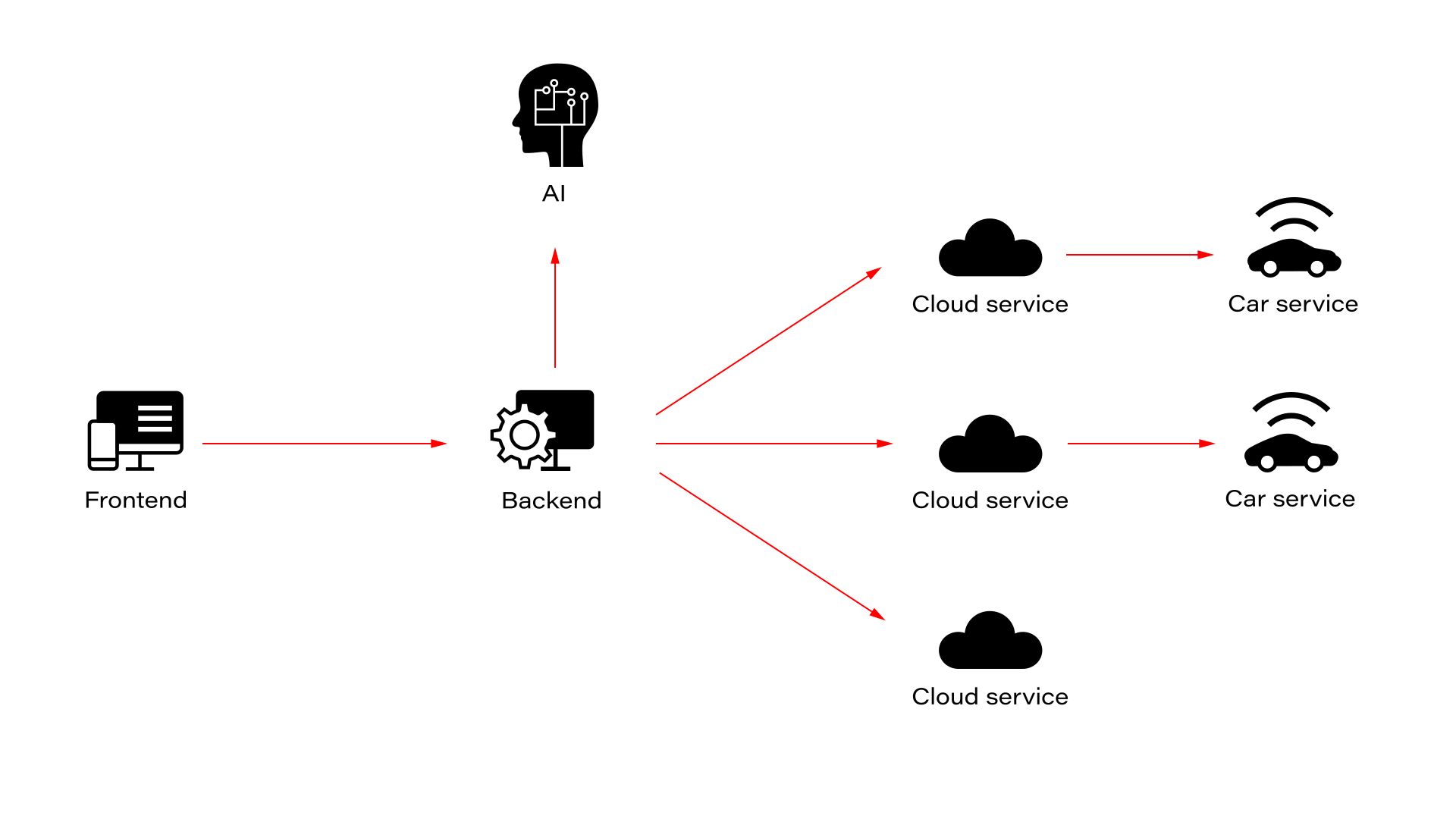
The diagram above is conceptual, of course. The backend is probably cloud-hosted, too, and cloud services linked to car services form the essence of the “connected cars” pattern.
The main concept for the application is “tool calling” – the LLM ability to call predefined functions with structuralized arguments. That’s why the backend is surrounded by different services. In a perfect world, those should be separated microservices designed for different use cases. However, this architecture is not scenario-based. There is no “if-else-if” ladder or so. The LLM determines how to utilize the tools based on its own decision-making process.
The sample conversation schema might look like the one presented below.
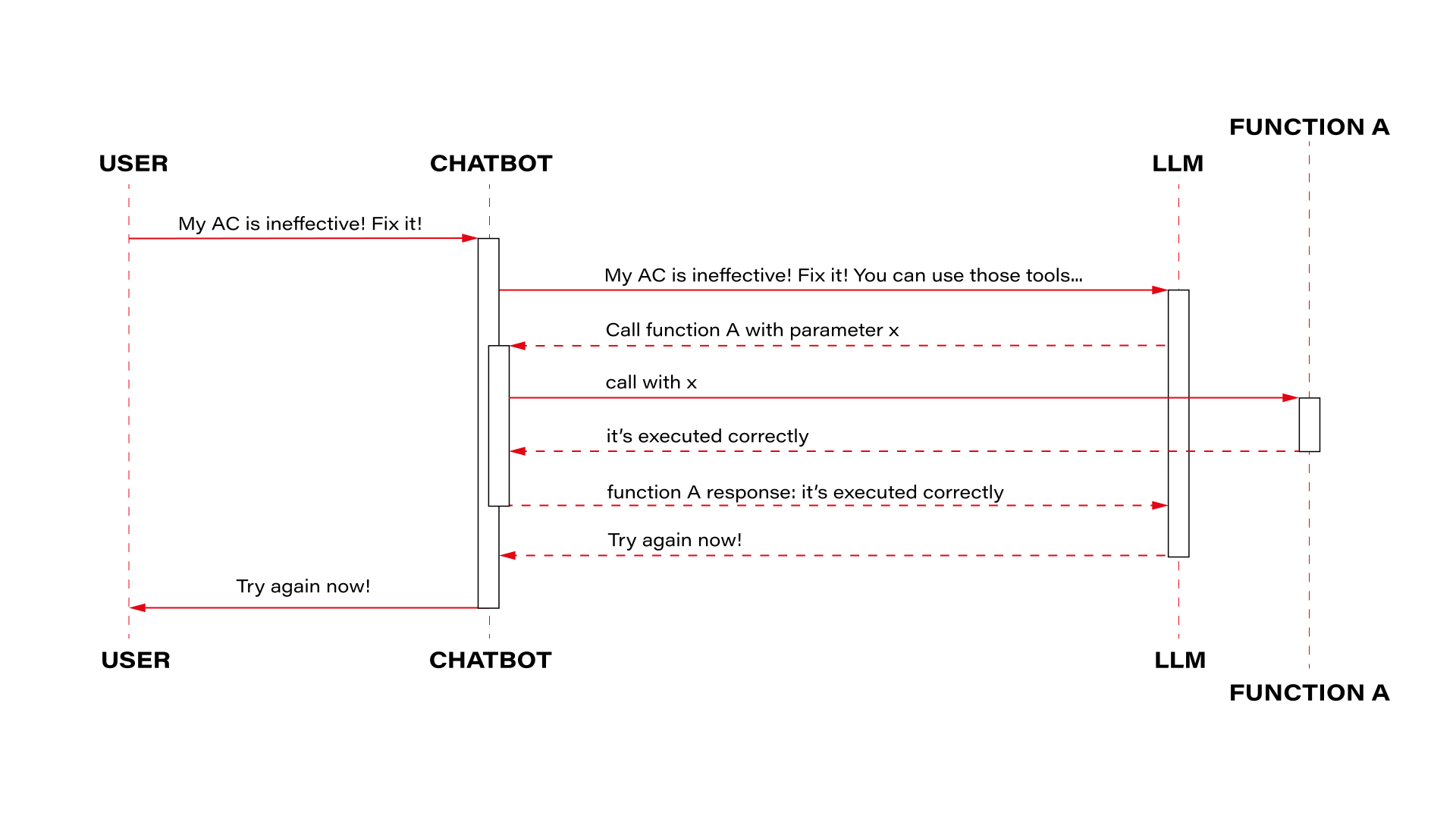
As you can see, the chatbot service calls the LLM, and the LLM returns command “call function A.” Then, the service calls the function and returns the response to the LLM (not the user!).
This approach is very flexible as functions (a.k.a. tools) might execute actions and return useful data. Also, the LLM may decide to use a function based on another function result. In the case above, it can, for example, use one function to check the climate control system status and discover that it’s running in the “eco mode”. Then, it might decide to call the “set mode” function with the argument “max AC” to change the mode. After that, the LLM can return an answer to the user with a message like “It should be fixed now”.
To build such an application, all you need to call the LLM like that (OpenAI GPT-4o example):
{
  "model": "gpt-4o",
  "messages": [
    {
      "role": "user",
      "content": "My AC is ineffective! Fix it!"
    }
  ],
  "tools": [
    {
      "type": "function",
      "function": {
        "name": "get AC status",
        "description": "Return current status of the climate control system"
      }
    },
    {
      "type": "function",
      "function": {
        "name": "set AC mode",
        "description": "Sets up the specified mode for the climate control system",
        "parameters": {
          "type": "object",
          "properties": {
            "mode": {
              "type": "string",
              "description": "Desired mode",
              "enum": ["ECO", “NORMAL”, "MAX AC"]
            }
          },
          "required": ["mode"]
        }
      }
    }
  ],
  "tool_choice": "auto"
}
As you can see, the response schema does not bother us here – the assumption is that the LLM is able to understand any reasonable response.
Dive
The subtitle should be a “deep dive”, but honestly, we’re just scratching the surface today. Nevertheless, let’s focus a little bit more.
So far, we have the user-facing application and the backend service. Now, let’s make it useful.
The AC example mentioned above is perfectly valid, but how can it be achieved? Let’s say there is an API for interaction with the AC in the car. It’s typical for all PHEVs and EVs and available for some HEVs, too, when you can turn on your AC remotely via the mobile app. However, the real value lies in the connected car
There is no IP address of the car hardcoded in the application. Usually, there is a digital twin in the cloud (a cloud service that represents the car). The application calls the twin, and the twin notifies the vehicle. There should also be some pub/sub queue in between to handle connectivity tier disruptions. Also, the security layer is extremely important. We don’t want anybody even to play the radio at max volume during a quiet night ride, not to mention turning off the lights or engaging breaks.
Which brings us to the list of possible actions.
Let’s assume all systems in the car are somehow connected, maybe using a common bus or a more modern ethernet-like network. Still, some executors, such as brakes, should be isolated from the system.
So, there is no “brake API” to stop a car. However, it may be beneficial for mechanics to execute some "dangerous" actions programmatically, e.g., to increase the pressure in the braking system without actually pressing the pedal. If this is the case, such functionalities should be accessible exclusively through a local connection without the need for digital twin integration. Therefore, we can assume there are two systems in the car – local and cloud-integrated, no matter the nature of the isolation (physical, network, or software). Let’s focus on the connected car aspect.
I believe the system should be able to change the vehicle settings, even if there is a risk that the driver could be surprised by an unauthorized change in the steering feel while taking a turn. This way, the chatbot might be useful and reduce support load by adjusting car settings based on the user's preferences. To avoid misusage, we can instruct the chatbot by prompt engineering to confirm each change with the user before execution and, of course, implement best-in-class security for all components. We can also allow certain operations only if the car is parked.
Which brings us back to the list of possible actions.
For the sake of this article, let’s assume the chatbot can change various car settings. Examples include:
- Climate control settings
- Driver assistant sensitivity and specific functions toggles
- Navigation System settings, like route type or other functions toggles
- 360 camera system settings, like brightness adjustment
- Sound system settings like equalizer
- Wiper settings
- Notifications settings
- Active steering system settings
This list is not complete, and the best thing is – it doesn’t need to be, as adding new functions (tool definition + API availability) might be a part of the future system OVA update.
What about reading real-time data? Should we connect to the car directly and read the status? Let’s leave this option for another article 😉 and focus on communication via the cloud.
There are two possibilities.
We can provide more tools to get data per source/component (a reminder – LLM decides to call for data, which then triggers an API call, and the LLM processes the received response). Alternatively, we could implement a single tool, “get vehicle data,” that collects and merges all data available from all data sources.
For the latter approach, two ways are available – do we really need a tool? Maybe we should inject the current state into each conversation, as it’s probably beneficial to have the current state anyway to solve all cases?
Let me give the standard consultant reply to those questions.
It depends.
More data in the context means extended response time and a higher bill. Also, some cases don’t need the entire context or don’t need it at all. On the other hand, if you let the LLM decide which part of the context is necessary (which function to call), it will also affect the time and cost.
The next part is the “cost” of collecting data. Some data sources might be slow or consume valuable in-car resources to calculate (maybe not appropriate) data.
My advice would be to start collecting all data in the background during session creation and attach it to the session progressively when ready. Additionally, provide the LLM with the capability to wait for data if it has not yet been supplied. This should be implemented as a function to handle instances where the user requests data-related action, but the necessary data is not yet available
The second part is splitting the data. You can use a much smaller LLM to decide which context data is necessary to answer the current question and remove unnecessary information to keep it concise.
The last part is company data. All LLM models are trained based on thousands of manuals available over the Internet, but this is usually not sufficient. Your chatbot should have the car manual at its fingertips, so the general knowledge is not enough. Therefore, you need to provide it. You can execute the RAG procedure and add some content to the context for each prompt, but my advice would be to hide it behind a function, too. Then, the LLM may decide when to call it to get some extra information if needed.
Use cases of Generative AI for connected cars
OK, we have all the components in place – there is the frontend, the backend, the model, and the toolbox. Can it be useful? As you would expect!
In the examples below, I will skip the part where the LLM commands the backend to perform an action, and the backend calls an API. I will also omit the process of the API response traveling back through the backend to the LLM. Additionally, I will assume that no new data is added to the context, so the LLM must decide which data it needs. Besides that, make sure that your context contains some system prompts to better explain all possibilities to the assistant.
Here are some examples.
User: I think my Lane Keeping Assist activates too frequently. Can you check it?
Assistant: [get driver assistance settings]
Assistant: [diagnose sensors]
Assistant: Everything looks good, but I can see that the Lane Keeping Assist mode is set to “fast”. Do you want me to lower the setting to “medium”?
User: Yes, please.
Assistant: [change LKA settings]
Assistant: It should be better now.
In the example above, the user has a problem with one of the driver assistance components. The system proposes and, after confirmation, executes settings changes, so the driver doesn’t need to find a proper setting in the on-board computer.
Check another case.
User: Whenever I’m parking the car in my garage, I can barely see anything in my rear camera. There is not much light there, but maybe you help me in some other way?
Assistant: [get camera settings]
Assistant: I can increase the brightness of the camera, but then it might be too bright for other places. What do you think?
User: Yes, please do that.
Assistant: [change settings]
Assistant: Here you are; let me know if you want me to roll back the change.
Usually, there is no brightness setting available for the user. To adjust it, the user would need to schedule a service department meeting, spend some time, and pay for the facility. The assistant may do it in a few seconds for free.
User: There are so many notifications in the car, so I can’t hear the important ones!
Assistant: [check last notifications]
Assistant: If you find some of my notifications unnecessary, I can mute some of them. What do you think?
User: Yes, please turn off the speeding avoidance warning.
Assistant: I can’t turn it off due to legal requirements, but I can replace the sound with vibration. feedback on the acceleration pedal. Do you want me to do that?
User: Sounds great!
Assistant: [adjust settings]
Assistant: It’s done. I hope you’ll be less distracted.
In this case, the assistant solves the issue of annoying notifications. Note the alternative solution suggestion and knowledge about the legal aspect. We can achieve it with proper function descriptions.
User: It seems my car can’t connect to the Internet.
Assistant: [check the connection] -> no connection to the car from the cloud service
Assistant: It seems your car is disconnected. Can you please check the cellular network signal icon on the infotainment main screen?
User: I can see the signal is good.
Assistant: [check last logs]
Assistant: I can see there were some issues with your connection before. Please try to open the settings in the car infotainment and restart the communication module. I’ll guide you through the process.
User: OK, what should I do?
Assistant: [check user manual]
Assistant: Go to “Settings”, then “Connectivity”, then “Cellular” and then click “Restart module”. Confirm when asked.
User: OK
Assistant: [check the connection]
Assistant: I can see the connection is restored. Can you confirm that? If not, I can schedule a service meeting for you.
User: No need; it works now!
In the last example, the Assistant guides the user using logs, the manual, and after checking real-time conditions. Without the LLM, the user would need to visit the dealer or at least use online support assistance.
Final words
With modern technology, we can bring some science fiction concepts to real life. Maybe WARP speed is not possible yet, but at least a car itself can give us solutions to problems recently solved only in much more expensive ways.
The beauty of it is – it’s really simple. Of course, there is a user-facing application to be made, the security to be ensured, and a bunch of functions to be implemented, but with modern connected cars, those elements are in place anyway. The tricky, novel part is a very simple application that uses the LLM as the brain power of the system.
As you can see the “ Attention is all you need ” paper that started the LLM revolution has allowed humanity to bring to life concepts present in our culture for decades. On the other hand, would this article have been ever written if its authors hadn’t watched the K.I.T.T. in their childhood? We will never know.