
Case study
The digital archaeology project:
How AI decoded 20 years of lost business logic

Legacy modernization isn't only about replacing old code with new code - it's also about recovering lost business intelligence that's been encrypted by time and poor documentation.
Starting point
In the car rental industry, legacy systems often contain decades of accumulated business logic that becomes increasingly difficult to access and understand over time. Many organizations find themselves in a position where their core systems work effectively but lack the transparency needed for confident modernization and innovation.
Our client, a major car rental company, faced exactly this challenge. Their core system, originally built decades ago and converted from COBOL to Java using automated tools, had become increasingly complex to maintain. The code was difficult to read, documentation was minimal, and even small modifications required extensive analysis. While the system functioned reliably, the underlying business logic was not easily accessible to current development teams.
The company recognized an opportunity:instead of working around these limitations indefinitely, they could invest in understanding their own technology and create a foundation for future innovation.
AI-agentic workflows on the recovery mission
Approach
Instead of the typical "rip and replace" modernization approach, we treated this as a knowledge recovery mission. We developed a structured reverse-engineering methodology that combined human expertise with AI-powered code analysis to decode the system's hidden logic.
Our approach centered on AI Agent Workflows - a Gen AI-powered solution we built specifically for legacy system analysis.This technology didn't just read code; it understood business intent, traced data flows, and reconstructed the decision-making logic that had been buried under years of automated conversions and undocumented changes.
Working alongside the client's specialists, we systematically analyzed the system layer by layer, extracting not just what the code does, but why it was designed that way and how it fits into the broader business context. Every discovered business rule was documented, every data dependency mapped, and every integration point clarified.
Breaking The Linear
We flipped the modernization process entirely. Instead of starting with new architecture, we started with deep analytical work - using AI to decode the existing system's business intelligence first. We treated the legacy code as a knowledge repository, not a technical obstacle. By the time we finished our reverse-engineering, the client had comprehensive understanding of their own system's logic and dependencies.
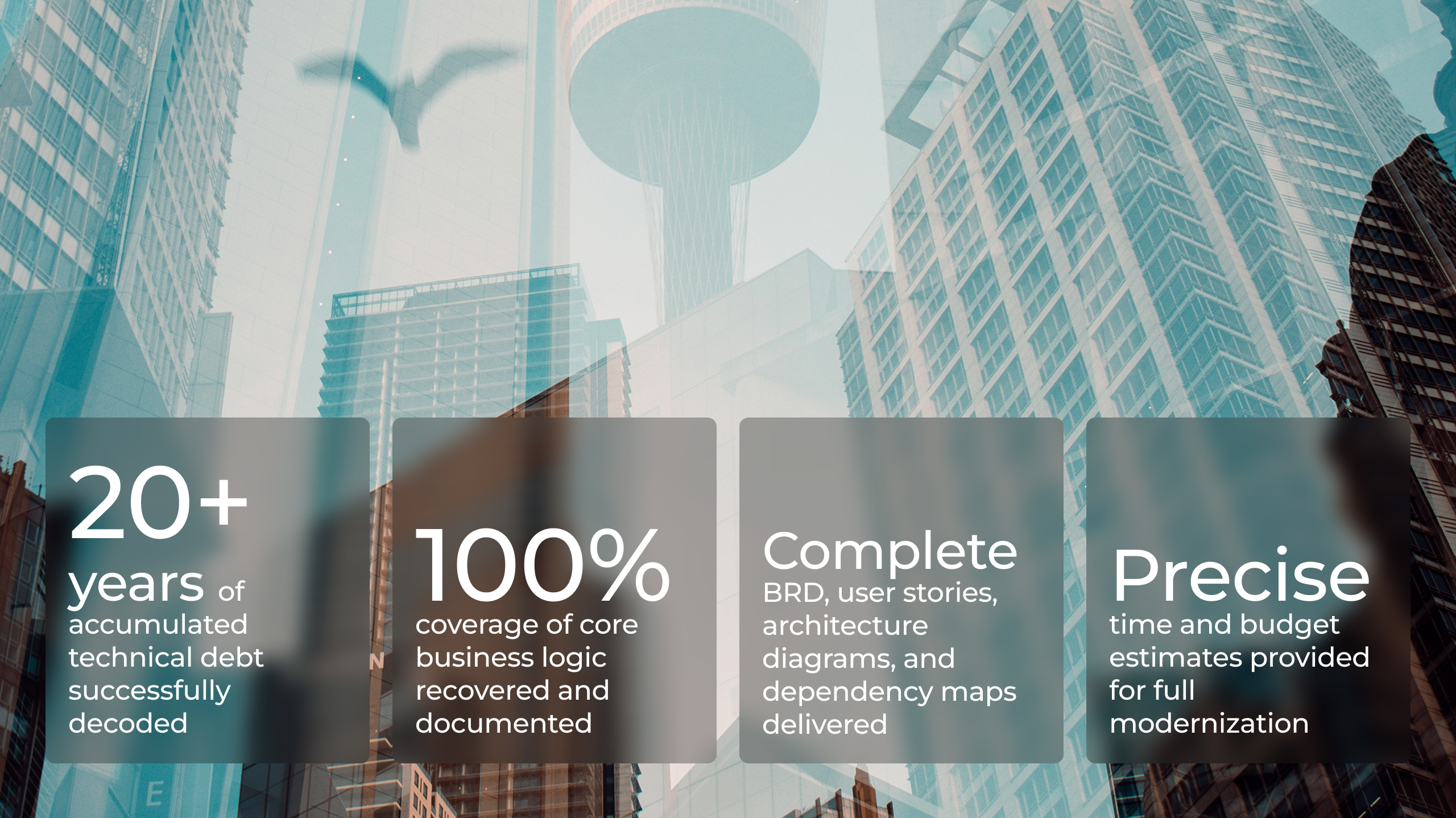
Strategic knowledge recovery initiative
Summary
This wasn't just a documentation project - it was a strategic knowledge recovery initiative that unlocked decades of accumulated business intelligence.
The client gained access to sophisticated business logic and processes that had evolved over decades. Complex rules and workflows became clearly documented, understandable, and modifiable. They transitioned from having limited insight into their legacy system to possessing a well-documented, fully comprehended platform.
Most importantly, we opened up a completely new trajectory: instead of approaching system changes with uncertainty, they now have the confidence and strategic vision needed for informed decision-making. They shifted from thinking "we need to be cautious because the system is complex" to thinking "now that we understand it completely, we can leverage this knowledge for innovation and growth."
.webp)