
Case study
When your data lab
can't keep up with your innovation speed
.jpg)
Scaling a data platform isn't about adding more servers - it's about redesigning how hundreds of engineers interact with data so infrastructure becomes invisible, not the bottleneck.
Starting point
The automotive industry now competes on data-driven features - from e-mobility optimization to autonomous driving capabilities. This demands infrastructure that processes massive vehicle telemetry in real-time, not systems designed for periodic reporting.
An automotive company's Data Science Lab faced this challenge. Their on-premises platform ingested telemetry from thousands of vehicles and testrig environments, but the virtual machine architecture couldn't scale to meet growing analytical demands. Manual processes dominated workflows - data analysts managed infrastructure instead of analyzing data, while development teams experienced delays accessing critical information.
The organization recognized an opportunity: transform their data infrastructure into an enterprise-grade platform that could accelerate product development.
Embedded partnership: Secure enterprise Kubernetes - and the team to run it
Approach
We embedded our consultants directly into the client's cross-functional teams, operating as a unified agile unit under the SAFe framework. This wasn't a traditional vendor engagement - it was a collaborative partnership where both teams shared responsibility for outcomes.
Our strategy focused on three simultaneous objectives: building enterprise-grade Kubernetes infrastructure, establishing secure separation between production and development environments, and ensuring complete knowledge transfer through hands-on collaboration. We conducted pair-programming sessions where our engineers and the client's teams worked together to build the production environment, exploring its architecture and operational patterns in real-time.
The technical work included designing multi-tenant management for applications and versions, implementing cost controls, and creating self-service capabilities for data analysts. Simultaneously, we supported day-to-day operations and maintenance, ensuring platform stability while teams learned to manage it independently.
Our goal extended beyond platform delivery - we aimed to build internal capability so the organization could evolve the infrastructure as their needs changed.
Breaking The Linear
We eliminated the transition phase entirely by building operational capability from day one. Our consultants and the client's engineers pair-programmed every component of the platform together. When architectural decisions needed to be made, we made them collaboratively. When production issues occurred, we debugged them jointly. By project completion, the internal team wasn't receiving a platform - they had already been operating it for months.
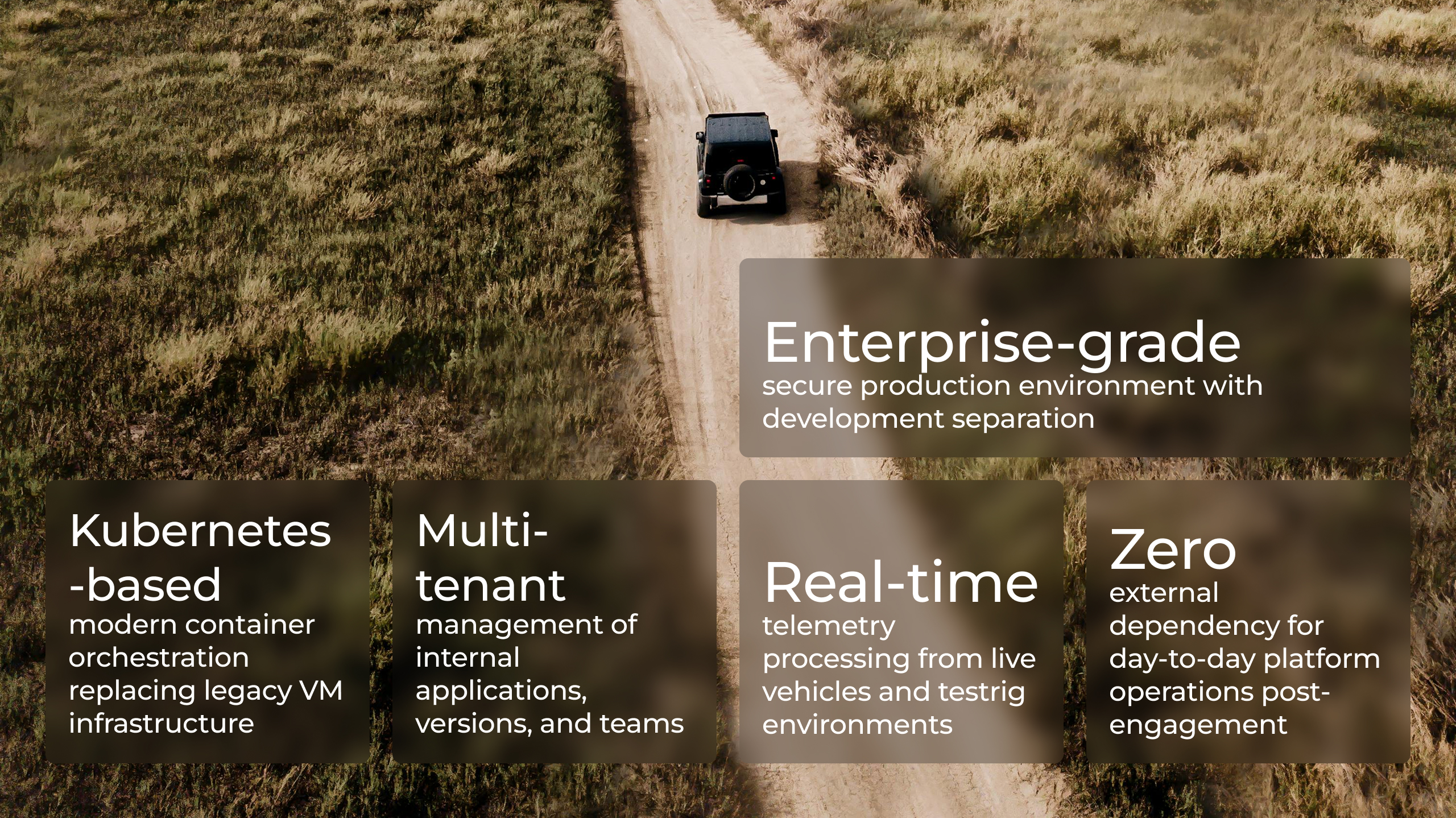
Beyond infrastructure: A strategic data capability teams control and evolve
Summary
We transformed the automotive company's Data Science Lab from managing infrastructure constraints into leveraging enterprise-grade data capabilities for innovation. The Kubernetes-based platform now serves as foundational infrastructure for product development across e-mobility, autonomous solutions, and other innovation initiatives.
Most importantly, we established a new operational model.The organization moved from viewing their data platform as a technical asset requiring external expertise to understanding it as a strategic capability they fully control and evolve. The question shifted from "how do we maintain this platform?" to "how do we leverage this platform to accelerate our next innovation breakthrough?"
.webp)