
Case study
From IT ticket queue to self-service in minutes
.jpg)
The value of data infrastructure isn't measured by storage capacity or processing power - it's measured by how quickly teams can go from question to analysis without external dependencies.
Starting point
Organizations across industries accumulate data at unprecedented scale, yet accessing that data remains surprisingly manual.Companies invest millions in data lakes and analytics infrastructure, then watch their data scientists wait weeks for environment provisioning. The bottleneck isn't storage or compute - it's the human approval chain between data and insights.
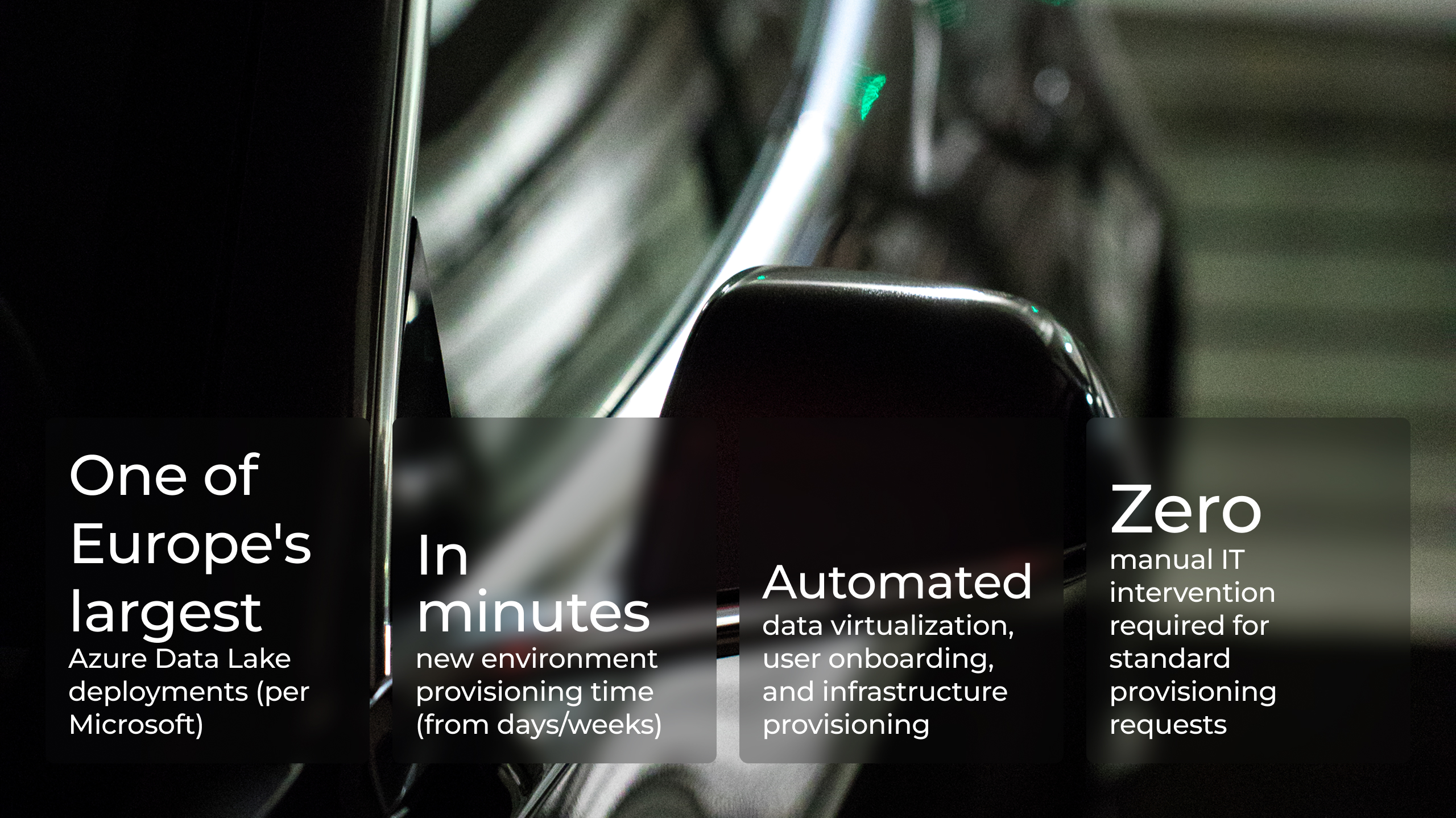
An automotive company, one of Europe's largest Azure DataLake adopters according to Microsoft, experienced this paradox firsthand. Their data infrastructure powered critical analytics across design, production, and sales operations. However, every new use case - predictive maintenance, market segmentation, performance optimization - required manual provisioning of environments, resources, and access controls. Data scientists and engineers submitted tickets, IT teams processed requests, and innovation waited in queue.
The company recognized that their data infrastructure investment wasn't delivering proportional returns. They had the data and the talent but lacked the operational model to connect them efficiently.
From ticket queues to on-demand: Killing the IT bottleneck
Approach
We began with collaborative discovery workshops focused on understanding how data scientists and engineers actually worked, not how organizational charts suggested they should work. These sessions revealed that the bottleneck wasn't technical capability - it was the repetitive manual processes between data and users.
Our solution centered on designing a self-service data virtualization platform that eliminated IT as a gatekeeper while maintaining security and governance. Teams could spin up data applications on demand, automate infrastructure provisioning, and access role-based permissions without submitting tickets or waiting for approvals.
We integrated automated provisioning directly into the company's existing request system, preserving familiar workflows while removing manual steps. The platform included automated data virtualization and streamlined user onboarding. Centralized management ensured consistency and reliability without requiring ongoing manual oversight.
The design philosophy was clear: infrastructure should respond to needs instantly, not eventually.
Breaking The Linear
We inverted the access model entirely. Instead of IT provisioning resources in response to requests, we built infrastructure that provisions itself based on user needs. Data scientists select required datasets and tools through self-service interface, platform automatically configures environment with appropriate security and governance, user begins analysis within minutes. Result: innovation constrained only by analytical capacity.
From 'can I have access?' to 'which dataset do I need?'
Summary
We transformed the automotive company's data operations from an IT-mediated process into a self-service capability. The platform now enables teams to access data infrastructure with the same ease they access other cloud services - instant, automated, and secure.
Most importantly, we shifted the organization's operational paradigm. They moved from viewing data access as a controlled resource requiring approval workflows to understanding it as an on-demand capability governed by automated policies. The question changed from "when will IT provision my environment?" to "which datasets do I need for this analysis?" IT teams redirected their focus from repetitive provisioning tasks to strategic platform evolution and governance design.
.webp)