
Generative AI for connected cars: Solution-oriented chatbots for personalized user support

Generative AI is becoming a major player in automotive innovation. The market is already valued at USD 480.22 million in 2024 , and it’s expected to grow to USD 3,900.03 million by 2034, with a steady annual growth rate of 23.3%. Moreover, by 2025, the global automobile sector will invest $11.1 billion in cognitive and AI technologies. These numbers show how quickly the industry is picking up on this technology’s potential.
GenAI is making its mark across various areas. From manufacturing optimization to autonomous driving, its impact is undeniable. Predictive maintenance systems identify issues early, AI-powered tools optimize vehicle development, and talking to in-car assistants is starting to feel like a scene out of a sci-fi movie.
Speaking of sci-fi, pop culture has always loved the idea of talking cars. There is K.I.T.T. (Knight Industries Two Thousand), of course, but also all Transformers and tons of cartoons, starting with Lightning McQueen. Is it just pure fiction? Not at all (except McQueen, for many reasons 😊)! Early attempts at smarter cars started with examples like a 2004 Honda offering voice-controlled navigation and Ford’s 2007 infotainment system. Fast forward to now, and we have a VW Golf with a GPT-based assistant that’s more conversational than ever.
But honestly, the most resourceful one is K.I.T.T. – it activates all onboard systems, diagnoses itself, and uses company resources (there is an episode when K.I.T.T. withdraws money from the company bank account using an ATM). In 1982, when the show first aired, it was just pure science fiction. But what about now? Is it more science or fiction? With Generative AI growing rapidly in automotive, we have to revisit that question.
Let’s break it down!
Prerequisites
Let’s assume we would like to create a solution-oriented chatbot connected with a car. By “solution-oriented,” I mean one that is really useful, able not only to change the attractive interior lighting but also to truly solve owners’ issues.
The idea is to use Generative AI, a large language model with its abilities in reasoning, problem-solving, and language processing.
Therefore, the first question is – where should the model be planted – in the cloud or a car?
For the first option, you need a constant Internet connection (which is usually not guaranteed in cars). In contrast, the second option typically involves a smaller and less versatile model, and you still need a lot of resources (hardware, power) to run it. The truth lies, as usual, in between (cloud model if available, local one otherwise), but today we’ll focus on the cloud model only.
The next step is to consider the user-facing layer. The perfect one is integrated into the car, isn’t it? Well, in most cases, yes, but there are some drawbacks.
The first issue is user-oriented – if you want to interact with your car when being outside of it, your mobile phone is probably the most convenient option (or a smartwatch, like Michael from Knight Rider). Also, infotainment systems are comprehensively tested and usually heavily sealed into cars, so introducing such a bot is very time-consuming. Therefore, the mobile phone is our choice.
We don’t want to focus on this application today, however. Depending on the target operating system, it probably should use speech-to-text recognition and text-to-speech generation and stream data both ways for a better user experience.
The core part is the chatbot backend – a regular application connecting the frontend and the LLM. It should be able to call external APIs and use two sources of knowledge – live car data and company-owned data sources.
Basics
Let’s gather the components. There is a customer-facing layer – the mobile application; then there is our main backend application, the LLM, of course, and some services to provide data and functionalities.
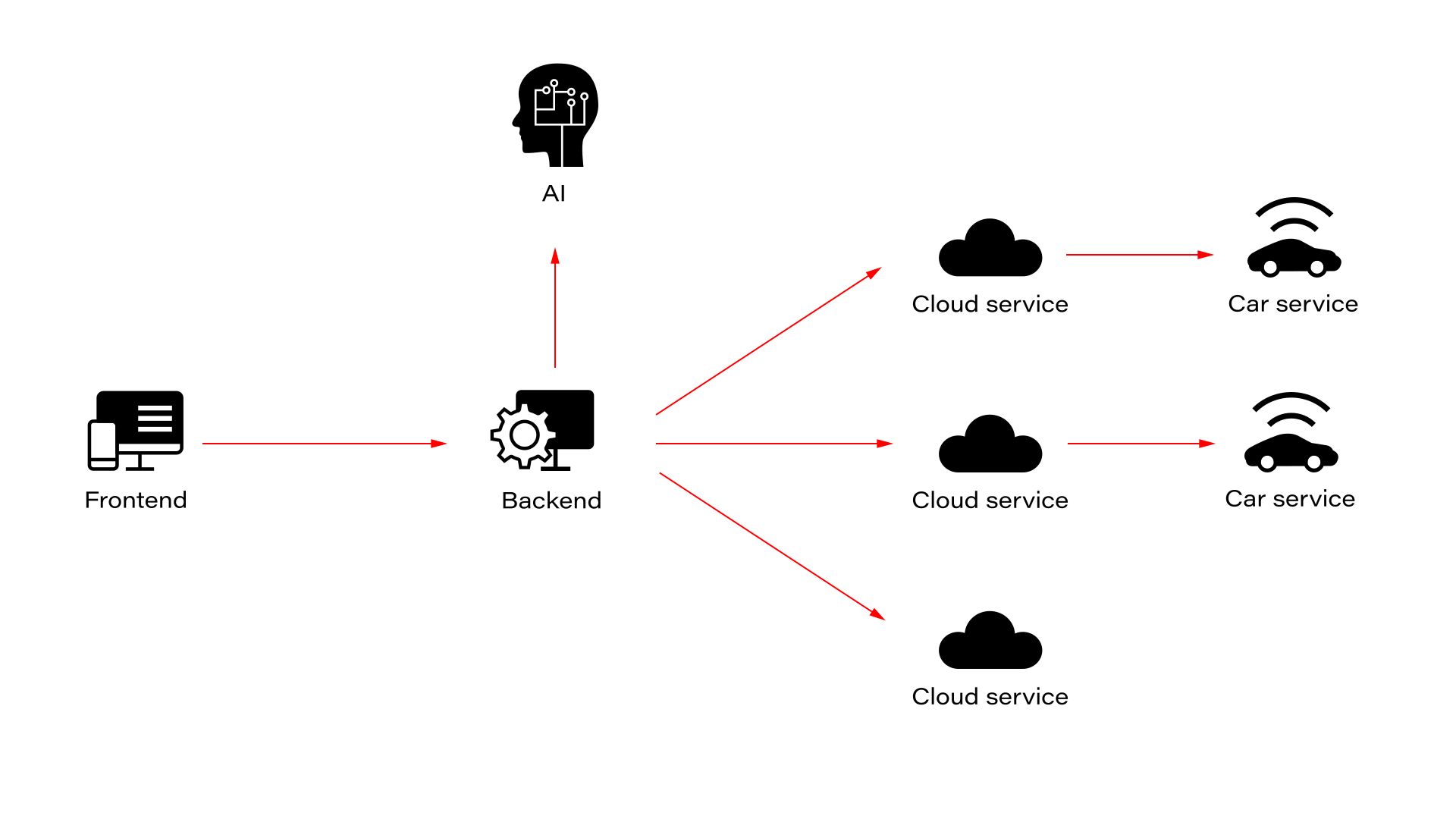
The diagram above is conceptual, of course. The backend is probably cloud-hosted, too, and cloud services linked to car services form the essence of the “connected cars” pattern.
The main concept for the application is “tool calling” – the LLM ability to call predefined functions with structuralized arguments. That’s why the backend is surrounded by different services. In a perfect world, those should be separated microservices designed for different use cases. However, this architecture is not scenario-based. There is no “if-else-if” ladder or so. The LLM determines how to utilize the tools based on its own decision-making process.
The sample conversation schema might look like the one presented below.
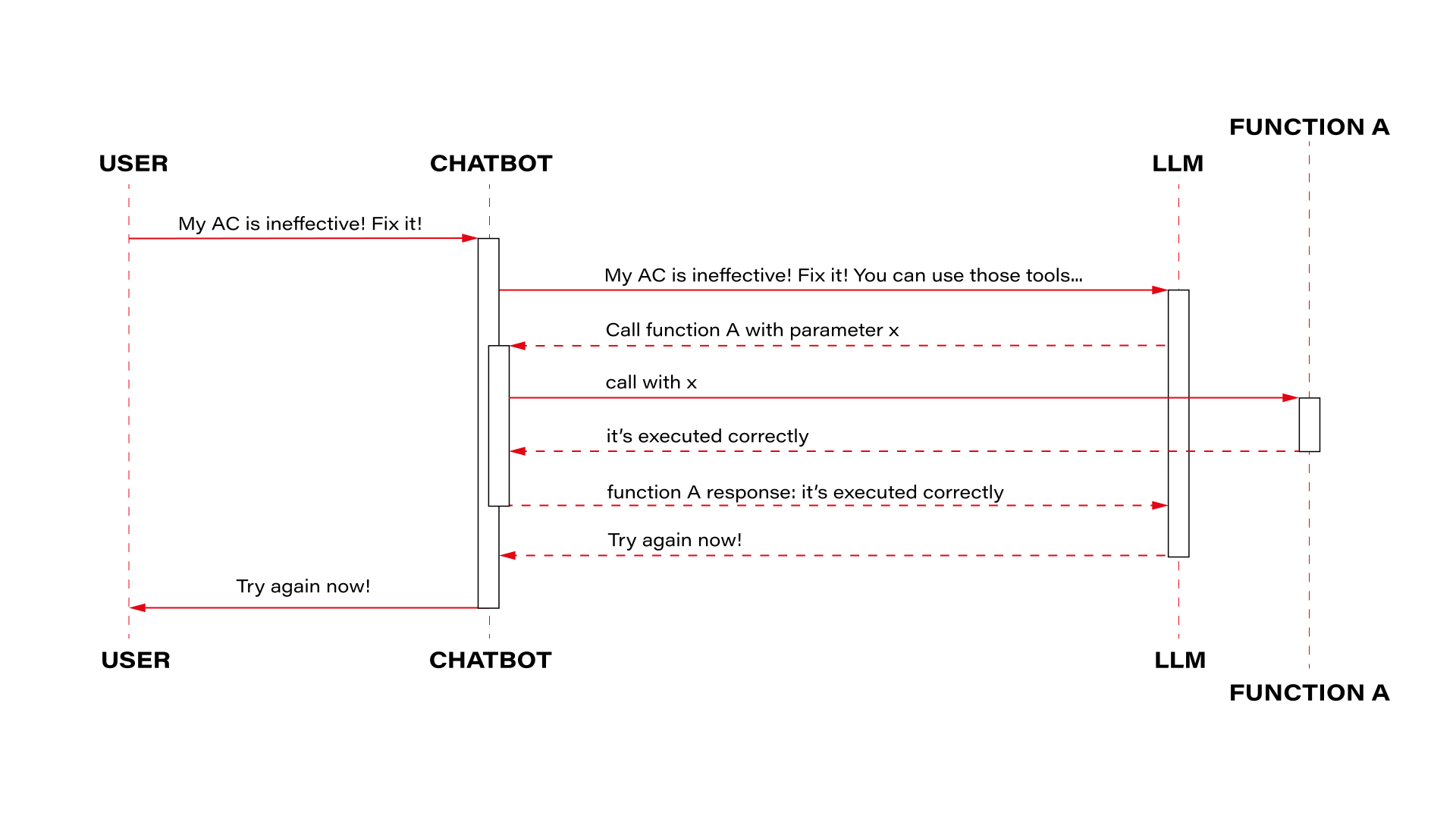
As you can see, the chatbot service calls the LLM, and the LLM returns command “call function A.” Then, the service calls the function and returns the response to the LLM (not the user!).
This approach is very flexible as functions (a.k.a. tools) might execute actions and return useful data. Also, the LLM may decide to use a function based on another function result. In the case above, it can, for example, use one function to check the climate control system status and discover that it’s running in the “eco mode”. Then, it might decide to call the “set mode” function with the argument “max AC” to change the mode. After that, the LLM can return an answer to the user with a message like “It should be fixed now”.
To build such an application, all you need to call the LLM like that (OpenAI GPT-4o example):
{
  "model": "gpt-4o",
  "messages": [
    {
      "role": "user",
      "content": "My AC is ineffective! Fix it!"
    }
  ],
  "tools": [
    {
      "type": "function",
      "function": {
        "name": "get AC status",
        "description": "Return current status of the climate control system"
      }
    },
    {
      "type": "function",
      "function": {
        "name": "set AC mode",
        "description": "Sets up the specified mode for the climate control system",
        "parameters": {
          "type": "object",
          "properties": {
            "mode": {
              "type": "string",
              "description": "Desired mode",
              "enum": ["ECO", “NORMAL”, "MAX AC"]
            }
          },
          "required": ["mode"]
        }
      }
    }
  ],
  "tool_choice": "auto"
}
As you can see, the response schema does not bother us here – the assumption is that the LLM is able to understand any reasonable response.
Dive
The subtitle should be a “deep dive”, but honestly, we’re just scratching the surface today. Nevertheless, let’s focus a little bit more.
So far, we have the user-facing application and the backend service. Now, let’s make it useful.
The AC example mentioned above is perfectly valid, but how can it be achieved? Let’s say there is an API for interaction with the AC in the car. It’s typical for all PHEVs and EVs and available for some HEVs, too, when you can turn on your AC remotely via the mobile app. However, the real value lies in the connected car
There is no IP address of the car hardcoded in the application. Usually, there is a digital twin in the cloud (a cloud service that represents the car). The application calls the twin, and the twin notifies the vehicle. There should also be some pub/sub queue in between to handle connectivity tier disruptions. Also, the security layer is extremely important. We don’t want anybody even to play the radio at max volume during a quiet night ride, not to mention turning off the lights or engaging breaks.
Which brings us to the list of possible actions.
Let’s assume all systems in the car are somehow connected, maybe using a common bus or a more modern ethernet-like network. Still, some executors, such as brakes, should be isolated from the system.
So, there is no “brake API” to stop a car. However, it may be beneficial for mechanics to execute some "dangerous" actions programmatically, e.g., to increase the pressure in the braking system without actually pressing the pedal. If this is the case, such functionalities should be accessible exclusively through a local connection without the need for digital twin integration. Therefore, we can assume there are two systems in the car – local and cloud-integrated, no matter the nature of the isolation (physical, network, or software). Let’s focus on the connected car aspect.
I believe the system should be able to change the vehicle settings, even if there is a risk that the driver could be surprised by an unauthorized change in the steering feel while taking a turn. This way, the chatbot might be useful and reduce support load by adjusting car settings based on the user's preferences. To avoid misusage, we can instruct the chatbot by prompt engineering to confirm each change with the user before execution and, of course, implement best-in-class security for all components. We can also allow certain operations only if the car is parked.
Which brings us back to the list of possible actions.
For the sake of this article, let’s assume the chatbot can change various car settings. Examples include:
- Climate control settings
- Driver assistant sensitivity and specific functions toggles
- Navigation System settings, like route type or other functions toggles
- 360 camera system settings, like brightness adjustment
- Sound system settings like equalizer
- Wiper settings
- Notifications settings
- Active steering system settings
This list is not complete, and the best thing is – it doesn’t need to be, as adding new functions (tool definition + API availability) might be a part of the future system OVA update.
What about reading real-time data? Should we connect to the car directly and read the status? Let’s leave this option for another article 😉 and focus on communication via the cloud.
There are two possibilities.
We can provide more tools to get data per source/component (a reminder – LLM decides to call for data, which then triggers an API call, and the LLM processes the received response). Alternatively, we could implement a single tool, “get vehicle data,” that collects and merges all data available from all data sources.
For the latter approach, two ways are available – do we really need a tool? Maybe we should inject the current state into each conversation, as it’s probably beneficial to have the current state anyway to solve all cases?
Let me give the standard consultant reply to those questions.
It depends.
More data in the context means extended response time and a higher bill. Also, some cases don’t need the entire context or don’t need it at all. On the other hand, if you let the LLM decide which part of the context is necessary (which function to call), it will also affect the time and cost.
The next part is the “cost” of collecting data. Some data sources might be slow or consume valuable in-car resources to calculate (maybe not appropriate) data.
My advice would be to start collecting all data in the background during session creation and attach it to the session progressively when ready. Additionally, provide the LLM with the capability to wait for data if it has not yet been supplied. This should be implemented as a function to handle instances where the user requests data-related action, but the necessary data is not yet available
The second part is splitting the data. You can use a much smaller LLM to decide which context data is necessary to answer the current question and remove unnecessary information to keep it concise.
The last part is company data. All LLM models are trained based on thousands of manuals available over the Internet, but this is usually not sufficient. Your chatbot should have the car manual at its fingertips, so the general knowledge is not enough. Therefore, you need to provide it. You can execute the RAG procedure and add some content to the context for each prompt, but my advice would be to hide it behind a function, too. Then, the LLM may decide when to call it to get some extra information if needed.
Use cases of Generative AI for connected cars
OK, we have all the components in place – there is the frontend, the backend, the model, and the toolbox. Can it be useful? As you would expect!
In the examples below, I will skip the part where the LLM commands the backend to perform an action, and the backend calls an API. I will also omit the process of the API response traveling back through the backend to the LLM. Additionally, I will assume that no new data is added to the context, so the LLM must decide which data it needs. Besides that, make sure that your context contains some system prompts to better explain all possibilities to the assistant.
Here are some examples.
User: I think my Lane Keeping Assist activates too frequently. Can you check it?
Assistant: [get driver assistance settings]
Assistant: [diagnose sensors]
Assistant: Everything looks good, but I can see that the Lane Keeping Assist mode is set to “fast”. Do you want me to lower the setting to “medium”?
User: Yes, please.
Assistant: [change LKA settings]
Assistant: It should be better now.
In the example above, the user has a problem with one of the driver assistance components. The system proposes and, after confirmation, executes settings changes, so the driver doesn’t need to find a proper setting in the on-board computer.
Check another case.
User: Whenever I’m parking the car in my garage, I can barely see anything in my rear camera. There is not much light there, but maybe you help me in some other way?
Assistant: [get camera settings]
Assistant: I can increase the brightness of the camera, but then it might be too bright for other places. What do you think?
User: Yes, please do that.
Assistant: [change settings]
Assistant: Here you are; let me know if you want me to roll back the change.
Usually, there is no brightness setting available for the user. To adjust it, the user would need to schedule a service department meeting, spend some time, and pay for the facility. The assistant may do it in a few seconds for free.
User: There are so many notifications in the car, so I can’t hear the important ones!
Assistant: [check last notifications]
Assistant: If you find some of my notifications unnecessary, I can mute some of them. What do you think?
User: Yes, please turn off the speeding avoidance warning.
Assistant: I can’t turn it off due to legal requirements, but I can replace the sound with vibration. feedback on the acceleration pedal. Do you want me to do that?
User: Sounds great!
Assistant: [adjust settings]
Assistant: It’s done. I hope you’ll be less distracted.
In this case, the assistant solves the issue of annoying notifications. Note the alternative solution suggestion and knowledge about the legal aspect. We can achieve it with proper function descriptions.
User: It seems my car can’t connect to the Internet.
Assistant: [check the connection] -> no connection to the car from the cloud service
Assistant: It seems your car is disconnected. Can you please check the cellular network signal icon on the infotainment main screen?
User: I can see the signal is good.
Assistant: [check last logs]
Assistant: I can see there were some issues with your connection before. Please try to open the settings in the car infotainment and restart the communication module. I’ll guide you through the process.
User: OK, what should I do?
Assistant: [check user manual]
Assistant: Go to “Settings”, then “Connectivity”, then “Cellular” and then click “Restart module”. Confirm when asked.
User: OK
Assistant: [check the connection]
Assistant: I can see the connection is restored. Can you confirm that? If not, I can schedule a service meeting for you.
User: No need; it works now!
In the last example, the Assistant guides the user using logs, the manual, and after checking real-time conditions. Without the LLM, the user would need to visit the dealer or at least use online support assistance.
Final words
With modern technology, we can bring some science fiction concepts to real life. Maybe WARP speed is not possible yet, but at least a car itself can give us solutions to problems recently solved only in much more expensive ways.
The beauty of it is – it’s really simple. Of course, there is a user-facing application to be made, the security to be ensured, and a bunch of functions to be implemented, but with modern connected cars, those elements are in place anyway. The tricky, novel part is a very simple application that uses the LLM as the brain power of the system.
As you can see the “ Attention is all you need ” paper that started the LLM revolution has allowed humanity to bring to life concepts present in our culture for decades. On the other hand, would this article have been ever written if its authors hadn’t watched the K.I.T.T. in their childhood? We will never know.

Data powertrain in automotive: Complete end-to-end solution
We power your entire data journey, from signals to solutions
Check related articles
Read our blog and stay informed about the industry's latest trends and solutions.
Developing software for connected cars - common challenges and how to tackle them
Automotive is transforming into a hyper-connected, software-driven industry that goes far beyond the driving experience. How to build applications in such an innovative environment? What are the main challenges of providing software for connected cars and how to deal with them? Let’s dive into the process of utilizing the capabilities of the cloud to move automotive forward.
People have always aimed for the clouds. From Icarus in Greek mythology, first airplanes and spaceships to dreams about flying cars – our culture and history of technology development express a strong desire to go beyond our limits. Although the vision from Back to the Future and other Sci-Fi movies didn’t come true and our cars cannot be used as flying vehicles, our cars actually are in the cloud.
Meanwhile, the idea of the Internet of Things came true; our devices are connected to the Internet . We have smartphones, smartwatches, smart homes and, as it turns out, smart cars. We are able to communicate with them to gather data or even remotely control them. The possibilities are only limited by hardware, but even it is constantly improving to follow the pace of rapid changes triggered by software development.
Offerings on the automotive market are developing rapidly with numerous features and promised experiences to the end customer. By using cutting-edge technologies, utilizing cloud platforms, and working with innovative software developers, automakers provide solutions to even the most demanding needs . And while our user experience is improving at an accelerated pace, there is still a broad list of challenges to tackle.
In this article, we dive into the technology behind the latest trends, take into account the most demanding areas of developing software in the cloud, and explain how proper solution empowers the change that affects us all.
Challenging determinants of the cloud revolution in automotive
Connecting with your car through a smartphone or utilizing information about traffic provided to your vehicle thanks to the platforms that accumulate data registered by other drivers is extremely useful.
Those innovative changes wouldn’t be possible without cloud infrastructure . And as there is no way back from moving to the cloud, the transition creates challenges in various areas: safety, security, responsiveness, integrity , and more.
Safety in the automotive sector
How to create a solution that doesn’t affect the safety of a driver? When developing new services, you cannot forget about the basics. Infotainment provided to vehicles is more advanced for every new release of a car and can be really engaging. The amount of delivered information combined with increasingly larger displays may lead to distraction and create dangerous situations. It’s worth mentioning that some of the colors may even impair the driver’s vision!
Integration with the cloud usually enables some of the remote commands. When implementing them, there are a lot of restrictions that need to be kept in mind. Some of them are obvious, such as you don’t want to disable the engine when a car is being driven 100km/h, but others may be much more complicated and unseen at first.
Providing security for car owners
Enabling services for your vehicle in the cloud, despite being extremely helpful to improve your experience, creates another way to break into your car. Everyone would like to open a car without using keys, but using a mobile phone, voice, or a fingerprint instead. And as these solutions seem modern and fancy, there is a big responsibility on the software side to do it securely.
Responsiveness enabling the seamless user experience
Customer-facing services need to deliver a seamless experience to the end-user. The customer doesn’t want to wait a minute or even ten seconds for unlocking a car door. These services need to do it immediately or not at all, as an issue with opening the doors just because the system had a ‘lag’ is not acceptable behavior.
Data integrity is a must
Another very important concept associated with providing solutions utilizing cloud technologies is data integrity. Information collected by your vehicle should be useful and up to date. You don’t want a situation when the mobile application says that the car has a range of 100km, but in the morning, it turns out that the tank is almost empty, and you need to refuel it before going to work.
How to integrate and utilize mobile devices to connect with your vehicle?
When discussing how to use mobile phones to control cars, a very important question occurs; how to communicate with the car? There is no simple answer, as it all depends on what model and version of a car it is, as depending on a provider, the vehicles are equipped with various technologies. Some of them are equipped with BLE, Wi-Fi Hotspots, or RFID tags, while others don’t offer a direct connection to the car, and the only way is to go through the backend side. Most of the manufacturers will expose some API over the Internet without providing a direct connection from mobile to the car. In such cases, usually, it’s a good practice to create your own backend which handles all API flaws. To do so, your system will need a platform to have a reliable solution.
When the limitation of hardware is met, there is always an option to equip the car with a custom device, which will expose a proper communication channel and will be integrated with the vehicle. To do so, it may use the OBD protocol. It gives us full control over the communication part, however, it’s expensive and hard to maintain the solution.
Building a platform to solve the challenges
There is no simple answer on how to solve the mentioned challenges and implement a resilient system that will deliver all necessary functionalities with the highest quality. However, it’s very important to remember that such a solution should be scalable and utilize cloud-native patterns. When designing a system for connected cars, the natural choice is to go with the microservice architecture. The implementation of the system is one thing, and partly this topic was covered in the previous article , but on the other hand, the very important aspect is a runtime, the platform. Choosing the wrong setup of virtual machines or having to deploy everything manually can lead to downtime of the system. Having a system that isn’t available for the customer constantly can damage your business.
Kubernetes to the rescue! As probably you know, Kubernetes is a container orchestration platform, which allows running workload in pods. The platform itself helped us to deliver many features faster and with ease to our clients. Nowadays, Kubernetes is so easily accessible that you can spin up a cluster in minutes using existing service providers like AWS or Azure. It allows you to increase the speed of delivery of new features, as they may be deployed immediately! What’s very important with Kubernetes, is its abstraction from infrastructure. The development team with expertise in Kubernetes is able to work on any cloud provider. Furthermore, mission-critical systems can successfully implement Kubernetes for their use cases as well.
Automotive cloud beyond car manufacturers
Automotive cloud is not only a domain of car manufacturers. As mentioned earlier, they offer digital services to integrate with their cars, but numerous mobility service providers integrate with these APIs to implement their own use cases.
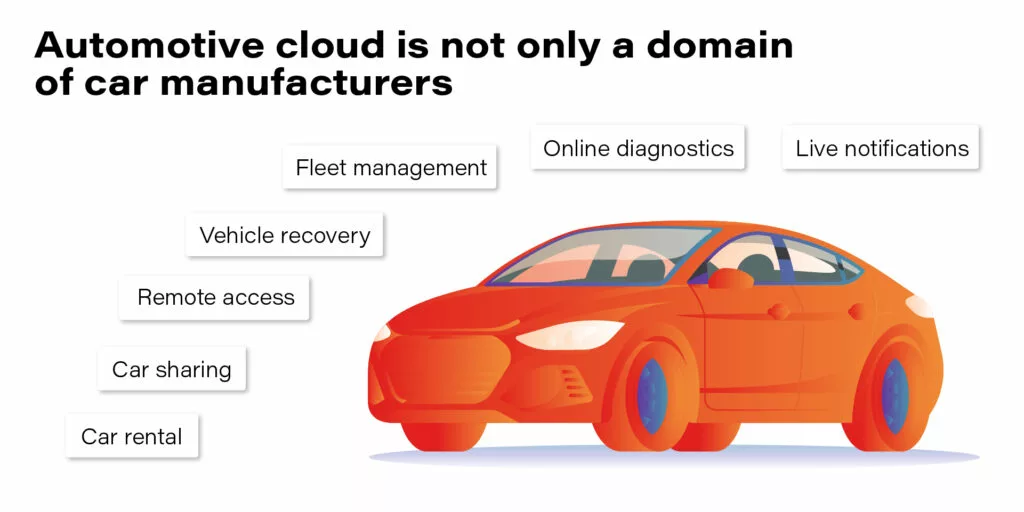
- Live notifications
- Online diagnostics
- Fleet management
- Vehicle recovery
- Remote access
- Car sharing
- Car rental
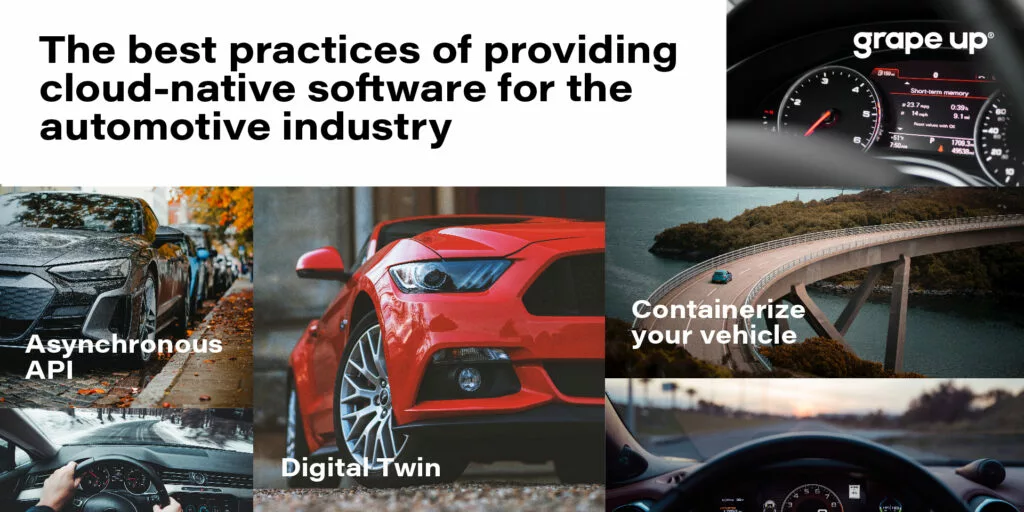
The best practices of providing cloud-native software for the automotive industry
Working with the leading auto motive brands and being engaged in numerous projects meant to deliver innovative applications. Our team have collected a group of helpful practices which make development easier and improve user experience. There are some must-have practices when it comes to delivering high-quality software, such as CI/CD, Agile, DevOps, etc., – they are crucial yet well-known for the experienced development team and we don’t focus on them in this article. Here we share tips dedicated for teams working with app delivery for automotive.
Containerize your vehicle
One of the things we’ve learned collaborating with Porsche is that vehicles are equipped with ECUs and installing software on them isn’t easy. However, Kubernetes helps to mitigate that challenge, as we can mock the target ECU by docker image with specialized operating systems and install software directly in it. That’s a good approach to create an integration environment that shortens the feedback loop and helps deliver software faster and better.
Asynchronous API
In the IoT ecosystem, you can’t rely too much on your connection with edge devices. There are a lot of connectivity challenges, for example, a weak cellular range. You can’t guarantee when your command to the car will be delivered and if the car will respond in milliseconds or even at all. One of the best patterns here is to provide the asynchronous API. It doesn’t matter on which layer you’re building your software if it’s a connector between vehicle and cloud or a system communicating with the vehicle’s API provider. Asynchronous API allows you to limit your resource consumption and avoid timeouts that leave systems in an unknown state.
Let’s take a very simple example of a mobile application for locking the car remotely.
Synchronous API scenario
- A customer presses a button on the application to lock the car.
- The request is sent and is waiting for a response.
- The request needs to be delegated to the car which may take some time.
- The backend component crashes and starts without any knowledge about the previous request.
- The application gets a timeout.
- What now? Is the car locked? What should be displayed to the end-user?
Asynchronous API scenario
- The customer presses a button on the application to lock the car.
- The request is sent and ended immediately.
- The request needs to be delegated to the car which may take some time.
- The backend component crashes and starts without any knowledge about the previous request.
- The car sends a request with the command result through the backend to the application.
- Application displays: “Car is locked.”
With asynchronous API, there’s always a way to resend the response. With synchronous API, after you lose connection, the system doesn’t know where to resend response out of the box. As you may see, the asynchronous pattern handles this case perfectly.
Digital Twin
DigDigital Twin is a virtual model of a process, a product or a service, in case of automotive – a digital cockpit of a car. This pattern helps to ensure the integrity of data and simplify the development of new systems by its abstraction over the vehicle. The concept is based on the fact that it stores the actual state of the vehicle in the cloud and constantly updates it based on data sent from a car. Every feature requiring some property of vehicle should be integrated with Digital Twin to limit direct integrations with a car and improve the execution time of operations.
Implementation of Digital Twin may be tricky though, as it all depends on the vehicle manufacturer and API it provides. Sometimes it doesn’t expose enough properties or doesn’t provide real-time updates. In such cases, it’s even impossible to implement this pattern.
Software for Connected Cars - Summary
We believe that the future will look more futuristic than we could have ever imagined. Autonomous cars, smart cars, smart homes, every device tries to make our lives easier. It’s not known when and how these solutions will fully utilize Artificial Intelligence to make this experience even better. Everything connects as numerous IoT devices are connected which provides us with unlimited possibilities.
T he automotive industry is currently transforming, and it isn’t only focusing on the driving experience anymore. There is a serious focus on connected mobility and other customer-oriented services to enhance our daily routines and habits. However, as software providers, we should keep in mind that automotive is a mature industry. The first connected car solutions were built years ago, and it’s challenging to integrate with them. These best practices should help focus on customer experience. Unreliable systems won’t encourage anyone to use it, and bad reviews can easily destroy a brilliant idea.
The automotive industry is experiencing a challenging transformation. We can notice these changes with every new model of a car and with every new service released. However, to keep up with the pace of the changing world, the industry needs modern technologies and reliable solutions, such as Kubernetes. And on top of that cloud-native application, software created with the best practices by experienced engineers who use the customer-first approach.
Generative AI in automotive: How industry leaders drive transformation
Generative AI is quickly emerging as one of the key drivers of automotive innovation. This shift is not just a future possibility; it's already happening. In 2023, the generative AI market in the automotive sector was valued at approximately USD 387.54 million . Looking ahead, it's projected to surge to about USD 2,691.92 million by 2032 , demonstrating a robust Compound Annual Growth Rate (CAGR) of 24.03% from 2023 to 2032. Major Original Equipment Manufacturers (OEMs) are integrating sophisticated AI algorithms into various aspects of the industry, from vehicle design to enhancing customer interactions.
The impact of generative AI in the automotive sector is already evident. For instance, NVIDIA's generative AI models empower designers to swiftly transform 2D sketches into intricate 3D models, significantly speeding up the design process and opening up new avenues for creativity and efficiency. Meanwhile, automotive manufacturing companies are exploring collaborations with tech giants to integrate advanced AI language models into their vehicles, enhancing the driving experience.

This article will explore how leading automotive players are leveraging generative AI to not only keep pace with the evolving demands of the market but also redefine mobility and automotive excellence.
Software-defined vehicles and generative AI
The introduction of software-defined vehicles (SDVs) represents a significant shift in the automotive industry, moving beyond traditional performance metrics such as horsepower and chassis design to focus on software and digital capabilities. By 2025, it is estimated that vehicles could require as much as 650 million lines of code each. These vehicles heavily rely on software for critical operations such as driving assistance, navigation, and in-car entertainment systems.
The integration of generative AI in this domain further amplifies these capabilities. Generative AI is known for its ability to create and optimize designs and solutions, which is beneficial in improving both the software and hardware aspects of SDVs. It helps in generating efficient algorithms for vehicle control systems, contributes to the development of more effective and adaptive software solutions, and even assists in designing vehicle components for better performance and efficiency.
However, bringing generative AI into this landscape presents both unique opportunities and significant challenges.
The opportunities and challenges
- Challenges
Integrating advanced AI systems into modern vehicles is a complex and multifaceted task that demands technical expertise and careful attention to data security and privacy , particularly with the increasing reliance on data-driven functionalities in vehicles.
The automotive industry is facing a complex regulatory environment. With the growing importance of AI and data in-vehicle systems, it has become crucial to comply with various international regulations and standards , covering areas such as data protection, safety, and environmental impact.
One significant challenge for OEMs is the lack of standardization within the software-defined vehicles industry, which can complicate the development and integration of new technologies as there are no universal norms or protocols to guide these processes.
Internal transformation is also a critical aspect of this integration. OEMs may need to revamp their internal capabilities, processes, and technological infrastructure to use generative AI effectively.
- Opportunities
Integrating generative AI technology allows for more creative and efficient vehicle design , resulting in quicker prototypes and more innovative models .
It also allows for creating personalized vehicles that cater to individual user preferences like never before. In manufacturing, generative AI promotes more efficient and streamlined production processes , which optimizes resources and reduces waste.
Let's explore how automotive manufacturers already use gen AI to boost their operations.
Generative AI applications in the automotive industry
Generative AI's integration into the automotive industry revolutionizes multiple facets of vehicle design, manufacturing, and user experience. Let's explore these areas:
Design and conceptualization
- Vehicle Design Enhancement : Artificial Intelligence is revolutionizing the vehicle design process by speeding up the initial phase of the design cycle. Generative design algorithms use parameters such as material properties, cost constraints, and performance requirements to generate optimal design solutions. For example, in vehicle body design, AI can propose multiple design options that optimize for aerodynamics and strength while minimizing weight. This enables quick visualization and modification of ideas.
Toyota Research Institute has introduced a generative AI technique to optimize the vehicle design process to produce more efficient and innovative vehicles. This approach allows designers to explore a wider range of design possibilities, including aerodynamic shapes and new material compositions.
- Digital Prototyping : The use of Generative AI technology makes it possible to create digital prototypes, which can be tested and refined extensively without the need for physical models. This approach is highly beneficial, as it enables designers to detect and correct potential design flaws early in the process.
BMW's use of NVIDIA Omniverse is a significant step in design improvement. The company uses this platform to create digital twins of their manufacturing facilities, integrating generative AI to enhance production efficiency and design processes.
Manufacturing and production
- Streamlining Manufacturing Processes : Generative AI significantly enhances the efficiency of manufacturing processes. Unlike traditional AI or machine learning models, generative AI goes beyond identifying inefficiencies; it actively generates novel manufacturing strategies and solutions. By inputting parameters such as production timelines, material constraints, and cost factors, generative AI algorithms can propose a range of optimized manufacturing workflows and processes.
BMW has implemented generative AI in a unique way to improve the scheduling of their manufacturing plant. In partnership with Zapata AI, BMW utilized a quantum-inspired generative model to optimize their plant scheduling, resulting in more efficient production. This process, known as Generator-Enhanced Optimization (GEO), has significantly improved BMW's production planning, demonstrating the potential of generative AI in industrial applications.
- Supply Chain Resilience : In the context of supply chain management, particularly during challenges like the automotive microchip shortage, generative AI plays a crucial role. Unlike conventional AI, gen AI can do more than just analyze existing supply chain networks; it can creatively generate alternative supply chain models and strategies. The algorithms can propose diverse and robust supplier networks by leveraging data about supplier capabilities, logistics constraints, and market demands.
- Customized Production : With generative AI, it is now possible to create personalized vehicles on a large scale, meeting the growing demand for customization in the automotive industry.
Predictive maintenance and modelling
Traditionally, predictive maintenance relies on historical data to forecast equipment failures, but generative AI enhances this process by creating detailed, simulated data environments. This technology generates realistic yet hypothetical scenarios, encompassing a vast array of potential machine failures or system inefficiencies that might not be present in existing data sets.
The generative aspect of this AI technology is particularly valuable in situations where real-world failure data is limited or non-existent. By synthesizing new data points, generative AI models can extrapolate from known conditions to predict how machinery will behave under various untested scenarios.
In modeling, generative AI goes a step further. It not only predicts when and how equipment might fail but also suggests optimal maintenance schedules, anticipates the impact of different environmental conditions, and proposes design improvements.
Customer experience and marketing
One of the challenges in using generative AI, particularly in customer interaction, is the accuracy of AI-generated responses. An example of this was an error by ChatGPT, where it was tricked into suggestion of buying a Chevy for a dollar . This incident underlines the potential risks of misinformation in AI-driven communication, emphasizing the need for regular updates, accuracy checks, and human oversight in AI systems. Nevertheless, this technology offers many opportunities for improving the customer experience:
- Personalized User Experiences and Enhanced Interaction : AI's capability to adapt to individual preferences not only enhances the driving experience but also improves the functionality of vehicle features.
For instance, in collaboration with Microsoft, General Motors is exploring the use of AI-powered virtual assistants that offer drivers a more interactive and informative experience. These assistants can potentially provide detailed insights into vehicle features and performance metrics and offer personalized recommendations based on driving patterns.
Also, Mercedes-Benz is exploring the integration of generative AI through voice-activated functionalities in collaboration with Microsoft. This includes leveraging the OpenAI Service plugin ecosystem, which could allow for a range of in-car services like restaurant reservations and movie ticket bookings through natural speech commands.
Example applications
- Simplified Manuals : AI technology, enabled by natural language processing, has simplified the interaction between drivers and their vehicles. Beyond just responding to voice commands with pre-existing information, a generative AI system can even create personalized guides or tutorials based on the driver's specific queries and past interactions.
Grape Up has developed an innovative voice-driven car manual that allows drivers to interact with their vehicle manual through voice commands, making it more accessible and user-friendly. With this technology, drivers no longer have to navigate through a traditional manual. Still, they can easily ask questions and receive instant verbal responses, streamlining the process of finding information about their vehicle.
- Roadside Assistance: In this scenario, generative AI can go beyond analyzing situations and suggesting solutions by creating new, context-specific guidance for unique problems. For instance, if a driver is stranded in a rare or complex situation, the AI could generate a step-by-step solution, drawing from a vast database of mechanical knowledge, previous incidents, and environmental factors.
- Map Generation : Here, generative AI can be used to not only update maps with real-time data but also to predict and visualize future road conditions or propose optimal routes that don't yet exist. For example, it could generate a route that balances time, fuel efficiency, and scenic value based on the driver's preferences and driving history.
- Marketing and Sales Innovation : Generative AI-enabled content engine is transforming the creation of digital advertising for the automotive industry. This content is tailored to meet the unique requirements of automotive brands and their consumers, thereby revolutionizing traditional marketing strategies.
Safety and compliance
- Enhancing Vehicle Safety : Generative AI in vehicles goes beyond traditional AI systems by not only assisting drivers but also by creating predictive models that enhance safety features. It processes and interprets data from cameras and sensors to foresee potential road hazards, often employing advanced generative models that simulate and predict various driving scenarios.
- Regulatory Compliance : Similarly, gen AI helps automakers comply with safety standards and navigate complex regulation changes by monitoring performance data and comparing it against regulatory benchmarks. This allows automakers to stay ahead of the compliance curve and avoid potential legal and financial repercussions.
Autonomous vehicle development
- Simulation and Testing : Generative AI is crucial for developing autonomous vehicle systems. It generates realistic simulations, including edge-case scenarios, to test and improve vehicle safety and performance.
- Enhancing ADAS Capabilities : AI technology can improve essential Advanced Driver Assistance Systems (ADAS) features such as adaptive cruise control, lane departure warnings, and automatic emergency braking by analyzing data from various sensors and cameras. Generative AI's strength in this context lies in its ability to not only process existing data but also to generate new data models, which can predict and simulate different driving scenarios. This leads to more advanced, reliable, and safer ADAS functionalities, significantly contributing to the evolution of autonomous and semi-autonomous driving technologies.
Conclusion
As the automotive industry accelerates towards a more AI-integrated future, the role of expert partners like Grape Up becomes increasingly crucial. Our expertise in navigating the intricacies of AI implementation can help automotive companies unlock the full potential of this technology. If you want to stay ahead in this dynamic landscape, now is the time to embrace the power of generative AI. For more information or to collaborate with Grape Up, contact our experts today.
Interested in our services?
Reach out for tailored solutions and expert guidance.