
The foundation for AI success: How to build a strategy to increase ROAI


AI adoption is on the rise but turning it into real business value is another story. 74% of companies struggle to scale AI initiatives , and only a tiny fraction - just 26% - develop the capabilities needed to move beyond proofs of concept. The real question on everyone's mind is - How to increase ROAI?
One of the biggest hurdles is proving the impact. In 2023, the biggest challenge for businesses was demonstrating AI’s usefulness in real operations . Many companies invest in this technology without a clear plan for how it will drive measurable results.
Even with these challenges, the adoption keeps growing. McKinsey's 2024 Global Survey on AI reported that 65% of respondents' organizations are regularly using Generative AI in at least one business function, nearly doubling from 33% in 2023. Businesses know its value, but making artificial intelligence work at scale takes more than just enthusiasm.
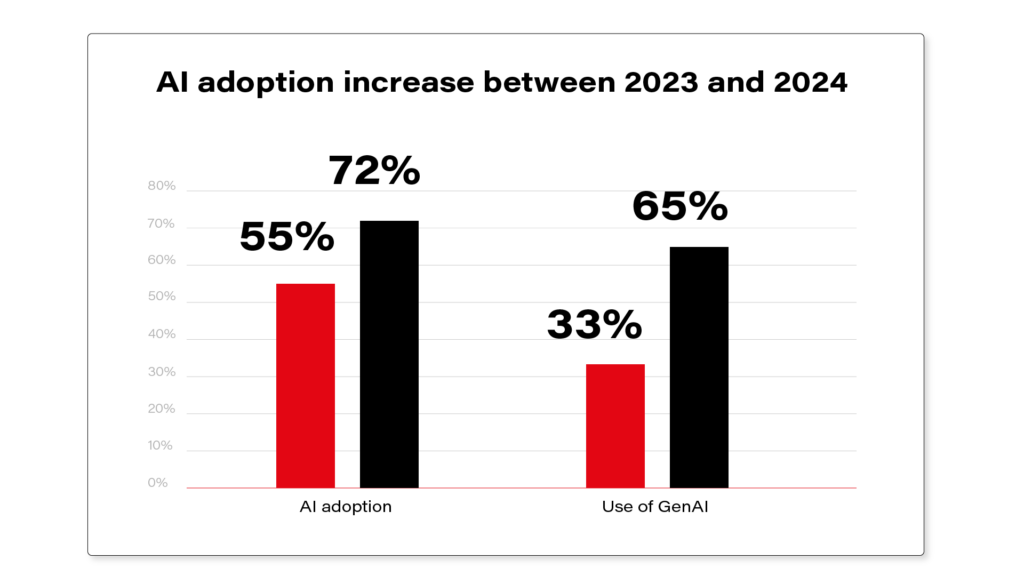
Source: https://www.mckinsey.com/capabilities/quantumblack/our-insights/the-state-of-ai
That’s where the right approach makes all the difference. A holistic strategy, strong data infrastructure, and efficient use of talent can help you increase ROAI and turn technology into a competitive advantage. But you need to start with building a foundation for AI investments and implementation first.
Why AI must be aligned with business goals
Too many AI projects fail when companies focus on the technology first instead of the problem it’s meant to solve. Investing in artificial intelligence just because it’s popular leads to expensive pilots that never scale, systems that complicate workflows instead of improving them, and wasted budgets with nothing to show for it.
Start with the problem, not the technology
Before committing resources, leadership needs to ask:
- What’s the goal? Is the priority cutting maintenance costs, making faster decisions, or detecting fraud more accurately? If the objective isn’t clear, neither will the results.
- Is AI even the right solution? Some problems don’t need machine learning. Sometimes, better data management or process improvements do the job just as well, without the complexity or cost of AI.
Choosing AI use cases that deliver real value
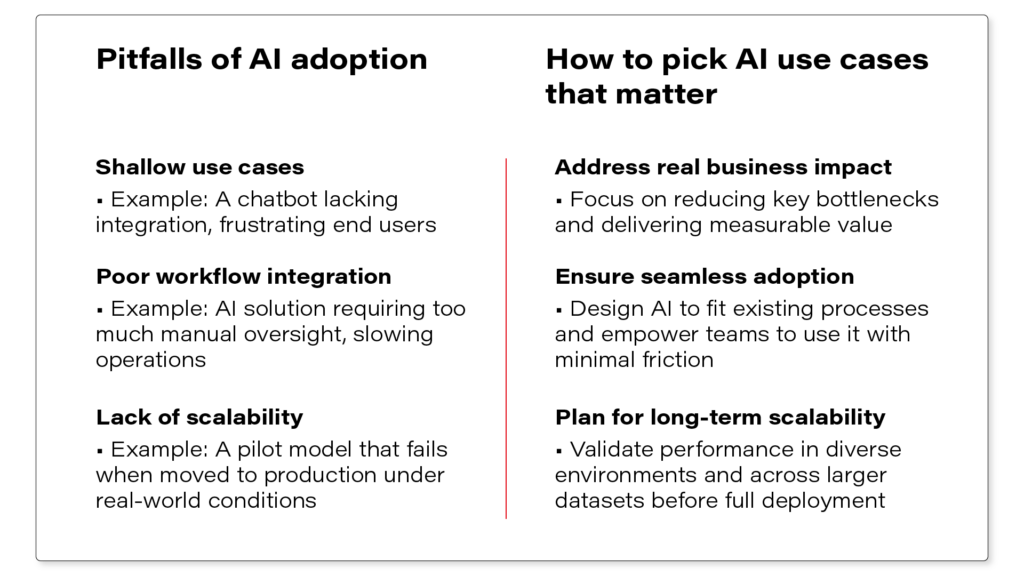
Once AI aligns with business goals, the next challenge is selecting initiatives that generate measurable impact. Companies often waste millions on projects that fail to solve real business problems, can’t scale, or disrupt workflows instead of improving them.
See which factors must align for AI to create tangible business value:
How responsible AI ties back to business results
Responsible AI protects long-term business value by creating systems that are transparent, fair, and aligned with user expectations and regulatory requirements. Organizations that take a proactive approach to AI governance minimize risks while building solutions that are both effective and trusted.
One of the biggest gaps in AI adoption is the lack of consistent oversight . Without regular audits and monitoring, models can drift, introduce bias, or generate unreliable results. Businesses need structured frameworks to keep AI reliable, adaptable, and aligned with real-world conditions. This also means actively managing ethical issues, explainability, and data security to maintain performance and trust.
As regulations evolve, compliance is no longer an afterthought. AI used in critical areas like fraud detection, risk assessment, and automated decision-making requires continuous monitoring to meet regulatory expectations. Companies that embed AI governance from the start avoid operational risks.
Another key challenge is trust . When AI-driven decisions lack transparency, scepticism grows. Users and stakeholders need clear visibility into how AI operates to build confidence. Companies that make decisions transparent and easy to understand improve adoption across their organization, and ultimately increase ROAI.
Measuring AI success and proving ROAI
The real test of AI’s success is whether it improves daily operations and delivers measurable business value. When teams work more efficiently, revenue grows, and risks become easier to manage, the investment is clearly paying off.
Key indicators of AI success
Is AI reducing manual effort? Automating repetitive tasks helps employees focus on more strategic work. If delays still slow operations or fraud detection overwhelms teams with false positives, AI may not be delivering real efficiency. Faster approvals and quicker customer issue resolution indicate AI is making a difference.
Is AI improving financial outcomes? Accurate forecasting cuts waste, and AI-driven pricing boosts profit margins. If automation isn’t lowering operational costs or streamlining workflows, it may not be adding real value.
Is AI strengthening security and compliance? Fraud detection prevents financial losses when it catches real threats without unnecessary disruptions. Compliance automation eases the burden of manual oversight, while AI-driven security reduces the risk of data breaches. If risks remain high, AI may need adjustments.
To prove AI’s return on investment, companies need to establish success criteria upfront , track AI performance over time, and compare different configurations (e.g., Generative AI use cases, LLM models ) to confirm the technology delivers cost savings and tangible benefits .
The hidden costs of AI initiatives and the challenge of scaling
Investing in artificial intelligence goes beyond development. Many companies focus on building and implementing models but underestimate the effort required to scale, maintain, and integrate them into existing systems. Costs accumulate over time, and without proper planning, AI projects can stall, and budgets stretch.
One of the highest ongoing costs is data . AI relies on clean, structured information, but collecting, storing, and maintaining it requires continuous effort. Over time, models need regular updates to remain accurate as well. Fraud tactics change, regulations evolve, and systems produce unreliable results without adjustments, leading to costly mistakes.
This becomes even more challenging when AI moves from a controlled pilot to full-scale implementation . A model that performs well in one department may not integrate easily across an entire organization. Expanding its use often exposes hidden costs, workflow disruptions, and technical limitations that weren’t an issue on a smaller scale.
Scaling AI successfully also requires coordination across different teams . While ML engineers refine models, business teams track measurable outcomes, and compliance teams manage regulatory requirements. You need these groups to align early.
AI must also integrate with existing enterprise systems without disrupting workflows, which requires dedicated infrastructure investments . Many legacy IT environments weren’t designed for AI-driven automation, which leads to increased costs for adaptation, cloud migration, and security improvements.
Companies that navigate these challenges effectively see real gains from AI. However, aligning strategy, execution, and scaling AI efficiently isn’t always straightforward. That’s where expert guidance makes a difference.
See how Grape Up helps businesses increase ROAI
Grape Up helps business leaders turn AI from a concept into a practical tool that delivers measurable ROAI by aligning technology with real business needs.
We work with companies to define AI roadmaps, making sure every initiative has a clear purpose and contributes to strategic goals. Our team supports data infrastructure and AI integration , so new solutions fit smoothly into existing systems without adding complexity.
From strategy to execution, Grape Up helps you increase ROAI. Make technology a real business asset adapted for long-term success.

Check related articles
Read our blog and stay informed about the industry's latest trends and solutions.
8 examples of how AI drives the automotive industry
Just a few years ago, artificial intelligence stirred our imagination via the voice of Arnold Schwarzenegger from "Terminator" or agent Smith from "The Matrix". It wasn't long before the rebellious robots' film dialogue replaced the actual chats we have with Siri or Alexa over our morning cup of coffee. Nowadays, artificial intelligence is more and more boldly entering new areas of our lives. The automotive industry is one of those that are predicted to speed up in the coming years. By 2030, 95-98% of new vehicles are likely to use this technology.
What will you learn from this article?
- How to use AI in the production process
- How AI helps drivers to drive safely and comfortably
- How to use AI in vehicle servicing
- What companies from the AI industry should pay attention to if they want to introduce such innovations
- You will learn about interesting use cases of the major brands
Looking at the application of AI in various industries, we can name five stages of implementation of such solutions. Today, companies from the Communication Technology (ICT) and Financial Services ("Matured Industries") sectors are taking the lead. Healthcare, Retail, Life Science ("Aspirational Industries") are following closely behind. Food & Beverages and Agriculture ("Strugglers") and companies from the Chemicals and Oil and Gas sectors ("Beginners") are bringing up the rear. The middle of the bunch is the domain of Automotive and, partly related to it, Industrial Machinery.

Although these days we choose a car mainly for its engine or design, it is estimated that over the next ten years, its software will be an equally significant factor that will impact our purchasing decision.
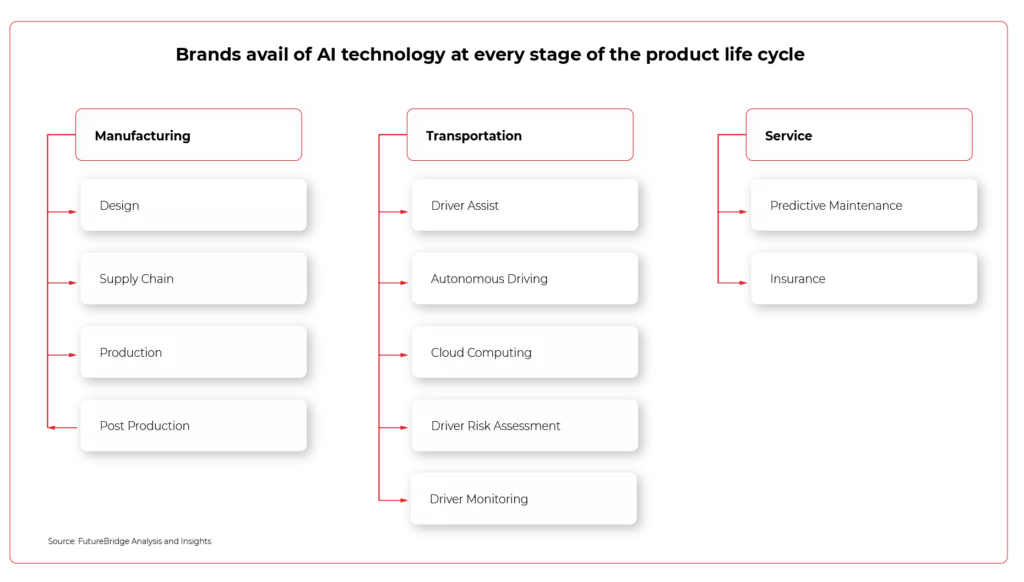
AI will not only change the way we use our vehicles, but also how we select, design, and manufacture them. Even now, leading brands avail of this type of technology at every stage of the product life cycle - from production through use, to maintenance and aftermarket.
Let's have a closer look at the benefits a vehicle manufacturing company can get when implementing AI in its operations.
Manufacturing - how AI improves production
1. You will be able to work out complex operations and streamline supply chains
An average passenger car consists of around 30,000 separate parts, which interestingly enough, are usually ordered from various manufacturers in different regions of the world. If, on top of that, we add a complicated manufacturing process, increasingly difficult access to skilled workers and market dependencies, it becomes clear that potential delays or problems in the supply chain result in companies losing millions. Artificial intelligence can predict these complex interactions, automate processes, and prevent possible failures and mishaps
- Artificial intelligence complements Audi's supply chain monitoring. When awarding contracts, it is verified that the partners meet the requirements set out in the company's internal quality code. In 2020, over 13,000 suppliers provided the Volkswagen Group with a self-assessment of their own sustainability performance. Audi only works with companies that successfully pass this audit.
2. More efficient production due to intelligent co-robots working with people
For years, companies from the automotive industry have been trying to find ways to enhance work on the production line and increase efficiency in areas where people would get tired easily or be exposed to danger. Industrial robots have been present in car factories for a long time, but only artificial intelligence has allowed us to introduce a new generation of devices and their work in direct contact with people. AI-controlled co-bots move materials, perform tests, and package products making production much more effective.
- Hyundai Vest Exoskeleton (H-VEX) became a part of Kia Motors’ manufacturing process in 2018. It provides wearable robots for assembly lines. AI in this example helps in the overall production while sensing the work of human employees and adjusting their motions to help them avoid injuries.
- AVGs (Automated Guided Vehicles) can move materials around plants by themselves. They can identify objects in their path and adjust their route. In 2018, an OTTO Motors device carried a load of 750 kilograms in this way!
3. Quality control acquires a completely new quality
The power of artificial intelligence lies not only in analyzing huge amounts of data but also in the ability to learn and draw conclusions. This fact can be used by finding weak points in production, controlling the quality of car bodies, metal or painted surfaces, and also by monitoring machine overload and predicting possible failures. In this way, companies can prevent defective products from leaving the factories and avoid possible production downtime.
- Audi uses computer vision to find small cracks in the sheet metal in the vehicles. Thus, even at the production stage, it reduces the risk of damaged parts leaving the factory.
- Porsche has developed "Sounce", a digital assistant, using deep learning methods. AI is capable of reliably and accurately detecting noise, for example during endurance tests. This solution, in particular, takes the burden off development engineers who so far had to be present during such tests. Acoustic testing based on Artificial Intelligence (AI) increases quality and reduces production costs.
4. AI will configure your dream vehicle
In a competitive and excessively abundant market, selling vehicles is very difficult. Brands are constantly competing in services and technologies that are to provide buyers with new experiences and facilitate the purchasing process. Manufacturers use artificial intelligence services not only at the stage of prototyping and modeling vehicles, but also at the end of the manufacturing process, when the vehicle is eventually sold. A well-designed configurator based on AI algorithms is often the final argument, by which the customer is convinced to buy their dream vehicle. Especially when we are talking about luxury cars.
- The Porsche Car Configurator is nothing more than a recommendation engine powered by artificial intelligence. The luxury car manufacturer created it to allow customers to choose a vehicle from billions of possible options. The configurator works using several million data and over 270 machine learning modules. Effect? The customer chooses the vehicle of their dreams based on customised recommendations.
Transportation - how AI facilitates driving vehicles
5. Artificial intelligence will provide assistance in an emergency
A dangerous situation on the road, vehicle in the blind spot, power steering on a slippery surface. All those situations can be supported by artificial intelligence, which will calculate the appropriate driving parameters or correct the way the driver behaves on the road. Instead of making automatic decisions - which are often emotion-imbued or lack experience - brands increasingly hand them over to machines, thus reducing the number of accidents and protecting people's lives.
- Verizon Connect solutions for fleet management allow you to send speed prompts to your drivers as soon as your vehicle's wipers are turned on. This lets the driver know that they have to slow down due to adverse road conditions such as rain or snow. And the intelligent video recorder will help you understand the context of the accident - for instance, by informing you that the driver accelerated rapidly before the collision.
6. Driver monitoring and risk assessment increase driving safety and comfort
Car journeys may be exhausting. But not for artificial intelligence. The biggest brands are increasingly equipping vehicles with solutions aimed at monitoring fatigue and driver reaction time. By combining intelligent software with appropriate sensors, the manufacturer can fit the car with features that will significantly reduce the number of accidents on the road and discomfort from driving in difficult conditions.
- Tesla monitors the driver's eyes, thus checking the driver's level of fatigue and preventing them from falling asleep behind the wheel. It’s mainly used for the Autopilot system to prevent driver from taking short nap during travel.
- The BMW 3 Series is equipped with a personal assistant, the purpose of which is to improve driving safety and comfort. Are you tired of the journey? Ask for the "the vitalization program" that will brighten the interior, lower the temperature or select the right music. Are you cold? All you have to do is say the phrase "I'm cold" and the seats will be heated to the optimal temperature.
Maintenance - how AI helps you take care of your car
7. Predictive Maintenance prevents malfunctions before they even appear
Cars that we are driving today are already pretty smart. They can alert you whenever something needs your attention and they can pretty precisely say what they actually need – oil, checking the engine, lights etc. The Connected Car era however equipped with the possibilities given by AI brings a whole lot more – predictive maintenance. In this case AI monitors all the sensors within the car and is set to detect any potential problems even before they occur.
AI can easily spot any changes, which may indicate failure, long before it could affect the vehicle’s performance. To go even further with this idea, thanks to the Over-The-Air Update feature, after finding a bug that can be easily fixed by a system patch, such solution can be sent to the car Over-The-Air directly by the manufacturer without the need for the customer to visit the dealership.
- Predi (an AI software company from California) has created an intelligent platform that uses the service order history and data from the Internet of Things to prevent breakdowns and deal with new possible ones faster.
8. Insure your car directly from the cockpit
Driving a car is not only about operating costs and repairs, but also insurance that each of us is required to purchase. In this respect, AI can be useful not only for insurance companies ( see how AI can improve the claims handling process ), but also for drivers themselves. Thanks to the appropriate software, we will remember about expiring insurance or even buy it directly from the comfort of our car, without having to visit the insurer's website or a stationary point.
- The German company ACTINEO, specialising in personal injury insurance, processes and digitises 120,000. claims annually. Their ACTINEO Cockpit service is a digital manager that allows for the comprehensive management of this type of cases, control of billing costs, etc.
- In collaboration with Ford, Arity provides insurers - with the driver's consent, of course - data on the driving style of the vehicle owner. In return for sharing this information, the driver is offered personalised insurance that matches his driving style. The platform’s calculations are based on "more than 440 billion miles of historical driving data from more than 23 million active telematics connections and more than eight years of data directly from cars (source: Green Car Congress).
When will AI take over the automotive industry?
In 2015, it is estimated that only 5-10% of cars had some form of AI installed. The last five years have brought the dissemination of solutions such as parking assistance, driver assistance and cruise control. However, the real boom is likely to occur within the next 8-10 years.
From now on, artificial intelligence in the automotive industry will no longer be a novelty or wealthy buyers’ whims. The spread of the Internet of Things, consumer preferences and finding ways of saving money in the manufacturing process will simply force manufacturers to do this - not only in the vehicle cockpits, but also on the production and service lines.
To this end, they will be made to cooperate with manufacturers of sensors and ultrasonic solutions (cooperation between BMW and Mobileye, Daimler from Bosch or VW and Ford with Aurora) and IT companies providing software for AI. A dependable partner who understands the potential of AI and knows how to use its power to create the car of the future is the key to success for companies in this industry.
How to manage operational challenges to sustain and maximize ROAI
Companies invest in artificial intelligence expecting better efficiency, smarter decisions, and stronger business outcomes. But too often, AI projects stall or fail to make a real impact. The technology works, but the real challenge is getting it to fit within business operations to maximize ROAI.
People resist change, legacy systems slow adoption down, compliance rules create obstacles, and costs pile up. More than 80% of AI projects never make it into production, double the failure rate of traditional IT projects. The gap between ambition and actual results is clear, but it doesn’t have to stay that way.
This article breaks down the biggest challenges holding companies back and offers practical ways to move past them. The right approach makes all the difference in turning AI from an experiment into a lasting source of business value.
Overcoming resistance to change
AI brings new ways of working, but not everyone feels comfortable with the shift. Employees often worry about job security, with 75% of U.S. workers concerned that AI could eliminate certain roles and 65% feeling uneasy about how it might affect their own positions.
Uncertainty grows when employees don’t understand how artificial intelligence fits into their work. People are more likely to embrace change when they see how technology supports them rather than disrupts what they do.
Open conversations and hands-on experience with new tools help break down fear. When companies provide training that focuses on practical benefits, employees gain confidence in using the technology instead of feeling like it’s something happening to them.
Leaders play a big role in setting the tone. Encouraging teams to test AI in small ways, celebrating early wins, and keeping communication clear makes tech feel like an opportunity rather than a threat. When employees see real improvements in their work, resistance turns into curiosity, and curiosity leads to stronger adoption.
But even when employees are ready, another challenge emerges - making it work with the technology already in place. That step is crucial if you want to maximize ROAI.
Integrating AI with legacy systems and managing costs
Many companies rely on applications built long before AI became essential to business operations. These legacy systems often store data in outdated formats, operate on rigid architectures, and struggle to handle the computing demands that technology requires. Adding new tools to these environments without careful planning leads to inefficiencies, increased costs, and stalled projects.
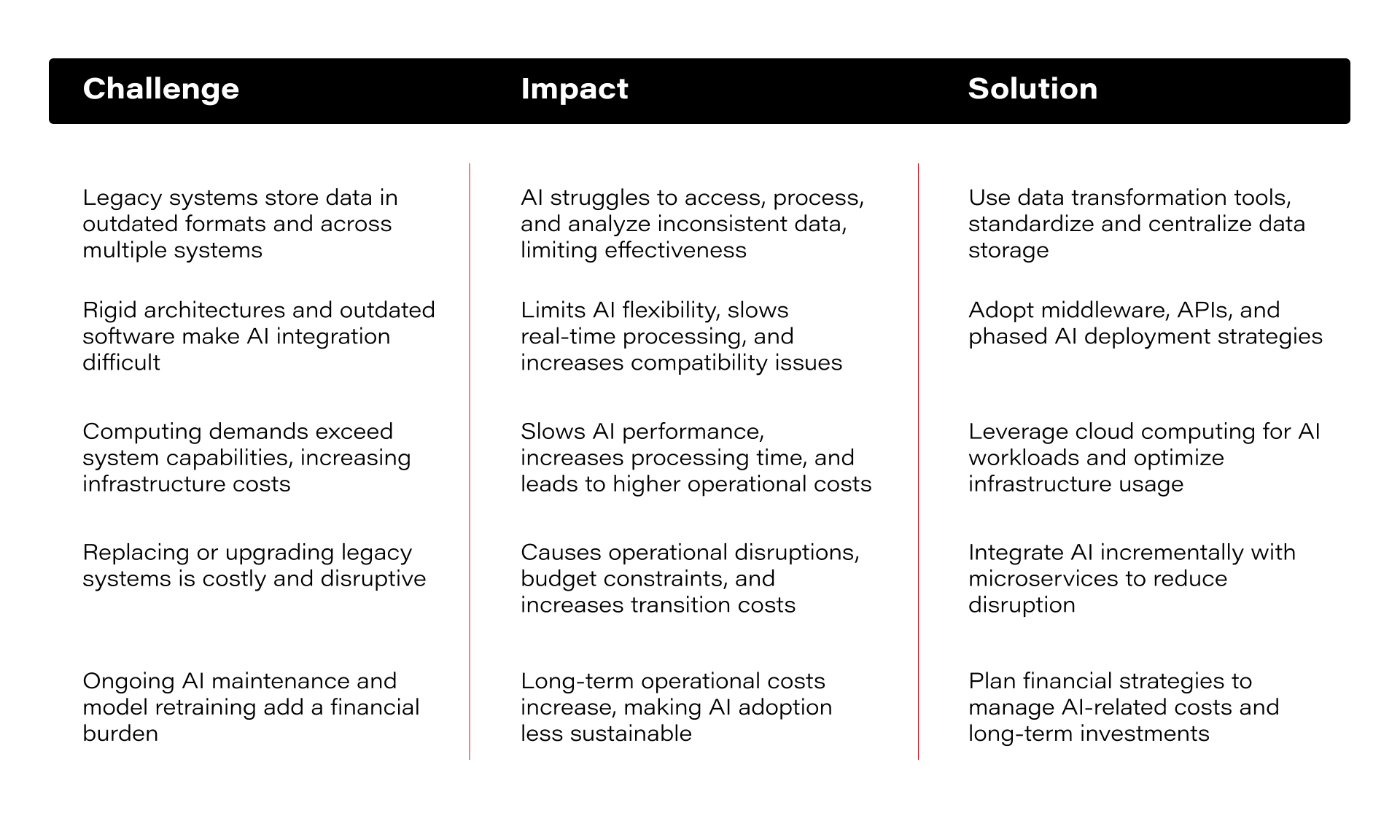
Technical challenges are only one piece of the puzzle, though. Even after AI is up and running, costs can add up fast. Businesses that don’t plan for ongoing expenses risk turning it into a financial burden instead of a long-term asset.
Upfront investments are just the beginning. As AI scales, companies face:
- Rising cloud and computing expenses – Models require significant processing power. Cloud services offer scalability, but expenses climb quickly as usage grows.
- Continuous updates and maintenance – AI systems need regular tuning and retraining to stay accurate. Many businesses underestimate how much this adds to long-term costs.
- Vendor lock-in risks – Relying too much on a single provider can lead to higher fees down the road. Limited flexibility makes it harder to switch to more affordable options.
Without a clear financial strategy, technology can become more expensive than expected. The right approach keeps costs under control while maximizing business value.
How to manage costs to maximize ROAI
- A clear breakdown of costs, from infrastructure to ongoing maintenance, helps businesses avoid unexpected expenses. Companies can make smarter investment decisions that lead to measurable returns when they understand both short-term and long-term costs.
- A mix of on-premise and cloud resources helps balance performance and cost. Sensitive data and frequent AI workloads can remain on-premise for security reasons, while cloud services provide flexibility and handle peak demand without major infrastructure upgrades.
- Open-source tools offer advanced capabilities without the high price tags of proprietary platforms. These solutions are widely supported and customizable, which helps cut software costs and reduces reliance on a single vendor.
- Some AI projects bring more value than others. Companies that focus on high-impact areas like process automation, predictive maintenance, or data-driven decision-making see more substantial returns. Prioritizing these helps you maximize ROAI.
AI delivers the best results when businesses plan for financial risks. Managing costs effectively allows companies to scale AI without stretching budgets too thin. But costs are only one part of the challenge - AI adoption also comes with regulatory and ethical responsibilities that businesses must address to maintain trust and compliance.
Staying ahead of AI regulations and ethical risks
Laws around AI are tightening, and companies that don’t adapt could face legal penalties or damage to their reputation.
AI regulations vary by region. The EU’s AI Act introduces strict rules, especially for high-risk applications, while the U.S. takes a more flexible approach that leaves room for industry-led standards. Countries like China are pushing for tighter controls, particularly around AI-generated content. Businesses that operate globally must navigate this mix of regulations and make sure they’re compliant in every market.
Beyond regulations, ethical concerns are just as pressing. AI models can reinforce biases, misuse personal data, or lack transparency in decision-making. Without the proper safeguards, technology can lead to discrimination, privacy violations, or decisions that users don’t understand. Customers and regulators expect it to be explainable and fair.
How to stay compliant and ethical without slowing innovation
- Keep up with AI regulations – Compliance isn’t a one-time task. Businesses need to monitor AI and data-related laws in key markets and adjust policies accordingly. Regular audits help ensure AI systems follow evolving legal standards.
- Make decisions transparent – AI models shouldn’t feel like a black box. Clear documentation, model explainability tools, and decision-tracking give businesses and users confidence in outcomes.
- Address bias and fairness – These models are only as far as the data they’re trained on. Regular bias testing, diverse training datasets, and fairness audits reduce the risk of unintended discrimination.
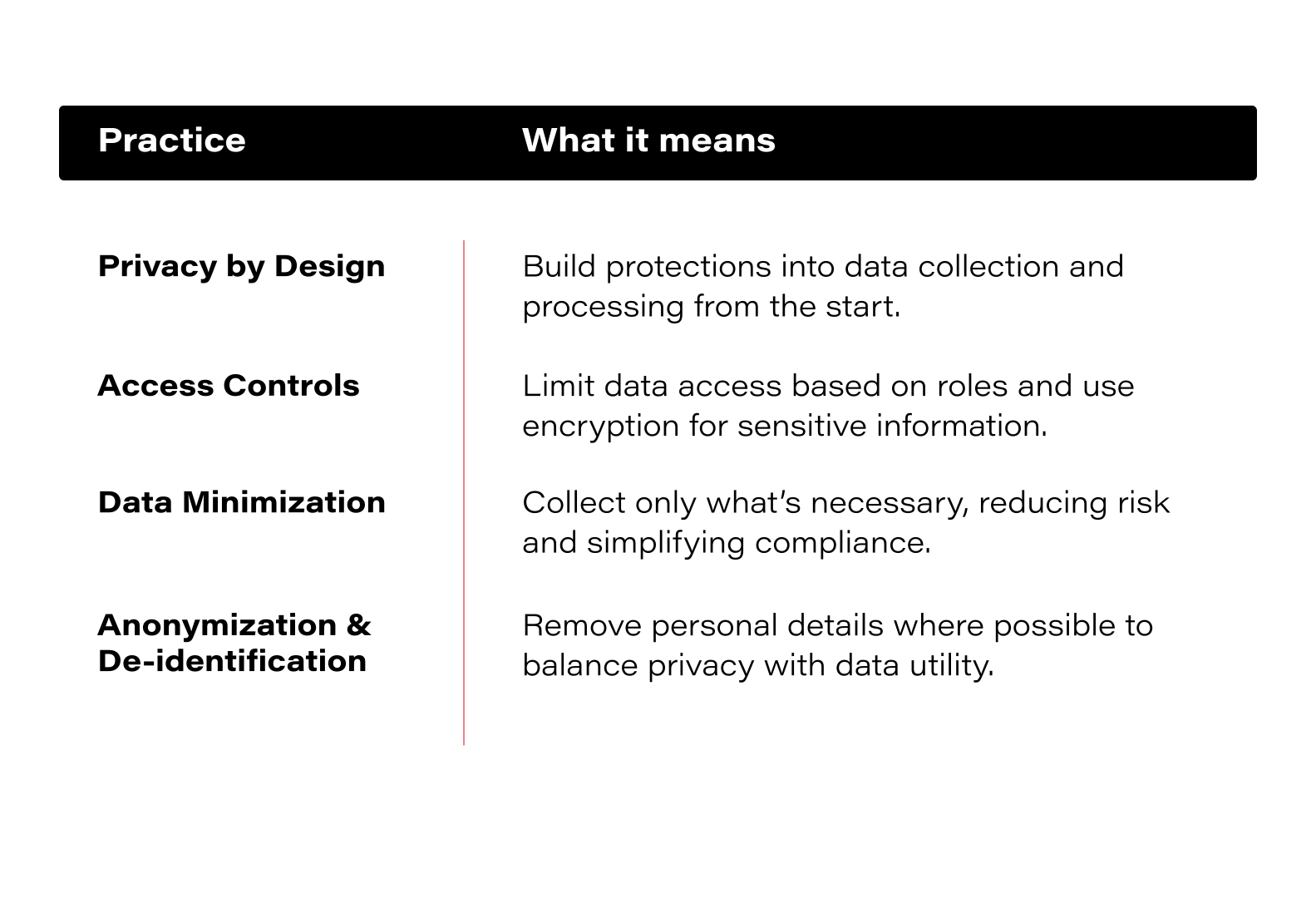
- Protect user privacy – Systems handle vast amounts of sensitive data. Strong encryption, anonymization techniques, and transparent data usage policies help prevent breaches and maintain user trust.
Maximize ROAI with Grape Up
Grape Up helps companies make AI a natural part of their business. With experience in AI development and system integration, the team works closely with organizations to bring tech into real operations without unnecessary costs or disruptions.
A strong background in software engineering and data infrastructure allows us to support businesses in adopting artificial intelligence in a way that fits their existing technology. We focus on practical, effective implementation when working with cloud environments or on-premises systems.
As technological advancements also come with responsibilities, we help companies stay on top of regulatory requirements and ethical considerations.
How is your company approaching AI adoption?
The key to ROAI: Why high-quality data is the real engine of AI success
Data might not literally be “the new oil,” but it’s hard to ignore its growing impact on companies' operations. By some estimates, the world will generate over 180 zettabytes of data by the end of 2025 . Yet, many organizations still struggle to turn that massive volume into meaningful insights for their AI projects.
According to IBM, poor data quality already costs the US economy alone $3.1 trillion per year - a staggering figure that underscores just how critical proper governance is for any initiative, AI included.
On the flip side, well-prepared data can dramatically boost the accuracy of AI models, shorten the time it takes to get results and reduce compliance risks. That’s why the high quality of information is increasingly recognized as the biggest factor in an AI project’s success or failure and a key to ROAI.
In this article, we’ll explore why good data practices are so vital for AI performance, what common pitfalls often derail organizations, and how usage transparency can earn customer trust while delivering a real return on AI investment.
Why data quality dictates AI outcomes
An AI model’s accuracy and reliability depend on the breadth, depth, and cleanliness of the data it’s trained on. If critical information is missing, duplicated, or riddled with errors, the model won’t deliver meaningful results, no matter how advanced it is. It’s increasingly being recognized that poor quality leads to inaccurate predictions, inefficiencies, and lost opportunities.
For example, when records contain missing values or inconsistencies, AI models generate results that don’t reflect reality. This affects everything from customer recommendations to fraud detection, making AI unreliable in real-world applications. Additionally, poor documentation makes it harder to trace data sources, increasing compliance risks and reducing trust in AI-driven decisions.
The growing awareness has made data governance a top priority across industries as businesses recognize its direct impact on AI performance and long-term value.
Metrics for success: Tracking the impact of quality data on AI
Even with the right data preparation processes in place, organizations benefit most when they track clear metrics that tie data quality to AI performance. Here are key indicators to consider:
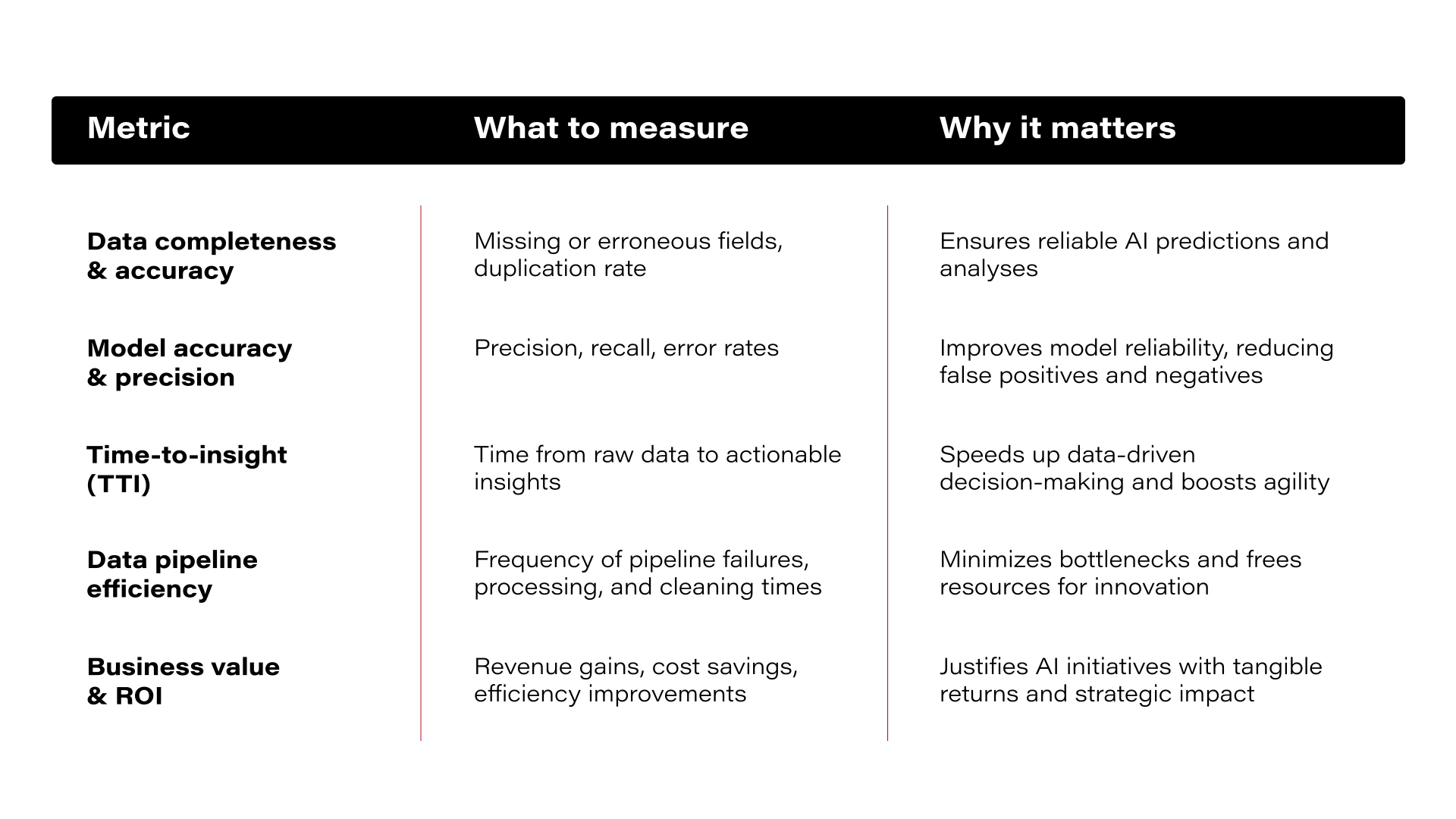
Monitoring these metrics lets organizations gain visibility into how effectively their information supports AI outcomes. The bottom line is that quality data should lead to measurable gains in operational efficiency, predictive accuracy, and overall business value. In other words - it's the key to ROAI.
However, even with strong data quality controls, many companies struggle with deeper structural issues that impact AI effectiveness.
AI works best with well-prepared data infrastructures
Even the cleanest sets won’t produce value if data infrastructure issues slow down AI workflows. Without a strong data foundation, teams spend more time fixing errors than training AI models.
Let's first talk about the people - they too are, after all, key to ROAI.
The right talent makes all the difference
Fixing data challenges is about tools as much as it is about people.
- Data engineers make sure AI models work with structured, reliable datasets.
- Data scientists refine data quality, improve model accuracy, and reduce bias.
- AI ethicists help organizations build responsible, fair AI systems.
Companies that invest in data expertise can prevent costly mistakes and instead focus on increasing ROAI.
However, even with the right people, AI development still faces a major roadblock: disorganized, unstructured data.
Disorganized data slows AI development
Businesses generate massive amounts of data from IoT devices, customer interactions, and internal systems. Without proper classification and structure, valuable information gets buried in raw, unprocessed formats. This forces data teams to spend more time cleaning and organizing instead of implementing AI in their operations.
- How to improve it: Standardized pipelines automatically format, sort, and clean data before it reaches AI systems. A well-maintained data catalog makes information easier to locate and use, speeding up development.
Older systems struggle with AI workloads
Many legacy systems were not built to process the volume and complexity of modern AI workloads. Slow query speeds, storage limitations, and a lack of integration with AI tools create bottlenecks. These issues make it harder to scale AI projects and get insights when they are needed.
- How to improve it: Upgrading to scalable cloud storage and high-performance computing helps AI process data faster. Moreover, integrating AI-friendly databases improves retrieval speeds and ensures models have access to structured, high-quality inputs.
Beyond upgrading to cloud solutions, businesses are exploring new ways to process and use information.
- Edge computing moves data processing closer to where it’s generated to reduce the need to send large volumes of information to centralized systems. This is critical in IoT applications, real-time analytics, and AI models that require fast decision-making.
- Federated learning allows AI models to train across decentralized datasets without sharing raw data between locations. This improves security and is particularly valuable in regulated industries like healthcare and finance, where data privacy is a priority.
Siloed data limits AI accuracy
Even when companies maintain high-quality data, access restrictions, and fragmented storage prevent teams from using it effectively. AI models trained on incomplete datasets miss essential context, which in turn leads to biased or inaccurate predictions. When different departments store data in separate formats or systems, AI cannot generate a full picture of the business.
- How to improve it: Breaking down data silos allows AI to learn from complete datasets. Role-based access controls provide teams with the right level of data availability without compromising security or compliance.
Fixing fragmented data systems and modernizing infrastructure is key to ROAI, but technical improvements alone aren’t enough. Trust, compliance, and transparency play just as critical a role in making AI both effective and sustainable.
Transparency, privacy, and security: The trust trifecta
AI relies on responsible data handling. Transparency builds trust and improves outcomes, while privacy and security keep organizations compliant and protect both customers and businesses from unnecessary risks. When these three elements align, people are more willing to share data, AI models become more effective, and companies gain an edge.
Why transparency matters
82% of consumers report being "highly concerned" about how companies collect and use their data, with 57% worrying about data being used beyond its intended purpose. When customers understand what information is collected and why, they’re more comfortable sharing it. This leads to richer datasets, more accurate AI models, and smarter decisions. Internally, transparency helps teams collaborate more effectively by clarifying data sources and reducing duplication.
Privacy and security from the start - a key to ROAI
While transparency is about openness, privacy and security focus on protecting data. Main practices include:
Compliance as a competitive advantage
Clear records and responsible data practices reduce legal risks and allow teams to focus on innovation instead of compliance issues. Customers who feel their privacy is respected are more willing to engage, while strong data practices can also attract partners, investors, and new business opportunities.
Use data as the strategic foundation for AI
The real value of AI comes from turning data into real insights and innovation - but none of that happens without a solid data foundation.
Outdated systems, fragmented records, and governance gaps hold back AI performance. Fixing these issues ensures AI models are faster, smarter, and more reliable.
Are your AI models struggling with data bottlenecks?
Do you need to modernize your data infrastructure to support AI at scale?
We specialize in building, integrating, and optimizing data architectures for AI-driven businesses.
Let’s discuss what’s holding your AI back and how to fix it.
Contact us to explore solutions tailored to your needs.
Interested in our services?
Reach out for tailored solutions and expert guidance.