
8 examples of how AI drives the automotive industry


Just a few years ago, artificial intelligence stirred our imagination via the voice of Arnold Schwarzenegger from "Terminator" or agent Smith from "The Matrix". It wasn't long before the rebellious robots' film dialogue replaced the actual chats we have with Siri or Alexa over our morning cup of coffee. Nowadays, artificial intelligence is more and more boldly entering new areas of our lives. The automotive industry is one of those that are predicted to speed up in the coming years. By 2030, 95-98% of new vehicles are likely to use this technology.
What will you learn from this article?
- How to use AI in the production process
- How AI helps drivers to drive safely and comfortably
- How to use AI in vehicle servicing
- What companies from the AI industry should pay attention to if they want to introduce such innovations
- You will learn about interesting use cases of the major brands
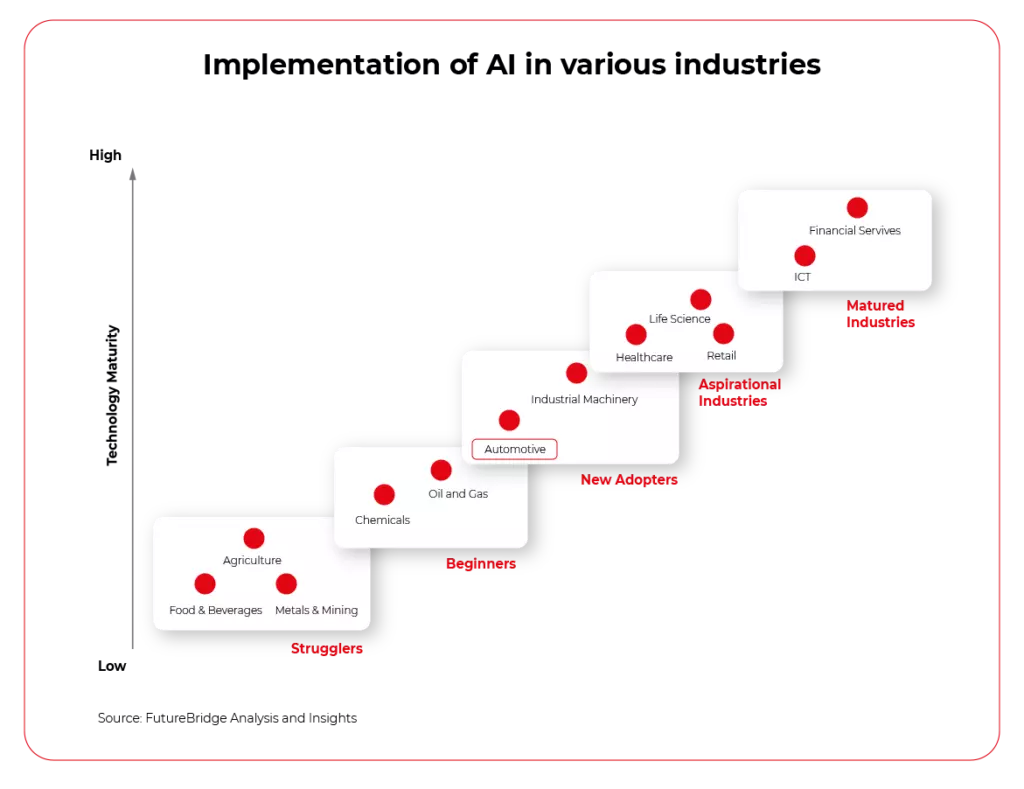
Looking at the application of AI in various industries, we can name five stages of implementation of such solutions. Today, companies from the Communication Technology (ICT) and Financial Services ("Matured Industries") sectors are taking the lead. Healthcare, Retail, Life Science ("Aspirational Industries") are following closely behind. Food & Beverages and Agriculture ("Strugglers") and companies from the Chemicals and Oil and Gas sectors ("Beginners") are bringing up the rear. The middle of the bunch is the domain of Automotive and, partly related to it, Industrial Machinery.
Although these days we choose a car mainly for its engine or design, it is estimated that over the next ten years, its software will be an equally significant factor that will impact our purchasing decision.
AI will not only change the way we use our vehicles, but also how we select, design, and manufacture them. Even now, leading brands avail of this type of technology at every stage of the product life cycle - from production through use, to maintenance and aftermarket.
Let's have a closer look at the benefits a vehicle manufacturing company can get when implementing AI in its operations.
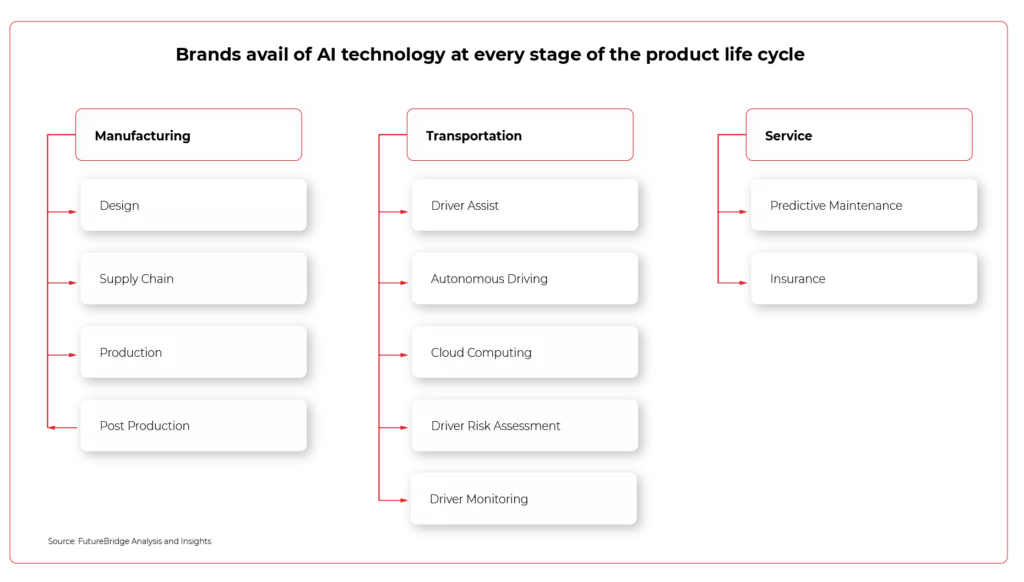
Manufacturing - how AI improves production
1. You will be able to work out complex operations and streamline supply chains
An average passenger car consists of around 30,000 separate parts, which interestingly enough, are usually ordered from various manufacturers in different regions of the world. If, on top of that, we add a complicated manufacturing process, increasingly difficult access to skilled workers and market dependencies, it becomes clear that potential delays or problems in the supply chain result in companies losing millions. Artificial intelligence can predict these complex interactions, automate processes, and prevent possible failures and mishaps
- Artificial intelligence complements Audi's supply chain monitoring. When awarding contracts, it is verified that the partners meet the requirements set out in the company's internal quality code. In 2020, over 13,000 suppliers provided the Volkswagen Group with a self-assessment of their own sustainability performance. Audi only works with companies that successfully pass this audit.
2. More efficient production due to intelligent co-robots working with people
For years, companies from the automotive industry have been trying to find ways to enhance work on the production line and increase efficiency in areas where people would get tired easily or be exposed to danger. Industrial robots have been present in car factories for a long time, but only artificial intelligence has allowed us to introduce a new generation of devices and their work in direct contact with people. AI-controlled co-bots move materials, perform tests, and package products making production much more effective.
- Hyundai Vest Exoskeleton (H-VEX) became a part of Kia Motors’ manufacturing process in 2018. It provides wearable robots for assembly lines. AI in this example helps in the overall production while sensing the work of human employees and adjusting their motions to help them avoid injuries.
- AVGs (Automated Guided Vehicles) can move materials around plants by themselves. They can identify objects in their path and adjust their route. In 2018, an OTTO Motors device carried a load of 750 kilograms in this way!
3. Quality control acquires a completely new quality
The power of artificial intelligence lies not only in analyzing huge amounts of data but also in the ability to learn and draw conclusions. This fact can be used by finding weak points in production, controlling the quality of car bodies, metal or painted surfaces, and also by monitoring machine overload and predicting possible failures. In this way, companies can prevent defective products from leaving the factories and avoid possible production downtime.
- Audi uses computer vision to find small cracks in the sheet metal in the vehicles. Thus, even at the production stage, it reduces the risk of damaged parts leaving the factory.
- Porsche has developed "Sounce", a digital assistant, using deep learning methods. AI is capable of reliably and accurately detecting noise, for example during endurance tests. This solution, in particular, takes the burden off development engineers who so far had to be present during such tests. Acoustic testing based on Artificial Intelligence (AI) increases quality and reduces production costs.
4. AI will configure your dream vehicle
In a competitive and excessively abundant market, selling vehicles is very difficult. Brands are constantly competing in services and technologies that are to provide buyers with new experiences and facilitate the purchasing process. Manufacturers use artificial intelligence services not only at the stage of prototyping and modeling vehicles, but also at the end of the manufacturing process, when the vehicle is eventually sold. A well-designed configurator based on AI algorithms is often the final argument, by which the customer is convinced to buy their dream vehicle. Especially when we are talking about luxury cars.
- The Porsche Car Configurator is nothing more than a recommendation engine powered by artificial intelligence. The luxury car manufacturer created it to allow customers to choose a vehicle from billions of possible options. The configurator works using several million data and over 270 machine learning modules. Effect? The customer chooses the vehicle of their dreams based on customised recommendations.
Transportation - how AI facilitates driving vehicles
5. Artificial intelligence will provide assistance in an emergency
A dangerous situation on the road, vehicle in the blind spot, power steering on a slippery surface. All those situations can be supported by artificial intelligence, which will calculate the appropriate driving parameters or correct the way the driver behaves on the road. Instead of making automatic decisions - which are often emotion-imbued or lack experience - brands increasingly hand them over to machines, thus reducing the number of accidents and protecting people's lives.
- Verizon Connect solutions for fleet management allow you to send speed prompts to your drivers as soon as your vehicle's wipers are turned on. This lets the driver know that they have to slow down due to adverse road conditions such as rain or snow. And the intelligent video recorder will help you understand the context of the accident - for instance, by informing you that the driver accelerated rapidly before the collision.
6. Driver monitoring and risk assessment increase driving safety and comfort
Car journeys may be exhausting. But not for artificial intelligence. The biggest brands are increasingly equipping vehicles with solutions aimed at monitoring fatigue and driver reaction time. By combining intelligent software with appropriate sensors, the manufacturer can fit the car with features that will significantly reduce the number of accidents on the road and discomfort from driving in difficult conditions.
- Tesla monitors the driver's eyes, thus checking the driver's level of fatigue and preventing them from falling asleep behind the wheel. It’s mainly used for the Autopilot system to prevent driver from taking short nap during travel.
- The BMW 3 Series is equipped with a personal assistant, the purpose of which is to improve driving safety and comfort. Are you tired of the journey? Ask for the "the vitalization program" that will brighten the interior, lower the temperature or select the right music. Are you cold? All you have to do is say the phrase "I'm cold" and the seats will be heated to the optimal temperature.
Maintenance - how AI helps you take care of your car
7. Predictive Maintenance prevents malfunctions before they even appear
Cars that we are driving today are already pretty smart. They can alert you whenever something needs your attention and they can pretty precisely say what they actually need – oil, checking the engine, lights etc. The Connected Car era however equipped with the possibilities given by AI brings a whole lot more – predictive maintenance. In this case AI monitors all the sensors within the car and is set to detect any potential problems even before they occur.
AI can easily spot any changes, which may indicate failure, long before it could affect the vehicle’s performance. To go even further with this idea, thanks to the Over-The-Air Update feature, after finding a bug that can be easily fixed by a system patch, such solution can be sent to the car Over-The-Air directly by the manufacturer without the need for the customer to visit the dealership.
- Predi (an AI software company from California) has created an intelligent platform that uses the service order history and data from the Internet of Things to prevent breakdowns and deal with new possible ones faster.
8. Insure your car directly from the cockpit
Driving a car is not only about operating costs and repairs, but also insurance that each of us is required to purchase. In this respect, AI can be useful not only for insurance companies ( see how AI can improve the claims handling process ), but also for drivers themselves. Thanks to the appropriate software, we will remember about expiring insurance or even buy it directly from the comfort of our car, without having to visit the insurer's website or a stationary point.
- The German company ACTINEO, specialising in personal injury insurance, processes and digitises 120,000. claims annually. Their ACTINEO Cockpit service is a digital manager that allows for the comprehensive management of this type of cases, control of billing costs, etc.
- In collaboration with Ford, Arity provides insurers - with the driver's consent, of course - data on the driving style of the vehicle owner. In return for sharing this information, the driver is offered personalised insurance that matches his driving style. The platform’s calculations are based on "more than 440 billion miles of historical driving data from more than 23 million active telematics connections and more than eight years of data directly from cars (source: Green Car Congress).
When will AI take over the automotive industry?
In 2015, it is estimated that only 5-10% of cars had some form of AI installed. The last five years have brought the dissemination of solutions such as parking assistance, driver assistance and cruise control. However, the real boom is likely to occur within the next 8-10 years.
From now on, artificial intelligence in the automotive industry will no longer be a novelty or wealthy buyers’ whims. The spread of the Internet of Things, consumer preferences and finding ways of saving money in the manufacturing process will simply force manufacturers to do this - not only in the vehicle cockpits, but also on the production and service lines.
To this end, they will be made to cooperate with manufacturers of sensors and ultrasonic solutions (cooperation between BMW and Mobileye, Daimler from Bosch or VW and Ford with Aurora) and IT companies providing software for AI. A dependable partner who understands the potential of AI and knows how to use its power to create the car of the future is the key to success for companies in this industry.

Grape Up guides enterprises on their data-driven transformation journey
Ready to ship? Let's talk.
Check related articles
Read our blog and stay informed about the industry's latest trends and solutions.
The future of autonomous driving connectivity – Quantum entanglement or 6G?
The title of the article is quite deceiving - both mentioned technologies are currently just distant concepts based on widely divergent connectivity mediums. It’s still a distant future, but let’s think for a while about where we are now, what awaits us in the very near future and where we are heading in the long term.
Autonomous driving and the whole Connected Car concept benefits greatly from internet connectivity. Traffic information, being able to request information about nearby cars, navigation, infrastructures like traffic lights, parking, or charging stations - all of that affects the decision about the actual path to be taken by the vehicle or driver.
Some of the systems are rather insensitive to the network bandwidth, for example, the layout of the roads does not require updates every second. On the other hand information about red light or vehicles losing traction nearby are critical and lowering latency directly affects the safety.
What technologies provide connectivity for autonomous driving?
These days cars mainly use the common mobile technology for connectivity: GPRS/EDGE, 3G/HSDPA, LTE, and 4G switching dynamically depending on network coverage. As the availability of 5G increases, the obvious next step is implementing it in the vehicle modems.
Can connected cars rely on 5G?
Obviously, 5G will never be available everywhere. The technology itself is a limitation here - it is millimeter-wave connectivity resulting in 2% of range compared to 4G (300-600m compared to 10-15km). Additionally, the latest Ericsson report predicts that by the end of 2026, 5G coverage is expected to reach 60 percent of the global population, while this still means mainly densely populated areas like cities and suburbs.
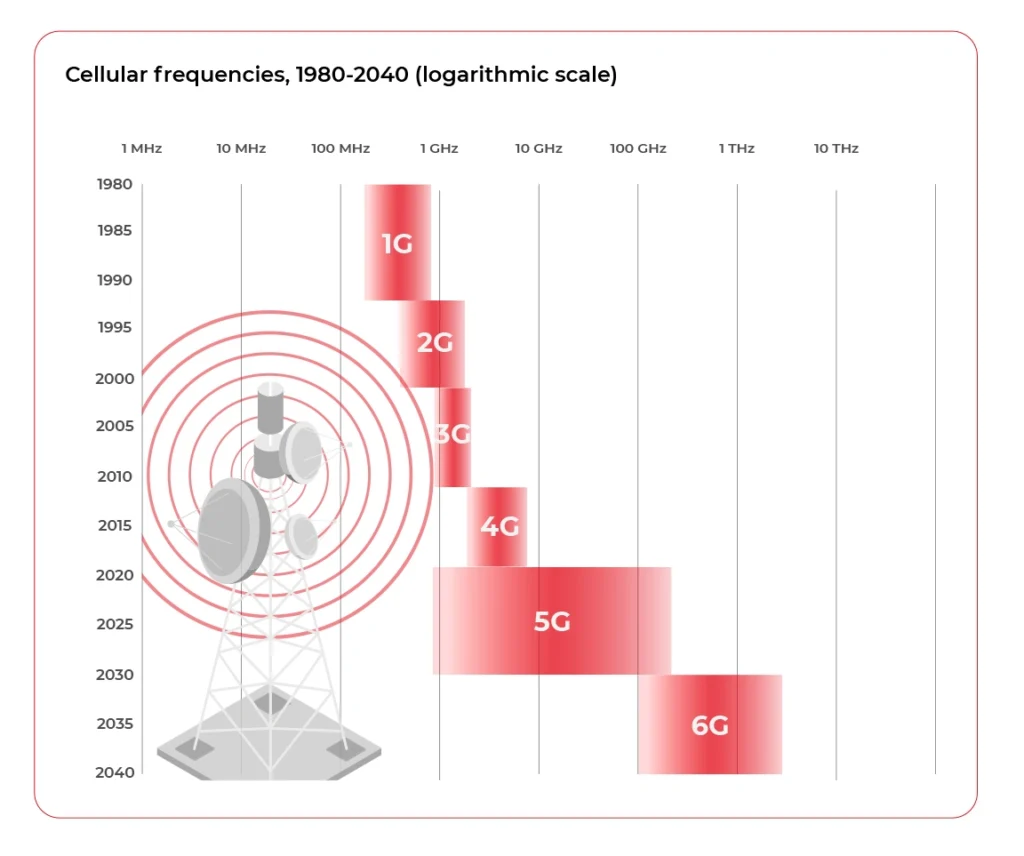
5G solves the latency and bandwidth problem but does not give full coverage, especially for rural areas and highways. Is there nothing more we can use to improve the situation? Not at all, multiple alternatives are being developed right now in parallel.
What are the alternatives to 5G?
There is IEE80211.p (WAVE - Wireless Access for the Vehicular Environment) based on the Wi-Fi WLAN standard focusing on improving the stability of the connection between high-speed vehicles. This is short-range, Vehicle2Vehicle and Vehicle2Infrarstructure communication.
While the 5G is not yet fully there, the 6G is starting to form. The successor of the 5th generation of the wireless cellular network is planned to increase the bandwidth, greatly allowing for extremely data consuming, real-time services to be built - like dynamic Virtual Reality streaming. The groups, like the Next G Alliance, are working on defining technical aspects and testing multiple possibilities, like THz wave frequencies as a physical medium for communication.
The other promising development is the LEO (Low Earth Orbit) satellite network, with a Starlink created by Elon Musk being the most popular currently available. This is no match in terms of latency to both 5G and 6G, but the unprecedented coverage and worldwide availability make it a great solution for situations, where the bandwidth is critical, while moderate latency is still sufficient.
The most futuristic medium, the quantum entanglement from the title of this article, seemed like the Holy Grail of communication - faster than light, meaning no latency at all. When the scientists announced that quantum entanglement works and was observed by comparing distant, entangled particles, the world held its breath. But in the end, there is currently no way to transmit anything this way - quantum entanglement breaks if one of the particles in the pair is forced to a particular quantum state. It’s disappointing but shows us that there may be a totally new way for communication still to be discovered.
Sum up: what connection type will be fueling Connected and Autonomous Cars
So what is the future of communication for Connected Cars and Autonomous Driving? 5G, 6G, satellite or wifi? The answer is all of them. As cars right now can dynamically switch between different kinds of mobile networks, in the future, they should also be able to pick the lowest latency connection available from a mobile network, satellite, wifi or whatever will be the future, or even use multiple simultaneously depending on the system requirements. Because there is no one best solution for all geographical regions, in-car systems, and conflicting requirements. Hybrid connectivity is the future of automotive connectivity.
How to achieve sustainable mobility using sustainable software development
Should the code be green?
Sustainable Mobility is the key goal for today and future vehicle manufacturers and mobility providers. Reducing the CO2 footprint of transportation contributes to building a better future for all of us. For the automotive industry, part of this goal is defined in the European Vehicle Emission Standards initiative, Euro 7 being the latest norm before all cars become fully zero-emission.
There are multiple paths leading into zero-emission transportation, most of which are being taken in parallel. Electric vehicles, especially charged using renewable energy sources such as solar energy. Fuel cells and hydrogen vehicles. Using recycled materials for both car interior and exterior. Car sharing, better urban transportation, and all kinds of initiatives leading to reducing the number of vehicles on the roads.
How software development companies can help us achieve sustainable mobility
Of course, software development companies can help with these kinds of initiatives by building software platforms for electric vehicles , efficient charging, and navigating to charging stations using renewable energy or making sure supply chains are fully invested in reducing CO2 emissions.
But is there anything, in general, we can do, or at least think about, to make software development more environment-aware?
One important aspect is the computational complexity of the code. More operations, assuming the same hardware, require more energy. This is especially important these days, as the microprocessors availability has become a huge bottleneck for the automotive industry. How can we mitigate this problem? Let’s look at two possibilities.
Building software for sustainable mobility with green coding
Firstly, does the programming language or code quality matter? Yes and yes. Let’s start by looking at the Energy Efficiency across Programming Languages paper from 2017 comparing the energy efficiency of programming languages (the lower, the better):

We can see that switching to a lower-level language can improve energy consumption. Is this the answer to the problem? Not directly. Procedural, statically typed languages are, in general, faster and have lower energy consumption, but at the same time are more complicated and require more time to write the same amount of code in easier to use ones. This is not a hard rule, as we can see Java gets a great result, although probably after optimizations.
Choosing energy-efficient computing resources
So one thing we can do is to think about the efficiency of the language when we choose the tech stack for our project. The other thing regarding the same problem is to optimize the code instead of adding more cores or GBs of memory - as it may be a cheaper solution initially.
The other improvement we can make comes to leveraging shared resources in the cloud for computation by building multi-layer computing systems, where results required immediately or in real-time can be computed on edge devices, while others can be computed at the edge of the cloud or in distributed cloud systems. Having those three layers, where two of them share resources between multiple vehicles or end-user devices, makes the computation both more cost-effective and requires less energy, as the bill is shared between multiple users.
Developers and software development departments can contribute to making the sustainable mobility goal achievable in the near future. Small steps and decisions regarding programming languages, frameworks, computing resources make a difference.
Connected car: Challenges and opportunities for the automotive industry
The development of connected car technology accelerated digital disruption in the automotive industry. Verified Market Research valued the connected car market at USD 72.68 billion in 2019 and projected its value to reach USD 215.23 billion by 2027. Along with the rapid growth of this market’s worth, we observe the constant development of new customer-centric services that goes far beyond driving experience.
While the development of connected car technology created a demand for connectivity solutions and drive-assistance systems, companies willing to build their position in this market have to face some significant challenges. This article is the first one of the mini-series that guides you through the main obstacles with building software for connected cars. We start with the basics of a connected vehicle, then dive into the details of prototyping and providing production-ready solutions. Finally, we analyze and predict the future of verticals associated with automotive-rental car enterprises, insurers, and mobility providers.
This series provides you with hands-on knowledge based on our experience in developing production-grade and cutting-edge software for the leading automotive and car rental enterprises. We share our insights and pointers to overcome recurring issues that happen to every software development team working with these technologies.
What is a Connected Car?
A Connected Car is a vehicle that can communicate bidirectionally with other systems outside the car , such as infrastructure, other vehicles, or home/office. Connected cars belong to the expanding environment of devices that comprise the Internet of Things landscape. As well as all devices that are connected to the internet, some functions of a vehicle can be managed remotely.
Along with that, IoT devices are valuable resources of data and information that enable further development of associated services. And while most car owners would describe it as the mobile application paired with a car that allows users to check the fuel level, open/close doors, control air conditioning, and, in some cases, start the ignition, this technology goes much further.
V2C - Vehicle to Cloud
Let’s focus on some real-case scenarios to showcase the capabilities of connected car technology. If a car is connected, it may also have a sat-nav system with a traffic monitoring feature that can alert a driver if there is a traffic jam in front of them and suggest an alternative route. Or maybe there is a storm at the upcoming route and navigation can warn the driver. How does it work?
That is mostly possible thanks to what we call V2C - Vehicle to Cloud communication. Utilizing the fact that a car is connected, and it is sending and gathering data, a driver may also try to find it, in case it was stolen. Telematics data is also helpful to understand the reasons behind an accident on the road - we can analyze what happened before the accident and what may have led to the event. The data can be also used for predictive maintenance, even if the rules managing the dates are changing dynamically.
While this seems just like a nice-to-have feature for the drivers, it allows car manufacturers to provide an extensive set of subscription-based features and functionalities for the end-users. The availability of services may depend on the current car state - location, temperature, and technical availability. As an example: during the winter, if the car is equipped with heated seats and the temperature drops under 0 Celsius, but the subscription for this feature expires, the infotainment can propose to buy the new one - which is more tempting when the user is at this time cold.
V2I - Vehicle to Infrastructure
A vehicle equipped with connected car technology is not limited to communicating only with the cloud. Such a car is capable of exchanging data and information with road infrastructure, and this functionality is called V2I - Vehicle to Infrastructure communication. A car processes information from infrastructure components - road signs, lane markings, traffic lights to support the driving experience by suggesting decision makings. In the next steps, V2I can provide drivers with information about traffic jams and free parking spots.
Currently, in Stuttgart, Germany, the city’s infrastructure provides the data live traffic lights data for vehicle manufacturers, so drivers can see not just what light is on, but how long they have to wait for the red light to switch to green again. This part of connected car technology can rapidly develop with the utilization of wireless communication and the digitalization of road infrastructure.
V2V - Vehicle to Vehicle
Another highly valuable type of communication provided by connected car technology is V2V - Vehicle to Vehicle. By developing an environment in which numerous cars are able to wirelessly exchange data, the automotive industry offers a new experience - every vehicle can use the information provided by a car belonging to the network, which leads to more effective communication covering traffic, car parking, alternative routes, issues on the road, or even some worth-seeing spots.
It may also significantly increase safety on the road, when one car notifies another that drives a few hundred meters behind him that it just had a hard breaking or that the road surface is slippery, using the information from ABS, ESP, or TC systems. That has not just an informational value but is also used for Adaptive Cruise Control or Travel Assist systems and reduces the speed of vehicles automatically increasing the safety of the travelers. V2V communication makes use of network and scale effects - the more users have connected to the network, the more helpful and complete information the network provides.
The list of use cases for connected car technology is only limited by our imagination but is excelling rapidly as many teams are joining the movement aiming to transform the way we travel and communicate. The Connected Car revolution leads to many changes and impacts both user experience and business models of the associated industries.
How connected car technology impacts business models of the automotive industry
Connected cars bring innovative solutions to the whole environment comprising the automotive landscape. Original Equipment Manufacturers (OEMs) have gained new revenue streams. Now vehicles allow their users to access stores and purchase numerous features and associated services that enhance customer experience, such as infotainment systems. By delivering aftermarket services directly to a car, the automotive industry monetizes new channels. Furthermore, these systems enable automakers to deliver advertisements, which become an increasing source of revenue.
The development of new technology in automotive creates a similar change as we observed in the mobile phone market. When smartphones equipped with operating systems had become a new normal, significantly increased the number of new apps that now allow their users to manage numerous services and tasks using the device.
But it is just an introduction to numerous business opportunities provided by connected cars. Since data has become a new competitive advantage that fuels the digital economy, collecting and distributing data about user behavior and vehicle performance is seen as highly profitable, especially when taking into account the potential interest of insurers providers.
Assembled data while used properly gives OEMs powerful insights into customer behavior that should lead to the rapid growth of new technologies and products improving customer experiences, such as predictive maintenance or fleet management.
The architecture behind connected car technology
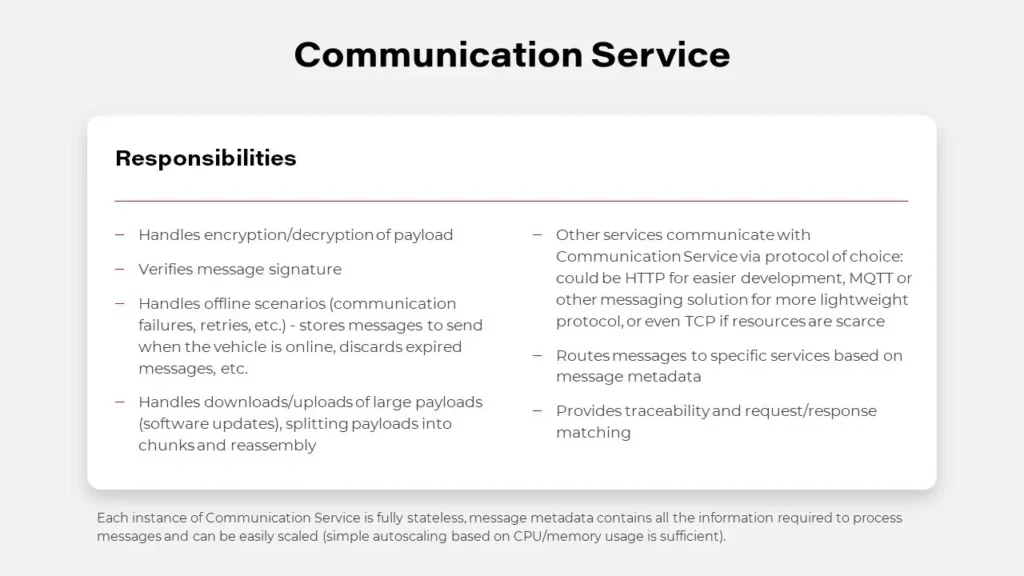
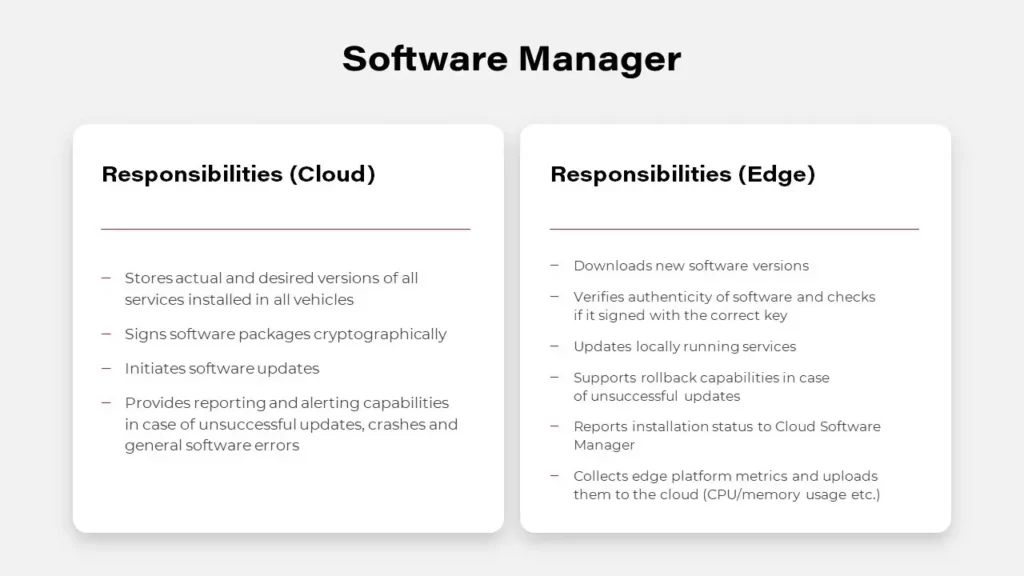
Automotive companies utilize data from vehicle sensors and allow 3rd party providers to access their systems through dedicated API layers. Let’s dive into such architecture.
High-Level Architecture
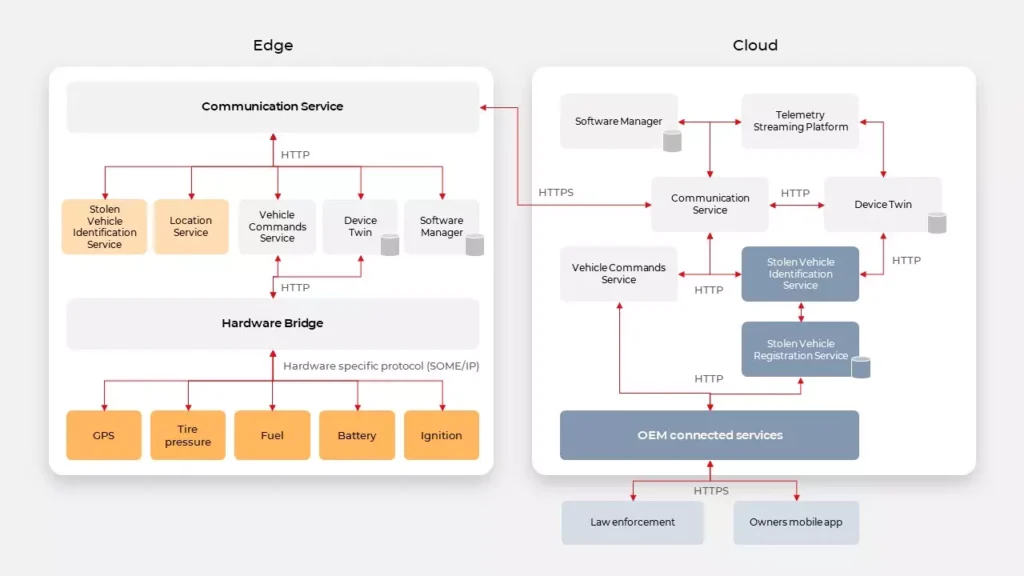
System components

Digital Twin in automotive
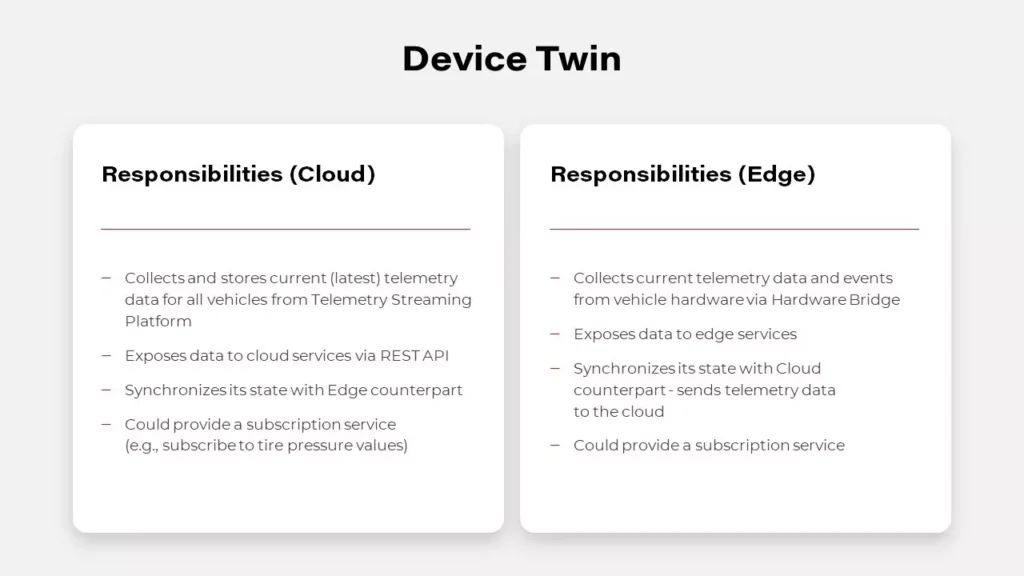
A digital twin is a virtual replica and software representation of a product, system, or process. This concept is being adopted and developed in the automotive industry, as carmakers utilize its powerful capabilities to increase customer satisfaction, improve the way they develop vehicles and their systems, and innovate. A digital twin empowers automotive companies to collect various information from numerous sensors, as this tool allows to capture operational and behavioral data generated by a vehicle. Equipped with these insights, the leading automotive enterprises work on enhancing performance and customize user experience, but meanwhile, they have to tackle significant challenges.
First of all, getting data from vehicles is problematic. Hardware built-in vehicles have particular limits, which leads to reduced capabilities in providing software. Unlike software, once shipped hardware cannot be easily adjusted to the changing conditions and works for several years at least. Furthermore, while willing to deliver a customer-centric experience, automakers still have to protect their users from numerous threats. To protect vehicles from denial of service attacks, vehicles can throttle the number of requests. Overall, it’s a good idea but can have a terrible impact when multiple applications are trying to get data from vehicles, e.g., in the rental domain. This complex problem can be simply solved by Digital Twin. It can expose data to all applications without them needing to connect to the vehicle by simply gathering all real-time vehicle data in the cloud.
Implementation of this pattern is possible by using NoSQL databases like MongoDB or Cassandra and reliable communication layers, examples are described below. Digital Twin may be implemented in two possible ways, uni- or bidirectional.
Unidirectional Digital Twin
Unidirectional Digital Twin is saving only values received from the vehicle, in case of conflict it resolves the situation based on event timestamp. However, it doesn’t mean that the event causing the conflict is discarded and lost, usually every event is sent to the data platform. The data platform is a useful concept for data analysis and became handy when implementing complex use cases like analyzing driver habits.
Bidirectional Digital Twin
The Bidirectional Digital Twin design is based on the concept of the current and desired state. The vehicle is reporting the current state to the platform, and on the other hand, the platform is trying to change the state in the vehicle to the desired value. In this situation, in case of conflict, not only the timestamp matters as some operations from the cloud may not be applied to the vehicle in every state, eg., the engine can’t be disabled when the vehicle is moving.
However, meeting the goal of developing a Digital Twin may be tricky though as it all depends on the OEM and provided API. Sometimes it doesn’t expose enough properties or doesn’t provide real-time updates. In such cases, it may be even impossible to implement this pattern.
API
At first, designing a Connected Car API isn’t different from designing an API for any other backend system. It should start with an in-depth analysis of a domain, in this case, automotive. Then user stories should be written down, and with that, the development team should be able to find common parts and requirements to be able to determine the most suitable communication protocol. There are a lot of possible solutions to choose from. There are several reliable and high-traffic oriented message brokers like Kafka or hosted solutions AWS Kinesis. However, the simplest solution based on HTTP can also handle the most complex cases when used with Server-Sent Events or WebSockets. When designing API for mobile applications, we should also consider implementing push notifications for a better user experience.
When designing API in the IoT ecosystem, you can’t rely too much on your connection with edge devices. There are a lot of connectivity challenges, for example, a weak cellular range. You can’t guarantee when your command to a car will be delivered, and if a car will respond in milliseconds or even at all. One of the best patterns here is to provide the asynchronous API. It doesn’t matter on which layer you’re building your software if it’s a connector between vehicle and cloud or a system communicating with the vehicle’s API provider. Asynchronous API allows you to limit your resource consumption and avoid timeouts that leave systems in an unknown state. It’s a good practice to include a connector, the logic which handles all connection flaws. Well designed and developed connectors should be responsible for retries, throttling, batching, and caching of request and response.
OEM’s are now implementing a unified API concept that enables its customers to communicate with their cars through the cloud at the same quality level as when they use direct connections (for example using Wi-Fi). This means that the developer sees no difference in communicating with the car directly or using the cloud. What‘s also worth noting: the unified API works well with the Digital Twin concept, which leads to cuts in communication with the vehicle as third-party apps are able to connect with the services in the cloud instead of communicating directly with an in-car software component.
What’s next for connected car technology
Once the challenges become tackled, connected vehicles provide automakers and adjacent industries with a chance to establish beneficial co-operations, build new revenue streams, or even create completely new business models. The possibilities delivered thanks to over-the-air communication (OTA) allowing to send fixes, updates, and upgrades to already sold cars, provide new monetization channels, and sustain customer relationships.
As previously mentioned, the global connected car market is projected to reach USD 215.23 billion by 2027. To acquire shares in this market, automotive companies are determined to adjust their processes and operations. Among key factors that impact the development of connected car technology, we can point out a few crucial. The average lifecycle of a car is about 10 years. Today, automakers make decisions regarding connected cars that will go into production two to four years from now. For the cellular connectivity strategy to remain relevant over 12 to 15 years, significant challenges and assumptions need to be collaboratively addressed by OEMs, telematics control unit suppliers, and service providers.
Automakers must manage software in the field reliably, cost-efficiently, and, most importantly, securely – not just patch fixes, but also continually upgrade and enhance the functionality. The availability of OTA updates reduces the burden on dealerships and certified repair centers but requires better and more extensive testing, as the breakage of critical features is not an option.
Cellular solutions need to be agile to be compatible with emerging network technologies over the vehicle lifetime, e.g., 5G to be the industry standard in the next few years. The chosen solution must deliver reliable, seamless, uninterrupted coverage in all countries and markets where the vehicles are sold and driven.
Solution developers must offer scalable, cost-effective ways to develop upgradeable software that can be universally deployed across technologies, hardware, and chipsets. A huge focus must be put on testing the changes automatically on both the cloud platform side and the vehicle side.
As Connected Vehicles proliferate, the auto industry will need to adapt and transform itself into the growing technological dependency. OEMs and Tier-1 manufacturers must partner with technology specialists to thrive in an era of software-defined vehicles. As connectivity requires skills and capabilities outside of the OEMs’ domain, automakers will necessarily have to be software developers. An open platform environment will go a long way to encourage external developers to design apps for vehicle connectivity platforms.
Interested in our services?
Reach out for tailored solutions and expert guidance.