
How to manage operational challenges to sustain and maximize ROAI


Companies invest in artificial intelligence expecting better efficiency, smarter decisions, and stronger business outcomes. But too often, AI projects stall or fail to make a real impact. The technology works, but the real challenge is getting it to fit within business operations to maximize ROAI.
People resist change, legacy systems slow adoption down, compliance rules create obstacles, and costs pile up. More than 80% of AI projects never make it into production, double the failure rate of traditional IT projects. The gap between ambition and actual results is clear, but it doesn’t have to stay that way.
This article breaks down the biggest challenges holding companies back and offers practical ways to move past them. The right approach makes all the difference in turning AI from an experiment into a lasting source of business value.
Overcoming resistance to change
AI brings new ways of working, but not everyone feels comfortable with the shift. Employees often worry about job security, with 75% of U.S. workers concerned that AI could eliminate certain roles and 65% feeling uneasy about how it might affect their own positions.
Uncertainty grows when employees don’t understand how artificial intelligence fits into their work. People are more likely to embrace change when they see how technology supports them rather than disrupts what they do.
Open conversations and hands-on experience with new tools help break down fear. When companies provide training that focuses on practical benefits, employees gain confidence in using the technology instead of feeling like it’s something happening to them.
Leaders play a big role in setting the tone. Encouraging teams to test AI in small ways, celebrating early wins, and keeping communication clear makes tech feel like an opportunity rather than a threat. When employees see real improvements in their work, resistance turns into curiosity, and curiosity leads to stronger adoption.
But even when employees are ready, another challenge emerges - making it work with the technology already in place. That step is crucial if you want to maximize ROAI.
Integrating AI with legacy systems and managing costs
Many companies rely on applications built long before AI became essential to business operations. These legacy systems often store data in outdated formats, operate on rigid architectures, and struggle to handle the computing demands that technology requires. Adding new tools to these environments without careful planning leads to inefficiencies, increased costs, and stalled projects.
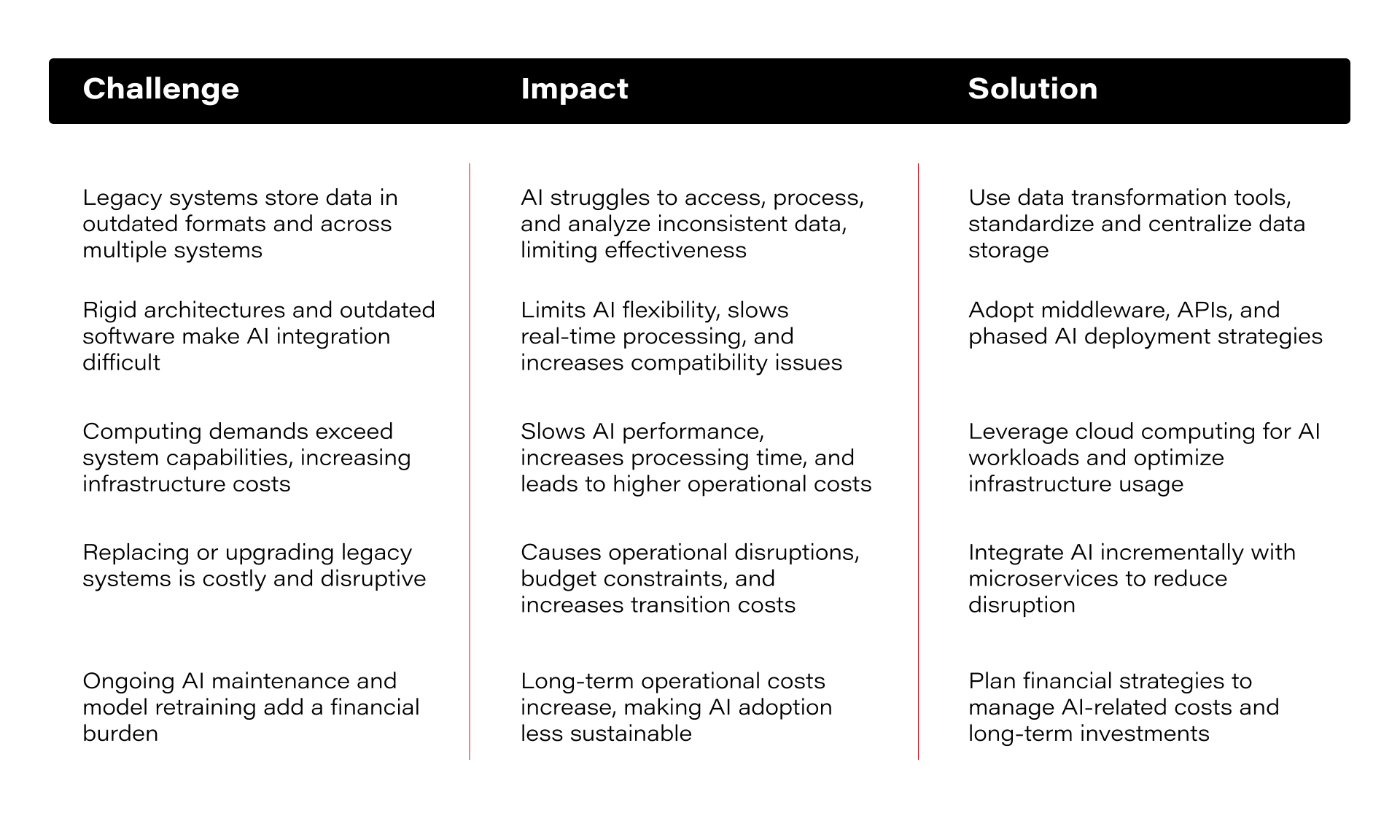
Technical challenges are only one piece of the puzzle, though. Even after AI is up and running, costs can add up fast. Businesses that don’t plan for ongoing expenses risk turning it into a financial burden instead of a long-term asset.
Upfront investments are just the beginning. As AI scales, companies face:
- Rising cloud and computing expenses – Models require significant processing power. Cloud services offer scalability, but expenses climb quickly as usage grows.
- Continuous updates and maintenance – AI systems need regular tuning and retraining to stay accurate. Many businesses underestimate how much this adds to long-term costs.
- Vendor lock-in risks – Relying too much on a single provider can lead to higher fees down the road. Limited flexibility makes it harder to switch to more affordable options.
Without a clear financial strategy, technology can become more expensive than expected. The right approach keeps costs under control while maximizing business value.
How to manage costs to maximize ROAI
- A clear breakdown of costs, from infrastructure to ongoing maintenance, helps businesses avoid unexpected expenses. Companies can make smarter investment decisions that lead to measurable returns when they understand both short-term and long-term costs.
- A mix of on-premise and cloud resources helps balance performance and cost. Sensitive data and frequent AI workloads can remain on-premise for security reasons, while cloud services provide flexibility and handle peak demand without major infrastructure upgrades.
- Open-source tools offer advanced capabilities without the high price tags of proprietary platforms. These solutions are widely supported and customizable, which helps cut software costs and reduces reliance on a single vendor.
- Some AI projects bring more value than others. Companies that focus on high-impact areas like process automation, predictive maintenance, or data-driven decision-making see more substantial returns. Prioritizing these helps you maximize ROAI.
AI delivers the best results when businesses plan for financial risks. Managing costs effectively allows companies to scale AI without stretching budgets too thin. But costs are only one part of the challenge - AI adoption also comes with regulatory and ethical responsibilities that businesses must address to maintain trust and compliance.
Staying ahead of AI regulations and ethical risks
Laws around AI are tightening, and companies that don’t adapt could face legal penalties or damage to their reputation.
AI regulations vary by region. The EU’s AI Act introduces strict rules, especially for high-risk applications, while the U.S. takes a more flexible approach that leaves room for industry-led standards. Countries like China are pushing for tighter controls, particularly around AI-generated content. Businesses that operate globally must navigate this mix of regulations and make sure they’re compliant in every market.
Beyond regulations, ethical concerns are just as pressing. AI models can reinforce biases, misuse personal data, or lack transparency in decision-making. Without the proper safeguards, technology can lead to discrimination, privacy violations, or decisions that users don’t understand. Customers and regulators expect it to be explainable and fair.
How to stay compliant and ethical without slowing innovation
- Keep up with AI regulations – Compliance isn’t a one-time task. Businesses need to monitor AI and data-related laws in key markets and adjust policies accordingly. Regular audits help ensure AI systems follow evolving legal standards.
- Make decisions transparent – AI models shouldn’t feel like a black box. Clear documentation, model explainability tools, and decision-tracking give businesses and users confidence in outcomes.
- Address bias and fairness – These models are only as far as the data they’re trained on. Regular bias testing, diverse training datasets, and fairness audits reduce the risk of unintended discrimination.
- Protect user privacy – Systems handle vast amounts of sensitive data. Strong encryption, anonymization techniques, and transparent data usage policies help prevent breaches and maintain user trust.
Maximize ROAI with Grape Up
Grape Up helps companies make AI a natural part of their business. With experience in AI development and system integration, the team works closely with organizations to bring tech into real operations without unnecessary costs or disruptions.
A strong background in software engineering and data infrastructure allows us to support businesses in adopting artificial intelligence in a way that fits their existing technology. We focus on practical, effective implementation when working with cloud environments or on-premises systems.
As technological advancements also come with responsibilities, we help companies stay on top of regulatory requirements and ethical considerations.
How is your company approaching AI adoption?

Data powertrain in automotive: Complete end-to-end solution
We power your entire data journey, from signals to solutions
Check related articles
Read our blog and stay informed about the industry's latest trends and solutions.
8 examples of how AI drives the automotive industry
Just a few years ago, artificial intelligence stirred our imagination via the voice of Arnold Schwarzenegger from "Terminator" or agent Smith from "The Matrix". It wasn't long before the rebellious robots' film dialogue replaced the actual chats we have with Siri or Alexa over our morning cup of coffee. Nowadays, artificial intelligence is more and more boldly entering new areas of our lives. The automotive industry is one of those that are predicted to speed up in the coming years. By 2030, 95-98% of new vehicles are likely to use this technology.
What will you learn from this article?
- How to use AI in the production process
- How AI helps drivers to drive safely and comfortably
- How to use AI in vehicle servicing
- What companies from the AI industry should pay attention to if they want to introduce such innovations
- You will learn about interesting use cases of the major brands
Looking at the application of AI in various industries, we can name five stages of implementation of such solutions. Today, companies from the Communication Technology (ICT) and Financial Services ("Matured Industries") sectors are taking the lead. Healthcare, Retail, Life Science ("Aspirational Industries") are following closely behind. Food & Beverages and Agriculture ("Strugglers") and companies from the Chemicals and Oil and Gas sectors ("Beginners") are bringing up the rear. The middle of the bunch is the domain of Automotive and, partly related to it, Industrial Machinery.

Although these days we choose a car mainly for its engine or design, it is estimated that over the next ten years, its software will be an equally significant factor that will impact our purchasing decision.
AI will not only change the way we use our vehicles, but also how we select, design, and manufacture them. Even now, leading brands avail of this type of technology at every stage of the product life cycle - from production through use, to maintenance and aftermarket.
Let's have a closer look at the benefits a vehicle manufacturing company can get when implementing AI in its operations.
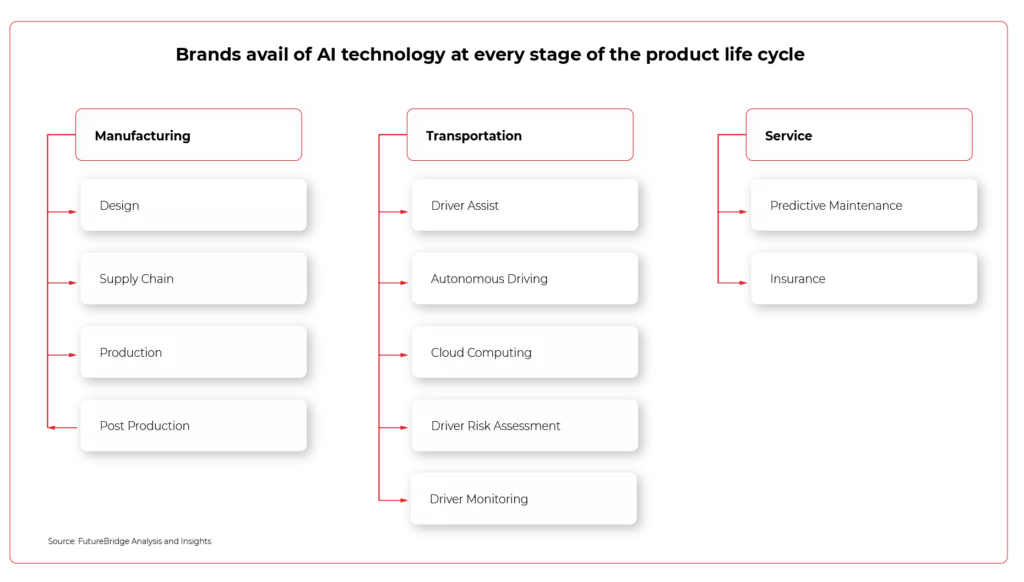
Manufacturing - how AI improves production
1. You will be able to work out complex operations and streamline supply chains
An average passenger car consists of around 30,000 separate parts, which interestingly enough, are usually ordered from various manufacturers in different regions of the world. If, on top of that, we add a complicated manufacturing process, increasingly difficult access to skilled workers and market dependencies, it becomes clear that potential delays or problems in the supply chain result in companies losing millions. Artificial intelligence can predict these complex interactions, automate processes, and prevent possible failures and mishaps
- Artificial intelligence complements Audi's supply chain monitoring. When awarding contracts, it is verified that the partners meet the requirements set out in the company's internal quality code. In 2020, over 13,000 suppliers provided the Volkswagen Group with a self-assessment of their own sustainability performance. Audi only works with companies that successfully pass this audit.
2. More efficient production due to intelligent co-robots working with people
For years, companies from the automotive industry have been trying to find ways to enhance work on the production line and increase efficiency in areas where people would get tired easily or be exposed to danger. Industrial robots have been present in car factories for a long time, but only artificial intelligence has allowed us to introduce a new generation of devices and their work in direct contact with people. AI-controlled co-bots move materials, perform tests, and package products making production much more effective.
- Hyundai Vest Exoskeleton (H-VEX) became a part of Kia Motors’ manufacturing process in 2018. It provides wearable robots for assembly lines. AI in this example helps in the overall production while sensing the work of human employees and adjusting their motions to help them avoid injuries.
- AVGs (Automated Guided Vehicles) can move materials around plants by themselves. They can identify objects in their path and adjust their route. In 2018, an OTTO Motors device carried a load of 750 kilograms in this way!
3. Quality control acquires a completely new quality
The power of artificial intelligence lies not only in analyzing huge amounts of data but also in the ability to learn and draw conclusions. This fact can be used by finding weak points in production, controlling the quality of car bodies, metal or painted surfaces, and also by monitoring machine overload and predicting possible failures. In this way, companies can prevent defective products from leaving the factories and avoid possible production downtime.
- Audi uses computer vision to find small cracks in the sheet metal in the vehicles. Thus, even at the production stage, it reduces the risk of damaged parts leaving the factory.
- Porsche has developed "Sounce", a digital assistant, using deep learning methods. AI is capable of reliably and accurately detecting noise, for example during endurance tests. This solution, in particular, takes the burden off development engineers who so far had to be present during such tests. Acoustic testing based on Artificial Intelligence (AI) increases quality and reduces production costs.
4. AI will configure your dream vehicle
In a competitive and excessively abundant market, selling vehicles is very difficult. Brands are constantly competing in services and technologies that are to provide buyers with new experiences and facilitate the purchasing process. Manufacturers use artificial intelligence services not only at the stage of prototyping and modeling vehicles, but also at the end of the manufacturing process, when the vehicle is eventually sold. A well-designed configurator based on AI algorithms is often the final argument, by which the customer is convinced to buy their dream vehicle. Especially when we are talking about luxury cars.
- The Porsche Car Configurator is nothing more than a recommendation engine powered by artificial intelligence. The luxury car manufacturer created it to allow customers to choose a vehicle from billions of possible options. The configurator works using several million data and over 270 machine learning modules. Effect? The customer chooses the vehicle of their dreams based on customised recommendations.
Transportation - how AI facilitates driving vehicles
5. Artificial intelligence will provide assistance in an emergency
A dangerous situation on the road, vehicle in the blind spot, power steering on a slippery surface. All those situations can be supported by artificial intelligence, which will calculate the appropriate driving parameters or correct the way the driver behaves on the road. Instead of making automatic decisions - which are often emotion-imbued or lack experience - brands increasingly hand them over to machines, thus reducing the number of accidents and protecting people's lives.
- Verizon Connect solutions for fleet management allow you to send speed prompts to your drivers as soon as your vehicle's wipers are turned on. This lets the driver know that they have to slow down due to adverse road conditions such as rain or snow. And the intelligent video recorder will help you understand the context of the accident - for instance, by informing you that the driver accelerated rapidly before the collision.
6. Driver monitoring and risk assessment increase driving safety and comfort
Car journeys may be exhausting. But not for artificial intelligence. The biggest brands are increasingly equipping vehicles with solutions aimed at monitoring fatigue and driver reaction time. By combining intelligent software with appropriate sensors, the manufacturer can fit the car with features that will significantly reduce the number of accidents on the road and discomfort from driving in difficult conditions.
- Tesla monitors the driver's eyes, thus checking the driver's level of fatigue and preventing them from falling asleep behind the wheel. It’s mainly used for the Autopilot system to prevent driver from taking short nap during travel.
- The BMW 3 Series is equipped with a personal assistant, the purpose of which is to improve driving safety and comfort. Are you tired of the journey? Ask for the "the vitalization program" that will brighten the interior, lower the temperature or select the right music. Are you cold? All you have to do is say the phrase "I'm cold" and the seats will be heated to the optimal temperature.
Maintenance - how AI helps you take care of your car
7. Predictive Maintenance prevents malfunctions before they even appear
Cars that we are driving today are already pretty smart. They can alert you whenever something needs your attention and they can pretty precisely say what they actually need – oil, checking the engine, lights etc. The Connected Car era however equipped with the possibilities given by AI brings a whole lot more – predictive maintenance. In this case AI monitors all the sensors within the car and is set to detect any potential problems even before they occur.
AI can easily spot any changes, which may indicate failure, long before it could affect the vehicle’s performance. To go even further with this idea, thanks to the Over-The-Air Update feature, after finding a bug that can be easily fixed by a system patch, such solution can be sent to the car Over-The-Air directly by the manufacturer without the need for the customer to visit the dealership.
- Predi (an AI software company from California) has created an intelligent platform that uses the service order history and data from the Internet of Things to prevent breakdowns and deal with new possible ones faster.
8. Insure your car directly from the cockpit
Driving a car is not only about operating costs and repairs, but also insurance that each of us is required to purchase. In this respect, AI can be useful not only for insurance companies ( see how AI can improve the claims handling process ), but also for drivers themselves. Thanks to the appropriate software, we will remember about expiring insurance or even buy it directly from the comfort of our car, without having to visit the insurer's website or a stationary point.
- The German company ACTINEO, specialising in personal injury insurance, processes and digitises 120,000. claims annually. Their ACTINEO Cockpit service is a digital manager that allows for the comprehensive management of this type of cases, control of billing costs, etc.
- In collaboration with Ford, Arity provides insurers - with the driver's consent, of course - data on the driving style of the vehicle owner. In return for sharing this information, the driver is offered personalised insurance that matches his driving style. The platform’s calculations are based on "more than 440 billion miles of historical driving data from more than 23 million active telematics connections and more than eight years of data directly from cars (source: Green Car Congress).
When will AI take over the automotive industry?
In 2015, it is estimated that only 5-10% of cars had some form of AI installed. The last five years have brought the dissemination of solutions such as parking assistance, driver assistance and cruise control. However, the real boom is likely to occur within the next 8-10 years.
From now on, artificial intelligence in the automotive industry will no longer be a novelty or wealthy buyers’ whims. The spread of the Internet of Things, consumer preferences and finding ways of saving money in the manufacturing process will simply force manufacturers to do this - not only in the vehicle cockpits, but also on the production and service lines.
To this end, they will be made to cooperate with manufacturers of sensors and ultrasonic solutions (cooperation between BMW and Mobileye, Daimler from Bosch or VW and Ford with Aurora) and IT companies providing software for AI. A dependable partner who understands the potential of AI and knows how to use its power to create the car of the future is the key to success for companies in this industry.
Generative AI in automotive: How industry leaders drive transformation
Generative AI is quickly emerging as one of the key drivers of automotive innovation. This shift is not just a future possibility; it's already happening. In 2023, the generative AI market in the automotive sector was valued at approximately USD 387.54 million . Looking ahead, it's projected to surge to about USD 2,691.92 million by 2032 , demonstrating a robust Compound Annual Growth Rate (CAGR) of 24.03% from 2023 to 2032. Major Original Equipment Manufacturers (OEMs) are integrating sophisticated AI algorithms into various aspects of the industry, from vehicle design to enhancing customer interactions.
The impact of generative AI in the automotive sector is already evident. For instance, NVIDIA's generative AI models empower designers to swiftly transform 2D sketches into intricate 3D models, significantly speeding up the design process and opening up new avenues for creativity and efficiency. Meanwhile, automotive manufacturing companies are exploring collaborations with tech giants to integrate advanced AI language models into their vehicles, enhancing the driving experience.

This article will explore how leading automotive players are leveraging generative AI to not only keep pace with the evolving demands of the market but also redefine mobility and automotive excellence.
Software-defined vehicles and generative AI
The introduction of software-defined vehicles (SDVs) represents a significant shift in the automotive industry, moving beyond traditional performance metrics such as horsepower and chassis design to focus on software and digital capabilities. By 2025, it is estimated that vehicles could require as much as 650 million lines of code each. These vehicles heavily rely on software for critical operations such as driving assistance, navigation, and in-car entertainment systems.
The integration of generative AI in this domain further amplifies these capabilities. Generative AI is known for its ability to create and optimize designs and solutions, which is beneficial in improving both the software and hardware aspects of SDVs. It helps in generating efficient algorithms for vehicle control systems, contributes to the development of more effective and adaptive software solutions, and even assists in designing vehicle components for better performance and efficiency.
However, bringing generative AI into this landscape presents both unique opportunities and significant challenges.
The opportunities and challenges
- Challenges
Integrating advanced AI systems into modern vehicles is a complex and multifaceted task that demands technical expertise and careful attention to data security and privacy , particularly with the increasing reliance on data-driven functionalities in vehicles.
The automotive industry is facing a complex regulatory environment. With the growing importance of AI and data in-vehicle systems, it has become crucial to comply with various international regulations and standards , covering areas such as data protection, safety, and environmental impact.
One significant challenge for OEMs is the lack of standardization within the software-defined vehicles industry, which can complicate the development and integration of new technologies as there are no universal norms or protocols to guide these processes.
Internal transformation is also a critical aspect of this integration. OEMs may need to revamp their internal capabilities, processes, and technological infrastructure to use generative AI effectively.
- Opportunities
Integrating generative AI technology allows for more creative and efficient vehicle design , resulting in quicker prototypes and more innovative models .
It also allows for creating personalized vehicles that cater to individual user preferences like never before. In manufacturing, generative AI promotes more efficient and streamlined production processes , which optimizes resources and reduces waste.
Let's explore how automotive manufacturers already use gen AI to boost their operations.
Generative AI applications in the automotive industry
Generative AI's integration into the automotive industry revolutionizes multiple facets of vehicle design, manufacturing, and user experience. Let's explore these areas:
Design and conceptualization
- Vehicle Design Enhancement : Artificial Intelligence is revolutionizing the vehicle design process by speeding up the initial phase of the design cycle. Generative design algorithms use parameters such as material properties, cost constraints, and performance requirements to generate optimal design solutions. For example, in vehicle body design, AI can propose multiple design options that optimize for aerodynamics and strength while minimizing weight. This enables quick visualization and modification of ideas.
Toyota Research Institute has introduced a generative AI technique to optimize the vehicle design process to produce more efficient and innovative vehicles. This approach allows designers to explore a wider range of design possibilities, including aerodynamic shapes and new material compositions.
- Digital Prototyping : The use of Generative AI technology makes it possible to create digital prototypes, which can be tested and refined extensively without the need for physical models. This approach is highly beneficial, as it enables designers to detect and correct potential design flaws early in the process.
BMW's use of NVIDIA Omniverse is a significant step in design improvement. The company uses this platform to create digital twins of their manufacturing facilities, integrating generative AI to enhance production efficiency and design processes.
Manufacturing and production
- Streamlining Manufacturing Processes : Generative AI significantly enhances the efficiency of manufacturing processes. Unlike traditional AI or machine learning models, generative AI goes beyond identifying inefficiencies; it actively generates novel manufacturing strategies and solutions. By inputting parameters such as production timelines, material constraints, and cost factors, generative AI algorithms can propose a range of optimized manufacturing workflows and processes.
BMW has implemented generative AI in a unique way to improve the scheduling of their manufacturing plant. In partnership with Zapata AI, BMW utilized a quantum-inspired generative model to optimize their plant scheduling, resulting in more efficient production. This process, known as Generator-Enhanced Optimization (GEO), has significantly improved BMW's production planning, demonstrating the potential of generative AI in industrial applications.
- Supply Chain Resilience : In the context of supply chain management, particularly during challenges like the automotive microchip shortage, generative AI plays a crucial role. Unlike conventional AI, gen AI can do more than just analyze existing supply chain networks; it can creatively generate alternative supply chain models and strategies. The algorithms can propose diverse and robust supplier networks by leveraging data about supplier capabilities, logistics constraints, and market demands.
- Customized Production : With generative AI, it is now possible to create personalized vehicles on a large scale, meeting the growing demand for customization in the automotive industry.
Predictive maintenance and modelling
Traditionally, predictive maintenance relies on historical data to forecast equipment failures, but generative AI enhances this process by creating detailed, simulated data environments. This technology generates realistic yet hypothetical scenarios, encompassing a vast array of potential machine failures or system inefficiencies that might not be present in existing data sets.
The generative aspect of this AI technology is particularly valuable in situations where real-world failure data is limited or non-existent. By synthesizing new data points, generative AI models can extrapolate from known conditions to predict how machinery will behave under various untested scenarios.
In modeling, generative AI goes a step further. It not only predicts when and how equipment might fail but also suggests optimal maintenance schedules, anticipates the impact of different environmental conditions, and proposes design improvements.
Customer experience and marketing
One of the challenges in using generative AI, particularly in customer interaction, is the accuracy of AI-generated responses. An example of this was an error by ChatGPT, where it was tricked into suggestion of buying a Chevy for a dollar . This incident underlines the potential risks of misinformation in AI-driven communication, emphasizing the need for regular updates, accuracy checks, and human oversight in AI systems. Nevertheless, this technology offers many opportunities for improving the customer experience:
- Personalized User Experiences and Enhanced Interaction : AI's capability to adapt to individual preferences not only enhances the driving experience but also improves the functionality of vehicle features.
For instance, in collaboration with Microsoft, General Motors is exploring the use of AI-powered virtual assistants that offer drivers a more interactive and informative experience. These assistants can potentially provide detailed insights into vehicle features and performance metrics and offer personalized recommendations based on driving patterns.
Also, Mercedes-Benz is exploring the integration of generative AI through voice-activated functionalities in collaboration with Microsoft. This includes leveraging the OpenAI Service plugin ecosystem, which could allow for a range of in-car services like restaurant reservations and movie ticket bookings through natural speech commands.
Example applications
- Simplified Manuals : AI technology, enabled by natural language processing, has simplified the interaction between drivers and their vehicles. Beyond just responding to voice commands with pre-existing information, a generative AI system can even create personalized guides or tutorials based on the driver's specific queries and past interactions.
Grape Up has developed an innovative voice-driven car manual that allows drivers to interact with their vehicle manual through voice commands, making it more accessible and user-friendly. With this technology, drivers no longer have to navigate through a traditional manual. Still, they can easily ask questions and receive instant verbal responses, streamlining the process of finding information about their vehicle.
- Roadside Assistance: In this scenario, generative AI can go beyond analyzing situations and suggesting solutions by creating new, context-specific guidance for unique problems. For instance, if a driver is stranded in a rare or complex situation, the AI could generate a step-by-step solution, drawing from a vast database of mechanical knowledge, previous incidents, and environmental factors.
- Map Generation : Here, generative AI can be used to not only update maps with real-time data but also to predict and visualize future road conditions or propose optimal routes that don't yet exist. For example, it could generate a route that balances time, fuel efficiency, and scenic value based on the driver's preferences and driving history.
- Marketing and Sales Innovation : Generative AI-enabled content engine is transforming the creation of digital advertising for the automotive industry. This content is tailored to meet the unique requirements of automotive brands and their consumers, thereby revolutionizing traditional marketing strategies.
Safety and compliance
- Enhancing Vehicle Safety : Generative AI in vehicles goes beyond traditional AI systems by not only assisting drivers but also by creating predictive models that enhance safety features. It processes and interprets data from cameras and sensors to foresee potential road hazards, often employing advanced generative models that simulate and predict various driving scenarios.
- Regulatory Compliance : Similarly, gen AI helps automakers comply with safety standards and navigate complex regulation changes by monitoring performance data and comparing it against regulatory benchmarks. This allows automakers to stay ahead of the compliance curve and avoid potential legal and financial repercussions.
Autonomous vehicle development
- Simulation and Testing : Generative AI is crucial for developing autonomous vehicle systems. It generates realistic simulations, including edge-case scenarios, to test and improve vehicle safety and performance.
- Enhancing ADAS Capabilities : AI technology can improve essential Advanced Driver Assistance Systems (ADAS) features such as adaptive cruise control, lane departure warnings, and automatic emergency braking by analyzing data from various sensors and cameras. Generative AI's strength in this context lies in its ability to not only process existing data but also to generate new data models, which can predict and simulate different driving scenarios. This leads to more advanced, reliable, and safer ADAS functionalities, significantly contributing to the evolution of autonomous and semi-autonomous driving technologies.
Conclusion
As the automotive industry accelerates towards a more AI-integrated future, the role of expert partners like Grape Up becomes increasingly crucial. Our expertise in navigating the intricacies of AI implementation can help automotive companies unlock the full potential of this technology. If you want to stay ahead in this dynamic landscape, now is the time to embrace the power of generative AI. For more information or to collaborate with Grape Up, contact our experts today.
Interested in our services?
Reach out for tailored solutions and expert guidance.