
Driving success in delivering innovation for automotive: Exploring various partnership models


The automotive sector has rapidly evolved, recognizing that cutting-edge software is now the primary factor differentiating car brands and models. Automotive leaders are reshaping the industry by creating innovative software-defined vehicles that seamlessly integrate advanced features, providing drivers with a genuinely captivating experience.
While some automotive manufacturers have begun building in-house expertise, others are turning to third-party software development companies for assistance. However, such partnerships can take on different forms depending on factors like the vendor’s size and specialization, which can sometimes lead to challenges in cooperation.
Still, success is possible if both parties adopt the right approach despite any problems that may arise. To ensure optimal collaboration, we recommend implementing the Value-Aligned Partnership concept.
By adopting this approach, vendors accept full accountability for delivery, match their contributions to the client's business goals, and use their experience to guarantee success. We use this strategy at Grape Up to ensure our clients receive the best possible results.
This article explores the advantages and challenges of working with service vendors of various sizes and specializations. It also highlights the Value-Aligned Partnership model as a way to overcome these challenges and maximize the benefits of client-vendor cooperation.
Large vendors and system integrators
Working with multi-client software vendors can pose unique challenges for automotive companies, as these companies typically operate on a body leasing model , providing temporary skilled personnel for development services.
Furthermore, these companies may lack specialized expertise , which is particularly true for large organizations with high turnover rates in their development teams. Despite having impressive case studies, the team assigned to a specific project doesn't always possess the necessary experience due to frequent personnel changes within the company.
Moreover, big vendors usually have numerous clients and projects to manage simultaneously. This may lead to limited personalized attention and cause potential delays in delivery. Outsourcing services to countries with different time zones, quality assurance procedures, and cultural norms can further complicate the situation.
However, despite these challenges, such partnerships have significant advantages, which should be considered in the decision-making process.
Advantages of partnering with large vendors and system integrators
- Access to diverse expertise : A wide array of specialists is available for various project aspects.
- Scalability advantage : Project resource requirements are met without bottlenecks.
- Accelerated time-to-market : Development speed is increased with skilled, available teams.
- Cost-efficiency : It's a cost-effective alternative via vendor teams, reducing overhead.
- Risk management : Turnover risks are handled by vendors to ensure continuity.
- Cross-industry insights application : Diverse sector practices are applied to automotive projects.
- Agile adaptation : They are efficiently adjusting to changing project needs.
- Enhanced global collaboration: Creativity is boosted by leveraging time zones and diverse perspectives from vendors.
Working with smaller vendors
Your other option is to work with smaller software companies, but you should be aware of the potential challenges of such collaboration, as well. For example, while they are exceptionally well-versed in a particular field or technology, they might lack the breadth of knowledge necessary to meet the needs of the industry. Additionally, limited resources or difficulties in scaling could hinder their ability to keep pace with the growing demands of the sector.
Furthermore, although these vendors excel in specific technical areas , they may struggle to provide comprehensive end-to-end solutions, leaving gaps in the development process.
Adding to these challenges, smaller companies often have a more restricted perspective due to their limited engagement in partnerships , infrequent conference attendance, and a narrower appeal that doesn't span a global audience. This can result in a lack of exposure to diverse ideas and practices, hindering their ability to innovate and adapt.
Benefits of working with smaller vendors
- Tailored excellence: Small vendors often craft industry-specific, innovative solutions without unnecessary features.
- Personal priority: They prioritize each client, ensuring dedicated attention and satisfaction.
- Flexible negotiation: Smaller companies offer negotiable terms and pricing, unlike larger counterparts.
- Bespoke solutions: They customize offerings based on your unique needs, unlike a generic approach.
- Agile responsiveness: Quick release cycles, technical agility, and transparent interactions are their strengths.
- Meaningful connections: They deeply care about your success, fostering personal relationships.
- Accountable quality: They take responsibility for their products, as development and support are integrated.
Niche specialization companies
Collaborating with a company specializing in the automotive sector offers distinct advantages, addressing challenges some large and small vendors face. Their in-depth knowledge of the automotive industry ensures tailored solutions that meet specific requirements efficiently.
As opposed to vendors who work in several industries, they are quick to adjust to shifts in the market, allowing software development projects to be successful and meet the ever-changing needs of the automobile sector.
It is important, however, to consider the potential drawbacks when entering partnerships that rely heavily on a narrow area of expertise. Niche solutions may not be versatile , and specialization can lead to higher costs and resistance to innovation . Additionally, overreliance on a single source could lead to dependency concerns and a limited perspective on the market. It is important to weigh these risks against the benefits and ensure that partnerships are balanced to avoid stagnation and limited options.
When working with software vendors, no matter their size or specialization level, it is essential to adopt the right approach to cooperation to mitigate risks and challenges.
Value-aligned partnership model explained
This cooperation model prioritizes shared values, expertise, and cultural compatibility. It's important to note, in this context, that a company's size doesn't limit its abilities to become a successful partner. Both large and small vendors can be just as driven and invested in professional development.
What matters most is a company's mindset and commitment to continuous improvement. Small and large businesses can excel by prioritizing a robust organizational culture, regular training sessions, knowledge sharing among employees, and partnerships that leverage the strengths of both parties.
Thus, the Value-Aligned Partnership is a model that brings together the benefits of working with different types of companies. It combines the diverse expertise of large vendors with the agility and tailored solutions of small companies while incorporating vast industry-specific knowledge.
In a value-aligned partnership model, the vendor goes beyond simply providing software development services. They actively engage in the journey towards success by fully immersing themselves in the client's vision . By thoroughly comprehending the customer's values and goals, a partner ensures that every contribution they make aligns seamlessly with the overall direction of the business and can even foster innovation within the client's company.
Building a strong partnership based on shared values takes time and effort, but it's worth it for the exceptional outcomes that result. Open communication, collaboration, and mutual understanding are key factors in creating a foundation for long-term cooperation and shared success between the two parties.
In the fast-paced and ever-changing automotive industry, having expertise specific to the domain is crucial. A value-aligned partner recognizes the importance of retaining in-house knowledge and skills related to the sector. As a company that prioritizes this approach, Grape Up invests in measures to minimize turnover , provide ongoing training and education, and ensure that our team possesses deep domain expertise . This commitment to automotive know-how strengthens the partnership's reliability and establishes us as a trusted, long-term ally for the automotive company.
Conclusion
The automotive industry is transforming remarkably with the rise of software-defined vehicles. OEMs realize they can't tackle this revolution alone and seek the perfect collaborators to join them on this exciting journey. These partners bring a wealth of expertise in software development, cloud technologies, artificial intelligence, and more. With their finger on the pulse of the automotive industry, they understand the ever-changing trends and challenges. They take the time to comprehend the OEM's vision, objectives, and market positioning, enabling them to provide tailored solutions that address specific needs.

Data powertrain in automotive: Complete end-to-end solution
We power your entire data journey, from signals to solutions
Check related articles
Read our blog and stay informed about the industry's latest trends and solutions.
How to enable data-driven innovation for the mobility insurance
Digitalization has changed the way we shop, work, learn and take care of our health or travel. Cars are no longer used just to get from A to B. They are jam-packed with technology that connects us to the world, enhances safety, prevents breakdowns, and even provides entertainment. With the rise of the Internet of Things and artificial intelligence, a vehicle is no longer understood solely in terms of its performance and sleek design. It has become software on wheels, a gateway to new worlds - not just physical, but also virtual. And if the nature of insurance itself is changing, then the company offering insurance must keep up with these changes as well. Insurance needs digital innovation, as much as any other market area.
These days customers are looking for customization, personalization, and understanding their needs on an almost organic level. Data and advanced analytics allow us to effectively satisfy these needs. Thanks to them, it is possible to fine-tune the offer, not so much for a specific group, but for a particular person - their habits, daily schedule, interests, health restrictions, or aesthetic preferences. And in the case described by us - a person's driving style and commuting patterns .
If you think about it, the insurer has the perfect tool in their hands. If they can tap into the potential of the software-defined vehicle and equip it with the right applications, there will be nearly zero chance of inaccurate insurance risk estimates. Data doesn't lie and shows a factual, not imaginary picture of a driver's driving style and behavior on the road.
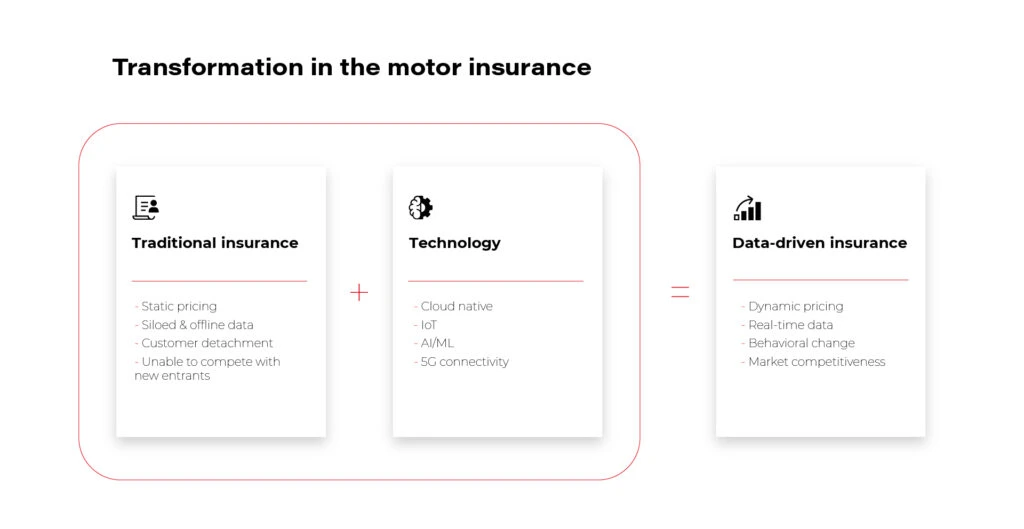
While in the traditional insurance model pricing is static and data is collected offline and not aligned with the driver's actual preferences, new technologies such as the cloud, the IoT, and AI allow for these limitations to be effectively lifted.
With them, an offering is created that competes in the marketplace, generates new revenue streams within the company, and builds customer loyalty.
Data-driven innovation - easier said than done. Or maybe not?
The transformation of a vehicle from a traditionally understood mechanical device into a "smartphone on four wheels," as Akio Toyoda once said about modern vehicles, takes time and will not happen overnight. But year by year it already happens, and as the new car models distributed by the big corporations show, this process is actually underway.
Read our article on the latest trends in the automotive industry
The so-called software-defined vehicle that we are developing with our clients at Grape Up is a vehicle that moves through an ecosystem of numerous variables, accessed by different players and technologies.
Clearly, one such provider can be - and should be - the insurer whose products have been tied to the automotive market invariably since 1897, when a certain Gilbert J. Loomis, a resident of Dayton, Ohio, first purchased an automotive liability insurance policy.
However, for insurance companies to play an integral role in the use of vehicle-generated data, the driver must receive a precisely functioning and secure service from which they will derive real benefits. Without building specific technical competencies and software-defined vehicle knowledge , the insurer cannot achieve these goals.
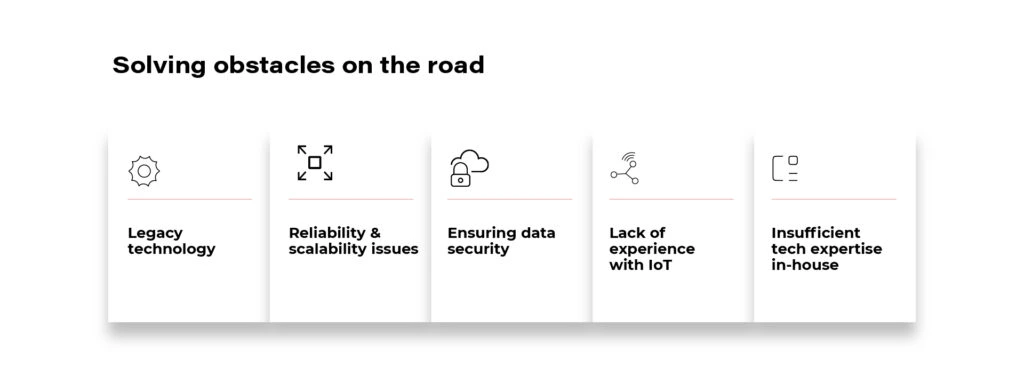
Only by creating this type of business unit from scratch in-house, or by partnering with software companies, will they be able to compete with insurtech startups like, e.g. Lemonade, which builds their businesses from the ground up based on AI and data analytics .
The right technology partner will take care of:
- data security;
- selection of cloud and IoT technologies;
- and will ensure the reliability and scalability of the proposed solutions.
During this time, the insurer can focus on what they do best - developing insurance competencies and tweaking their offers.
How to choose the right technology partner?
Just as customers are looking for insurance that accommodates their driving and lifestyle, an insurance company should select a technology partner that has more than just technical skills to offer. After all, changing the model in which a traditional insurance company operates does not boil down to creating a digital sales channel on the Internet and launching a modern website. We are talking about a completely different scale of operations requiring the insurance company to be embedded in a completely new, rapidly developing environment.
Therefore they need a partner who naturally navigates the software-defined vehicle ecosystem, understands its specifics, and has experience in working with the automotive industry. Besides, it should be someone knowledgeable about the specifics of the P&C insurance market and the challenges faced by the insurance client.

It is only at the intersection of these three areas: technology, automotive, and insurance, that competencies are built to effectively compete against modern insurtechs.
Like in the Japanese philosophy of ikigai, which explains how to find one's sense of purpose and give meaning to one's work, both companies can build valuable, useful solutions for users. They will bring satisfaction not only to customers but also to the insurance company, which will open a new revenue channel and meet the needs of the market.
How to choose a technological partner to develop data-driven innovation
Insurance companies, especially those focused on life and car insurance, in their offers are placing more and more emphasis on big data analytics and driving behavior-based propositions. We should expect that this trend will only gain ground in the future. And this raises further questions. For instance, what should be taken into account when choosing a technological partner for insurance-technology-vehicle cooperation?
Challenges in selecting a technology partner
The potential of telematics insurance programs encourages auto insurers to move from traditional car insurance and build a competitive advantage on collected data.
No wonder technology partners are sought to support and develop increasingly innovative projects. Such synergistic collaboration brings tangible benefits to both parties.
As we explained in the article How to enable data-driven innovation for the mobility insurance , the right technology partner will ensure:
- data security;
- cloud and IoT technology selection;
- the reliability and scalability of the proposed solutions.
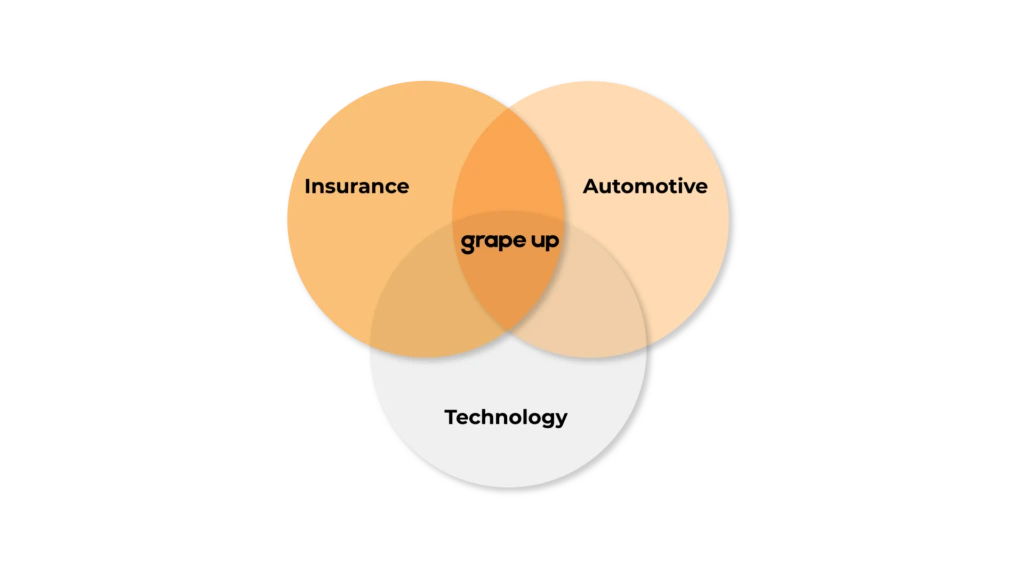
Finding such a partner, on the other hand, is not easy, because it must be a company that efficiently navigates in as many as three areas: AI/cloud technology, automotive, and insurance . You need a team of specialists who operate naturally in the software-defined vehicle ecosystem , and who are familiar with the characteristics of the P&C insurance market and the challenges faced by insurance clients.
Aim for the cloud. The relevance of AI and data collection and analytics technologies
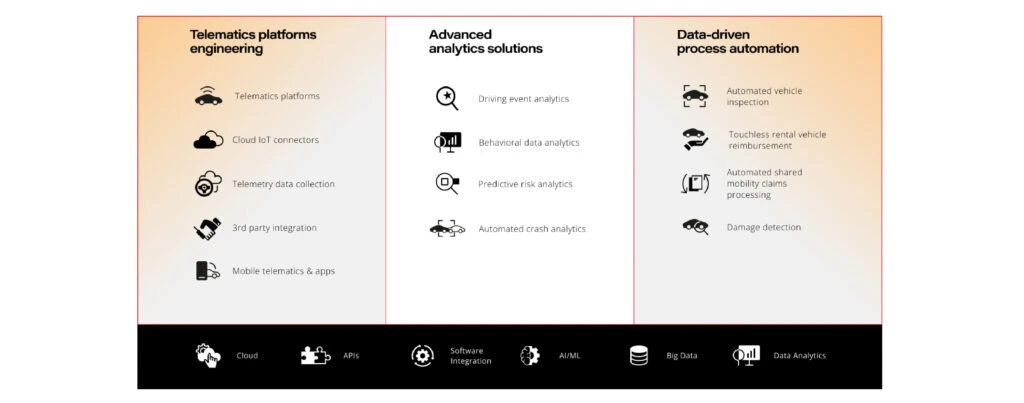
Information is the most important asset of the 21st century. The global data collection market in 2021 was valued at $1.66 billion. No service based on the Internet of Things and AI could operate without a space to collect and analyze data. Therefore, the ideal insurance industry partner must deliver proprietary and field-tested cloud solutions . And preferably those that are dependable. Cloud services offered these days by insurance partners include:
- cloud R&D,
- cloud and edge computing,
- system integration,
- software engineering,
- cloud platforms development.
Connectivity between the edge device and the cloud must be stable and fast. Mobility devices often operate in limited connectivity conditions, therefore car insurance businesses should leverage multiple methods to ensure an uninterrupted connection. Dynamic switching of cellular, satellite, and Wi-Fi communications combined with globally distributed cloud infrastructure results in reliable transmission and low latency.
A secure cloud platform is capable of handling an increasing number of connected devices and providing them all with the required APIs while maintaining high observability.
As a result, the data collected is precise, valid, and reliable . They provide full insight into what is happening on the road, allowing you to better develop insurance quotes. No smart data-driven automation is possible without it.
Data quality, on the other hand, also depends on the technologies implemented inside the vehicle ( which we will discuss further below) and on all intermediate devices, such as the smartphone. The capabilities of a potential technology partner must therefore reach far beyond basic IT skills and most common technologies.
Telemetry data collection
Obviously, data acquisition and collection is not enough, because information about what is happening on the road, usage and operation of components in itself is just a "record on paper". But to make such a project a reality, you still need to implement advanced analytical tools and telematics solutions.
Real-time data streaming from telematics devices, mobile apps, and connected car systems gives access to driving data, driver behavior analysis, and car status. It enables companies to provide insurance policies based on customer driving habits .
Distributed AI
AI models are an integral part of modern vehicles. They predict front and rear collision, control damping of the suspension based on the road ahead, recognize road signs, or lanes. Modern infotainment applications suggest routes and settings depending on driver behavior and driving conditions.
Empowering the automotive industry to build software-defined vehicles. Automotive aspect
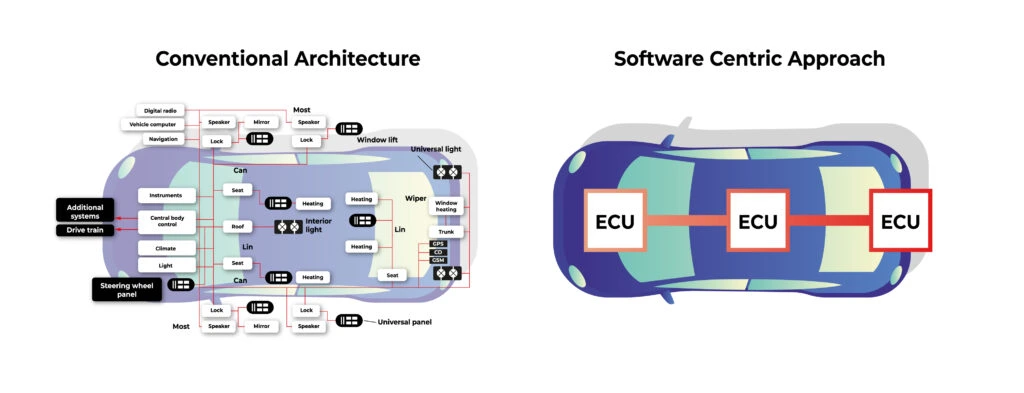
Today it is necessary to take into consideration a strategy towards modern, software-defined vehicles. According to Daimler AG, this can be expressed by the letters “CASE”:
- C onnected.
- A utonomous
- S hared.
- E lectric.
This idea means the major focus is going to be put on making the cars seamlessly connected to the cloud, support or advancements in autonomous driving based on electric power.
Digitalization and evolution of the computer hardware caused a natural evolution of the vehicle. New SoC’s (System on a Chip, integrated board containing CPU, memory, and peripherals) are multipurpose and powerful enough to handle not just a single task but multiple, simultaneously. It would not be an exaggeration to say that the cars of the future are smart spaces that combine external solutions (e.g. cloud computing, 5G) with components that work internally (IoT sensors). Technology solution providers must therefore work in two directions, understanding the specifics of both these ecosystems. Today, they cannot be separated.
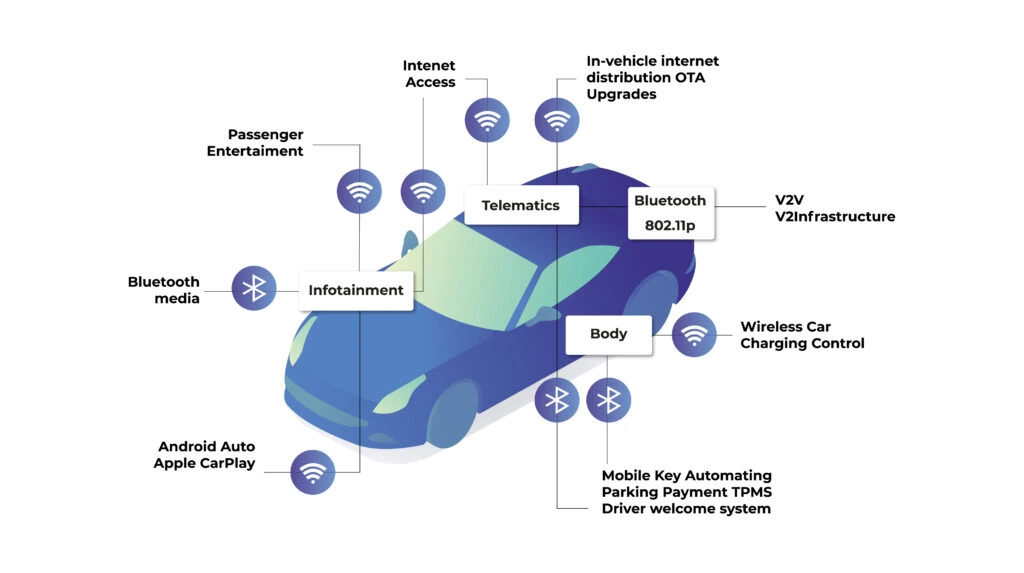
The partner must be able to operate at the intersection of cloud technologies, AI and telemetry data collection. Ideally, they should know how these technologies can be practically used in the car. Such a service provider should also be aware of the so-called bottlenecks and potential discrepancies between the actual state and the results of the analysis. This knowledge comes from experience and implementation of complex software-defined vehicle projects.
Enabling data-driven innovation for mobility insurance. Insurance context
There are companies on the market that are banking on the innovative combination of automotive and automation. Although you have to separate the demand of OEMs and drivers from the demand of the insurance industry.
It's vital that the technology partner chosen by an insurance company is aware of this. This, naturally, involves experience supported by a portfolio for similar clients and specific industry know-how. The right partner will understand the insurer's expectations and correctly define their needs, combining them with the capabilities of a software-defined vehicle .
From an insurer's standpoint, the key solutions will be the following:
- Roadside assistance . For accurately determining the location of an emergency (this is important when establishing the details of an incident with conflicting stakeholders’ versions).
- Crash detection. To take proactive measures geared toward mitigating the consequences.
- UBI and BBI. The data gathered from mobile devices, plug-in dongles, or the vehicle embedded onboard systems can be processed and used to build risk profiles and tailored policies based on customers’ driving styles and patterns.
Technology and safety combined
The future of technology-based insurance policies is just around the corner. Simplified roadside assistance, drive safety support, stolen vehicle identification, personalized driving feedback, or crash detection- all of these enhance service delivery, benefit customers, and increase profitability in the insurance industry.
Once again, it is worth highlighting that the real challenge, as well as opportunity, is to choose a partner that can handle different, yet consistent, areas of expertise.
If you also want to develop data-driven innovation in your insurance company, contact GrapeUp. Browse our portfolio of automo tive & insurance projects .
Interested in our services?
Reach out for tailored solutions and expert guidance.