
V2X: What needs to be done to accelerate the implementation


Technology that allows vehicles to communicate wirelessly with other vehicles and road infrastructure is the go-to solution of the future. Regrettably, for the time being, the business justification for V2X roll-out by most OEMs remains beyond reach. What are the prospects for the coming years and what can be done to bring the vision of mass V2X implementation closer?
The role of V2X in supporting ADAS and AV
To begin with the basics, let's explore the dynamics of change today when it comes to automation in the automotive industry .
The relationship between ADAS (i.e., the systems that currently prevail) and V2X (new type systems) is best captured in the chart below. It shows that the higher the SAE automation levels are, the more the role of V2X technology is emphasized.
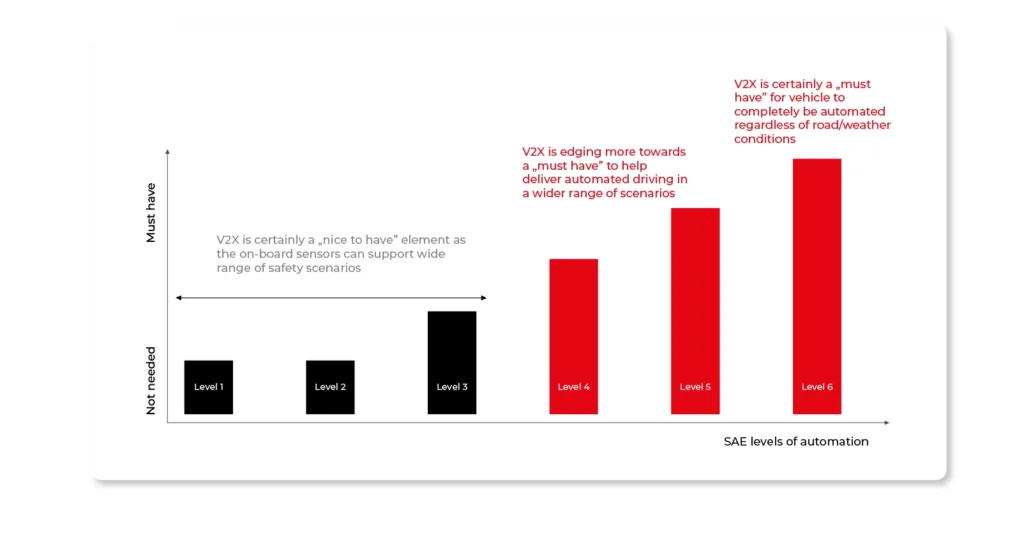
Levels 0 to 2 represent the dominance of old-style, sensor-based security systems. Higher levels of automation are already more oriented toward extensive collaboration:
- Between vehicles,
- Between vehicles and infrastructure.
Advanced Driver Assistance Systems (ADAS) for the past 20 years have relied mainly on elements such as onboard sensors (cameras, radars, ultrasound). Low-level automation worked for a while, but it has its shortcomings. Primarily it is about its maximum range, which is only up to 200 meters. The other thing is its low performance in contact with obstacles, such as blind bends and densely parked vehicles.
Meanwhile, sensing technologies have developed so widely that today it is possible to fully collaborate in such configurations as:
- V2V – Vehicle-to-Vehicle.
- V2D – Vehicle-to-device.
- V2P – Vehicle-to-pedestrian.
- V2H – Vehicle-to-home.
- V2G – Vehicle-to-grid.
- V2I – Vehicle-to-Infrastructure.
The most optimistic scenario assumes, among other things, that most vehicles will be able to connect with each other on highways. And this will markedly increase road safety.
Does this mean that as automotive development continues, V2X will replace existing ADAS solutions? Not necessarily. Yet, it is possible that V2X will greatly expand the applications of current and future driver assistance systems. Thus, it will facilitate reaching greater levels of vehicle autonomy.
V2X: benefits and unique selling points
V2X technology, which enables vehicle-to-vehicle and vehicle-to-infrastructure information exchange, is considered a resource worth having and developing in any automotive company. This is chiefly due to the numerous benefits that can be achieved in terms of traffic efficiency and safety. Here are just some of them.
- Addressing the LoS (Lack of Sight) problem which involves the non-visibility of another object. V2X can even detect elements that are invisible or undetectable by traditional sensors. This includes "blind spots" in the side mirror or objects behind a sharp bend.
- Early warning. Drivers of connected vehicles learn in a timely manner about dangers on multi-lane roads, especially high-speed roads. This allows them to react to the problem at an early stage. It is advisable to know that a vehicle's ABS system is activated within 1 mile of another vehicle equipped with V2X.
- Reducing congestion and streamlining traffic. With the technology described here, such modern fleet management methods as platooning can be successfully applied (see the following paragraphs for more details on this thread).
- Driving assistance even in adverse weather conditions. Fog interferes with " standard" sensors, such as cameras. Meanwhile, the V2X also performs well during limited visibility.
- Efficient alerting. Approaching emergency vehicles can signal their presence from a great distance. Drivers are therefore able to quickly form an emergency lane on the highway.
- Attaining higher levels of vehicle autonomy. Partially autonomous vehicles perform well in a wide range of scenarios on the road (including merging scenarios).
Are there any limitations when implementing V2X?
One of the obstacles facing OEMs at this point is insufficient demand. Although the technology is up and running and there are already many use cases around the world, consumers are reluctant to pay extra for it. This is happening for a good reason.
For example, most customers don't understand why they should pay extra for safety-related functionalities. These are already regulated by law anyway, and besides, they are guaranteed as part of ADAS (and these systems are already included in the basic vehicle price). Let's also bear in mind that a high level of data penetration in a car is not always possible. Most cars are still not high-tech enough. Many features would therefore simply be unavailable. So - why should we incur the cost of it anyway?
Beyond that, there is a long delay between the availability of the technology and the existence of a sufficient number of cars equipped with it. Meanwhile, to talk about V2X on a large scale, these two factors must exist in parallel.
Also, the road infrastructure is not necessarily designed to handle V2X. City authorities still have to focus on "putting out the current fires," so technological development sometimes takes a back seat. Besides, not all of the city's road investment is being carried out at the same time due to limited funds.
Of course, in the long run, safer roads and less congestion are the goal worth achieving, but things can't be done all at once. Examples from specific regions of the world, described in the following paragraphs, in fact, illustrate this point well.
DSRC vs. C-V2X
In the framework of V2X, there are two competing technology solutions:
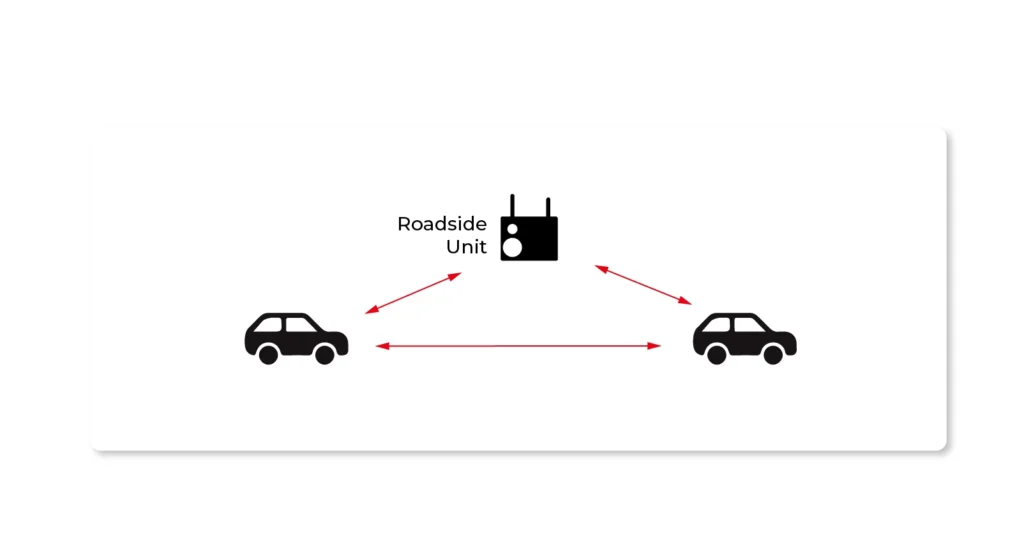
DSRC - Dedicated Short-Range Communication
A form of wireless communication technology defined by the 802.11p standard. It is essentially an amendment to the IEEE 802.11 (WLAN) standard that defines changes and enhancements in order to effectively support Intelligent Transport Systems (ITS).
C-V2X - Cellular – V2X
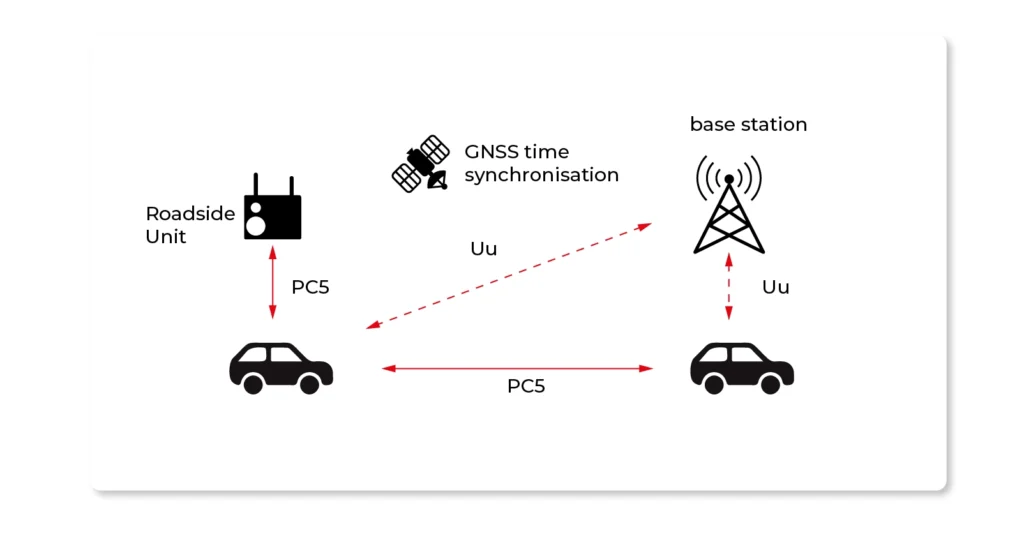
A form of a wireless communication solution using mobile network technology. C-V2X has two modes of operation: PC5 (Direct communication) and Uu (Indirect method of communication using a cellular network).
Implementation of systems in specified regions of the world
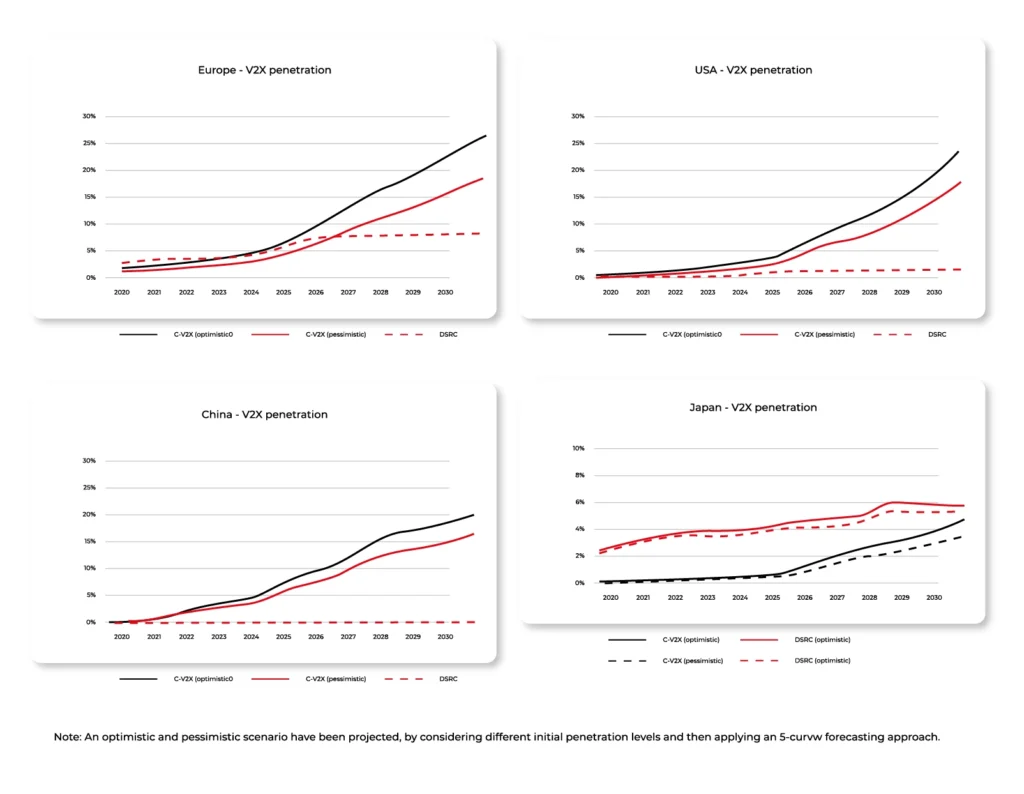
After decades of development of the aforementioned technology, it is slowly becoming apparent that DSRC is giving way to the popularity of C-V2X. Although the former system still dominates in Europe and the US, this will certainly not last forever. According to experts, before long US and European OEMs will prefer C-V2X in their vehicles exclusively. For the time being, however, both solutions are operating equally in these markets.
This is quite different from China, where the use of Cellular V2X has been embraced without question. For what it's worth, the issue is a bit more complicated in another Asian region, namely Japan, where DSRC-based ETC (electronic toll collection) has been under development for many years. In the Land of the Cherry Blossom, there is uncertainty about which way to eventually head. Cautious predictions, however, point to a slow transition to C-V2X.
Fundamentals for developing V2X
One thing to realize with V2X is that the benefits are spread across all traffic users. For this to happen, however, some key driving forces are needed for the introduction and market adoption of this technology. These are:
- Platooning.
- Fuel efficiency.
- Smart cities.
- Driver and pedestrian safety.
- Platooning
Trucks moving in a single formation is an environmentally friendly and commercially viable solution. But what does it have in common with V2X? Quite a lot, because for platooning to take place, advanced communications technology is a must.
V2X allows trucks in a platoon to coordinate braking and acceleration among each other. It also makes it possible to perform many complex maneuvers .
Main beneficiaries
Carriers, fleet operators and the entire logistics industry, in general, would benefit enormously from V2X technology. This would not only optimize the transportation costs themselves but also fit in with increasingly stringent emissions standards.
- Fuel efficiency
Governments around the world strive to reduce their environmental impact by cutting emissions. In Europe, for instance, the EC Strategy on Sustainable and Smart Mobility is being prepared, outlining plans to reduce them by up to 90 (!) percent by 2050. To achieve this goal, policymakers are looking for technologies that help comply with the aforementioned limits. V2X shows huge potential in this regard.
Example? Solutions such as GLOSA (green light speed optimization) minimize the need for a car to come to a complete stop just before traffic lights and then restart the engine or accelerate. Consequently, fuel consumption and harmful gas emissions are reduced.
Main beneficiaries
Environmental policymakers and regulators are (and will be) under mounting pressure related to emissions. V2X can play a key role in this puzzle, and it is up to policymakers to adopt and implement this technology.
The advantages of the aforementioned technology, however, can also be enjoyed by OEMs. Since V2X reduces fuel consumption, the driver spends less on a monthly basis. Such information can be quoted in marketing communications.
- Smart cities
The idea of a smart city is based on interconnected technologies and systems for collecting and using data. So it is quite natural that for functioning, smart cities need V2K solutions.
They enable communication between vehicles and buildings, signals, pedestrians, and other road users. All information is transmitted in real-time, so you gain greater awareness of your surroundings and current needs. More broadly, such intelligent transportation and road infrastructure management systems help reduce congestion. Noise levels, pollution in densely populated areas, and the likelihood of collisions are also curbed.
Automated urban logistics is the future of urbanization - without any doubt.
Main beneficiaries
Connected through VCX, a smart urban area can offer many benefits not only for overall security, but also for local commerce and the quality of life for its residents.
City authorities can plan individual processes more efficiently, resulting in real savings. In a potential scenario, city-funded traffic operators are immediately notified of incidents via V2X and smart cameras. By doing so, they warn other road users of the danger or make an instant decision to set up a detour. If necessary, they prioritize emergency vehicles.
Urban businesses are also enjoying the perks of a V2X-equipped smart city. That's because they benefit from shorter times for transporting goods from the place of manufacture to the point of trade. This is due to less congestion on the roads, intelligent route planning, and fully automated city logistics.
- Driver and pedestrian safety
Traffic collisions, injuries, and deaths not only incur unit costs but also seriously drain the public budget.
The solution to these problems may lie exactly in V2X technology, which makes it possible to identify more hazards on the road than ever before. Drivers can react more quickly to dangerous maneuvers by other road users and make early decisions that could potentially affect someone's health or life.
Main beneficiaries
Consumer purchasing power and public opinion certainly have a bearing on the success of V2X deployment. If road users understand that such solutions actually contribute to safety, they will be eager to push them.
Local politicians will also benefit from the achievements of new connected vehicle technologies. They, in fact, often base their election campaigns on claims related to reducing road accidents in their regions. And V2X is helping to fulfill those promises.
Who will implement first - cities or OEMs?
An important question to be answered is who will ultimately be responsible for the introduction and development of V2X. And who will begin to do it on a large scale. The answer is not straightforward.
From the very outset, cities are faced with the difficult task of making significant infrastructure investments. For this, funds have to be obtained at some point, especially since once implemented solutions still have to be sustained. Certainly, though, the benefits associated with V2X are well worth the funds expended on this technology.
On the other hand, we have OEMs that need a trigger to push their products forward. This must be fostered by the right market environment (a sufficient number of vehicles with V2X capabilities) and the commitment of the authorities responsible for maintaining public infrastructure. At this point, there are also constraints related to consumer reluctance, e.g. in the face of excessively high vehicle data penetration rates.
So, it all boils down to goodwill, openness to change, and the fact that certain technologies need to mature on the market.

Data powertrain in automotive: Complete end-to-end solution
We power your entire data journey, from signals to solutions
Check related articles
Read our blog and stay informed about the industry's latest trends and solutions.
Developing software for connected cars - common challenges and how to tackle them
Automotive is transforming into a hyper-connected, software-driven industry that goes far beyond the driving experience. How to build applications in such an innovative environment? What are the main challenges of providing software for connected cars and how to deal with them? Let’s dive into the process of utilizing the capabilities of the cloud to move automotive forward.
People have always aimed for the clouds. From Icarus in Greek mythology, first airplanes and spaceships to dreams about flying cars – our culture and history of technology development express a strong desire to go beyond our limits. Although the vision from Back to the Future and other Sci-Fi movies didn’t come true and our cars cannot be used as flying vehicles, our cars actually are in the cloud.
Meanwhile, the idea of the Internet of Things came true; our devices are connected to the Internet . We have smartphones, smartwatches, smart homes and, as it turns out, smart cars. We are able to communicate with them to gather data or even remotely control them. The possibilities are only limited by hardware, but even it is constantly improving to follow the pace of rapid changes triggered by software development.
Offerings on the automotive market are developing rapidly with numerous features and promised experiences to the end customer. By using cutting-edge technologies, utilizing cloud platforms, and working with innovative software developers, automakers provide solutions to even the most demanding needs . And while our user experience is improving at an accelerated pace, there is still a broad list of challenges to tackle.
In this article, we dive into the technology behind the latest trends, take into account the most demanding areas of developing software in the cloud, and explain how proper solution empowers the change that affects us all.
Challenging determinants of the cloud revolution in automotive
Connecting with your car through a smartphone or utilizing information about traffic provided to your vehicle thanks to the platforms that accumulate data registered by other drivers is extremely useful.
Those innovative changes wouldn’t be possible without cloud infrastructure . And as there is no way back from moving to the cloud, the transition creates challenges in various areas: safety, security, responsiveness, integrity , and more.
Safety in the automotive sector
How to create a solution that doesn’t affect the safety of a driver? When developing new services, you cannot forget about the basics. Infotainment provided to vehicles is more advanced for every new release of a car and can be really engaging. The amount of delivered information combined with increasingly larger displays may lead to distraction and create dangerous situations. It’s worth mentioning that some of the colors may even impair the driver’s vision!
Integration with the cloud usually enables some of the remote commands. When implementing them, there are a lot of restrictions that need to be kept in mind. Some of them are obvious, such as you don’t want to disable the engine when a car is being driven 100km/h, but others may be much more complicated and unseen at first.
Providing security for car owners
Enabling services for your vehicle in the cloud, despite being extremely helpful to improve your experience, creates another way to break into your car. Everyone would like to open a car without using keys, but using a mobile phone, voice, or a fingerprint instead. And as these solutions seem modern and fancy, there is a big responsibility on the software side to do it securely.
Responsiveness enabling the seamless user experience
Customer-facing services need to deliver a seamless experience to the end-user. The customer doesn’t want to wait a minute or even ten seconds for unlocking a car door. These services need to do it immediately or not at all, as an issue with opening the doors just because the system had a ‘lag’ is not acceptable behavior.
Data integrity is a must
Another very important concept associated with providing solutions utilizing cloud technologies is data integrity. Information collected by your vehicle should be useful and up to date. You don’t want a situation when the mobile application says that the car has a range of 100km, but in the morning, it turns out that the tank is almost empty, and you need to refuel it before going to work.
How to integrate and utilize mobile devices to connect with your vehicle?
When discussing how to use mobile phones to control cars, a very important question occurs; how to communicate with the car? There is no simple answer, as it all depends on what model and version of a car it is, as depending on a provider, the vehicles are equipped with various technologies. Some of them are equipped with BLE, Wi-Fi Hotspots, or RFID tags, while others don’t offer a direct connection to the car, and the only way is to go through the backend side. Most of the manufacturers will expose some API over the Internet without providing a direct connection from mobile to the car. In such cases, usually, it’s a good practice to create your own backend which handles all API flaws. To do so, your system will need a platform to have a reliable solution.
When the limitation of hardware is met, there is always an option to equip the car with a custom device, which will expose a proper communication channel and will be integrated with the vehicle. To do so, it may use the OBD protocol. It gives us full control over the communication part, however, it’s expensive and hard to maintain the solution.
Building a platform to solve the challenges
There is no simple answer on how to solve the mentioned challenges and implement a resilient system that will deliver all necessary functionalities with the highest quality. However, it’s very important to remember that such a solution should be scalable and utilize cloud-native patterns. When designing a system for connected cars, the natural choice is to go with the microservice architecture. The implementation of the system is one thing, and partly this topic was covered in the previous article , but on the other hand, the very important aspect is a runtime, the platform. Choosing the wrong setup of virtual machines or having to deploy everything manually can lead to downtime of the system. Having a system that isn’t available for the customer constantly can damage your business.
Kubernetes to the rescue! As probably you know, Kubernetes is a container orchestration platform, which allows running workload in pods. The platform itself helped us to deliver many features faster and with ease to our clients. Nowadays, Kubernetes is so easily accessible that you can spin up a cluster in minutes using existing service providers like AWS or Azure. It allows you to increase the speed of delivery of new features, as they may be deployed immediately! What’s very important with Kubernetes, is its abstraction from infrastructure. The development team with expertise in Kubernetes is able to work on any cloud provider. Furthermore, mission-critical systems can successfully implement Kubernetes for their use cases as well.
Automotive cloud beyond car manufacturers
Automotive cloud is not only a domain of car manufacturers. As mentioned earlier, they offer digital services to integrate with their cars, but numerous mobility service providers integrate with these APIs to implement their own use cases.
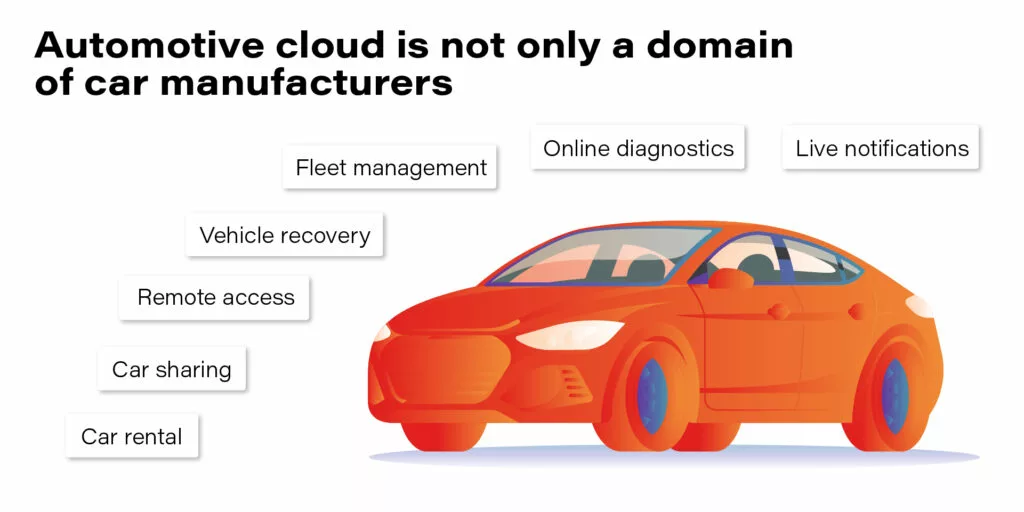
- Live notifications
- Online diagnostics
- Fleet management
- Vehicle recovery
- Remote access
- Car sharing
- Car rental
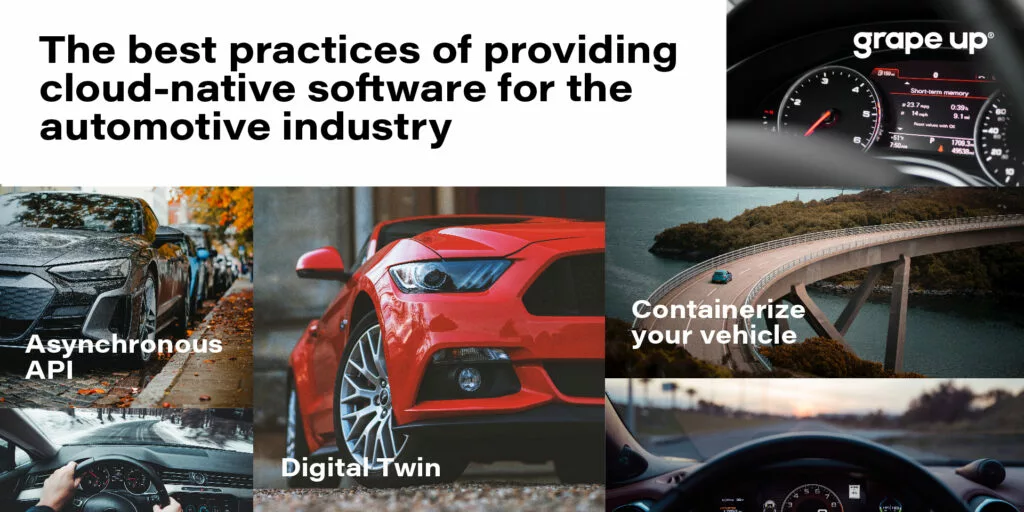
The best practices of providing cloud-native software for the automotive industry
Working with the leading auto motive brands and being engaged in numerous projects meant to deliver innovative applications. Our team have collected a group of helpful practices which make development easier and improve user experience. There are some must-have practices when it comes to delivering high-quality software, such as CI/CD, Agile, DevOps, etc., – they are crucial yet well-known for the experienced development team and we don’t focus on them in this article. Here we share tips dedicated for teams working with app delivery for automotive.
Containerize your vehicle
One of the things we’ve learned collaborating with Porsche is that vehicles are equipped with ECUs and installing software on them isn’t easy. However, Kubernetes helps to mitigate that challenge, as we can mock the target ECU by docker image with specialized operating systems and install software directly in it. That’s a good approach to create an integration environment that shortens the feedback loop and helps deliver software faster and better.
Asynchronous API
In the IoT ecosystem, you can’t rely too much on your connection with edge devices. There are a lot of connectivity challenges, for example, a weak cellular range. You can’t guarantee when your command to the car will be delivered and if the car will respond in milliseconds or even at all. One of the best patterns here is to provide the asynchronous API. It doesn’t matter on which layer you’re building your software if it’s a connector between vehicle and cloud or a system communicating with the vehicle’s API provider. Asynchronous API allows you to limit your resource consumption and avoid timeouts that leave systems in an unknown state.
Let’s take a very simple example of a mobile application for locking the car remotely.
Synchronous API scenario
- A customer presses a button on the application to lock the car.
- The request is sent and is waiting for a response.
- The request needs to be delegated to the car which may take some time.
- The backend component crashes and starts without any knowledge about the previous request.
- The application gets a timeout.
- What now? Is the car locked? What should be displayed to the end-user?
Asynchronous API scenario
- The customer presses a button on the application to lock the car.
- The request is sent and ended immediately.
- The request needs to be delegated to the car which may take some time.
- The backend component crashes and starts without any knowledge about the previous request.
- The car sends a request with the command result through the backend to the application.
- Application displays: “Car is locked.”
With asynchronous API, there’s always a way to resend the response. With synchronous API, after you lose connection, the system doesn’t know where to resend response out of the box. As you may see, the asynchronous pattern handles this case perfectly.
Digital Twin
DigDigital Twin is a virtual model of a process, a product or a service, in case of automotive – a digital cockpit of a car. This pattern helps to ensure the integrity of data and simplify the development of new systems by its abstraction over the vehicle. The concept is based on the fact that it stores the actual state of the vehicle in the cloud and constantly updates it based on data sent from a car. Every feature requiring some property of vehicle should be integrated with Digital Twin to limit direct integrations with a car and improve the execution time of operations.
Implementation of Digital Twin may be tricky though, as it all depends on the vehicle manufacturer and API it provides. Sometimes it doesn’t expose enough properties or doesn’t provide real-time updates. In such cases, it’s even impossible to implement this pattern.
Software for Connected Cars - Summary
We believe that the future will look more futuristic than we could have ever imagined. Autonomous cars, smart cars, smart homes, every device tries to make our lives easier. It’s not known when and how these solutions will fully utilize Artificial Intelligence to make this experience even better. Everything connects as numerous IoT devices are connected which provides us with unlimited possibilities.
T he automotive industry is currently transforming, and it isn’t only focusing on the driving experience anymore. There is a serious focus on connected mobility and other customer-oriented services to enhance our daily routines and habits. However, as software providers, we should keep in mind that automotive is a mature industry. The first connected car solutions were built years ago, and it’s challenging to integrate with them. These best practices should help focus on customer experience. Unreliable systems won’t encourage anyone to use it, and bad reviews can easily destroy a brilliant idea.
The automotive industry is experiencing a challenging transformation. We can notice these changes with every new model of a car and with every new service released. However, to keep up with the pace of the changing world, the industry needs modern technologies and reliable solutions, such as Kubernetes. And on top of that cloud-native application, software created with the best practices by experienced engineers who use the customer-first approach.
Interested in our services?
Reach out for tailored solutions and expert guidance.