
From data to decisions: The role of data platforms in automotive


Connected, autonomous, and electric cars are changing the automotive industry. Yet, the massive amount of data they generate often remains siloed across different systems, making management and collaboration challenging.
This article examines how data platforms unify information, connecting teams across departments - from engineering to customer support - to analyze trends, address operational challenges, and refine strategies for success.
How are data platforms transforming the automotive industry?
Data platforms resolve fragmentation issues by consolidating data from various sources into a unified system. This structure not only improves data accessibility within departments but also enables secure collaboration with trusted external partners
The impact of this approach is clear: improved safety through fewer accidents, better performance thanks to real-time analytics, and quicker development of features supporting solutions such as advanced driver assistance systems and personalized in-car experiences .
As the demand for effective data solutions accelerates, the global automotive data management market , valued at $1.58 billion in 2021, is projected to grow by 20.3% annually through 2030. This rapid development underscores how essential platforms are for addressing the increasing complexity of modern automotive operations, making them vital tools for staying competitive and meeting customer expectations.
Defining data platforms in automotive
Combined with a structured data architecture that defines how information is ingested, stored, and delivered, the platform acts as the operational backbone that transforms this architecture into a functional system. By removing duplications, cutting down on storage expenses, and making it easier to manage data , the platform helps OEMs spend less time on technical hassles and more time gaining meaningful insights that drive their business forward.
In an industry where data flows through multiple departments, this centralized approach ensures that knowledge is not only easily available but also readily applicable to innovative solutions.
Data platforms as the engine for data-driven insights
Unlike standalone systems that only store or display information, automotive data platforms support the processing and integration of information, making it analysis-ready.
Here's a closer look at how it works:
Data ingestion
Automotive platforms handle a variety of inputs, categorized into real-time and batch-processed data. Real-time information, such as CAN bus telemetry, GPS tracking, and ADAS sensor outputs, supports immediate diagnostics and safety decisions.
Batch processing, on the other hand, involves data that is collected over time and processed collectively at scheduled intervals. Examples include maintenance records, dealership transactions, and even unstructured feedback logs.
Many platforms offer hybrid processing to meet specific operational and analytical needs.
Moreover, there are some unique methods used in the automotive industry to gather data, including:
- Over-the-air (OTA) updates: remotely deliver software or firmware updates to vehicles to improve performance, fix bugs, or add features without requiring a service visit.
- Vehicle-to-Everything (V2X) communication: capture real-time data on traffic, infrastructure, and environmental conditions.
These industry-focused techniques enable companies to obtain data critical for operational and strategic insights.
Data processing and storage
Processing involves cleansing for reliability, normalizing for consistency, and transforming data to meet specific requirements, such as diagnostics or performance analytics. These steps ensure the information is accurate and tailored for its intended use.
The processed information is stored in centralized repositories: data warehouses for structured records (e.g., transactions) and data lakes for semi-structured or unstructured inputs (e.g., raw sensor data or feedback logs). Centralized storage allows quick, flexible access for teams across the organization.
Fundamental principles for a modern data platform
- Scalability and simplicity: Easily expandable to accommodate growing data needs.
- Flexibility and cost-efficiency: Adaptable to evolving requirements without high overhead costs.
- Real-time decision-making: Providing immediate access to critical information.
- Unified data access: Breaking down silos for a complete organizational view.
Data platforms in automotive: Key applications for efficiency and revenue
Many companies recognize the importance of data, but only a few use it effectively to gain meaningful insights about their business and customers. Better use of information can help your company drive more informed decisions about products and operations. Consider this:
-> Is data being used to improve the customer experience in tangible ways?
-> Are your teams focused on creating new solutions, or are they spending too much time preparing and organizing data?
Data platforms serve as the foundation for specific use cases:
Customer services and new revenue opportunities
Data on vehicle usage and driver behavior supports personalized services and drives innovative business models. Examples include:
- Maintenance reminders : Platforms analyze usage data to alert drivers about upcoming service needs.
- Third-party partnerships : For example, insurers can access driving behavior data through controlled platforms and offer tailored policies like pay-as-you-drive.
- Infotainment : Secure data-sharing capabilities allow developers to design custom infotainment systems and other features, creating new revenue opportunities for companies.
Operational efficiency
Let’s look at where else the platforms are used to solve real-world challenges. It’s all about turning raw information into revenue-growing results.
In predictive maintenance , access to consistent sensor data helps identify patterns, reduce vehicle downtime, prevent unexpected breakdowns, and ensure proactive safety measures.
Ford’s data platform illustrates how unifying data from over 4,600 sources - including dealership feedback, repair records, and warranty services - can drive new business models. By centralizing diverse inputs, Ford demonstrates the potential for predictive insights to address customer needs and refine operational strategies.
In supply chain management , integrating data from manufacturing systems and inventory tools supports precise resource allocation and production scheduling.
Volkswagen 's collaboration with AWS and Siemens on the Industrial Cloud is a clear example of how data platforms optimize these operations. By connecting data from global plants and suppliers, Volkswagen has achieved more precise production scheduling and management.
Product development benefits from data unification that equips engineers with the visibility they need to resolve performance challenges faster, ensuring continuous improvement in vehicle designs. This integrated approach ensures better collaboration across teams. Aggregated data highlights frequent problems in vehicle components, while customer feedback guides the creation of features aligned with market demands, driving higher-quality outcomes and user satisfaction.
Fleet management also sees significant improvements through the use of data platforms. Real-time information collected from vehicles allows for improved route planning while reducing fuel consumption and delivery times. Additionally, vehicle usage data helps optimize fleet operations by preventing overuse and extending vehicle lifespans.
Regulatory compliance
Another key advantage of centralizing data is easier compliance with regulations such as GDPR and the EU Data Act. A unified system simplifies managing access, tracking usage, and securely sharing information. It also supports meeting safety and environmental standards by providing quick access to the data required for audits and reporting.
What’s next for automotive data platforms
While some data platforms' capabilities are already in place, the following represent emerging trends and transformational predictions that will define the future:
AI-powered personalization
Platforms are evolving to deliver even more sophisticated personalization. In the future, they’ll integrate data from multiple sources - vehicles, mobile apps, and smart home devices - to create a unified profile for each driver. This will enable predictive services, like suggesting vehicle configurations for specific trips or dynamically adjusting settings based on the driver’s schedule and habits.
Connected ecosystems
Future platforms may process data from smart cities, energy grids, and public transport systems, creating a holistic view for better decision-making. For example, they could optimize fleet operations by aligning vehicle usage with real-time energy availability and urban traffic flow predictions, expanding opportunities for sustainability and efficiency.
Real-time data processing
The next generation of platforms will handle larger volumes of information with greater speed, supporting developments like autonomous systems and advanced simulations. By combining historical data with real-world inputs, they will improve predictive capabilities; for instance, refining AI algorithms for better safety outcomes or optimizing fleet routes to reduce emissions and costs.
Enhanced cybersecurity
Looking ahead, data platforms will incorporate more advanced security measures, such as decentralized systems like blockchain to safeguard data integrity. They will also provide proactive threat detection, using AI to identify and mitigate risks before breaches occur. This will be critical as vehicles and ecosystems become increasingly connected.
These advancements will not only address current challenges but also redefine how vehicles interact with their environment, improving functionality, safety, and sustainability.
Ready to change your automotive data strategy?
As the industry evolves with connectivity, autonomy, and electrification, the need for dependable and flexible systems grows.
Need a secure, scalable platform designed for automotive requirements?
Whether you're creating one from scratch or improving an existing system, we can help provide solutions that improve operational efficiency and create new revenue opportunities.

Data powertrain in automotive: Complete end-to-end solution
We power your entire data journey, from signals to solutions
Check related articles
Read our blog and stay informed about the industry's latest trends and solutions.
How to monetize car data - 3 strategies for companies and 28 practical use cases
Data is the currency of the 21st century. Those who have access to it can manage it wisely and draw constructive conclusions to get ahead and outperform the competition. The business model based on their monetization is no longer the domain strictly reserved for the Silicon Valley giants. Also, companies whose products and services are not directly related to data trading are trying their hand in this field. The automotive industry is one of the market sectors where data monetization will soon bring the greatest benefits. It is estimated that by 2030 it will be as much as $ 450-750 billion on a global scale.
In this article, you will learn:
What are the 4 megatrends to increase the amount of data from cars.
* Which technologies will enable better data downloading.
* Who can earn money from vehicle data monetization.
* What are the three main data monetization strategies.
* 28 practical use cases of how you can generate revenue.
The increase in revenues on this account is not only due to the electronics and sensors that are installed inside the vehicles. Social and cultural changes will also contribute to the increase in the amount of generated data - for example, the need to reduce city traffic and the search for ways of traveling alternative to vehicles with combustion engines.
Among the megatrends that will contribute to a greater inflow of data for monetization, the following are usually mentioned:
- electrification;
- connectivity;
- diverse mobility / shared mobility;
- and autonomous driving.
The trends that will transform the way we travel and use vehicles today are opportunities not only for OEMs (original equipment manufacturers), but also for insurance companies, fleet managers, toll providers, fuel retailers, and companies dealing with parking or traffic.
All these industries are increasingly joined by technologies that not only help to collect data but also to process it. The flow of information between these market sectors will enable the development of effective methods of obtaining data and creating new services that can be monetized.
In particular, it will be enabled due to the 8 developing technologies:
1. Big data analytics
2. High-speed data towers (5G)
3. Software platforms
4. Data cloud
5. High definition maps
6. High-resolution positioning (GPS)
7. Smart road infrastructure
8. V2X communication
Due to the extensive technological infrastructure, the amount of data that can be obtained from the vehicle will increase immeasurably with today's possibilities. It is estimated that in the near future, up to 10,000+ points from which data can be collected will be accessible in the car.
Understand the drivers and their needs
/„The challenge for industry players is that data will not be car-centric, but customer-centric.” – European premium OEM”/
While technology plays a key role in converting data into real currency, we should bear in mind one thing. In fact, the data is generated not by the vehicle, but by its user. It is the user’s attitude towards technology, privacy, and convenience that determines the success of obtaining information. Without their consent and willingness, there is no effective data monetization strategy.
As the examples of Google or Facebook show, the use of data without users' knowledge sooner or later ends in lawsuits, reluctance, and consumers turning their backs on the brand.
So how can you get users' consent to share data?
The answer is simple - although putting it into practice may be a real challenge - offer something in return. If you give something to the driver, they will share the data you care about the most.
Among the universal benefits on which you can build a strategy for obtaining data from drivers, the following are especially noteworthy:
- time savings,
- greater overall comfort and driving comfort,
- increased level of safety,
- reduction of vehicle operating costs,
- entertainment or increasing driving experience.
Research shows that drivers are much more willing to share data about the external environment of the vehicle - e.g., driving conditions, the technical condition of the vehicle, or even its location. However, they are not so eager to share data from their vehicle interior, e.g., the possibility of recording conversations. However, the percentage of such approvals increases dramatically, up to 60%, when drivers are offered more safety in return.
Younger customers and frequent travelers (who spend over 20 hours in their cars weekly) are also more open to this type of service - which results from their attitude to life, as well as personal needs. Differences in attitudes to privacy can also be shown in different markets (e.g., in Asia, Germany, or the USA). This is due to cultural differences, data regulations, and the technological advancement of a given region.
Regardless of where the company operates, in order to consider effective data monetization, you need to answer three key questions:
- WHO drives a given car?
- HOW do they behave behind the wheel?
- WHERE do they drive?
Understanding the consumer's needs and the way they travel is the starting point for developing an effective data monetization strategy. Only then can we choose the right tools and technologies enabling us to turn data into profits.
Monetizing car data - 28 practical use cases
Each case of data collection in a vehicle can potentially be turned into a benefit. It may concern one of the three areas:
- Generating revenue
- Reducing costs
- Increasing safety and security
Data monetization strategies can be based on only one of these assumptions or be a mix of activities from different areas. Let's have a look at the specific methods that are currently developing in the automotive market.
1. Generating revenue
Generating revenue from data in the automotive industry is frequently done by selling new functionalities and services. Usually (but not always), they are directly linked to the vehicle and are aimed at the driver ( direct monetization ).
Due to a large number of sensors and the fact that the car of the future will perfectly know and read the driver's needs, this type of vehicle is also perfect for being fitted with tailored advertising .
The third way of generating income can also be selling data to advertising companies that will use it to promote third-party brands. Obviously, this model causes the most distrust and reservations among the majority of consumers.
Direct monetization
1. Over-the-air-software add-ons / OTA
Do you want your car's operating system to be faster and more efficient? Or maybe you need to have it repaired, but you are too busy to visit your car dealer? Updating your software in the cloud will let you avoid stress and save you time. Analysts estimate that by 2022 automotive companies will have made about 100 million such vehicle updates annually.
2. Networked parking service
Being able to enter the car park without paying the traditional fee, and a suggestion where you can find a free space. Who wouldn't take advantage of such a convenience in congested cities, for a small surcharge or by providing the registration number of their own vehicle? The system of smart car parks connected to the network offers such possibilities.
3. Tracking/theft protection service
A car is often a valuable and indispensable resource for company activities (but also for private individuals). Vehicle theft does not only involve a financial loss but often logistics-related issues, too. Users increasingly often agree to share their location and modern tracking systems that will easily locate the vehicle in the event of theft.
4. Vehicle usage monitoring and scoring
Who wouldn't want to pay less for vehicle insurance or its rental? Systems monitoring drivers’ behavior while driving and evaluating them in line with the regulations may soon become the standard of services offered by insurers and rental companies.
5. Connected navigation service
Real-time road traffic updates, current fuel prices at nearby filling stations, possible parking options, access to repair stations or car wash - all that by means of voice commands and questions we ask our GPS while driving. For such convenience, most drivers will be delighted to share their data.
6. Onboard delivery of mobility-related content /services
7. Onboard platform to purchase non-driving related goods
Just as the phone is no longer used merely for telephone calls, the car increasingly often plays additional roles. Listening to music from the Internet or streaming videos by passengers (or by the driver, when the car is parked) is completely normal today. Soon we can expect that shopping from the driver's seat will also become the order of the day. And not necessarily only shopping for goods related to mobility and the car.
8. Usage-based tolling and taxation
Each road user and road infrastructure is subject to the same tax obligations and fees. Meanwhile, modern technology allows us to monitor how we use the infrastructure and how often we do it. There is an extensive group of drivers who could save a lot by sharing this type of data with road management.
9. „Gamified” / social like driving experience
“Tell me and I will forget, show me and I may remember; involve me and I will understand.” - Confucius said over 2,500 years ago, and nothing has changed since. Having fun, competing with friends, and having personal experience are still the strongest incentives for us to take new action. It also relates to our purchases.
10. Fleet management solution
Managing a fleet of vehicles, each in different locations, driven by a different driver, and carrying a different load is a real challenge. Unless the entire fleet is managed using one central platform that collects data from individual vehicles. Then everything is close at hand.
11. In-car hot-spot
Mobile internet onboard? Not only the driver who can update necessary data and stay in touch with the base (in the case of a fleet vehicle) will benefit, but also the passengers. In-car hot-spot is an ideal product for companies from the telecom industry, travel companies, insurers, and fleets.
Tailored advertising
12. Predictive maintenance
Advertising is not scared of any medium and, like a chameleon, it adjusts to the environment in which it appears. A car that, just like a smartphone, gets new functions every now and then, becomes an ideal place for such activities. Especially those messages that help drivers predict possible breakdowns and remind them about the upcoming service or oil change are highly appreciated.
13. Targeted advertisements and promotions
Apart from targeting advertisements in terms of the needs related to the vehicle operation, advertisers can also select ads based on who and where is driving the car, the driver's age, gender, or interests. Of course, the accuracy of targeting depends on the amount of data that can be obtained from the vehicle user. Drivers can therefore see displayed ads based on their current and past behavior and linked to the businesses and places featured on their route.
Selling data
Gathering vehicle data and selling it to third parties ? We only mention this point because, being experts, we feel it is our duty. As the previous and subsequent use cases show, there are many more creative ways, approved by drivers, that will allow them to benefit from car data.
2. Reducing costs
Data is a mine of information. Companies from the automotive industry can earn money not only by selling new products but also by enhancing existing solutions, reducing R&D costs, or offering cheaper services to users. Potentially, not only producers but also end users can benefit from data acquisition.
R&D and material costs reduction
14. Warranty costs reduction
Every year, companies from the automotive industry spend huge amounts of money on user warranty services. Data on how the vehicle is used, or what breaks down the most often can not only improve the service process itself and increase consumer satisfaction but also help make real savings in companies. Based on the analyzed information, it is possible to more precisely select the scope of warranty and its duration and even adjust it to specific users.
15. Traffic data based retail footprint and stock level optimization
By using advanced geospatial analysis, traditional stores and malls are capable of locating heavy-traffic areas. Wherever the number of vehicles and the frequency of trips increases, there is a potential for greater sales. It is also easier to plan and adjust the stock, expecting potential consumer interest. Companies from the automotive industry, which have data from vehicles, are a natural business partner for this submarket.
16. Data feedback based R&D optimization
Regardless of the sector in which we operate, the R&D department cannot exist without market feedback, looking for new trends and insights. In the automotive industry, continuous product optimization is the key to success. Data provided by managers is a constant source of inspiration and optimization that can contribute to a company's market position. Of course, provided that they are properly analyzed and used for new products.
Customers cost reduction
17. Usage-based insurance PAYD / PHYD
Switching from an insurance based on accident history to insurance based on date, time, and actual driving style? The advantages for the insurer do not need any explanation. For drivers who travel safely on the road and have nothing to be ashamed of, pay as you drive (PAYD) or pay how you drive (PHYD) insurance certainly has unquestionable benefits and is worth sacrificing a bit of privacy.
18. Driving style suggestions
Do you want to know how to drive more economically? How to adjust the speed to the road conditions or shorten the travel time? Systems installed in connected cars will be happy to help you with this. All you have to do is share information about how you are getting on behind the wheel.
19. E-hailing
24/7 availability, the possibility to order a ride from a location where there are no traditional taxis, the ease of paying via a mobile application. There are many advantages to using the services of brands such as Uber or Lyft. Although no one heard about these companies a few years ago, today they set trends related to our mobility . All due to the skillful use of data and the creation of a business model based on the driver and passenger benefit.
20. Carpooling
Fuel economy and pro-ecological trends increasingly contribute to our conscious use of vehicles. Instead of driving alone, we share travel costs increasingly often and invite other people to travel with us. The creation of applications and infrastructure based on consumer data, which will facilitate driver and passengers recognition, is an ideal model for companies from the automotive industry.
21. P2P car sharing
Your car is parked in the garage because you cycle daily or use public transport? Rent it to other drivers via the peer-to-peer platform and earn money. Of course, the company behind the mentioned application that connects both parties will also earn a few bobs on it, as that's what its business model is all about.
22. Trucks platooning
Connecting vehicles into convoys has existed as long as traffic. However, today's technology and data flow offer additional benefits. Trucks platooning is the creation of a convoy using communication technology and automated driving assistance systems. In such a convoy, one of the cars is the "leader", and the rest adapt to its actions, requiring no or little action from the drivers. Advantages for companies organizing a convoy? Lower Co2 emissions (up to 16% from the trailing vehicles and by up to 8% from the lead vehicle), better road safety, saving drivers time, and getting tasks done faster.
Improved customer satisfaction
23. Early recall detection and software updates
The data received from the vehicle enables early detection of faults and prevents unnecessary problems on the road, and even more - it allows to repair them remotely in the OTA (over-the-air) model. Thanks to such amenities, the driver does not have to download the required software or visit their authorized dealer in person to repair the vehicle.
3. Increasing safety and security
24. Driver’s condition monitoring service
Drowsiness and fatigue are some of the most common factors contributing to road accidents. Thanks to driver monitoring systems in the form of infrared sensors and a camera integrated into the steering wheel, the vehicle can warn the driver in advance and recognize symptoms that could lead to an accident or falling asleep at the wheel. This is one of the amenities that drivers most often agree on when it comes to sharing vehicle data.
25. Improved road/infrastructure maintenance and design
Analyzing data from vehicles can help both the drivers themselves and the road service. For instance, when cars regularly skid at some point - which is detected by ESP / ABS systems, road workers can introduce certain speed limits or improve the road profile. This type of data is also useful in planning road repairs when the renovation needs to be planned during less traffic volume.
26. Breakdown call service
Tyre pressure monitoring, battery and engine condition, fuel level, and electricity drops in the vehicle. Monitoring such data can prevent more than one accident, and should it happen, it helps the driver overcome the obstacles much faster. When roadside assistance knows where the driver is and what exactly happened to the car, it can react much faster or instruct the driver how to fix the problem.
27. Emergency call service
Data from connected cars can save not only our holidays but also our lives. When every second counts and the driver or other road users cannot call an ambulance or fire brigade, the connected car will do it for them. Thanks to the emergency call service option, the vehicle sends information about the location of the vehicle and its status to the appropriate services.
28. Road laws monitoring on enforcement
Data collected from vehicles - especially on a large scale - can tell a lot about the way a given group drives or about the compliance with the rules of the road. Providing data from your own vehicle to the traffic law monitoring services can improve our habits, reduce the number of road hogs and drunk drivers, and help adjust the law to new conditions.
Crucial factors in data monetization
The data stream generated by vehicles will increase year by year. In order to be well prepared for the monetization of this information and not to miss the opportunities for the automotive industry for additional sources of income, it is crucial to take care of several key issues.
- First of all : find a steadfast IT partner with experience in the field, who will supplement the competencies of the OEM with cloud solutions, AI, and building platforms based on data monitoring and analysis.
- Secondly : constantly create and test car products and services based on real needs and amenities for customers - which is inherently related to the next point.
- Thirdly : create an open policy for the management of customers’ data that rules out trading in confidential information or unclear or misleading regulations of data use.
Only the development of a business strategy based on all these assumptions can bring real benefits and help stand out from the competitors.
As you can see, this is not a simple and quick process to implement, as many entities are involved in it, and various interest groups may clash. So, is the game worth the candle? The answer is in the stories of telephone companies that used to believe that the telephone should only be used for making calls, and it did not have to be smart.
Whether we like it or not, vehicles are changing right before our very eyes and are increasingly often used not only for getting from A to B. People who do not understand it and do not see the opportunities facing the automotive industry may soon share the fate of the mobile giants from over a dozen years ago.
How to build software architecture for new mobility services - gathering telemetry data
In the modern world, tech companies strive to collect as much information as possible about the status of owned cars to enable proactive maintenance and rapid responses to any incidents that may occur. These incidents could involve theft, damage, or the cars simply getting lost. The only way to remotely monitor their status is by obtaining telemetry data sent by the vehicles and storing it on a server or in the cloud. There are numerous methods for gathering this data, but is there an optimal approach? Is there a blueprint for designing an architecture for such a system? Let's explore.
What does “telemetry” mean in a car?
This article is about gathering telemetry data, so let's begin with a quick reminder of what it is. Telemetry in cars refers to the technology that enables the remote collection and transmission of real-time data from various components of a vehicle to a central monitoring system. This data encompasses a wide range of parameters, including, for example:
- engine performance,
- fuel consumption,
- tire pressure,
- vehicle speed,
- percentage of electric vehicle battery,
- braking activity,
- acceleration,
- GPS position,
- odometer
Collecting vehicle details is valuable, but what is the real purpose of this information?
Why collect telemetry data from a car?
The primary use of telemetry data is to monitor a car's status from anywhere in the world, and it's especially crucial for companies like car rental firms such as Hertz or Europcar, as well as transportation companies like Uber. Here are some examples:
- Tracking Stolen Cars : Companies can quickly track a stolen vehicle if they store its GPS position.
- Accident Analysis : If a car is involved in an accident, the company can assess the likelihood of the event by analyzing data such as a sudden drop in speed to zero and high acceleration. This allows companies to provide replacement cars promptly.
- Fuel or Charging Management : In cases where a rental car is returned without a full tank of fuel or not fully charged, the company can respond quickly to make the car available for the next rental.
These are just a few examples of how telemetry data can be utilized, with many more possibilities. Understanding the value of telemetry data, let's delve into the technical aspects of acquiring and using this data in the next part of the article.
To begin planning the architecture, we need answers to some fundamental questions
How will the telemetry data be used?
Architectural planning should commence with an understanding of the use cases for the collected telemetry data. This includes considering what the end user intends to do with the data and how they will access it. Common uses for this data include:
- Sharing data on a dashboard : To enable this, an architecture should be designed to support an API that retrieves data from databases and displays it on a dashboard,
- Data analytics : Depending on the specific needs, appropriate analytic tools should be planned. This can vary from real-time analysis (e.g. AWS Kinesis Data Analytics) to near real-time analysis (e.g. Kafka) or historical data analysis (e.g. AWS Athena),
- Sharing data with external clients : If external clients require real-time data, it's essential to incorporate a streaming mechanism into your architecture. If real-time access is not needed, a REST API should be part of the plan.
Can we collect the data from cars?
We should not collect any data from cars unless we either own the car or have a specific legal agreement to do so. This requires not only planning the architecture for acquiring access to the car but also for disposing of it. For example, if we collect telemetry or location data from a car through websockets and the company decides to sell the car, we should immediately cease tracking the car. Storing data from it, especially location data, might be illegal as it could potentially allow tracking of the location of a person inside the car.
How do we manage permissions to the car?
If we have legal permission to collect data from the car, we must include correct permission management in our architecture. Some key considerations include:
- Credential and token encryption,
- Secure storage of secrets, such as using AWS Secret Manager,
- Regular rotation of credentials and tokens for security,
- Implementing minimum access levels for services and vehicles,
- Good management of certificates,
- Adhering to basic security best practices.
How do we collect the data?
Now that we have access to the data, it's time to consider how to collect it. There are several known methods to do this:
- Pull Through REST/GRPC API: In this scenario, you'll need to implement a data poller. This approach may introduce latency in data acquisition and is not the most scalable solution. Additionally, you may encounter request throttling issues due to hitting request limits.
- External Service Push Through REST/GRPC: Here, you should set up a listener, which is essentially a service exposed with an endpoint, such as an ECS task or a Lambda function on AWS. This method might incur some costs, and it's crucial to consider automatic scaling to ensure no data is lost. Keep in mind that the endpoint will be publicly exposed, so robust permission management is essential.
- Pulling From a Stream: This approach is often recommended as it's the most scalable and secure option. You can receive data in real-time or near real-time, making it highly efficient. The primary considerations are access to the stream and the service responsible for pulling data from it.
- Queues: Similar to streams, queues can be used for data collection, and they may offer better data ordering. However, streams are typically faster but might be more expensive. This is another viable option for collecting vehicle data from external services.
- Websockets: Websockets are a suitable solution when bidirectional data flow is required, and they can be superior to REST/GRPC APIs in such cases. For example, they are an appropriate choice when a client needs confirmation that data has been successfully acquired. Websockets also allow you to specify which telemetry data can be acquired and at what frequency. A notable example is the Tesla Websockets ( https://github.com/teslamotors/fleet-telemetry/blob/main/protos/vehicle_data.proto ).
Where to store the data?
After collecting the data, it's important to decide where to store it. There are various databases available, and the choice depends on your specific data use cases and access patterns. For instance:
- Commonly Used Data : For data that will be frequently accessed, you can opt for a traditional database like MongoDB or PostgreSQL.
- Low-Maintenance Database : If you prefer a database that requires minimal maintenance, AWS DynamoDB is a good choice.
- Infrequently Used Data for Analytics : When data won't be used frequently but will be utilized for occasional data analytics, you can consider using an AWS S3 bucket with the appropriate storage tier, coupled with AWS Athena for data analysis.
- Complex Data Analysis : If the data will be regularly analyzed with complex queries, AWS Redshift might be a suitable solution.
When planning your databases, don't forget to consider data retention. If historical data is no longer needed, it's advisable to remove it to avoid excessive storage costs.
Example
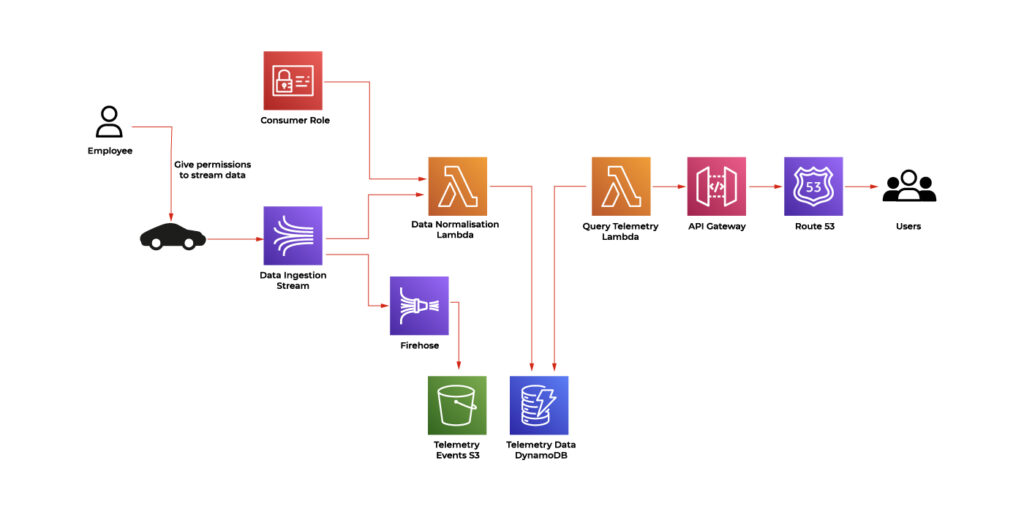
Here is an example of such an architecture on AWS in which:
- An employee grants permissions to the car to stream the data.
- The data is streamed using AWS Kinesis Stream and saved to an S3 bucket by AWS Kinesis Firehose for audit purposes.
- The data is also normalized by the AWS Lambda function and stored in AWS DynamoDB.
- The stored data is queried by another AWS Lambda function.
- The query Lambda is triggered by an AWS API Gateway to enhance security, such as limiting requests per second.
- The API is exposed via Route 53 to the end user, which can be, for example, a dashboard or an external API.
Conclusion
In the modern tech landscape, the quest for complete vehicle data is a paramount objective. Tech companies seek to collect critical information about the status of owned cars to enable proactive maintenance and rapid responses to a spectrum of incidents, from theft and damage to simple misplacement. This imperative relies on the remote monitoring of vehicles through the collection and storage of data on servers or in the cloud, offering the capability to monitor a vehicle's status from any corner of the globe. This is especially essential for companies like car rental firms and transportation services, with applications ranging from tracking stolen cars through GPS data to analyzing accident events and managing fuel or charging for rental vehicles.
The core of this mission is to strike a balance between data collection, security, and architectural planning. The process involves careful consideration of data collection methods, adherence to legal and security best practices, and informed choices for data storage solutions. The evolving landscape of vehicle data offers endless possibilities for tech companies to harness the power of telemetry and deliver an enhanced experience for their customers.
Interested in our services?
Reach out for tailored solutions and expert guidance.