
Digital twin factory in the automotive industry - so the future is happening today


Retail stores and factories are being cloned for the virtual world, for familiarity and efficiency. Now it's time for automotive, which is more and more willing to use digital twin factory. This innovative technology perfectly bridges the real and virtual worlds. It is already happening now, for instance in BMW factories.
Digital twin and Industry 4.0
The fourth industrial revolution necessitates the use of advanced data-driven technologies. This includes digital twins. It's an idea that allows you to simulate products, services, and entire processes for creating more efficient and faster quality solutions. By using video, images, diagrams or other data for advanced 3D mapping, a new virtual reality is created.
This concept is becoming increasingly common in various market sectors, including automotive . Not only individual vehicle parts , but even entire factories are already being created in the digital space. The latter can be seen, for example, at BMW.
But it is also being used in many other sectors, not just the industry as such. For instance, tests are being carried out to use the technology for surgical treatment of patients with heart conditions - so digital twins would be used for the advanced replication and examination of internal organs. Besides, they would enable faster development of prototypes of even such machines as airplanes. Architects, by contrast, no longer have to rely solely on their imagination in such a scenario, but can use perfectly reproduced models of skyscrapers, accurate down to the nearest centimeter.
Digital twins enter factories now
Just imagine this scenario: the opening gate of a manufacturing plant. Coating a car door with paint. Workers, going from section to section, carrying out their jobs. Except that these are just very realistic simulations. And the workers are, in fact, only avatars. This is how the idea of the digital twin in the automotive industry can be summarized. It's creating a separate, comprehensively perceived manufacturing process.
The digital twin in the automotive industry includes a virtual replica of the entire car and its physical behavior, including software, electronics, mechanisms, etc. And it can additionally store all performance and sensor data in real-time, as well as configuration changes, service history, and warranty information.
Making the digital twin a reality at BMW
This trend is already becoming widespread. For example, at the German BMW factory. The virtual three-dimensional replica of the vehicle factory used by the company is a space reproduced down to the smallest detail, which can be accessed using a screen or VR goggles. Why " dabble" in such technology at all? To save money, at least, among other things. Non-physical, virtual resources allow you to test or improve assembly line parts without having to move or operate on heavy machinery.
Machine learning algorithms also help in managing robots. These, in a simulated version, can make various complex moves to make the process as streamlined as possible. And all this without wasting energy on time-consuming tests. Besides, this way robots learn new ways of working.
Advanced software also simulates,e.g., the behavior of workers: their paths of movement and actions. By doing so, an attempt is made to minimize possible ergonomic problems. Frank Bachmann, BMW's factory manager, says the time needed to plan the factory's operations has been reduced by at least 25 percent . Anyway, the changes are happening as we speak , because even before the individual parts of the drive systems for electric vehicles leave the BMW plant, the entire production process is already finalized in the virtual version of the Regensburg factory.
The aforementioned benefits are such a boon for BMW that the company intends to develop more of this type of technology. Their soon-to-be-introduced twin factory model is expected to be a replica of the factory in Hungary, and subsequently, this will apply to other factories around the world.
Innovation driven by synergistic collaboration
BMW is an automotive giant that promotes and uses the virtual technology of tomorrow not alone, but with the right support from technology companies that are responsible for the software implementation. In the case of the German automotive brand, the partner is the chip company, Nvidia. It uses its proprietary Omniverse system, which offers the possibility to simulate the entire production process, taking into account even such physical factors as gravity.
Clearly, everything is to be conducted in the framework of photorealistic detail. This complex virtual environment allows for the creation of diverse 3D models. It's also innovative in the sense that Omniverse's open file standard is compatible with numerous computer-aided design packages. Richard Kerris, general manager of Omniverse at Nvidia, refers to the project as "one of the most complex simulations ever made".
But the solutions do not close at Invidia, and automotive companies can also choose from other offers of technological implementations. And there is every indication that there will be more and more of these offerings. For example, in November 2021, Amazon unveiled the AWS IoT TwinMaker , a service that generates digital duplicates of real-world systems for business. An immersive 3D view of systems and operations enables optimizing efficiency, increasing production, and improving performance. So does the platform-as-a-service (PaaS) offering, Azure Digital Twins . It enables the creation of digitally based models of various environments such as buildings, factories, power grids, and even entire cities.
Use cases, in other words: how can the concept of digital twin be used in the automotive industry?
It may seem to some that creating digital twins in the automotive industry is unnecessary "gadgetry" or blind following of trends.
After all, why simulate the creation of a vehicle? Isn't it better to spend time, energy, and resources on improving what is already underway? Isn't it better to invest in the REAL production result? All of this is not so simple. Especially when you realize that this technology is not just about virtualizing the vehicle development stage. The idea behind digital twin factories focuses not so much on the development of the cars themselves, but on the entire broad ecosystem. It is about creating and sustaining, in a controlled environment, the entire production environment:
- logistics,
- employees,
- deployment of machinery,
- chain value.
Ding Zhao, a Carnegie Mellon University professor specializing in artificial intelligence and digital simulations, argues that simulations are crucial to the industry. This is the case for two reasons. First, it's about simulating dangerous situations. Under "normal" circumstances, this is often simply impossible. Just as impossible is running machines for millions of cycles each time, only to collect the necessary data for analysis.
The simulation, therefore, takes into account the entire environment of the production process. It is a comprehensive and all-encompassing view of the problem. A virtual answer to the question of real needs, and of real benefits. And these are numerous.
Prediction first
The digital twin gives people in charge of maintaining productivity in a factory an important "weapon" to fight against financial loss. It's called predictive maintenance. Predicting what's to come saves resources and allows us to better plan future production and sales activities.
This ranges from product testing, determining maintenance needs and line improvements, to turnover planning. For instance, different types of chassis can be tested in diverse weather conditions. In a virtual world, of course. What is more, such solutions can be tested right away by customers, who will thus immediately share their impressions of the product. So you get feedback even before the solution is released on the market.
OEMs can maintain a twin vehicle of each VIN and software number and can do updates wirelessly (SOTA) or temporarily enable or disable some features.
In the simulation, for example, you can also pay attention to functionalities that drivers rarely use. If something doesn't work, you can back out of the idea, even before it is implemented.
In addition, it is also possible to configure the infrastructure of factories so that employees can be trained remotely without physically installing the equipment. This opens up further possibilities for the internationalization of a brand. In this way, a manufacturing company in the U.S. can train a new team in Japan even before the plant in the Land of Cherry Blossoms is completed.
Improving manufacturing capabilities
The technology described here yields huge savings not only in terms of money but also in terms of time. In the traditional automotive industry, companies have to focus too long on verifying new features or designs. And all because they have to wait for the production process to be completed.
The digital twin clears this hurdle. You can easily test the impact of a new machine with new features and parameters for your production output. It's a fast, yet reliable way to verify the success and performance of an innovative project.
Effective data management
Virtual simulation technology allows for reliable data analysis , both present, and past. All data, e.g. regarding stoppages or configuration changes, are collected in real-time. So you can see exactly when machine stoppages are likely to occur. And not only that.
As a result, people in decision-making positions can plan uninterrupted production with minimal financial loss. And car dealers, having an insight into a vehicle's service history, know exactly what they are marketing.
Based on this, you can also better anticipate customers' demand and improve customer satisfaction when using the car.
Importantly, the data collected is integrated and unified across several sources simultaneously. It is not a problem to get insight into performance data, driver behavior data , and archived information on previous models.
Perfect finish
As you may be aware, the production of a new model may take even 5-6 years, therefore even a minor oversight may disturb the stability of a company, especially when it concerns the flagship and widely advertised model. For image and financial reasons, it is particularly significant today that the product is competitive, reliable and perfectly developed.
What is the conclusion? Even a small omission can impair the stability of a company, especially when it involves its flagship and widely advertised model. For image and financial reasons, what matters today is that the product is competitive, reliable and perfectly developed.
The digital twin, which allows design and simulation in a completely virtual environment, favors the creation of products perfect in every detail. High-performance rendering and visualization tools allow you to select from a wide variety of materials and textures. And nothing stands in the way of optimizing airflow or heat emission. Every detail will be planned.
Why use a digital twin?
There are many benefits when using a digital twin in automotive. A simulation of this type means:
- an optimal design of the production process already at the digital copy stage, rather than on a "living organism".
- saving time and money. By "getting ahead" of future production problems.
- a better estimate of production line extension costs
- an easier analysis of each stage of the production process for so-called "bottlenecks".
- faster, more interactive communication between vehicle designers, stakeholders and end customers.
- improved ergonomics at all workstations in the plant.
- the determination of product behavior throughout the life cycle. Thus facilitating R&D work.
- the ability to reuse proven models and quickly evaluate the impact of changes.
- an option to integrate all data between the previous vehicle generation and the current vehicle design in a digital model.
Clearly, this is one of the most cost-effective data-driven manufacturing concepts today.
Digital Twin factory. No longer science fiction
The concept of digital twins in the automotive industry is the future, not science fiction. Before long, every factory or building will have a digital counterpart, helping to better manage it.
The digital and real worlds will seamlessly intertwine. The convergence of physical and virtual versions offers the possibility of overcoming various challenges that are now commonplace in the automotive value chain.
The most powerful giants, with BMW at the forefront, know this. Everything indicates that soon every manufacturer in the industry will have to consider investing in such solutions at some stage and to some extent. Anyway, from the company's point of view, it is not a sacrifice, but a chance to develop against the competition. And an opportunity to achieve numerous measurable benefits.

Grape Up guides enterprises on their data-driven transformation journey
Ready to ship? Let's talk.
Check related articles
Read our blog and stay informed about the industry's latest trends and solutions.
The next step for digital twin – virtual world
Digital Twin is a widely spread concept of creating a virtual representation of object state. The object may be small, like a raindrop, or huge as a factory. The goal is to simplify the operations on the object by creating a set of plain interfaces and limiting the amount of stored information. With a simple interface, the object can be easily manipulated and observed, while the state of its physical reflection is adjusted accordingly.
In the automotive and aerospace industries , this is a common approach to use virtual objects representation to design, develop, test, manufacture, and operate both parts of a vehicle, like an engine, drivetrain, chassis/fuselage, or a full vehicle – a whole car, motorcycle, truck or aircraft. Virtual representations are easier to experiment with, especially on a bigger scale, and to operate - especially in situations when connectivity between a vehicle and the cloud is not stable ability to query the state anyway is vital to provide a smooth user experience.
It’s not always critical to replicate the object with all details. For some use cases, like airflow modeling for calculating drag force, mainly exterior parts are important. For computer vision AI simulation, on the other hand, user checking if the doors and windows are locked only requires a boolean true/false state. And to simulate the combustion process in the engine, even the vehicle type is not important.
Today, artificial intelligence takes a significant role in a lot of car systems, to name a few: driver assistance, fatigue check, predictive maintenance, emergency braking, and collision avoidance, speed limit recognition, and prediction. Most of those systems do not live in a void - to operate correctly they require information about the surrounding world gathered through V2X connections, cameras, radars, lidars, GPS position, thermometers, or ABS/ESP sensors.
Let’s take Adaptive Cruise Control (ACC). The vehicle is kept in lane using computer vision and a front-facing camera. The distance to surrounding vehicles and obstacles is calculated using both a camera and a radar/lidar. Position on the map is gathered using GPS, and the speed limit is jointly calculated using the navigation system, road sign recognition, and distance to the vehicle ahead. This is an example of a complex system, which is hard to test - all parts of it have to be simulated separately, for example, by injecting a fake GPS path. Visualizing this kind of test system is complicated, and it’s hard to use data gathered from the car to reproduce the failure scenarios.
Here the Virtual World comes to help. The virtual world is an extension of the vehicle shadow concept where the multiple types of digital twins coexist in the same environment knowing their presence and interfaces. The system is composed of digital representation of physical assets whenever possible – including elements recognized via computer vision. Vehicles, road infrastructure, positioning systems, or even pedestrians are part of the virtual world. All vehicles are part of the same environment meaning they can share the data regarding the position of other traffic participants.
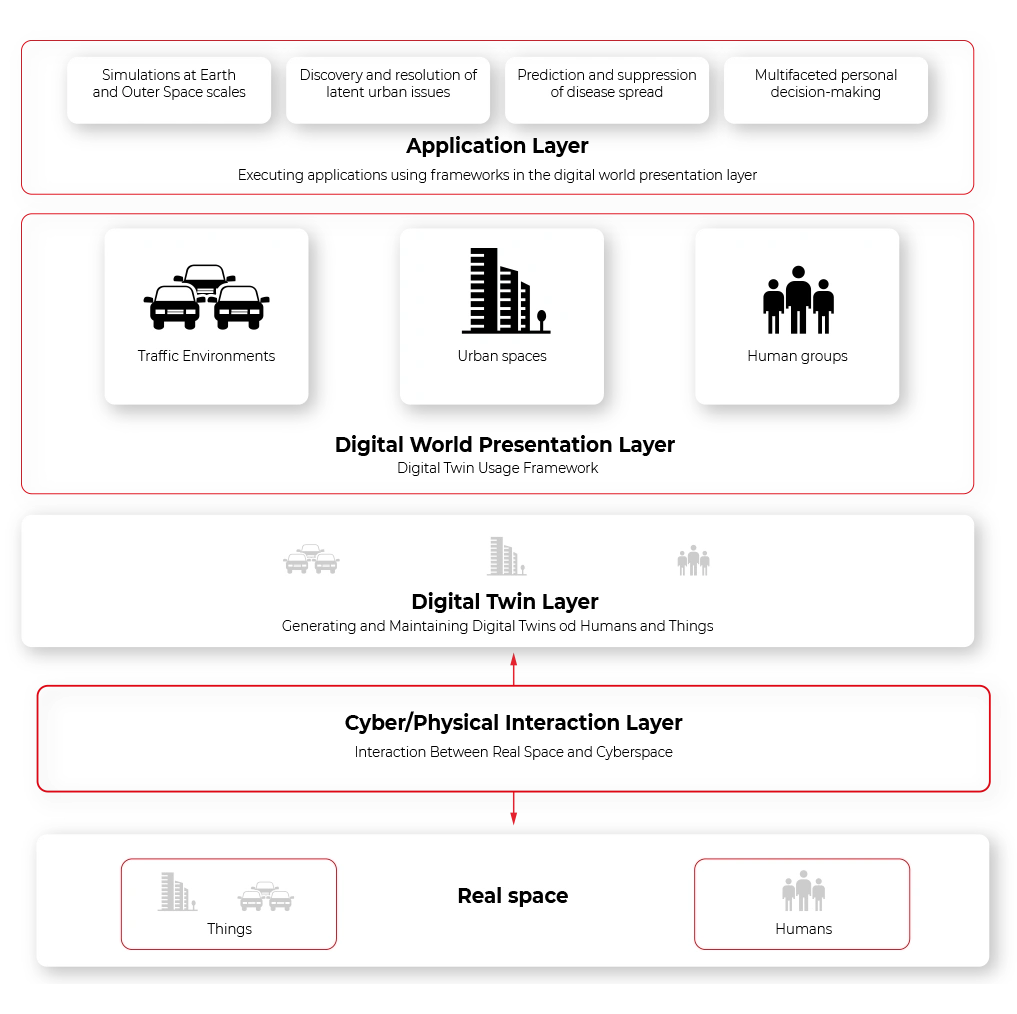
- Such a system provides multiple benefits: Improved accuracy of assistance systems, as the recognized infrastructure and traffic participants can come from other vehicles, and their position can be estimated even when they are still outside the range of sensors.
- Easier, more robust communication between infrastructure, vehicles, pedestrians, and cloud APIs as everything remains in the same digital system.
- Possibility to fully reproduce conditions of system failure as the state history of not just vehicle, but all of its surrounding remains in cloud and can be used to recreate and visualize the area.
- Ability to enhance existing systems leveraging data from the greater area - for example, immediately notifying about an obstacle on the road in 500 meters and suggestion to reduce speed.
- The extensive information set can be used to build new AI/ML applications, like real-time weather information (rain sensor) can be built to close sunroofs of vehicles parked in the area.
- The same system can be used to better simulate its behavior, even using data from real vehicles.
- Common interfaces allow for quicker implementation.
Obviously, there are also challenges - the amount of data to be stored is huge, so it should be heavily optimized, and storage has to be highly scalable. There is also an impact of the connection between the car and the cloud . Overall, the advantages overweight the disadvantages, and the Virtual World will be a common pattern in the next years with the growing implementation of software-defined vehicles and machine learning applications requiring more and more data to improve its operations.
What's next for the digital twin
Digital twins, or virtual copies of material objects, are being used in various types of simulations and the automotive industry is tapping into the potential offered by this technology. Representatives of this market can comprehensively monitor equipment and systems and prevent numerous failures. But what does the future hold for Digital Twin solutions, and who will play the leading role in their development in the years ahead?
The concept of Digital Twin today
To get started, let's have a few words of reminder. A virtual model called a digital twin is based on data from an actual physical object, equipped with special sensors. The collected information allows to the creation of a simulation of the object’s behavior in the real world, while testing takes place in virtual space.
The concept of Digital Twins is developing by leaps and bounds, with its origins dating back to 2003. For many years, more components have been added to this technology . Currently, we distinguish the following:
- digital (virtual) aspect,
- physical object,
- the connection between the two,
- data,
- services.
The last two were added to the classification by experts only in recent years. This was triggered by developments such as machine learning, Big Data , IoT, and cybersecurity technologies.
Capabilities of digital twins in automotive
Digital twins are excelling in many fields when it comes to working on high-tech cars, especially those connected to the network. Below are selected areas of influence.
Designing the vehicle
3D modeling is a way of designing that has been around for many years in the widespread automotive manufacturing industry. But this one is not standing still, and the growing popularity of digital twins is proof of that. Digital replicas extend the concept of physical 3D modeling to virtual representations of software, interactive systems, and usage simulations. As such, they take the conceptual process to a higher level of sophistication.
Production stage
Design is not everything. In fact, the technology mentioned above also works well at the production stage . First and foremost, DT's solutions facilitate control over advanced manufacturing techniques. Since virtual twins improve real-time monitoring and management of facilities, they support the construction of increasingly complex products.
Besides, the safety of the work itself during the production of cars and parts adds to the issue. By simulating manufacturing processes , digital twins contribute to the creation of appropriate employment conditions.
Advanced event prediction
Virtual copies have the ability to simulate the physical state of a vehicle and thus predict the future. Predictive maintenance in this case is based on such reliable data as temperature, route, engine condition, or driver behavior. This can be used to ensure optimal vehicle performance.
Aspects of cyber security
DT predicted for automotive software can help simulate the risk of data theft or other cybersecurity threats. The digital twin of the whole Datacenter can be created to simulate different attack vectors. Continuous software monitoring is also helpful in the early detection of vulnerabilities to hacking attacks (and more)
Development of security-improving systems
Virtual replicas of vehicles and the real world also enable the prediction of specific driving situations and potential vehicle responses. This is valuable knowledge that can be used, for example, to further develop ADAS systems such as electronic stability control and autonomous driving. This is all aimed at ensuring safer, faster, and more economical driving.
How will the digital twin trend evolve in the coming years?
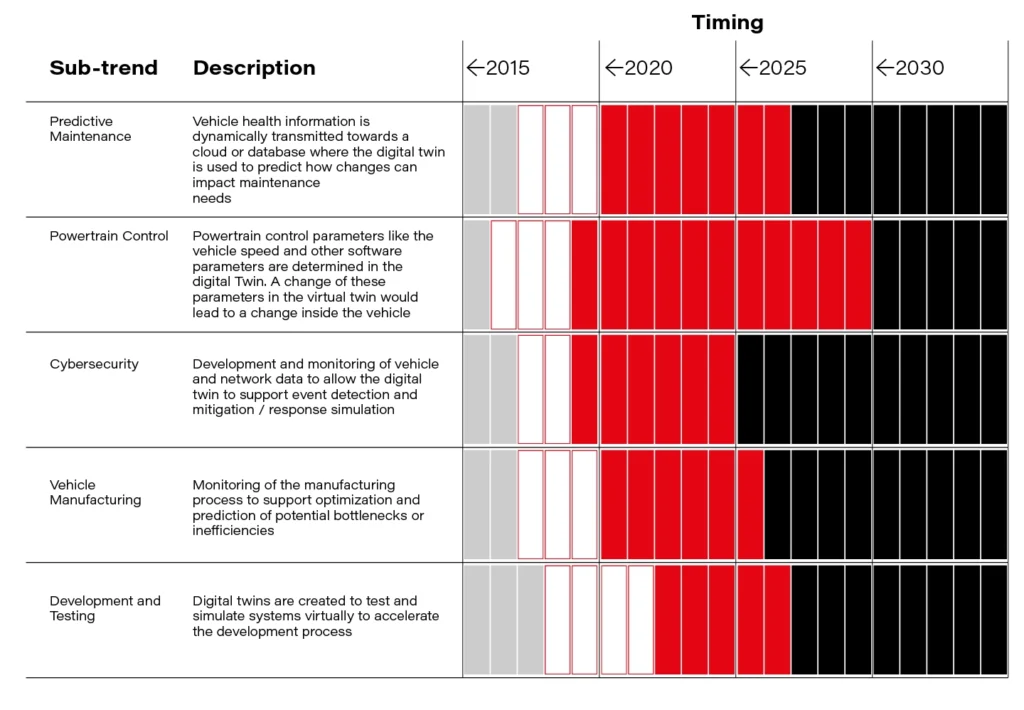
One of the leading trend analysis companies from the automotive world has developed its own prediction of the development of specific sub-trends within the scope of the digital twin. In this regard, the experts analyzed such areas of development as:
- Predictive Maintenance.
- Powertrain Control (e.g. vehicle speed and other software parameters).
- Cybersecurity.
- Vehicle Manufacturing.
- Development and Testing.
The analysis shows that all of the above issues will move into the mainstream in the third decade of the 21st century. On the other hand, some of them will develop at a slower pace in the years to come, while others will develop at a slightly higher rate.
Subtrend Powertrain Control will have a lot to say. As early as around 2025, we will see that basic control parameters will be defined and tested primarily in the digital twin.
To a lesser extent, but still, Development and Testing solutions will also be implemented. DTs will be created to simulate systems in such a way as to accelerate development processes. The same will be true in the area of Predictive Maintenance. Vehicle condition information will soon be sent in bulk to the cloud or database. There, a virtual copy will be used to predict how certain changes will affect maintenance needs.
Key players in DT development in automotive
The market is already witnessing the emergence of brands that will push (with varying intensity) DT technology in the broader automotive sector (cars, software, parts). Specifically standing out in this regard are:
- Tesla,
- BOSCH,
- SIEMENS,
- Porsche,
- Volkswagen,
- Continental.
Both OEMs and Suppliers will shift their focus to the Development and Testing area. The proportions are somewhat different in the case of Vehicle Manufacturing, as this slice of the pie tends to go to OEMs for the time being. However, it is possible that parts manufacturers will also get their share before long. On the other hand, without any doubt, the area of Cybersecurity already belongs to OEMs , and the percentage of such companies that use DT to improve cybersecurity is prevalent.
The digital twin and the future of automotive brands
The digital twin is a solution that helps address mature challenges specific to the entire modern automotive industry. It supports digitization processes and data-driven decision-making. Manufacturers can apply this technology at all stages of the production process, thus eliminating potential abnormalities.
In the upcoming years, we can expect DT-type applications to become more common, especially among OEMs.
So what are brands supposed to do if they want to secure a significant position in a market where the DM trend is becoming highly relevant? First, it's a good idea if they collaborate with those driving change. Second, it' s worth adopting a specific strategy, as not every sub-trend needs to be addressed in every scenario. This is brilliantly illustrated in the SBD chart below. The authors of this chart recommend certain behaviors, breaking them down into specific categories and relating them to specific market participants.
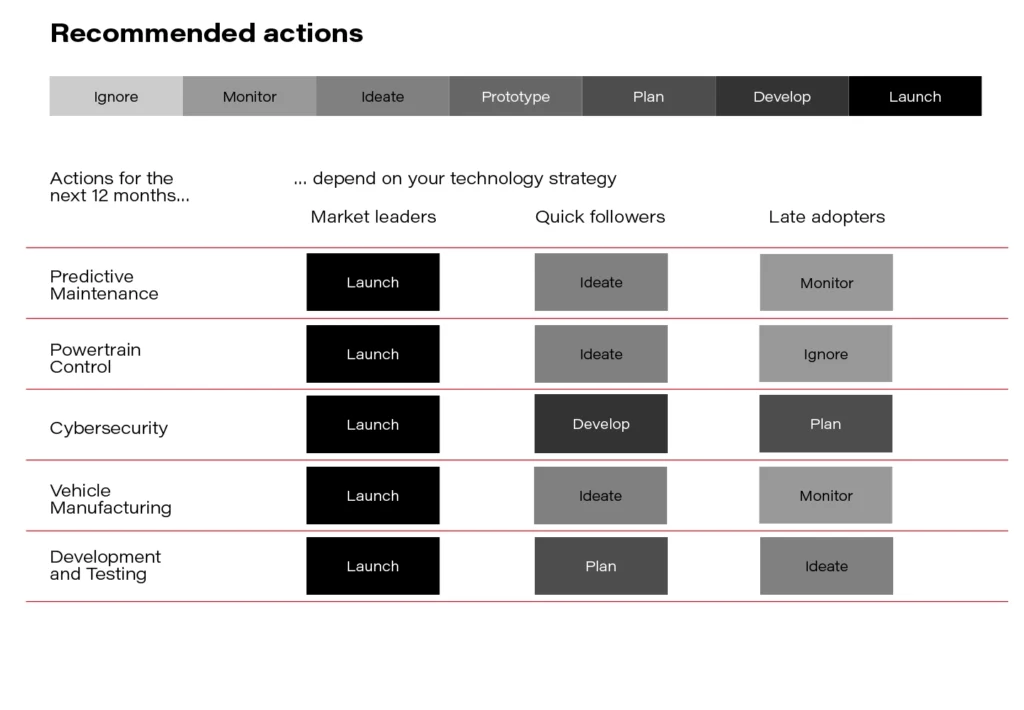
Based on this overview, it's good to see that the leaders don't have too much choice, and over the next 12 months, they should be releasing solutions that fall into every sub-trend. The issue of cyber security is becoming essential as well . The digital twins have great potential in developing it, so basically all stakeholders should focus on this area.
Interested in our services?
Reach out for tailored solutions and expert guidance.