
Cloud solutions and AI software to serve the transport in cities of the future


Cities of the future are spaces that are comfortable to live in, eco-friendly, safe, and intelligently managed. It's hard to imagine such a futuristic scenario without the use of advanced technology. Preferably one that combines various elements within one coherent data processing system. Especially great potential lies in solutions at the crossroads of automotive, telematics, and AI. Let's dive into the transport in cities of the future.

GPS data
GPS technology gives developers the ability to monitor the vehicle position in real-time, and on top of that generate the data on parameters such as speed, distance, and travel time. Using this kind of telemetry information , combined with fuel level, speed limits, traffic information, and the estimated time of arrival, the urban transportation passengers can be instantly alerted to ongoing, but also predicted delays and problems on route.
An advanced version of this system can also propose different routes, to avoid building up traffic in congested areas and reduce the average travel time of the passengers, making everyone happy.
Sensors and detectors
Installed along roads, such elements collect data on traffic volumes, vehicle speeds, and which lanes are being occupied. Sensors embedded in roads are used today by about 25% of smart city stakeholders in the United States (Otonomo study).
Additionally, the so-called agglomerative clustering algorithm helps to identify clusters of places or destinations.
Connected Vehicles (CV)
The latest generation of intelligent transportation systems works closely with the Internet of Things (IoT), specifically the Internet of Vehicles(IoV). This allows for increased efficiency, mobility, and safety of autonomous cars.
Wireless connectivity provides communication in indoor and outdoor environments . There is possible interaction:
- Vehicle-to-vehicle (V2V),
- Vehicle to Vehicle Sensor (V2S),
- Vehicle-road infrastructure (V2R),
- Vehicle-Internet (V2I).
In the latter case, the vehicle couples with ITS infrastructure: traffic signs, traffic lights, and road sensors.
Digital twin (case study: Antwerp)
A digital twin is a kind of bridge between the digital and physical worlds . It supports decision-makers in their complex decisions about the quality of life in the city, allowing them to budget even more effectively.
In the Belgian city of Antwerp a digital twin, a 3D digital replica of the city, was launched in 2018. The model features real-time values from air quality and traffic sensors.
The city authorities can see exactly what the concentration of CO2 emissions and noise levels are in the city center. They also notice to what extent limited car traffic in certain city areas affects traffic emissions.
Automated Highway Systems (AHS)
Connected vehicles have opened the way for further innovations. Automated highway systems will be among them. Fully autonomous cars will move along designated lanes. The flow of cars will be controlled by a central city system.
The new solution will allow the causes of congestion on highways to be pinpointed and reduces the likelihood of collisions.
Traffic zone division
Traditional traffic zoning takes into account the social and economic factors of an area. Whereas today, this can be based on much better data downloaded in real-time from smartphones. You can see exactly where most vehicles are accumulating at any given time. These are not always "obvious" places, because, for instance, at 3 p.m. there may be heavier traffic on a small street near a popular corporation than on an exit road in the city center.
This modern categorization simplifies the city's complex road network, enabling more efficient traffic planning without artificial division into administrative boundaries.
Possibilities vs. practice
There are some interesting findings from a study conducted in 2021 by the analytics firm Lead to Market. It aimed to determine how cities are using vehicle data to enhance urban life. Today, these are being used for:
- alleviating bottlenecks in cities for business travelers and tourists (36%),
- better management of roads and infrastructure (18%),
- spatial and urban planning (18%),
- managing accident scenes (14%),
- improving parking (6%),
- mitigating environmental impacts (2%).
Surprisingly, however, only 22% of respondents use vehicle data for real-time daily traffic management. What could be the reason behind this? Ben Wolkow, CEO of Otonomo, points to one main reason: data dispersion. Today, it comes from a variety of sources. Meanwhile: for connected vehicle data to power smart city development in a meaningful way, they need to shift to a single connected data source .
It's good to know that data from connected vehicles currently account for less than one-tenth of smart city analysis. But experts agree that this will be changing in favor of new solutions.
Technology that shapes the city
Vehicles are becoming increasingly intelligent and connected. Hardware, software, and sensors can now be fully integrated into the digital infrastructure. On top of that, full communication between vehicles and sensors on and off the road is made possible. Wireless connectivity, AI , edge computing, and IoT are supporting predictive and analytical processes in larger metropolitan areas.
The biggest challenge, however, is the skillful use of data and its uninterrupted retrieval. It is, therefore, crucial to find a partner with whom you can co-develop, e.g. some reliable traffic analysis software.

Grape Up guides enterprises on their data-driven transformation journey
Ready to ship? Let's talk.
Check related articles
Read our blog and stay informed about the industry's latest trends and solutions.
Predictive transport model and automotive. How can smart cities use data from connected vehicles?
There are many indications that the future lies in technology. Specifically, it belongs to connected and autonomous vehicles(CAVs), which, combined with 5G, AI, and machine learning, will form the backbone of the smart cities of the future. How will data from vehicles revolutionize city life as we've known it so far?
Data is "fuel" for the modern, smart cities
The UN estimates that by 2050, about 68 percent of the global population will live in urban areas. This raises challenges that we are already trying to address as a society.
Technology will significantly support connected, secure, and intelligent vehicle communication using vehicle-to-vehicle (V2V), vehicle-to-infrastructure (V2I), and vehicle-to-everything (V2X) protocols. All of this is intended to promote better management of city transport, fewer delays, and environmental protection.
This is not just empty talk, because in the next few years 75% of all cars will be connected to the internet, generating massive amounts of data. One could even say that data will be a kind of "fuel" for mobility in the modern city . It is worth tapping into this potential. There is much to suggest that cities and municipalities will find that such innovative traffic management, routing, and congestion reduction will translate into better accessibility and increased safety. In this way, many potential crises related to overpopulation and excess of cars in agglomerations will be counteracted.
What can smart cities use connected car data for?
Traffic estimation and prediction systems
Data from connected cars, in conjunction with Internet of Things (IoT) sensor networks, will help forecast traffic volumes. Alerts about traffic congestion and road conditions can also be released based on this.
Parking and signalization management
High-Performance Computing and high-speed transmission platforms with industrial AI /5G/ edge computing technologies help, among other things, to efficiently control traffic lights and identify parking spaces, reducing the vehicle’s circling time in search of a space and fuel being wasted.
Responding to accidents and collisions
Real-time processed data can also be used to save the lives and health of city traffic users. Based on data from connected cars , accident detection systems can determine what action needs to be taken (repair, call an ambulance, block traffic). In addition, GPS coordinates can be sent immediately to emergency services, without delays or telephone miscommunication.
Such solutions are already being used by European warning systems, with the recently launched eCall system being one example. It works in vehicles across the EU and, in the case of a serious accident, will automatically connect to the nearest emergency network, allowing data (e.g. exact location, time of the accident, vehicle registration number, and direction of travel) to be transmitted, and then dial the free 112 emergency number. This enables the emergency services to assess the situation and take appropriate action. In case of eCall failure, a warning is displayed.
Reducing emissions
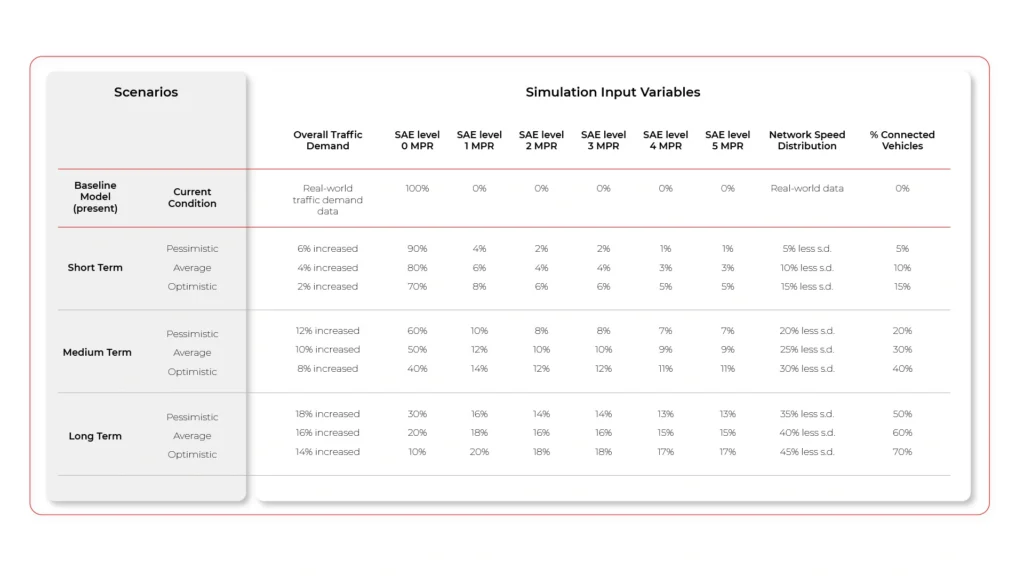
Less or more sustainable car traffic equals less harmful emissions into the atmosphere. Besides, data-driven simulations enable short- and long-term planning, which is essential for low-carbon strategies.
Improved throughput and reduced travel time
Research clearly shows that connected and automated vehicles add to the comfort of driving. The more such cars on the streets, the better the road capacity on highways.
As this happens, the travel time also decreases. By a specific amount, about 17-20 percent. No congestion means that fewer minutes have to be spent in traffic jams. Of course, this generates savings (less fuel consumption), and also for the environment (lower emissions).
Traffic management (case studies: Hangzhou and Tallinn)
Intelligent traffic management systems (ITS) today benefit from AI . This is apparent in the Chinese city of Hangzhou, which prior to the technology-transportation revolution ranked fifth among the most congested cities in the Middle Kingdom.
Data from connected vehicles there helps to efficiently manage traffic and reduce congestion in the city's most vulnerable districts. They also notify local authorities of traffic violations, such as running red lights. All this without investing in costly municipal infrastructure over a large area. Plus, built-in vehicle telematics requires no maintenance, which also reduces operating costs.
A similar model was compiled in Estonia by Tallinn Transport Authority in conjunction with German software company PTV Group. A continuously updated map illustrates, among other things, the road network and traffic frequency in the city.
Predictive maintenance in public transport
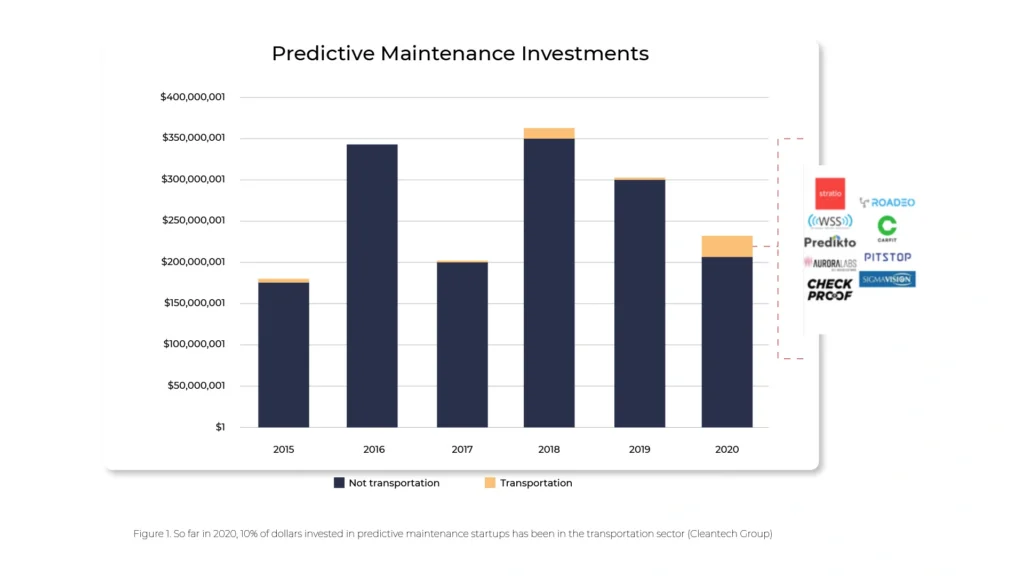
Estimated downtime costs for high-utilization fleets, such as buses and trucks, range from $448 to $760 daily . Just realize the problem of one bus breaking down in a city. All of a sudden, you find that delays affect not just one line, but many. Chaos is created and there are stoppages.
Fortunately, with the trend to equip more and more vehicles with telematics systems, predictive maintenance will be easier to implement. This will significantly increase the usability and safety of networked buses . Meanwhile, maintenance time and costs will drop.
Creating smart cities that are ahead of their time
Connected vehicle data not only make smart cities much smarter, but when leveraged for real-time safety, emergency planning, and reducing congestion, it saves countless lives and enables a better, cleaner urban experience – said Ben Wolkow, CEO of Otonomo.
The digitization of the automotive sector is accelerating the trend of smart and automated city traffic management. A digital transport model can forecast and analyze the city’s mobility needs to improve urban planning.
Not only the self-driving vehicles: 9 use cases of AI in transportation
Accidents, traffic congestion, lack of parking lots and poor state of roads. These are the 4 Horsemen of the Road Apocalypse that on occasion haunt cities around the globe. Have they come to settle in the largest agglomerations for good? Can AI in transportation combat them and make mobility smoother, more comfortable, and safer? Practical solutions introduced by the biggest transport companies from all over the world show that it is possible. And we do not have to wait for fully self-driving cars to use the advantages of AI. The changes are happening right before our eyes.
In 1900, the number of vehicles in the USA - the only country that produced cars at the time - reached 4192 vehicles. Today, the number of motor cars is estimated to be around 600 million, and with the current growth in production, this number is expected to double in the next 30 years. Our cities are congested, polluted and in many places getting around in a car during rush hour borders on the miraculous. Not to mention the real endurance test that drivers' nerves are put to.
Government agencies and shipping companies must explore solutions that reduce the number of vehicles in cities and equip urban infrastructure and cars with tools that effectively offset the side effects of technological globalization. The Internet of Things and artificial intelligence are coming to the rescue to facilitate a new class of intelligent transportation systems (ITS), not only for automotive but also for rail, marine, and aircraft transportation.
By analyzing massive amounts of data from vehicles and connecting the road infrastructure into a seamless network of information exchange , many aspects of transportation can be successfully addressed. The benefits of using AI in this market area are not only for cities and drivers but also for transport companies, pedestrians, and the environment. The whole transport ecosystem benefits from it, not just one of its constituent parts. We should all care about the development of these technologies and the broadest possible use of them in transport.
Thanks to the above-mentioned technologies, new trends are developing, such as micro-mobility, shared mobility or, especially in the Netherlands and Scandinavia, the idea of mobility-as-a-service (MaaS), which encourages drivers to give up their own vehicle and exchange it for one in which transport is provided as a service.
Benefits of introducing AI in transportation
According to Market Data Forecast, the global transportation AI market will be worth around $3.87 billion by 2026 and is estimated to grow at a CAGR of 15.8% between 2021 and 2026. And it's no wonder that more and more businesses are embracing these solutions. The benefits of using AI technology in transportation are truly far-reaching and, indeed, their future is looking bright. With the development of data analytics and more modern sensors gathering information, new and innovative applications are bound to emerge.
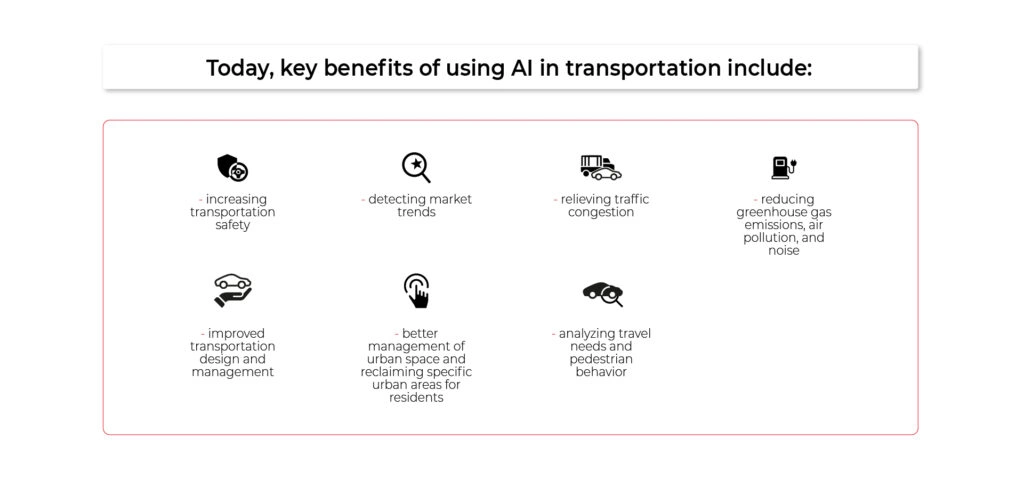
Today, key benefits of using AI in transportation include:
- increasing transportation safety;
- detecting market trends;
- relieving traffic congestion;
- reducing greenhouse gas emissions, air pollution, and noise;
- improved transportation design and management;
- better management of urban space and reclaiming specific urban areas for residents;
- analyzing travel needs and pedestrian behavior.
9 use cases of AI in transportation
When talking about using AI in transportation, self-driving cars are the most often mentioned examples that stir the imagination. Although such solutions have already been tested on the city streets (e.g. Waymo and Cruise in California) and occasionally we hear news about reaching by the manufacturer the highest (5th) level of automation, we are still a little away from the dissemination of vehicles that do not need any attention of the driver.
The main challenges faced by autonomous driving remain unchanged. First, detection of objects on the road and their categorization, and second, making the right decisions by the neural network, decision tree, or, in most cases, complicated hybrid model.
In 95% of cases, the neural network controlling the vehicles is already behaving correctly and making the best possible decisions. But there is still a marginal 5%, and this level is the most difficult to achieve at the moment. It simply takes time and more data to "train" a neural network. With the dropping price of LIDARs [light detection and ranging sensors], high resolutions camera, and the computing power of the GPUs [graphic processing units] increasing, it is only a matter of the next few years before this barrier is overcome - first in limited controlled areas (e.g. factories and harbors), the form of autonomized truck transport, and then using city vehicles.
Meanwhile, there are already more than a dozen advanced technologies on the road today that are taking advantage of the AI ‘’goodies’’ and changing the way we control vehicle flow, driver safety, and driving behavior. Let's take a closer look at them.
1.Traffic detection & traffic signs
If traffic regulations were boiled down to one simple rule that even a few-year-old child could understand, red and green lights would definitely be second to none. Meanwhile, there are hundreds of road accidents each year related to running the red light and not stopping the vehicle at the right moment. Many factors contribute to this, such as driver fatigue, inclement weather, misuse of cell phones while driving, or simply rushing and time pressure.
People make mistakes and always will, these cannot be avoided. However, we have started to teach the machine to recognize traffic lights and eradicate such mistakes (the first attempts were made by BMW and Mercedes). With this technology, the braking system will react automatically when the driver tries to run a red light, and thus we can prevent disaster.
2. Pedestrian detection
The unpredictability of pedestrians and their different behavior on the road is one of the main factors holding back the mass introduction of autonomous cars. Thanks to computer vision, AI already recognizes trees, unusual objects, and pedestrians without much of a struggle, and can warn drivers of a human approaching the roadway. The problem arises when a pedestrian is carrying groceries, holding a dog on a lead, or is in a wheelchair. Their unusual shape increases the difficulty for the machine to properly identify a human. Although it must be admitted that by using various object detection functions - based on motion, textures, shapes, or gradients - it is practically 100% successful.
However, the pedestrian's intention still remains a great challenge. Will he or she step onto the road or not? Are they only walking by the side of the road, or do they intend to cross it? These elements are always ambiguous and a neural network is needed to predict them effectively. To this end, the human pose estimation method comes in handy. It is based on the dynamics of the human skeleton and is capable of predicting human intentions in real-time.
3.Traffic Flow Analysis
Noise, smog, clogged city arteries, stressed drivers, economic losses, greenhouse gas emissions - traffic congestion and vehicle crowding in cities give rise to numerous undesirable phenomena. AI can effectively help counteract all of them and make transportation much more efficient and convenient.
By relying on in-vehicle sensors, municipal CCTV cameras, and even drones to monitor vehicle flow, the algorithms can watch and keep track of the traffic both on highways and in the city. This allows them to warn drivers of potential congestion or accidents and direct the flow of vehicles in an efficient manner. It is also invariably useful for the town and urban planners involved in constructing new roads and improving the city's infrastructure. With prior traffic analysis and the vast amount of data available, AI can identify the best planning solutions and help reduce undesirable situations right at the planning stage.
4.Inspection of dangerous turns, traffic circles and bike lanes
On a macro scale AI can help us change the entire road network, and on a micro-scale- a single intersection or traffic circle that needs repair. The analysis of the material provided by intelligent algorithms can calculate the trajectory of vehicles entering the bend, analyze the risk of potential conflicts between vehicles - pedestrians - cyclists, the speed at which vehicles enter the bend, or the waiting time at the traffic lights. The analysis of all this invaluable information can help optimize a given road section, and improve the safety and convenience of transport.
5.Computer Vision-Powered Parking Management
Entering the city center by car and finding a parking lot is often a struggle. If we connect the city's parking lots into an efficient network of sensors that monitor available spaces, the length of time vehicles are parked, and the hours when vehicles are most heavily congested, this key aspect of traffic can be greatly enhanced. With maps embedded in vehicles, AI can facilitate finding free parking spots, alert you to potential parking overcrowding, and - something actually pretty common - allow you to find your car when you forget where you parked it.
Such solutions are particularly useful in places such as airports, sports stadiums or arenas, where traffic must be smooth, and a high volume of visitors may pose a threat to safety.
6. Automated license plate recognition
A useful application of AI and computer vision is car license plate recognition. This type of technology is often used when entering highways, tunnels, ferries, or restricted areas constrained by gates or barriers. AI helps verify whether a given vehicle is on the list of registrations that, due to the fee paid or the drivers' status, are allowed to access a given area.
License plate recognition by algorithms is also a well-proven tool in the hands of the police and security services, who in this way are able to pinpoint the route of a particular vehicle or verify the driver's alibi.
7. Road condition monitoring
Each year potholes cause $3,000,000,000 worth of damage to vehicles in the U.S. alone. Intelligent algorithms can warn drivers of surprises lurking on the roads and monitor the condition of the road surface, so they can notify the authorities in advance of potential spots that will soon need fixing. This is enabled by linking the camera to ADAS, which applies machine learning to gather real-time information from the road surface where it is moving.
In this way, the driver can be warned not only of roadway damage but also of wet surfaces, ice, potholes or dangerous road debris. All of this improves safety for travelers, prevents accidents, and saves money - both in terms of drivers' finances and city funds.
8. Automatic Traffic Incident Detection
Video surveillance has been with us on the roads for ages, but it wasn't until the system was supported by AI solutions that it became possible to detect traffic incidents more efficiently, respond faster and provide information to traffic users practically in real-time.
By linking cameras within an ITS system, using computer vision technology, and equipping vehicles with intelligent sensors, we can detect different types of accidents. Intelligent algorithms save lives, prevent serious accidents and warn road users of hazardous situations by recommending safer travel options.
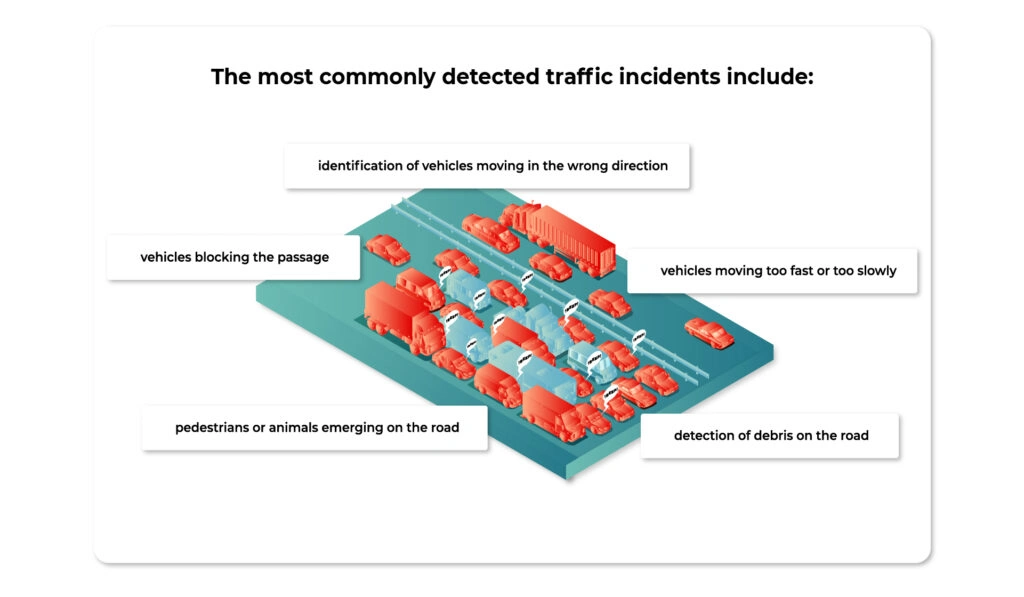
The most commonly detected traffic incidents include:
- pedestrians or animals entering on the road;
- vehicles moving too fast or too slowly;
- vehicles blocking the passage;
- detection of debris on the road;
- identification of vehicles moving in the wrong direction
9. Driver Monitoring
Finally, there is a full category of artificial intelligence solutions that apply directly in the interior of the car and affect the drivers themselves (we covered this in more depth in this article ). Among them, three are particularly noteworthy:
- driver’s fatigue monitoring - by detecting the driver's face and estimating the position of the head, the system can detect drowsiness and emotions of the driver and thus prevent an accident.
- alerts when the driver gets distracted - for instance, when they reach for their cell phone, veer out of their lane, or turn around in the back seat to talk to fellow passengers.
- emergency assist systems - when the driver is not responsive and does not operate the vehicle, the car first tries to wake the driver by braking and pulling safety belts, and if it fails pulls over and calls emergency.
AI in transportation: setting the course for change
Given the speed at which computer processing power is changing and the number of sensors from which data is being collected , fully automated cars on city roads are likely to be a question of the nearest 5-10 years. Change is happening at an exponential rate and today's applications of AI in transportation are just the first glimpse of the possibilities offered by intelligent algorithms. Change is essential and inevitable, e.g. due to the challenges facing the global community when it comes to global warming.
An increasing number of people live in cities, own not one but two vehicles, and want to travel to work or do their shopping in comfort. Transport companies and city managers must join forces with IT companies to fully tap into the potential of AI and change transport to be more efficient, environmentally friendly and suited to the way we want to use our cities. This is the only way we can make transportation sustainable and remove obstacles on the way to a zero-carbon economy and smart cities. Otherwise, we may face a vision of the future in which scientists predict traffic congestion 10 times worse than we experience today.
Interested in our services?
Reach out for tailored solutions and expert guidance.