
In-car infotainment: How to build long-term relationships and unlock new revenue streams


With the automotive industry seeking to create a more comfortable and enjoyable travel experience for its customers, automakers and designers are stepping up investment in in-car infotainment solutions. These technologies aim to personalize the travel experience by providing noise reduction, in-vehicle sound zones, and immersive audio/video content tailored to the driver's lifestyle. And more importantly, they contribute to building OEM customer loyalty, new revenue streams, and creating lasting customer relationships.
Four in-car entertainment strategies, almost endless opportunities to build a new offer
There is no turning back from in-car entertainment. The development of flat screens, broadband internet access, and the possibility of personalization and customization of content to the viewer are the reasons why no one is willing to give up this form of service.
For automakers, it's an opportunity to build a stronger relationship with their customers and create new (often subscription-based) revenue models .
For the driver and especially for passengers, it's about overcoming the boredom associated with long journeys and introducing solutions into vehicles that until now have been known for their high-end audiophile systems.
No wonder an increasing number of OEMs today are consciously developing the concept of the digital cockpit of the future . This approach is supposed to shift the focus from the practical functionality of the vehicle to providing compelling entertainment.
Most popular in-car infotainment strategies
Of course, the process of change is not simple and cannot happen overnight. It requires continuous growth in vehicle technological performance, partially related to the car's GPU, E/E Architecture, 5G Internet access, and the development of new display forms. Nevertheless, OEMs have at their disposal one of the following four strategies for developing such solutions.
1. Rear-Seat Entertainment
Using this strategy, entertainment is streamed to displays located in the rear seats or on the roof of the vehicle (for example, the BMW i7)... The user does not need to use a smartphone or tablet in addition to this solution to enjoy the leisure experience.
2. Any-Seat Entertainment
In this solution, content streaming can apply to all displays of the infotainment system in the car (including the driver's seat) - again without having to use smartphones and tablets to navigate. This concept allows video viewing, e.g., while charging an electric car.
3. Augmented Entertainment
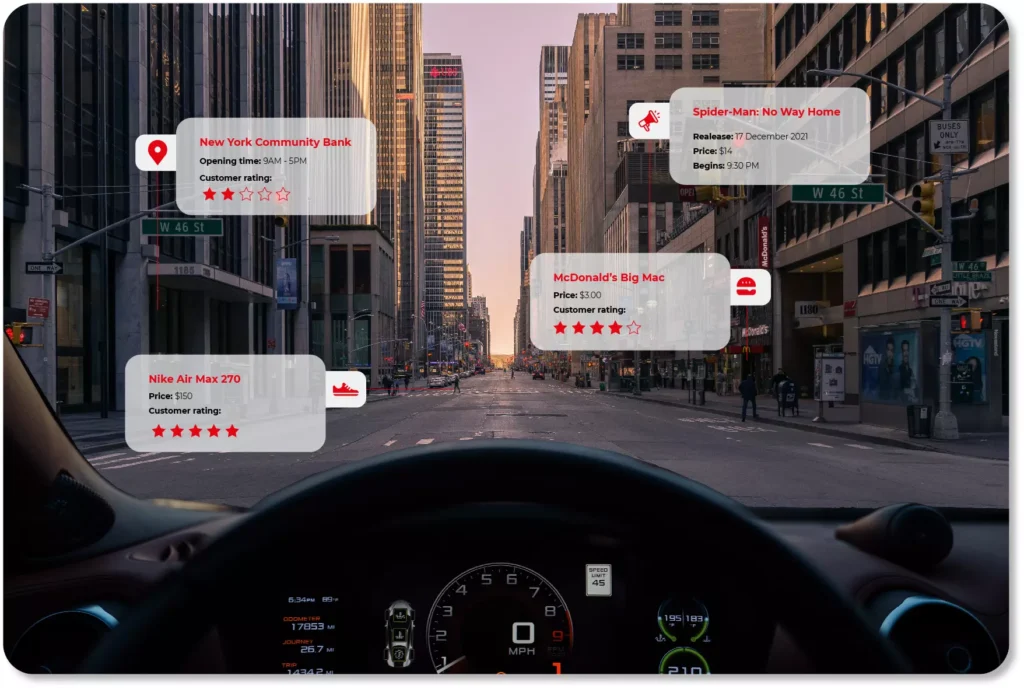
A step further can be taken by manufacturers who incorporate the capabilities of 4D cinema and AR applications into their offer. This approach creates a whole new kind of driver's cockpit and develops a unique UX that may become a vehicle's trademark. This type of screen has a variety of potential applications, such as displaying destination-related information, traffic warnings, or intelligent terrain mapping of other vehicles. In the near future, this technology may also be used for augmented marketing, such as showing interesting offers and discounts from nearby restaurants, shops, or malls on the windscreen.
4. Live Entertainment
Finally, real-time entertainment services enable car-to-car interaction and/or social networking among vehicle users. These types of solutions can be used to share viewing, commentary, and engagement among vehicle users through cultural events or music concerts, for example.
New possibilities of infotainment in cars. The 2022 perspective
The ability to combine modern audio-visual technologies with data analytic s and personalized user information allows OEMs to create entirely new services and products, often ones previously unrelated to the automotive industry.
- Among these the most notable is, of course, streaming video and audio content, which is usually based on partnerships with third parties (e.g., Netflix, Amazon, YouTube, Apple TV or Spotify) and usually operate on a subscription model. In the future, the car is likely to become another medium where we can simply activate the service and continue watching videos, as we move from the living room to the vehicle.
- Access to gaming platforms and services that will provide an interactive way of spending time for the driver and passengers while traveling or charging their EV.
- A tourist offer that is related to visiting a particular place - acts as a virtual travel agency, which highlights specific points on the map and expands the knowledge of the visited locations (also in the form of quizzes or riddles for passengers).
- Audiovisual, highly personalized ads, tailored to the context of where we are traveling, the driver's needs, or resulting from the wear and tear of the vehicle components.
Dynamic growth of the in-car infotainment market
With each passing year, there are new examples of interesting implementations in in-car entertainment, and the market itself is growing rapidly. In 2020, it was valued at more than $21 million, while by 2028 it is predicted to grow to more than $37.5 million, registering a CAGR of 7.5% from 2021 to 2028.
Below is a rundown of the most interesting advanced infotainment solutions that are becoming increasingly popular and have been implemented by specific OEMs in recent times.
- Larger display and video entertainment on demand
With large displays and the increasingly widespread streaming of video and audio content into the vehicle, a substantial base is becoming established for the development of infotainment in the automotive industry.
It is all about introducing more immersive services and features in vehicles. This is especially relevant for EVs, because, after all, drivers need to pass their time somehow while charging their vehicles at public stations, and this can be done from the comfort of the car seat.
Total spending on video on demand is expected to reach $127 billion by 2025 (11.8% CAGR). Video streaming alone is expected to account for 86% of revenues .
The chart below illustrates how trends are changing in terms of screen sizes in today's automotive market . It is noticeable that, roughly since 2017, there has been a marked increase in the use of large displays in vehicles.
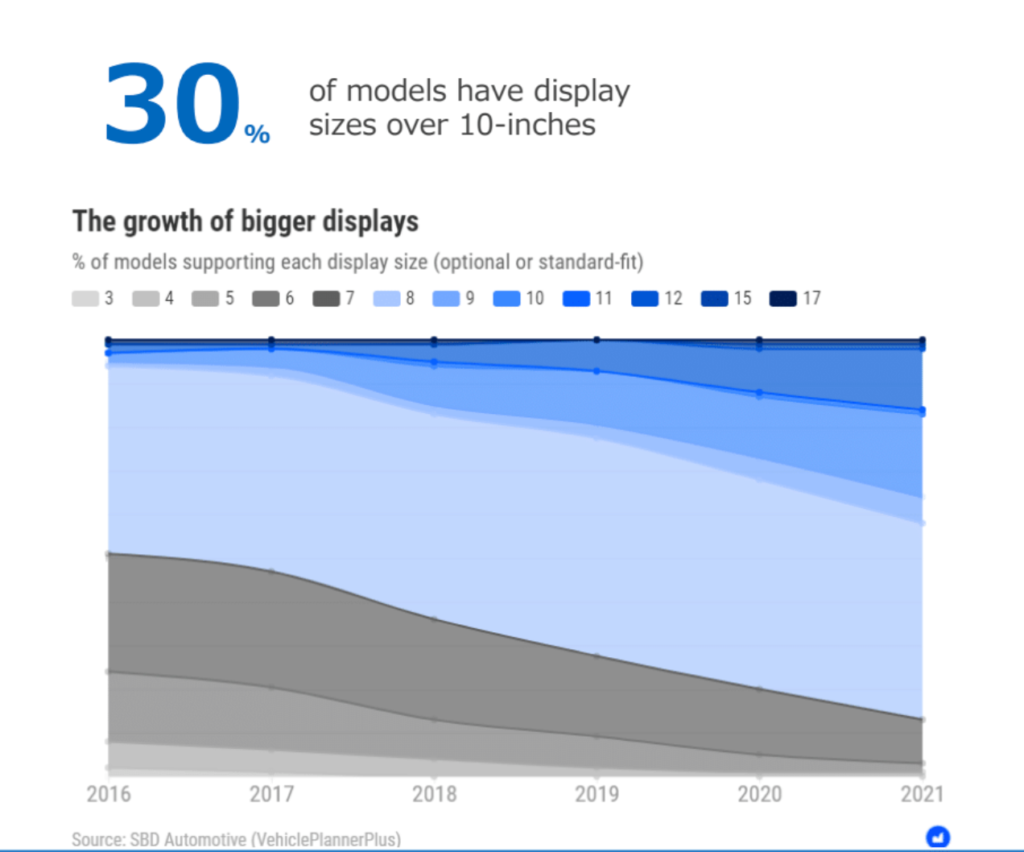
Continuing down this path, major OEMs are already announcing in-vehicle video streaming services that use this type of display and video entertainment. Some of the latest examples from the market are as follows:
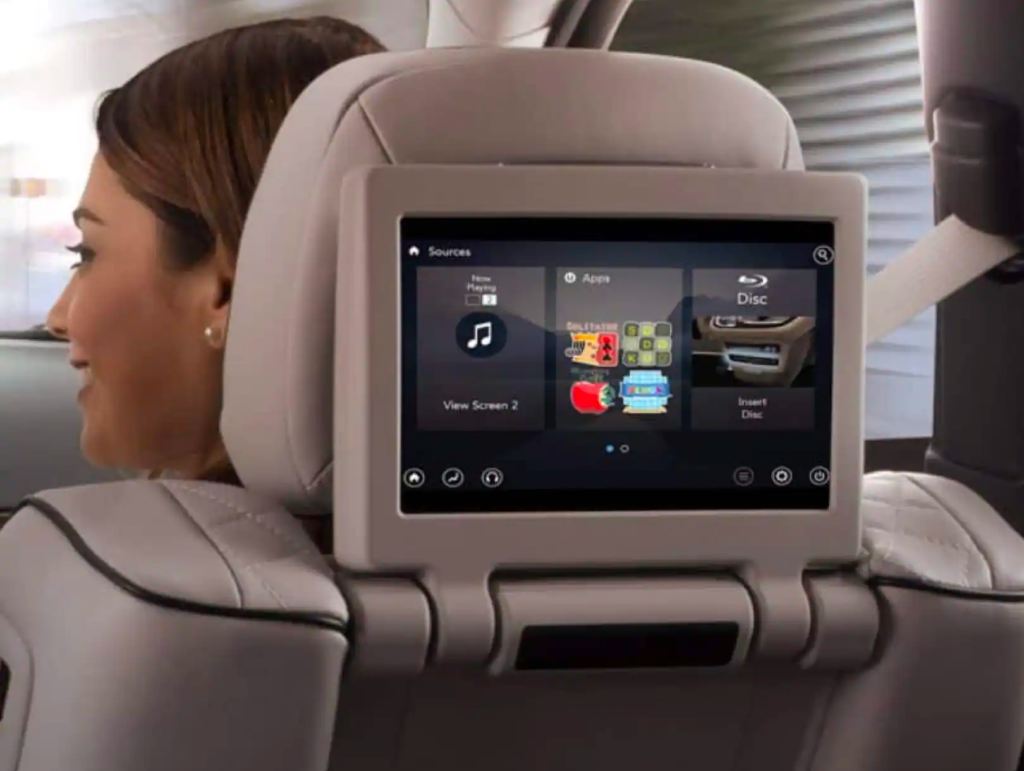
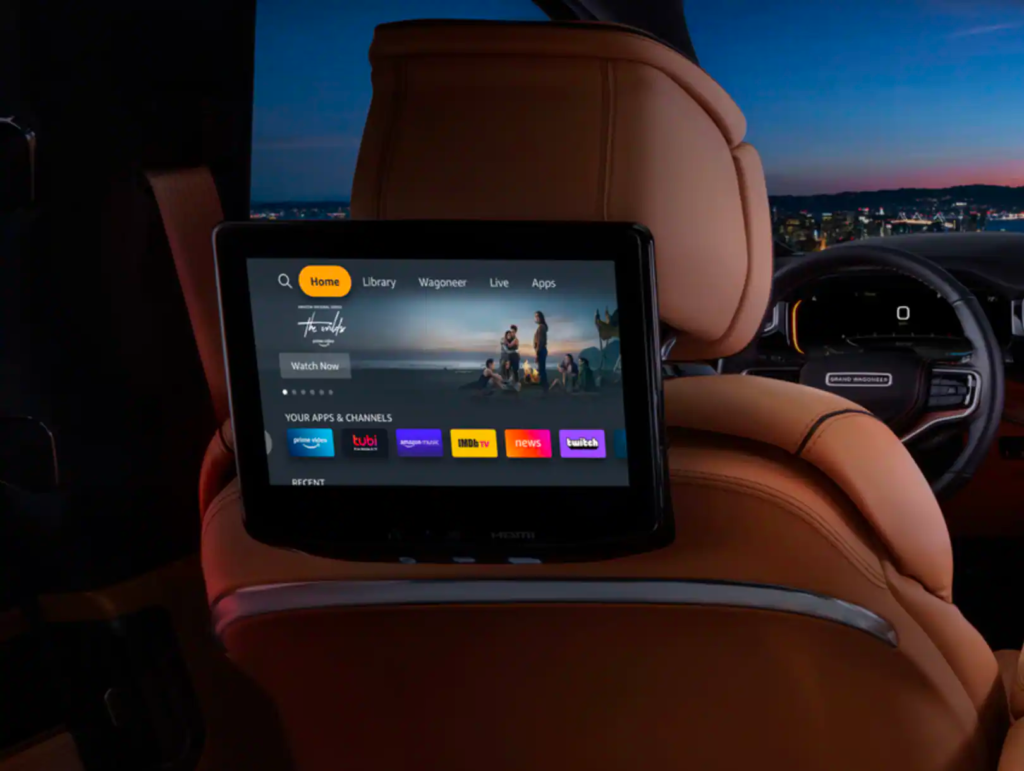
- Jeep Wagoneer and Grand Wagoneer from the Stellantis fleet have recently been offering Amazon Fire TV as infotainment for rear-seat passengers. It allows users to stream movies, shows, or games via a Wi-Fi hotspot or download content for later. The same service will also be implemented in vehicles from Ford Motor Co . factories.
- Volvo intends to implement a YouTube app, available via the Play Store in vehicles equipped with Google Automotive Services. The idea is to provide entertainment while charging an EV.
- BMW has recently unveiled its proprietary Theater Screen concept. This mode adjusts lighting and dimming, converting the car's interior into a mobile theater. The idea is supposed to be workable thanks to a 31-inch widescreen display. It offers a 32:9 aspect ratio and 8K resolution and includes built-in Amazon Fire TV and smart TV features.

- Enhanced in-vehicle display capabilities with flexible interactive displays
Design teams are persistently seeking ways to further integrate displays into the surface of a car's dashboard. Some of the most remarkable solutions in the automotive market today are Flexible Interactive Displays (FITs).
They allow manufacturers to provide more display areas for infotainment functions . All vehicle elements, such as Center consoles, pillars, and seat backs, can potentially be converted into one large screen. It could extend across the entire passenger space, turning the vehicle into a mobile movie theater or high-tech office. These types of solutions are already being tested by ROYOLE.
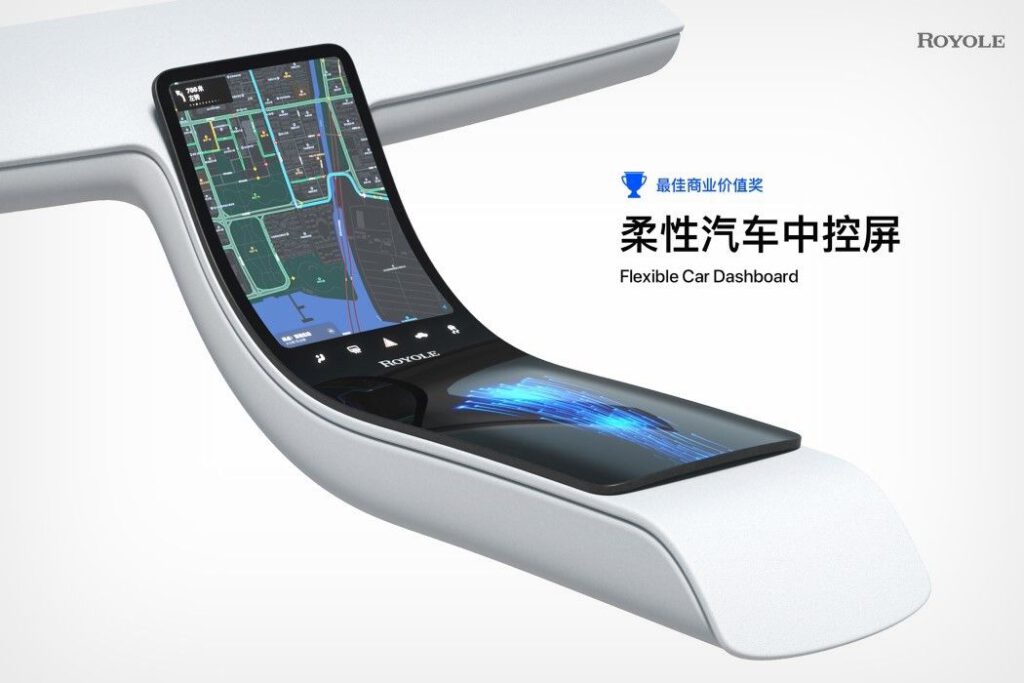
This technology is essential not only for convenience but also for safety. This is due to the idea of replacing layers of glass (traditionally used in automotive electronics) with durable plastic.
In the future, it might be possible to build sensors (e.g. fingerprint reader) into the display area. This will enable the interface to be controlled from a screen spanning the entire surface.
- The sound provides a more comfortable experience
While video content has only recently begun to make its way into cars, a good sound system and access to music have always been part of the automotive experience (in fact, for many consumers they were an essential factor in deciding whether to purchase a particular vehicle). Car manufacturers and designers are well aware of this and are stepping up their investments in the following solutions.
- Noise reduction. A focused anti-noise system prevents the penetration of noises common to driving but does not block sounds important to maintaining safety (such as emergency sirens). Next-generation active noise cancellation has been applied, for example, in the new Cadillac Lyriq, where it intelligently measures road vibrations and, using an AKG speaker system, actively reduces noises from outside.
- In-vehicle Sound Zones. This allows the driver and passengers to access different audio content. There is also an option to share the same sound at different volume levels. An additional advantage of such solutions is that unwanted music from the back seat does not distract the driver during the ride.
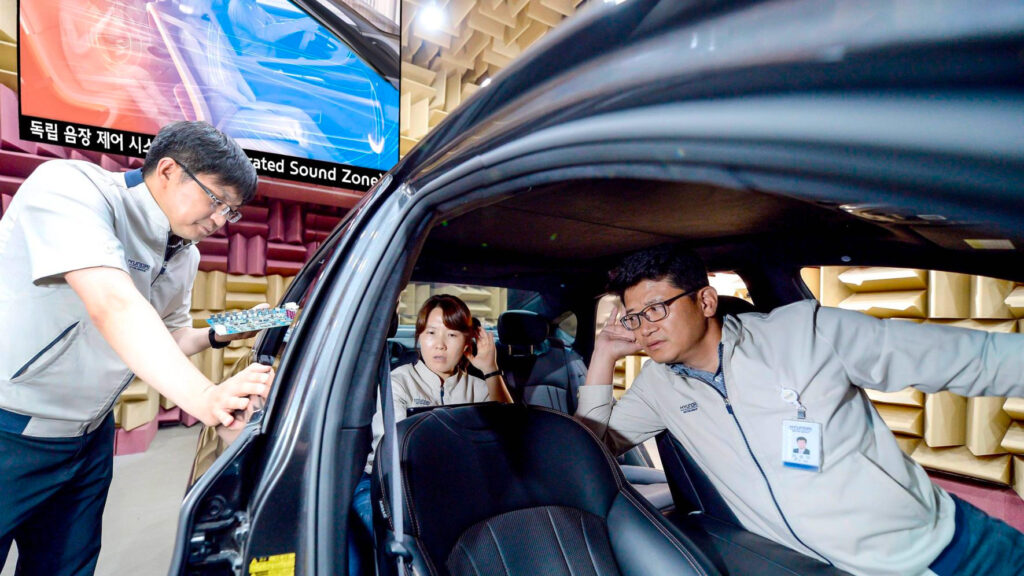
Hyundai , for example, is testing such a solution. Whilst using the latest-generation Separated Sound Zone (SSZ) technology developed in-house, the Asian brand is able to create and control sound fields in the car. Both the driver and each passenger are able to hear isolated sounds without a headset.
- Immersive solutions customized to the driver's lifestyle
Key players in the market are becoming bolder in developing immersive technologies in their vehicles and emphasizing personalized options to tailor the journey to the user's specifications.
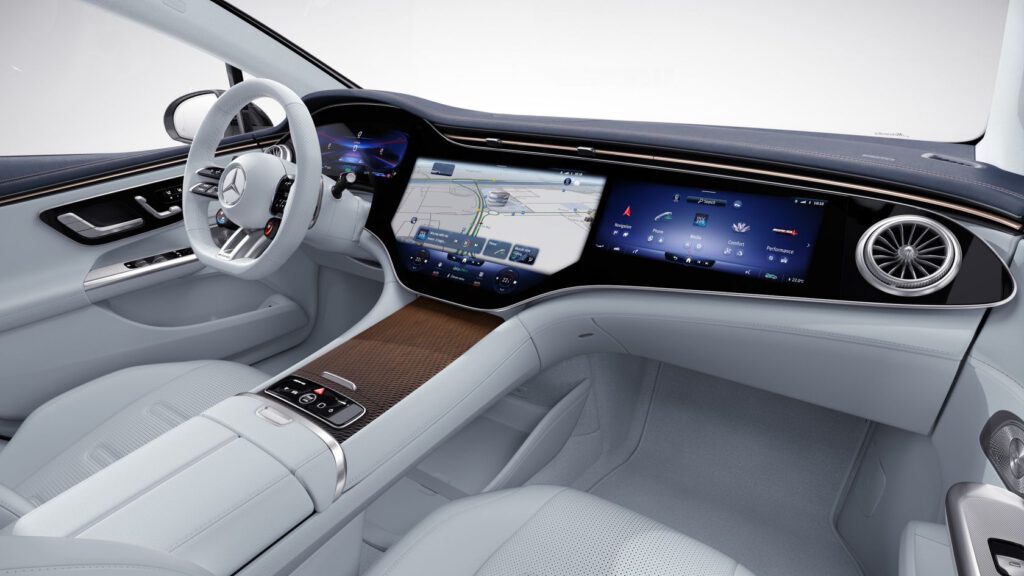
Developed by Mercedes-Benz, MBUX Hyperscreen is a prime example. It is designed to provide a high degree of individualized infotainment content. The vehicle users can determine for themselves which information to display in a specific place, in a specific order, and in line with a selected theme. In order to aggregate streaming content from various sources within its own vehicles, Mercedes has partnered with California-based ZYNC. The collaboration is expected to help develop a platform and interface that will allow access to digital entertainment from different providers.
The designers of the NIO ES7 Electric SUV are taking it even further. This vehicle will be equipped with Banyan smart OS software and NIO's Aquila Super Sensing and Adam Super Computing platform. All of these will be combined with a compatible digital cockpit based on AR/VR. This is a golden opportunity to"immerse" yourself in a world filled with colors and sounds . The passenger riding in the back can delight in a 200+ inch "screen" and a 7.1.4 Dolby Atmos sound system.
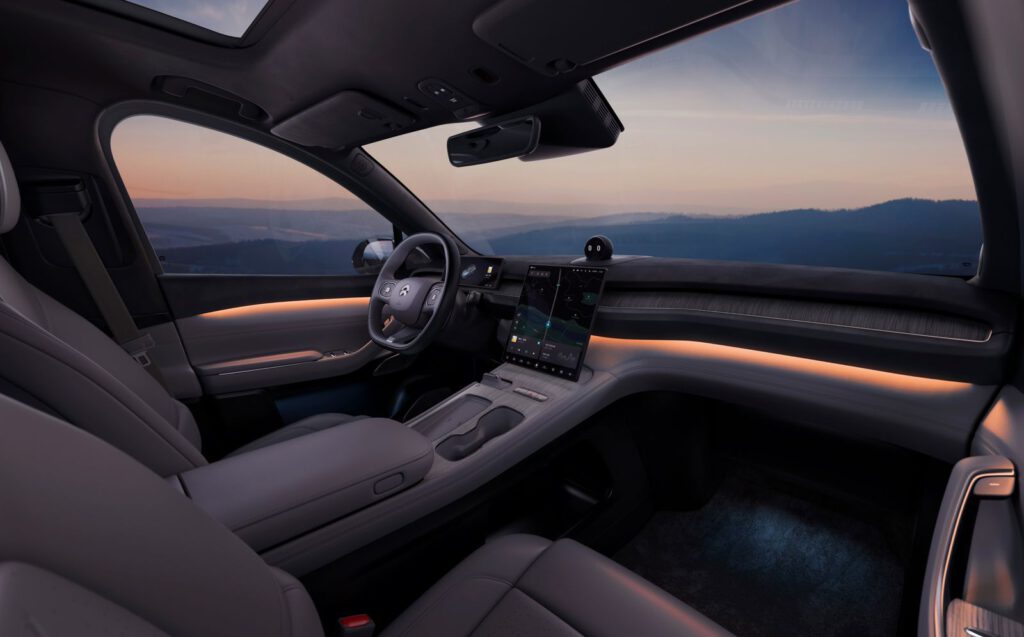
After all, the aforementioned EV is already being advertised by the developers as a "second living room," being a continuation of home entertainment. What is noteworthy is not just the audiovisual system itself, but also the options for dimming the lights or the appropriate choice of seat positions, which are supposed to make the viewer feel as if they are watching a movie at home. This is a perfect example of how the automotive industry is getting closer to the users, their daily life , and their habits.
Why is in-car infotainment a key to building long-term relationships and new revenue streams?
Tremendous competition and market oversupply make it more difficult than ever to commit a customer to a brand. User loyalty needs to be built in many possible ways and new ways to reach out with an offer need to be sought.
Car infotainment is at the cusp of dynamic development and is certainly one of the leading areas that can help find new groups of customers and create lasting relationships with them.
This type of technology is no longer an add-on option, but an indication of "being up-to-date." Manufacturers who focus on the development of car infotainment become trendsetters and initiators of change. They make it clear that they follow their consumers, and understand their lifestyles and expectations. And this is not insignificant for the modern consumer.
Research shows that customers are willing to pay more for a vehicle with these types of solutions - we're talking about up to $10,000 for a single car. In contrast, more than 70% of younger millennials list infotainment technology and features as "must-haves" when buying a car.
With these statistics in mind, it is necessary to remain competitive in this area and constantly develop the offer.
A special focus should be also put on the areas that build customer loyalty and connect them more strongly with the brand, for example:
- access to media- based on a subscription model,
- rich entertainment offerings for the driver and passengers;
- personalization features and adjusting to users' lifestyles;
- a fine-tuned user interface (UX), for a seamless and intuitive experience.
If you combine seamless and intuitive in-car infotainment with a deep understanding of consumer needs, chances for building long-term relationships and unlocking new revenue streams grow dramatically.

Data powertrain in automotive: Complete end-to-end solution
We power your entire data journey, from signals to solutions
Check related articles
Read our blog and stay informed about the industry's latest trends and solutions.
Beyond Spotify and Netflix- the future of in-vehicle infotainment systems in connected cars
It cost a staggering $200 for that time. The antenna took up almost the entire roof of the car, the batteries barely fit under the front seat, and the huge speakers had to be fixed to the back of the seat backrest. The year was 1922, just over 20 years after the launch of the first mass-produced Oldsmobile Curved Dash car. Entertainment had just made its entrance into the car industry - Chevrolet introduced the first car radio. From then on it only got more exciting.
Nowadays, 100 years on from that event, we can no longer envisage a car without radio, music, or news. In fact, we can no longer imagine a car without entertainment in the broadest sense of the word. Because the radio - at least in its traditional form - is slowly becoming obsolete. It's being replaced by a "personal radio station" created by the driver - streaming music, favorite podcasts, audiobooks, and even video content.
Although we are still a far cry from the catchy phrase "a smartphone on wheels" , first uttered in 2011 by Akio Toyoda, the automotive industry is indeed heading in this direction. Cars are ceasing to be vehicles designed to take us from A to B. Like any other device connected to the Internet, they are becoming a gate to new worlds of entertainment, shopping, learning, or gaming.
When finishing shopping or listening to an audiobook on one device, we want to seamlessly continue the activity on a laptop or desktop computer. Whether we like it or not, the car is becoming another medium that will allow us to stay virtually connected all the time.
Akio Toyoda was wrong. A car is much more than a "smartphone" on wheels!
A potentially larger screen than a smartphone (not only the touchscreen in-vehicle infotainment system panel, but the windscreen too, which can also be used to display content), at least 4 seats that can be independently paired with the in-car entertainment system, and, ironically, much more mobility than mobile devices.
As we look at the development of V2X (vehicle-to-everything) technology, which will turn vehicles into the Internet of Things devices, the opportunities that lie ahead for the automotive industry in the entertainment field are hard to estimate.
One thing is certain. This process cannot be stopped. Every company in the automotive industry must be aware of the upcoming changes.
According to IHS Markit data, in 2014 only 53% of cars in the USA had a dashboard touch screen, while today this percentage has already reached 82%. These types of solutions can bring automotive companies entirely new revenue streams, and most importantly they will be less dependent on vehicle production cycles and with much higher margins.
The in-vehicle infotainment system market is estimated to be worth $78.9 billion by 2025. [Allied Market Research].
Quo Vadis in-vehicle infotainment systems?
In-vehicle voice assistants for infotainment control
Siri, Alexa, or Google Now are names that have become part of the consumer market and make life easier for most of us, allowing us to make phone calls, send messages or manage our own calendars. While sending voice commands to our phone or the speaker in our home or office is nothing new, communicating with our own car is still some kind of novelty.
And it is here while driving when we need to focus on the road and have our hands free, that voice technology can be of the most benefit and make driving more efficient and smooth. And of course, more fun.
Navigant Research (Guidehouse) predicts that by 2028, 90% of vehicles will be equipped with a voice assistant. Already today - looking at Voicebot.ai data - a large proportion of commands given by drivers are entertainment-related. Playing music, listening to podcasts, finding out about movies, ordering food, or making purchases directly from behind the wheel is becoming increasingly popular among drivers with enhanced IVI systems.
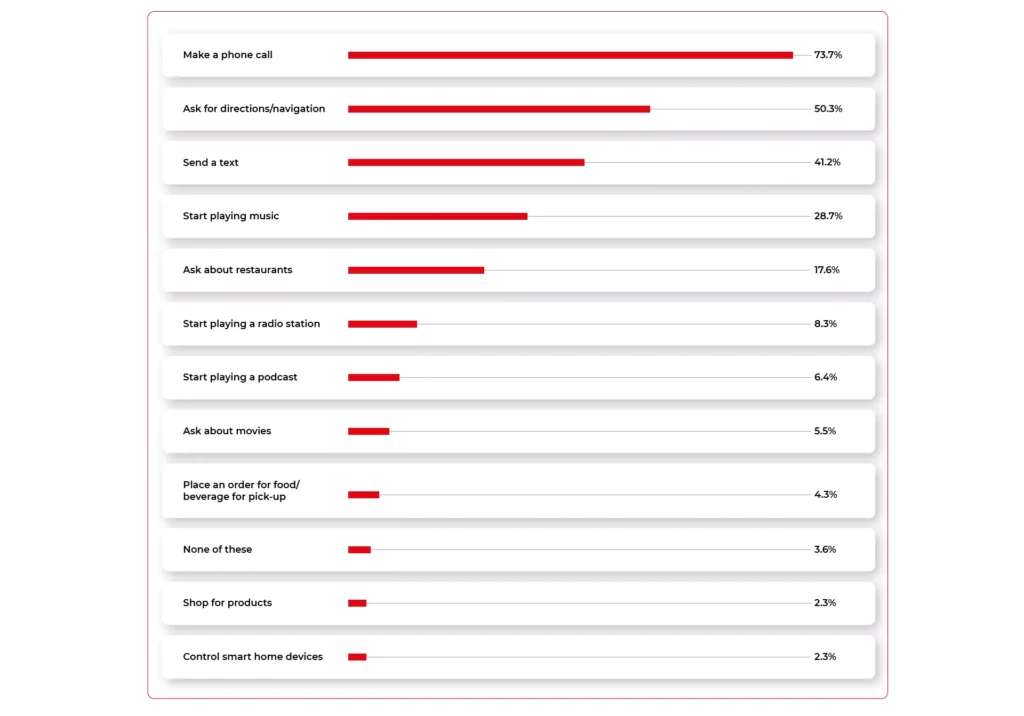
The main players in this section are certainly the manufacturers already known for their other platforms, namely Google and Apple, which are integrating their Android Auto and Carplay technologies in partnership with major OEMs. Hot on its heels is Amazon, which has not only begun collaborating to bring Alexa into Toyota, Ford, and BMW vehicles but also released an Amazon Echo device that any driver can install in their car themselves (as long as it meets the manufacturer's technical requirements).
Vehicle manufacturers, however, are no longer just waiting for the offers of the largest players in this market, but are developing their systems or working with smaller business partners to help them develop such solutions.
Korea's Hyundai has entered into an operation with Saltlux, a company specializing in semantic networks. Honda, Kia Motors, and Daimler are working with the SoundHound start-up. And Volkswagen has invested $180 million in the Chinese start-up Mobvoi.
Gesture-recognition
Voice command in the car is a trend that will continue to grow every year. Yet, there are situations in which gestures are much better than voice commands - for example when you are on a call or have a cold and don't want to strain your throat. Gestures are universal for every driver, while voice assistant applications are often still hampered by technological limitations, for example, due to the variety of accents or the system's adaptation to the driver's language.
As the system recognizes a gesture made with the palm of your hand, fingers, or even your head, you can stay focused on your driving and at the same time activate a specific function when you cannot use your voice command. Scrolling through songs on the radio, raising or lowering the temperature in the car, launching a text message application - all these actions can be configured using gestures. Instead of clicking and scrolling through a touchpad, which always entails taking your eyes off the road, gestures will allow you to boost safety and easily manage the entire system.
Virtual reality & Augmented reality
While currently the introduction of virtual reality in vehicles only makes sense for passengers who do not need to focus on driving, augmented reality technologies are already being successfully implemented in vehicles. Unlike VR, augmented reality does not distract drivers from reality and allows them to concentrate on driving. And they can even increase safety.
Although today this type of technology can only be found in the most innovative and prestigious IVI systems (one of the first cars in which this technology was used was Mercedes-Benz GLE 2020), we should expect this type of solution to develop in the near future, as it brings a whole new quality to in-car entertainment.
Their direct equivalent to the automotive field is the heads-up display system, which is an additional head-up display integrated into the vehicle's windscreen in addition to the IVI control panel. This screen can be used to display destination-related information, traffic warnings, or information about other vehicles on the road (so-called intelligent terrain mapping).
In the near future, these technologies may also be applied in entertainment itself - for instance in the form of augmented marketing. The windscreen will then display interesting offers and discounts from the restaurants, shops or shopping malls we have just passed. The displayed images will of course adapt to our driving speed, and we can decide for ourselves what kind of messages we wish to see.
On-demand in-car services
In-vehicle infotainment systems are the point of contact between different parties: customers, internet providers, companies producing vehicles, making entertainment, or electronic equipment (e.g. smartphones).
In most cases, drivers already have their favorite apps (Google and Apple being in the lead, of course) and use their favorite streaming services. Competing with platforms like Spotify, Netflix, Pandora or Slacker may not necessarily be the best strategy for automotive companies. It is much better to make use of the recognisability of brands that provide entertainment content and, based on this, extend it with a unique offer for their own clients. Opening up to partnerships with third-party platforms is the best way to address customer needs and create a stream of data that can be monetized .
One of the interesting market examples of this type are the efforts of the GM concern, which has created its own car application in the form of a marketplace, from which the driver can make purchases at Starbucks or Dunkin' Donuts, pay for the fuel at selected petrol stations, and book a hotel or a table at a restaurant.
We should expect that the trend of shopping straight from the car and making the most of the time we have on our commute to/from work while being stuck in traffic jams will not be limited to listening to music and podcasts only. With the development of the Internet of Things, drivers will also be able to control other devices within their "smart" network from their vehicles.
Samsung is already creating solutions that allow the driver to look into their own fridge and decide whether they need to go shopping, turn up the thermostat to prepare the perfect temperature for the return home, activate the alarm when going on holiday, or open the gate automatically.
Rear seat entertainment
Most modern IVI systems are not just an integrated head-unit, i.e. a touch panel on the vehicle dashboard for the driver, but more and more often, interactive panels dedicated to the passengers. These offer practically endless opportunities for entertainment. And we don't just mean the extensive range of streaming video services that can be subscribed to in the vehicle.
After all, the interactivity of the screens makes it possible to implement various applications and gamification elements in the car. These can take the form of quizzes, common picture drawing, shopping via third-party applications, or even karaoke singing, which can also engage the driver.
But what if the sound or type of music doesn't suit the driver, who wants to concentrate on driving? There are already solutions that direct the sound from different areas of the vehicle so that each passenger can listen to different music without wearing headphones.
This is how, for example, the Separated Sound Zone (SSZ) works in KIA cars. Based on multiple loudspeakers and the physical wave acoustics principles, the sounds do not overlap but instead reach their intended audience. Even if powerful beats dominate in the back seat, you can still relax while listening to calmer music in the driver's seat.
In-vehicle infotainment enters a new era
In-car entertainment has a long history. Ever since mobile devices became part of our lives, it is nothing new to connect a smartphone to a Bluetooth radio or for passengers to watch videos on their own smartphones/tablets. The only difference was that, until recently, in-vehicle infotainment was just an accessory, an element that makes a difference and highlights a brand. Today it is a factor on which customers often rely when buying a new vehicle.
In-vehicle infotainment is increasingly rarely limited to a touch screen panel on the dashboard. Right before our eyes, it is growing to be omnipresent and taking precedence over other vehicle functions. Brands that miss this moment and, like Blockbuster in the video content market or Nokia in the mobile market, may find themselves in a completely new reality. A reality in which totally different companies will be on top of the bunch.
How to monetize vehicle data thanks to in-car technologies - the biggest challenges and control points of the process - Part 1
Brook. Not a stream yet, though. But in the foreseeable future, it is going to be a proper river. What are we talking about? Data obtained from vehicles. Experts estimate that data inflow is likely to rise from approximately 33 zettabytes (this is how much we obtained in 2018) to 175 zettabytes in 2052. For OEMs and companies from the broadly-defined automotive industry, this means one thing. Endless monetization possibilities. Providing that they face the challenges connected with data capture, filtering and storage, and become familiar with the in-vehicle technologies enabling that.
The potential is enormous. However, the Capgemini report shows that there is still a long way ahead before reaching its full potential. Today, as many as 44% of OEM customers do not yet avail of any online service in their cars, and still, connecting to the network is just the starting point because without the Internet there is no option of monetizing data. And even if the vehicle is already connected to the network, only every second driver declares frequent use of this type of service.
Anyway, the condition of the Internet is a challenge in itself. Today, in modern vehicles, there are around 100 points from which information can be downloaded (in the future it is estimated that there will be up to 10,000 of them!)
Before we get to know the technologies that enable it (about which we will write in the second part of the article), let's have a look at the challenges and checkpoints that must be considered when creating a data monetization strategy for a software-defined vehicle.
5 things to bear in mind if you want to monetize vehicle data
1. Developing the customer value proposition
This is where it all begins- from creating a sales offer and an environment in which drivers will believe you have something unique and valuable for them. Without trade, no technology will guarantee your success. Customers will simply not want to share data.
Think about the unique offer you want to present to them and develop a clear data management policy. As a result, it should be followed by the selection of appropriate technologies, and then their implementation in vehicles.
Obtaining data to offer the driver safety or a good sense of direction differs from getting information related to entertainment or directing the customer to a sale in a nearby shopping mall.
It would be perfect if the developed customer value proposition was consistent with your brand's DNA and features that have always been associated with it. This would make it easier to convince users, remain in line with your business assumptions, and stand out from the competition. Focus on technology application, not on technology just to be used.
2. Consider matching technology with the data for which users are most likely to "pay"
Speaking of users’ preferences, even today, at the stage when the technologies of obtaining data from vehicles are not fully-fledged yet, it can be seen that for some services customers are willing to give up some of their privacy, while they are largely opposed or reluctant towards others.
Capgemini's research shows that the group with the greatest potential includes services related to safety and facilitating driving:
- hazard warning;
- collision warning;
- theft detection system;
- e-call;
- interactive language assistance.
On the other hand, the greatest objection among users is aroused by services related to broadly -defined shopping:
- In-car delivery;
- in car e-commerce.
Keep this in mind when choosing technology to help you monetize your data.
3. Data collector strategy
The data in the vehicle is acquired by means of special sensors and then sent to collectors, which are supposed to gather this data and enable it to be transferred to the cloud. To effectively filter this data and derive maximum benefit from it, you need reliable technology to facilitate it. Due to the huge amount of data and the interaction between various sensors, the universal data collector is the best solution, as it collects all information obtained from sensors in the car.
In order to fully use its potential, during the implementation phase of this technology, it is crucial to ensure close work of the engineering team with people responsible for digital data management (see the next section). Close cooperation of both teams will help to obtain more interesting data and implement new services more efficiently.
4. Provider of IoT data platform
Collecting data from vehicles is impossible without an IoT platform connected to cloud solutions dedicated to the automotive industry - this is where data is sent and analyzed to be later collected by the vehicle sensors.
Regardless of which platform you choose (the most popular solutions on the market today are: Microsoft Azure, Amazon AWS, and Otonomo, operating in the SaaS system), 5 features that such a platform should have are of paramount importance to enable the efficient flow of information.
You can read more about it in our article on this issue .
5. Data enrichment
While this article focuses on technologies directly related to obtaining data from the vehicle, it should not be overlooked that the software-defined vehicle operates in a wider ecosystem. Monetization of data from vehicles will not be possible without technologies related to infrastructure (e.g. smart-road infrastructure, V2X communication , or high-speed data towers), as well as coordination of back-end processes for which entities such as policymaker, cybersecurity specialist, technical regulator, road infrastructure operator or billing/tolling player are accountable.
To create more valuable and attractive services, a coherent policy is necessary, as it will enrich the data stream from third parties and the user themselves, and will improve cooperation between elements of the ecosystem.
Checkpoints inside the car
In-car technologies are not the only gateway for data that companies can obtain from drivers (another entry point may be, for instance, the driver's smartphone or road infrastructure). However, they are the ones over which OEMs and manufacturers have the greatest control, technically at least.
Before we directly describe the technologies in the vehicle allowing that data to be obtained, let's focus on the checkpoints that are crucial for the capture of information, its quality, and value for building services.
In the software-defined vehicle ecosystem, we can identify three such areas, a kind of bottleneck on which the flow of data depends. These are:
- Vehicle interior and infrastructure.
- Connection to cloud.
- Data cloud.
Let's have a look at the first area, which is practically entirely the responsibility of the automotive company and is directly related to the equipment in the vehicle.
We can list the following groups of such checkpoints which require closer attention when building a data monetization strategy.
1. Gateway to the customer
Key points due to the start of data gathering and the user's experience - their willingness to share data, and thus increasing the value of the gathered data for the manufacturer.
- HMI (i.e. a set of technologies enabling the driver to activate the vehicle and begin collecting data, e.g. touch screens, visual sensors, voice commands, etc. - certainly a topic for a separate article)
- Data gateway (port, mobile data connection, USB port, radio connection)
- Customer ID
2. Points that build loyalty and the need to buy
That is, the contact points with the offer that allow you to easily download new applications, pay bills and influence the user's willingness to renew the service. The more transparent, engaging, and easy-to-use, the more likely the user is to continue their subscription.
- App store / ecosystem
- Billing platform
- In-vehicle infotainment (IVI)
- Apps/ content
3. Key points for data security, data analysis and usability
- CPU/ control unit
- Car sensors / actuators
Software-defined vehicles do not run in a vacuum
When creating a data monetization strategy for a software-defined vehicle, one should always bear in mind the wide ecosystem in which such a vehicle operates. It is not enough to equip it with the technology itself and wait for the flow of data that will turn into specific value for the enterprise . In such a complex and extensive ecosystem, nothing happens by itself. There is no room for improvisation, omitting checkpoints, and presenting half-baked offers. Yes, the technology that downloads data from the vehicle is crucial, but it won't work unless we bear in mind the broader data management context that reaches beyond collecting and analyzing it.
How to monetize car data - 3 strategies for companies and 28 practical use cases
Data is the currency of the 21st century. Those who have access to it can manage it wisely and draw constructive conclusions to get ahead and outperform the competition. The business model based on their monetization is no longer the domain strictly reserved for the Silicon Valley giants. Also, companies whose products and services are not directly related to data trading are trying their hand in this field. The automotive industry is one of the market sectors where data monetization will soon bring the greatest benefits. It is estimated that by 2030 it will be as much as $ 450-750 billion on a global scale.
In this article, you will learn:
What are the 4 megatrends to increase the amount of data from cars.
* Which technologies will enable better data downloading.
* Who can earn money from vehicle data monetization.
* What are the three main data monetization strategies.
* 28 practical use cases of how you can generate revenue.
The increase in revenues on this account is not only due to the electronics and sensors that are installed inside the vehicles. Social and cultural changes will also contribute to the increase in the amount of generated data - for example, the need to reduce city traffic and the search for ways of traveling alternative to vehicles with combustion engines.
Among the megatrends that will contribute to a greater inflow of data for monetization, the following are usually mentioned:
- electrification;
- connectivity;
- diverse mobility / shared mobility;
- and autonomous driving.
The trends that will transform the way we travel and use vehicles today are opportunities not only for OEMs (original equipment manufacturers), but also for insurance companies, fleet managers, toll providers, fuel retailers, and companies dealing with parking or traffic.
All these industries are increasingly joined by technologies that not only help to collect data but also to process it. The flow of information between these market sectors will enable the development of effective methods of obtaining data and creating new services that can be monetized.
In particular, it will be enabled due to the 8 developing technologies:
1. Big data analytics
2. High-speed data towers (5G)
3. Software platforms
4. Data cloud
5. High definition maps
6. High-resolution positioning (GPS)
7. Smart road infrastructure
8. V2X communication
Due to the extensive technological infrastructure, the amount of data that can be obtained from the vehicle will increase immeasurably with today's possibilities. It is estimated that in the near future, up to 10,000+ points from which data can be collected will be accessible in the car.
Understand the drivers and their needs
/„The challenge for industry players is that data will not be car-centric, but customer-centric.” – European premium OEM”/
While technology plays a key role in converting data into real currency, we should bear in mind one thing. In fact, the data is generated not by the vehicle, but by its user. It is the user’s attitude towards technology, privacy, and convenience that determines the success of obtaining information. Without their consent and willingness, there is no effective data monetization strategy.
As the examples of Google or Facebook show, the use of data without users' knowledge sooner or later ends in lawsuits, reluctance, and consumers turning their backs on the brand.
So how can you get users' consent to share data?
The answer is simple - although putting it into practice may be a real challenge - offer something in return. If you give something to the driver, they will share the data you care about the most.
Among the universal benefits on which you can build a strategy for obtaining data from drivers, the following are especially noteworthy:
- time savings,
- greater overall comfort and driving comfort,
- increased level of safety,
- reduction of vehicle operating costs,
- entertainment or increasing driving experience.
Research shows that drivers are much more willing to share data about the external environment of the vehicle - e.g., driving conditions, the technical condition of the vehicle, or even its location. However, they are not so eager to share data from their vehicle interior, e.g., the possibility of recording conversations. However, the percentage of such approvals increases dramatically, up to 60%, when drivers are offered more safety in return.
Younger customers and frequent travelers (who spend over 20 hours in their cars weekly) are also more open to this type of service - which results from their attitude to life, as well as personal needs. Differences in attitudes to privacy can also be shown in different markets (e.g., in Asia, Germany, or the USA). This is due to cultural differences, data regulations, and the technological advancement of a given region.
Regardless of where the company operates, in order to consider effective data monetization, you need to answer three key questions:
- WHO drives a given car?
- HOW do they behave behind the wheel?
- WHERE do they drive?
Understanding the consumer's needs and the way they travel is the starting point for developing an effective data monetization strategy. Only then can we choose the right tools and technologies enabling us to turn data into profits.
Monetizing car data - 28 practical use cases
Each case of data collection in a vehicle can potentially be turned into a benefit. It may concern one of the three areas:
- Generating revenue
- Reducing costs
- Increasing safety and security
Data monetization strategies can be based on only one of these assumptions or be a mix of activities from different areas. Let's have a look at the specific methods that are currently developing in the automotive market.
1. Generating revenue
Generating revenue from data in the automotive industry is frequently done by selling new functionalities and services. Usually (but not always), they are directly linked to the vehicle and are aimed at the driver ( direct monetization ).
Due to a large number of sensors and the fact that the car of the future will perfectly know and read the driver's needs, this type of vehicle is also perfect for being fitted with tailored advertising .
The third way of generating income can also be selling data to advertising companies that will use it to promote third-party brands. Obviously, this model causes the most distrust and reservations among the majority of consumers.
Direct monetization
1. Over-the-air-software add-ons / OTA
Do you want your car's operating system to be faster and more efficient? Or maybe you need to have it repaired, but you are too busy to visit your car dealer? Updating your software in the cloud will let you avoid stress and save you time. Analysts estimate that by 2022 automotive companies will have made about 100 million such vehicle updates annually.
2. Networked parking service
Being able to enter the car park without paying the traditional fee, and a suggestion where you can find a free space. Who wouldn't take advantage of such a convenience in congested cities, for a small surcharge or by providing the registration number of their own vehicle? The system of smart car parks connected to the network offers such possibilities.
3. Tracking/theft protection service
A car is often a valuable and indispensable resource for company activities (but also for private individuals). Vehicle theft does not only involve a financial loss but often logistics-related issues, too. Users increasingly often agree to share their location and modern tracking systems that will easily locate the vehicle in the event of theft.
4. Vehicle usage monitoring and scoring
Who wouldn't want to pay less for vehicle insurance or its rental? Systems monitoring drivers’ behavior while driving and evaluating them in line with the regulations may soon become the standard of services offered by insurers and rental companies.
5. Connected navigation service
Real-time road traffic updates, current fuel prices at nearby filling stations, possible parking options, access to repair stations or car wash - all that by means of voice commands and questions we ask our GPS while driving. For such convenience, most drivers will be delighted to share their data.
6. Onboard delivery of mobility-related content /services
7. Onboard platform to purchase non-driving related goods
Just as the phone is no longer used merely for telephone calls, the car increasingly often plays additional roles. Listening to music from the Internet or streaming videos by passengers (or by the driver, when the car is parked) is completely normal today. Soon we can expect that shopping from the driver's seat will also become the order of the day. And not necessarily only shopping for goods related to mobility and the car.
8. Usage-based tolling and taxation
Each road user and road infrastructure is subject to the same tax obligations and fees. Meanwhile, modern technology allows us to monitor how we use the infrastructure and how often we do it. There is an extensive group of drivers who could save a lot by sharing this type of data with road management.
9. „Gamified” / social like driving experience
“Tell me and I will forget, show me and I may remember; involve me and I will understand.” - Confucius said over 2,500 years ago, and nothing has changed since. Having fun, competing with friends, and having personal experience are still the strongest incentives for us to take new action. It also relates to our purchases.
10. Fleet management solution
Managing a fleet of vehicles, each in different locations, driven by a different driver, and carrying a different load is a real challenge. Unless the entire fleet is managed using one central platform that collects data from individual vehicles. Then everything is close at hand.
11. In-car hot-spot
Mobile internet onboard? Not only the driver who can update necessary data and stay in touch with the base (in the case of a fleet vehicle) will benefit, but also the passengers. In-car hot-spot is an ideal product for companies from the telecom industry, travel companies, insurers, and fleets.
Tailored advertising
12. Predictive maintenance
Advertising is not scared of any medium and, like a chameleon, it adjusts to the environment in which it appears. A car that, just like a smartphone, gets new functions every now and then, becomes an ideal place for such activities. Especially those messages that help drivers predict possible breakdowns and remind them about the upcoming service or oil change are highly appreciated.
13. Targeted advertisements and promotions
Apart from targeting advertisements in terms of the needs related to the vehicle operation, advertisers can also select ads based on who and where is driving the car, the driver's age, gender, or interests. Of course, the accuracy of targeting depends on the amount of data that can be obtained from the vehicle user. Drivers can therefore see displayed ads based on their current and past behavior and linked to the businesses and places featured on their route.
Selling data
Gathering vehicle data and selling it to third parties ? We only mention this point because, being experts, we feel it is our duty. As the previous and subsequent use cases show, there are many more creative ways, approved by drivers, that will allow them to benefit from car data.
2. Reducing costs
Data is a mine of information. Companies from the automotive industry can earn money not only by selling new products but also by enhancing existing solutions, reducing R&D costs, or offering cheaper services to users. Potentially, not only producers but also end users can benefit from data acquisition.
R&D and material costs reduction
14. Warranty costs reduction
Every year, companies from the automotive industry spend huge amounts of money on user warranty services. Data on how the vehicle is used, or what breaks down the most often can not only improve the service process itself and increase consumer satisfaction but also help make real savings in companies. Based on the analyzed information, it is possible to more precisely select the scope of warranty and its duration and even adjust it to specific users.
15. Traffic data based retail footprint and stock level optimization
By using advanced geospatial analysis, traditional stores and malls are capable of locating heavy-traffic areas. Wherever the number of vehicles and the frequency of trips increases, there is a potential for greater sales. It is also easier to plan and adjust the stock, expecting potential consumer interest. Companies from the automotive industry, which have data from vehicles, are a natural business partner for this submarket.
16. Data feedback based R&D optimization
Regardless of the sector in which we operate, the R&D department cannot exist without market feedback, looking for new trends and insights. In the automotive industry, continuous product optimization is the key to success. Data provided by managers is a constant source of inspiration and optimization that can contribute to a company's market position. Of course, provided that they are properly analyzed and used for new products.
Customers cost reduction
17. Usage-based insurance PAYD / PHYD
Switching from an insurance based on accident history to insurance based on date, time, and actual driving style? The advantages for the insurer do not need any explanation. For drivers who travel safely on the road and have nothing to be ashamed of, pay as you drive (PAYD) or pay how you drive (PHYD) insurance certainly has unquestionable benefits and is worth sacrificing a bit of privacy.
18. Driving style suggestions
Do you want to know how to drive more economically? How to adjust the speed to the road conditions or shorten the travel time? Systems installed in connected cars will be happy to help you with this. All you have to do is share information about how you are getting on behind the wheel.
19. E-hailing
24/7 availability, the possibility to order a ride from a location where there are no traditional taxis, the ease of paying via a mobile application. There are many advantages to using the services of brands such as Uber or Lyft. Although no one heard about these companies a few years ago, today they set trends related to our mobility . All due to the skillful use of data and the creation of a business model based on the driver and passenger benefit.
20. Carpooling
Fuel economy and pro-ecological trends increasingly contribute to our conscious use of vehicles. Instead of driving alone, we share travel costs increasingly often and invite other people to travel with us. The creation of applications and infrastructure based on consumer data, which will facilitate driver and passengers recognition, is an ideal model for companies from the automotive industry.
21. P2P car sharing
Your car is parked in the garage because you cycle daily or use public transport? Rent it to other drivers via the peer-to-peer platform and earn money. Of course, the company behind the mentioned application that connects both parties will also earn a few bobs on it, as that's what its business model is all about.
22. Trucks platooning
Connecting vehicles into convoys has existed as long as traffic. However, today's technology and data flow offer additional benefits. Trucks platooning is the creation of a convoy using communication technology and automated driving assistance systems. In such a convoy, one of the cars is the "leader", and the rest adapt to its actions, requiring no or little action from the drivers. Advantages for companies organizing a convoy? Lower Co2 emissions (up to 16% from the trailing vehicles and by up to 8% from the lead vehicle), better road safety, saving drivers time, and getting tasks done faster.
Improved customer satisfaction
23. Early recall detection and software updates
The data received from the vehicle enables early detection of faults and prevents unnecessary problems on the road, and even more - it allows to repair them remotely in the OTA (over-the-air) model. Thanks to such amenities, the driver does not have to download the required software or visit their authorized dealer in person to repair the vehicle.
3. Increasing safety and security
24. Driver’s condition monitoring service
Drowsiness and fatigue are some of the most common factors contributing to road accidents. Thanks to driver monitoring systems in the form of infrared sensors and a camera integrated into the steering wheel, the vehicle can warn the driver in advance and recognize symptoms that could lead to an accident or falling asleep at the wheel. This is one of the amenities that drivers most often agree on when it comes to sharing vehicle data.
25. Improved road/infrastructure maintenance and design
Analyzing data from vehicles can help both the drivers themselves and the road service. For instance, when cars regularly skid at some point - which is detected by ESP / ABS systems, road workers can introduce certain speed limits or improve the road profile. This type of data is also useful in planning road repairs when the renovation needs to be planned during less traffic volume.
26. Breakdown call service
Tyre pressure monitoring, battery and engine condition, fuel level, and electricity drops in the vehicle. Monitoring such data can prevent more than one accident, and should it happen, it helps the driver overcome the obstacles much faster. When roadside assistance knows where the driver is and what exactly happened to the car, it can react much faster or instruct the driver how to fix the problem.
27. Emergency call service
Data from connected cars can save not only our holidays but also our lives. When every second counts and the driver or other road users cannot call an ambulance or fire brigade, the connected car will do it for them. Thanks to the emergency call service option, the vehicle sends information about the location of the vehicle and its status to the appropriate services.
28. Road laws monitoring on enforcement
Data collected from vehicles - especially on a large scale - can tell a lot about the way a given group drives or about the compliance with the rules of the road. Providing data from your own vehicle to the traffic law monitoring services can improve our habits, reduce the number of road hogs and drunk drivers, and help adjust the law to new conditions.
Crucial factors in data monetization
The data stream generated by vehicles will increase year by year. In order to be well prepared for the monetization of this information and not to miss the opportunities for the automotive industry for additional sources of income, it is crucial to take care of several key issues.
- First of all : find a steadfast IT partner with experience in the field, who will supplement the competencies of the OEM with cloud solutions, AI, and building platforms based on data monitoring and analysis.
- Secondly : constantly create and test car products and services based on real needs and amenities for customers - which is inherently related to the next point.
- Thirdly : create an open policy for the management of customers’ data that rules out trading in confidential information or unclear or misleading regulations of data use.
Only the development of a business strategy based on all these assumptions can bring real benefits and help stand out from the competitors.
As you can see, this is not a simple and quick process to implement, as many entities are involved in it, and various interest groups may clash. So, is the game worth the candle? The answer is in the stories of telephone companies that used to believe that the telephone should only be used for making calls, and it did not have to be smart.
Whether we like it or not, vehicles are changing right before our very eyes and are increasingly often used not only for getting from A to B. People who do not understand it and do not see the opportunities facing the automotive industry may soon share the fate of the mobile giants from over a dozen years ago.
Interested in our services?
Reach out for tailored solutions and expert guidance.