
How OEMs can leverage subscription business model


The subscription business model outperforms the non-subscription business as we observe the shift from ownership towards usership. The success of services like Netflix for movies, Spotify for music, Microsoft Game Pass for video games quickly spreads outside from the entertainment industry. For industries based on the services, not on physical products, the shift from one-time or reoccurring payment to subscription-based service is easier.
Not-so-warm welcome for subscription model in automotive
It’s harder to justify monthly payments for the service if it enables the device or feature already present in the product you have already paid for. The huge backlash in media happened in a reaction to BMW’s announcement in 2020 that the company has been considering selling heated seats as a subscription-based feature.
Most of the criticism was associated with the fact that the overall price of the car was the same, and obviously, it was already equipped with the electric pad in the seat, while there was no additional software for handling the feature - it was just enabling and disabling the button. Some of the journalists even called that “simple-feature-as-a-service.” That resulted in nightmarish marketing for the idea and postponed the implementation of similar models by other OEMs, encouraging them to rethink the risk of making similar announcements.
Subscription business models become new normal
But in the last few years, a lot has changed. People get used to the subscription payment model appreciating its benefits. Also, more and more features in the car are based on the software , so it’s just easier to justify additional payment over the initial vehicle purchase. The overall reception of the idea shifted from mostly negative to neutral or positive.
At this point, customers understand that sometimes building-in hardware that is not activated can be cheaper than making hundreds of configuration versions. Also, the vehicle manufacturers start to learn how to better advertise the benefits of the subscription business model and how to better pick the features that fit this kind of model. It also enabled certain flexibility if this is a corporate vehicle, with basic default configuration, and the driver would like to add Apple CarPlay or enable additional convenience features, like opening the car with the smartphone.
How OEMs can successfully implement a subscription model
For OEMs planning to start with this business model, the moment for building a platform supporting subscription-based services is now. Not just the payment system, because the subscription business model is based on the idea that the feature can be enabled and disabled on the fly, basically making Connected Car a key requirement , while OTA makes it much more robust long-term .
It all starts with requirements. Let’s try first to distinguish typical types of feature purchase for a vehicle:
- Standard equipment (automatically activated in production phase)
- Runtime - associated with the driver or limited-time licenses
- Lifetime - associated with the vehicle, does not expire
- Purchased on an initial configuration in a dealership
- Purchased aftersales (either in dealership or online)
- Subscription - associated with driver or vehicle, can expire
- Automatic re-subscription (e.g., no end time)
- Manual re-subscription (e.g., end time after X months)
The other key aspect is offering differentiation between countries, regions, and continents. The same feature may be available as a subscription in the EU while only available as a one-time purchase in the USA.
To make the offer complete, the manufacturer may allow buying a custom offer specific to geographical location - for example, the additional package offered when the driver enters Nürburgring - 24 hours of additional racing time-tracking features.
Building a system for the new model
Our system has to handle all those use cases. To accomplish that, we need to build a solution in which the scheduler (sometimes called cron, from the name of Linux job scheduler) is the core component. It is responsible for triggering notifications or events at specific periods - for example, resubscription notification monthly, to trigger the payment, or license cancellation event after a configured period.
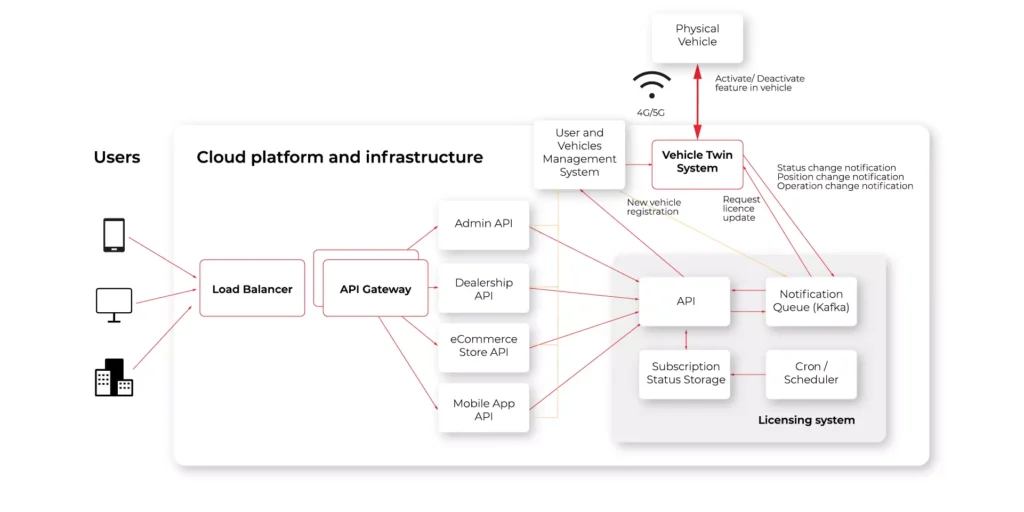
The scheduler itself is just a single, small part of the system. The other important piece is the database for storing the subscription status and the API backend for retrieving and updating the values. Consistency is crucial, as the feature getting disabled by mistake leads to a bad user experience.
The system has to be connected to the vehicle . In most cases, this is done asynchronously through queues like Kafka or RabbitMQ. This gives better stability and reliability than direct connections.
Lastly, we need to ensure that the feature is actually enabled or disabled in the vehicle. This means the vehicle has to receive the correct, unique license for that feature when it’s enabled, and revoke it when it is disabled (alternatively, the license can be automatically pushed every, for example, 30 days, with expiration time set to 33-35 days, to prevent feature loss when connectivity or payment problems occur.
To avoid building an additional retry mechanism into the licensing system itself, it’s better to update the feature state using Digital Twin. In this case, the digital representation of the vehicle is updated with the new license, and it is then responsible to synchronize itself with the vehicle when the internet connection to the car is available. This makes the system conformant to the single-responsibility principle, so the license system does not have to know or understand the vehicle connectivity.
That’s the basic architecture of our system for handling licenses and subscriptions of digital services. Obviously, that’s just the beginning. For OEMs, where the scale of digital business grows exponentially, the next important topic would be the reliability of the system. For that, scaling to meet the demand is important, as well as caching the current state of licenses to avoid complex queries.
Apart from that, this is enough to start with the feature activation and deactivation and handling subscriptions. Of course, it must be connected to mobile apps and online stores for purchases and to payment systems, but those are already used by most enterprises.
Is this really the future? It seems like we can’t avoid it anymore, especially with shared mobility growth, the ability to unlock temporarily additional features is tempting. Imagine grabbing a Ferrari for a weekend to take it to the track, enabling an additional 50HP and an advanced AI for measuring your times and proposing a better moment to break before the turn and accelerate afterward. And paying for only 2 days. This may make all the difference in convincing customers to the new subscription business models.

Data powertrain in automotive: Complete end-to-end solution
We power your entire data journey, from signals to solutions
Check related articles
Read our blog and stay informed about the industry's latest trends and solutions.
Beyond Spotify and Netflix- the future of in-vehicle infotainment systems in connected cars
It cost a staggering $200 for that time. The antenna took up almost the entire roof of the car, the batteries barely fit under the front seat, and the huge speakers had to be fixed to the back of the seat backrest. The year was 1922, just over 20 years after the launch of the first mass-produced Oldsmobile Curved Dash car. Entertainment had just made its entrance into the car industry - Chevrolet introduced the first car radio. From then on it only got more exciting.
Nowadays, 100 years on from that event, we can no longer envisage a car without radio, music, or news. In fact, we can no longer imagine a car without entertainment in the broadest sense of the word. Because the radio - at least in its traditional form - is slowly becoming obsolete. It's being replaced by a "personal radio station" created by the driver - streaming music, favorite podcasts, audiobooks, and even video content.
Although we are still a far cry from the catchy phrase "a smartphone on wheels" , first uttered in 2011 by Akio Toyoda, the automotive industry is indeed heading in this direction. Cars are ceasing to be vehicles designed to take us from A to B. Like any other device connected to the Internet, they are becoming a gate to new worlds of entertainment, shopping, learning, or gaming.
When finishing shopping or listening to an audiobook on one device, we want to seamlessly continue the activity on a laptop or desktop computer. Whether we like it or not, the car is becoming another medium that will allow us to stay virtually connected all the time.
Akio Toyoda was wrong. A car is much more than a "smartphone" on wheels!
A potentially larger screen than a smartphone (not only the touchscreen in-vehicle infotainment system panel, but the windscreen too, which can also be used to display content), at least 4 seats that can be independently paired with the in-car entertainment system, and, ironically, much more mobility than mobile devices.
As we look at the development of V2X (vehicle-to-everything) technology, which will turn vehicles into the Internet of Things devices, the opportunities that lie ahead for the automotive industry in the entertainment field are hard to estimate.
One thing is certain. This process cannot be stopped. Every company in the automotive industry must be aware of the upcoming changes.
According to IHS Markit data, in 2014 only 53% of cars in the USA had a dashboard touch screen, while today this percentage has already reached 82%. These types of solutions can bring automotive companies entirely new revenue streams, and most importantly they will be less dependent on vehicle production cycles and with much higher margins.
The in-vehicle infotainment system market is estimated to be worth $78.9 billion by 2025. [Allied Market Research].
Quo Vadis in-vehicle infotainment systems?
In-vehicle voice assistants for infotainment control
Siri, Alexa, or Google Now are names that have become part of the consumer market and make life easier for most of us, allowing us to make phone calls, send messages or manage our own calendars. While sending voice commands to our phone or the speaker in our home or office is nothing new, communicating with our own car is still some kind of novelty.
And it is here while driving when we need to focus on the road and have our hands free, that voice technology can be of the most benefit and make driving more efficient and smooth. And of course, more fun.
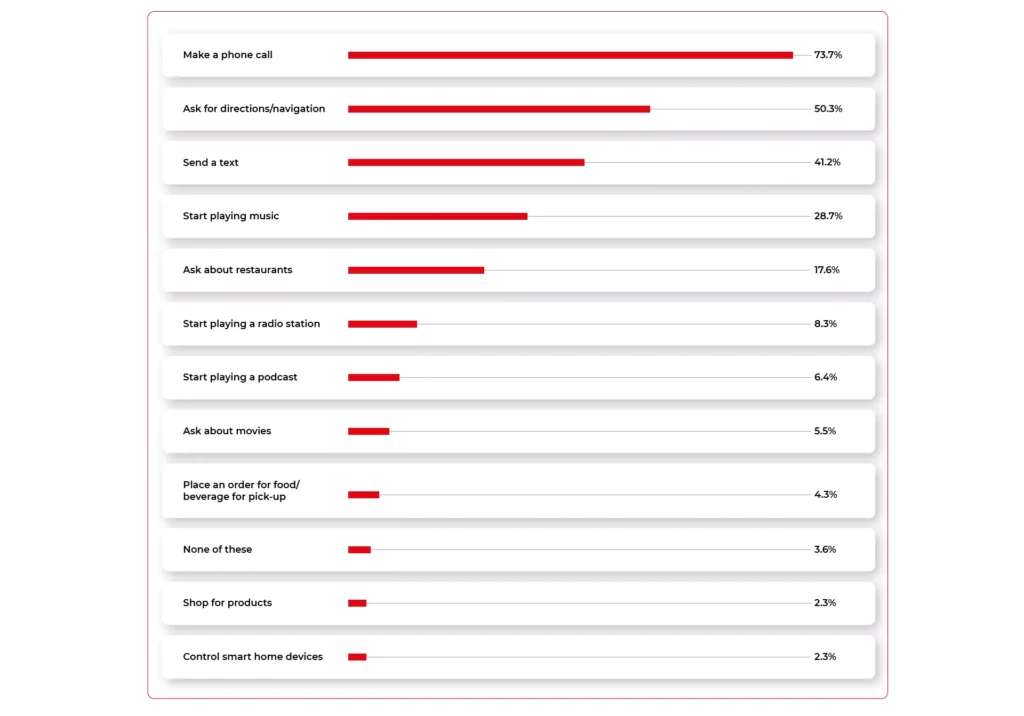
Navigant Research (Guidehouse) predicts that by 2028, 90% of vehicles will be equipped with a voice assistant. Already today - looking at Voicebot.ai data - a large proportion of commands given by drivers are entertainment-related. Playing music, listening to podcasts, finding out about movies, ordering food, or making purchases directly from behind the wheel is becoming increasingly popular among drivers with enhanced IVI systems.
The main players in this section are certainly the manufacturers already known for their other platforms, namely Google and Apple, which are integrating their Android Auto and Carplay technologies in partnership with major OEMs. Hot on its heels is Amazon, which has not only begun collaborating to bring Alexa into Toyota, Ford, and BMW vehicles but also released an Amazon Echo device that any driver can install in their car themselves (as long as it meets the manufacturer's technical requirements).
Vehicle manufacturers, however, are no longer just waiting for the offers of the largest players in this market, but are developing their systems or working with smaller business partners to help them develop such solutions.
Korea's Hyundai has entered into an operation with Saltlux, a company specializing in semantic networks. Honda, Kia Motors, and Daimler are working with the SoundHound start-up. And Volkswagen has invested $180 million in the Chinese start-up Mobvoi.
Gesture-recognition
Voice command in the car is a trend that will continue to grow every year. Yet, there are situations in which gestures are much better than voice commands - for example when you are on a call or have a cold and don't want to strain your throat. Gestures are universal for every driver, while voice assistant applications are often still hampered by technological limitations, for example, due to the variety of accents or the system's adaptation to the driver's language.
As the system recognizes a gesture made with the palm of your hand, fingers, or even your head, you can stay focused on your driving and at the same time activate a specific function when you cannot use your voice command. Scrolling through songs on the radio, raising or lowering the temperature in the car, launching a text message application - all these actions can be configured using gestures. Instead of clicking and scrolling through a touchpad, which always entails taking your eyes off the road, gestures will allow you to boost safety and easily manage the entire system.
Virtual reality & Augmented reality
While currently the introduction of virtual reality in vehicles only makes sense for passengers who do not need to focus on driving, augmented reality technologies are already being successfully implemented in vehicles. Unlike VR, augmented reality does not distract drivers from reality and allows them to concentrate on driving. And they can even increase safety.
Although today this type of technology can only be found in the most innovative and prestigious IVI systems (one of the first cars in which this technology was used was Mercedes-Benz GLE 2020), we should expect this type of solution to develop in the near future, as it brings a whole new quality to in-car entertainment.
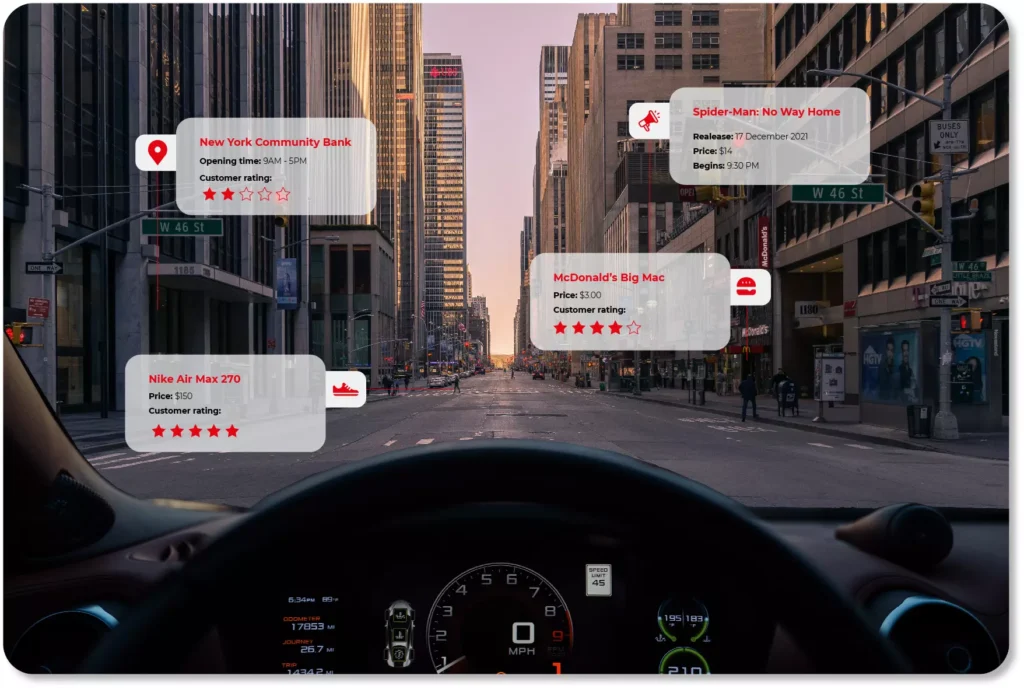
Their direct equivalent to the automotive field is the heads-up display system, which is an additional head-up display integrated into the vehicle's windscreen in addition to the IVI control panel. This screen can be used to display destination-related information, traffic warnings, or information about other vehicles on the road (so-called intelligent terrain mapping).
In the near future, these technologies may also be applied in entertainment itself - for instance in the form of augmented marketing. The windscreen will then display interesting offers and discounts from the restaurants, shops or shopping malls we have just passed. The displayed images will of course adapt to our driving speed, and we can decide for ourselves what kind of messages we wish to see.
On-demand in-car services
In-vehicle infotainment systems are the point of contact between different parties: customers, internet providers, companies producing vehicles, making entertainment, or electronic equipment (e.g. smartphones).
In most cases, drivers already have their favorite apps (Google and Apple being in the lead, of course) and use their favorite streaming services. Competing with platforms like Spotify, Netflix, Pandora or Slacker may not necessarily be the best strategy for automotive companies. It is much better to make use of the recognisability of brands that provide entertainment content and, based on this, extend it with a unique offer for their own clients. Opening up to partnerships with third-party platforms is the best way to address customer needs and create a stream of data that can be monetized .
One of the interesting market examples of this type are the efforts of the GM concern, which has created its own car application in the form of a marketplace, from which the driver can make purchases at Starbucks or Dunkin' Donuts, pay for the fuel at selected petrol stations, and book a hotel or a table at a restaurant.
We should expect that the trend of shopping straight from the car and making the most of the time we have on our commute to/from work while being stuck in traffic jams will not be limited to listening to music and podcasts only. With the development of the Internet of Things, drivers will also be able to control other devices within their "smart" network from their vehicles.
Samsung is already creating solutions that allow the driver to look into their own fridge and decide whether they need to go shopping, turn up the thermostat to prepare the perfect temperature for the return home, activate the alarm when going on holiday, or open the gate automatically.
Rear seat entertainment
Most modern IVI systems are not just an integrated head-unit, i.e. a touch panel on the vehicle dashboard for the driver, but more and more often, interactive panels dedicated to the passengers. These offer practically endless opportunities for entertainment. And we don't just mean the extensive range of streaming video services that can be subscribed to in the vehicle.
After all, the interactivity of the screens makes it possible to implement various applications and gamification elements in the car. These can take the form of quizzes, common picture drawing, shopping via third-party applications, or even karaoke singing, which can also engage the driver.
But what if the sound or type of music doesn't suit the driver, who wants to concentrate on driving? There are already solutions that direct the sound from different areas of the vehicle so that each passenger can listen to different music without wearing headphones.
This is how, for example, the Separated Sound Zone (SSZ) works in KIA cars. Based on multiple loudspeakers and the physical wave acoustics principles, the sounds do not overlap but instead reach their intended audience. Even if powerful beats dominate in the back seat, you can still relax while listening to calmer music in the driver's seat.
In-vehicle infotainment enters a new era
In-car entertainment has a long history. Ever since mobile devices became part of our lives, it is nothing new to connect a smartphone to a Bluetooth radio or for passengers to watch videos on their own smartphones/tablets. The only difference was that, until recently, in-vehicle infotainment was just an accessory, an element that makes a difference and highlights a brand. Today it is a factor on which customers often rely when buying a new vehicle.
In-vehicle infotainment is increasingly rarely limited to a touch screen panel on the dashboard. Right before our eyes, it is growing to be omnipresent and taking precedence over other vehicle functions. Brands that miss this moment and, like Blockbuster in the video content market or Nokia in the mobile market, may find themselves in a completely new reality. A reality in which totally different companies will be on top of the bunch.
How to monetize vehicle data thanks to in-car technologies - the biggest challenges and control points of the process - Part 1
Brook. Not a stream yet, though. But in the foreseeable future, it is going to be a proper river. What are we talking about? Data obtained from vehicles. Experts estimate that data inflow is likely to rise from approximately 33 zettabytes (this is how much we obtained in 2018) to 175 zettabytes in 2052. For OEMs and companies from the broadly-defined automotive industry, this means one thing. Endless monetization possibilities. Providing that they face the challenges connected with data capture, filtering and storage, and become familiar with the in-vehicle technologies enabling that.
The potential is enormous. However, the Capgemini report shows that there is still a long way ahead before reaching its full potential. Today, as many as 44% of OEM customers do not yet avail of any online service in their cars, and still, connecting to the network is just the starting point because without the Internet there is no option of monetizing data. And even if the vehicle is already connected to the network, only every second driver declares frequent use of this type of service.
Anyway, the condition of the Internet is a challenge in itself. Today, in modern vehicles, there are around 100 points from which information can be downloaded (in the future it is estimated that there will be up to 10,000 of them!)
Before we get to know the technologies that enable it (about which we will write in the second part of the article), let's have a look at the challenges and checkpoints that must be considered when creating a data monetization strategy for a software-defined vehicle.
5 things to bear in mind if you want to monetize vehicle data
1. Developing the customer value proposition
This is where it all begins- from creating a sales offer and an environment in which drivers will believe you have something unique and valuable for them. Without trade, no technology will guarantee your success. Customers will simply not want to share data.
Think about the unique offer you want to present to them and develop a clear data management policy. As a result, it should be followed by the selection of appropriate technologies, and then their implementation in vehicles.
Obtaining data to offer the driver safety or a good sense of direction differs from getting information related to entertainment or directing the customer to a sale in a nearby shopping mall.
It would be perfect if the developed customer value proposition was consistent with your brand's DNA and features that have always been associated with it. This would make it easier to convince users, remain in line with your business assumptions, and stand out from the competition. Focus on technology application, not on technology just to be used.
2. Consider matching technology with the data for which users are most likely to "pay"
Speaking of users’ preferences, even today, at the stage when the technologies of obtaining data from vehicles are not fully-fledged yet, it can be seen that for some services customers are willing to give up some of their privacy, while they are largely opposed or reluctant towards others.
Capgemini's research shows that the group with the greatest potential includes services related to safety and facilitating driving:
- hazard warning;
- collision warning;
- theft detection system;
- e-call;
- interactive language assistance.
On the other hand, the greatest objection among users is aroused by services related to broadly -defined shopping:
- In-car delivery;
- in car e-commerce.
Keep this in mind when choosing technology to help you monetize your data.
3. Data collector strategy
The data in the vehicle is acquired by means of special sensors and then sent to collectors, which are supposed to gather this data and enable it to be transferred to the cloud. To effectively filter this data and derive maximum benefit from it, you need reliable technology to facilitate it. Due to the huge amount of data and the interaction between various sensors, the universal data collector is the best solution, as it collects all information obtained from sensors in the car.
In order to fully use its potential, during the implementation phase of this technology, it is crucial to ensure close work of the engineering team with people responsible for digital data management (see the next section). Close cooperation of both teams will help to obtain more interesting data and implement new services more efficiently.
4. Provider of IoT data platform
Collecting data from vehicles is impossible without an IoT platform connected to cloud solutions dedicated to the automotive industry - this is where data is sent and analyzed to be later collected by the vehicle sensors.
Regardless of which platform you choose (the most popular solutions on the market today are: Microsoft Azure, Amazon AWS, and Otonomo, operating in the SaaS system), 5 features that such a platform should have are of paramount importance to enable the efficient flow of information.
You can read more about it in our article on this issue .
5. Data enrichment
While this article focuses on technologies directly related to obtaining data from the vehicle, it should not be overlooked that the software-defined vehicle operates in a wider ecosystem. Monetization of data from vehicles will not be possible without technologies related to infrastructure (e.g. smart-road infrastructure, V2X communication , or high-speed data towers), as well as coordination of back-end processes for which entities such as policymaker, cybersecurity specialist, technical regulator, road infrastructure operator or billing/tolling player are accountable.
To create more valuable and attractive services, a coherent policy is necessary, as it will enrich the data stream from third parties and the user themselves, and will improve cooperation between elements of the ecosystem.
Checkpoints inside the car
In-car technologies are not the only gateway for data that companies can obtain from drivers (another entry point may be, for instance, the driver's smartphone or road infrastructure). However, they are the ones over which OEMs and manufacturers have the greatest control, technically at least.
Before we directly describe the technologies in the vehicle allowing that data to be obtained, let's focus on the checkpoints that are crucial for the capture of information, its quality, and value for building services.
In the software-defined vehicle ecosystem, we can identify three such areas, a kind of bottleneck on which the flow of data depends. These are:
- Vehicle interior and infrastructure.
- Connection to cloud.
- Data cloud.
Let's have a look at the first area, which is practically entirely the responsibility of the automotive company and is directly related to the equipment in the vehicle.
We can list the following groups of such checkpoints which require closer attention when building a data monetization strategy.
1. Gateway to the customer
Key points due to the start of data gathering and the user's experience - their willingness to share data, and thus increasing the value of the gathered data for the manufacturer.
- HMI (i.e. a set of technologies enabling the driver to activate the vehicle and begin collecting data, e.g. touch screens, visual sensors, voice commands, etc. - certainly a topic for a separate article)
- Data gateway (port, mobile data connection, USB port, radio connection)
- Customer ID
2. Points that build loyalty and the need to buy
That is, the contact points with the offer that allow you to easily download new applications, pay bills and influence the user's willingness to renew the service. The more transparent, engaging, and easy-to-use, the more likely the user is to continue their subscription.
- App store / ecosystem
- Billing platform
- In-vehicle infotainment (IVI)
- Apps/ content
3. Key points for data security, data analysis and usability
- CPU/ control unit
- Car sensors / actuators
Software-defined vehicles do not run in a vacuum
When creating a data monetization strategy for a software-defined vehicle, one should always bear in mind the wide ecosystem in which such a vehicle operates. It is not enough to equip it with the technology itself and wait for the flow of data that will turn into specific value for the enterprise . In such a complex and extensive ecosystem, nothing happens by itself. There is no room for improvisation, omitting checkpoints, and presenting half-baked offers. Yes, the technology that downloads data from the vehicle is crucial, but it won't work unless we bear in mind the broader data management context that reaches beyond collecting and analyzing it.
Interested in our services?
Reach out for tailored solutions and expert guidance.