
Connected car: Challenges and opportunities for the automotive industry



The development of connected car technology accelerated digital disruption in the automotive industry. Verified Market Research valued the connected car market at USD 72.68 billion in 2019 and projected its value to reach USD 215.23 billion by 2027. Along with the rapid growth of this market’s worth, we observe the constant development of new customer-centric services that goes far beyond driving experience.
While the development of connected car technology created a demand for connectivity solutions and drive-assistance systems, companies willing to build their position in this market have to face some significant challenges. This article is the first one of the mini-series that guides you through the main obstacles with building software for connected cars. We start with the basics of a connected vehicle, then dive into the details of prototyping and providing production-ready solutions. Finally, we analyze and predict the future of verticals associated with automotive-rental car enterprises, insurers, and mobility providers.
This series provides you with hands-on knowledge based on our experience in developing production-grade and cutting-edge software for the leading automotive and car rental enterprises. We share our insights and pointers to overcome recurring issues that happen to every software development team working with these technologies.
What is a Connected Car?
A Connected Car is a vehicle that can communicate bidirectionally with other systems outside the car , such as infrastructure, other vehicles, or home/office. Connected cars belong to the expanding environment of devices that comprise the Internet of Things landscape. As well as all devices that are connected to the internet, some functions of a vehicle can be managed remotely.
Along with that, IoT devices are valuable resources of data and information that enable further development of associated services. And while most car owners would describe it as the mobile application paired with a car that allows users to check the fuel level, open/close doors, control air conditioning, and, in some cases, start the ignition, this technology goes much further.
V2C - Vehicle to Cloud
Let’s focus on some real-case scenarios to showcase the capabilities of connected car technology. If a car is connected, it may also have a sat-nav system with a traffic monitoring feature that can alert a driver if there is a traffic jam in front of them and suggest an alternative route. Or maybe there is a storm at the upcoming route and navigation can warn the driver. How does it work?
That is mostly possible thanks to what we call V2C - Vehicle to Cloud communication. Utilizing the fact that a car is connected, and it is sending and gathering data, a driver may also try to find it, in case it was stolen. Telematics data is also helpful to understand the reasons behind an accident on the road - we can analyze what happened before the accident and what may have led to the event. The data can be also used for predictive maintenance, even if the rules managing the dates are changing dynamically.
While this seems just like a nice-to-have feature for the drivers, it allows car manufacturers to provide an extensive set of subscription-based features and functionalities for the end-users. The availability of services may depend on the current car state - location, temperature, and technical availability. As an example: during the winter, if the car is equipped with heated seats and the temperature drops under 0 Celsius, but the subscription for this feature expires, the infotainment can propose to buy the new one - which is more tempting when the user is at this time cold.
V2I - Vehicle to Infrastructure
A vehicle equipped with connected car technology is not limited to communicating only with the cloud. Such a car is capable of exchanging data and information with road infrastructure, and this functionality is called V2I - Vehicle to Infrastructure communication. A car processes information from infrastructure components - road signs, lane markings, traffic lights to support the driving experience by suggesting decision makings. In the next steps, V2I can provide drivers with information about traffic jams and free parking spots.
Currently, in Stuttgart, Germany, the city’s infrastructure provides the data live traffic lights data for vehicle manufacturers, so drivers can see not just what light is on, but how long they have to wait for the red light to switch to green again. This part of connected car technology can rapidly develop with the utilization of wireless communication and the digitalization of road infrastructure.
V2V - Vehicle to Vehicle
Another highly valuable type of communication provided by connected car technology is V2V - Vehicle to Vehicle. By developing an environment in which numerous cars are able to wirelessly exchange data, the automotive industry offers a new experience - every vehicle can use the information provided by a car belonging to the network, which leads to more effective communication covering traffic, car parking, alternative routes, issues on the road, or even some worth-seeing spots.
It may also significantly increase safety on the road, when one car notifies another that drives a few hundred meters behind him that it just had a hard breaking or that the road surface is slippery, using the information from ABS, ESP, or TC systems. That has not just an informational value but is also used for Adaptive Cruise Control or Travel Assist systems and reduces the speed of vehicles automatically increasing the safety of the travelers. V2V communication makes use of network and scale effects - the more users have connected to the network, the more helpful and complete information the network provides.
The list of use cases for connected car technology is only limited by our imagination but is excelling rapidly as many teams are joining the movement aiming to transform the way we travel and communicate. The Connected Car revolution leads to many changes and impacts both user experience and business models of the associated industries.
How connected car technology impacts business models of the automotive industry
Connected cars bring innovative solutions to the whole environment comprising the automotive landscape. Original Equipment Manufacturers (OEMs) have gained new revenue streams. Now vehicles allow their users to access stores and purchase numerous features and associated services that enhance customer experience, such as infotainment systems. By delivering aftermarket services directly to a car, the automotive industry monetizes new channels. Furthermore, these systems enable automakers to deliver advertisements, which become an increasing source of revenue.
The development of new technology in automotive creates a similar change as we observed in the mobile phone market. When smartphones equipped with operating systems had become a new normal, significantly increased the number of new apps that now allow their users to manage numerous services and tasks using the device.
But it is just an introduction to numerous business opportunities provided by connected cars. Since data has become a new competitive advantage that fuels the digital economy, collecting and distributing data about user behavior and vehicle performance is seen as highly profitable, especially when taking into account the potential interest of insurers providers.
Assembled data while used properly gives OEMs powerful insights into customer behavior that should lead to the rapid growth of new technologies and products improving customer experiences, such as predictive maintenance or fleet management.
The architecture behind connected car technology
Automotive companies utilize data from vehicle sensors and allow 3rd party providers to access their systems through dedicated API layers. Let’s dive into such architecture.
High-Level Architecture
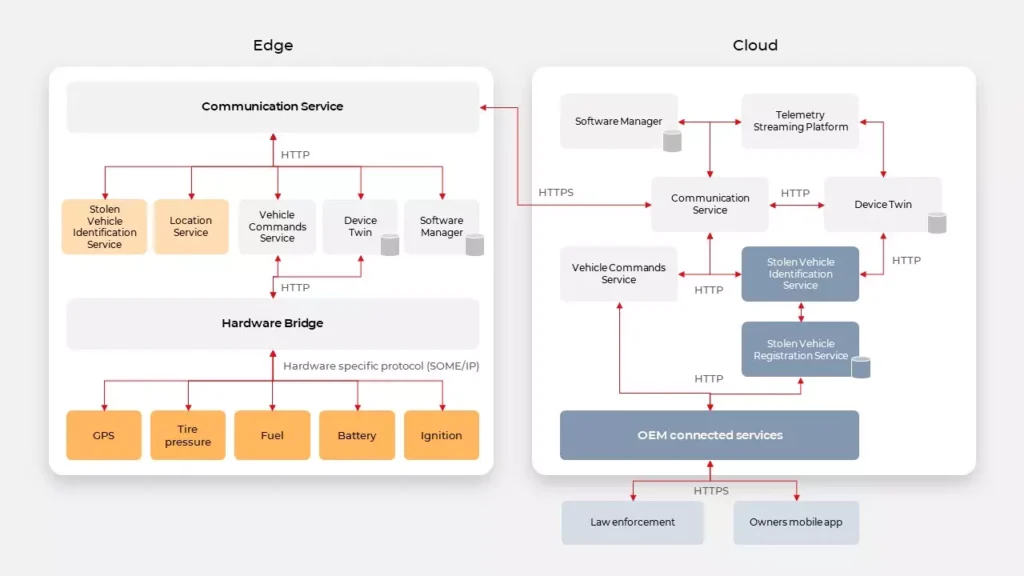
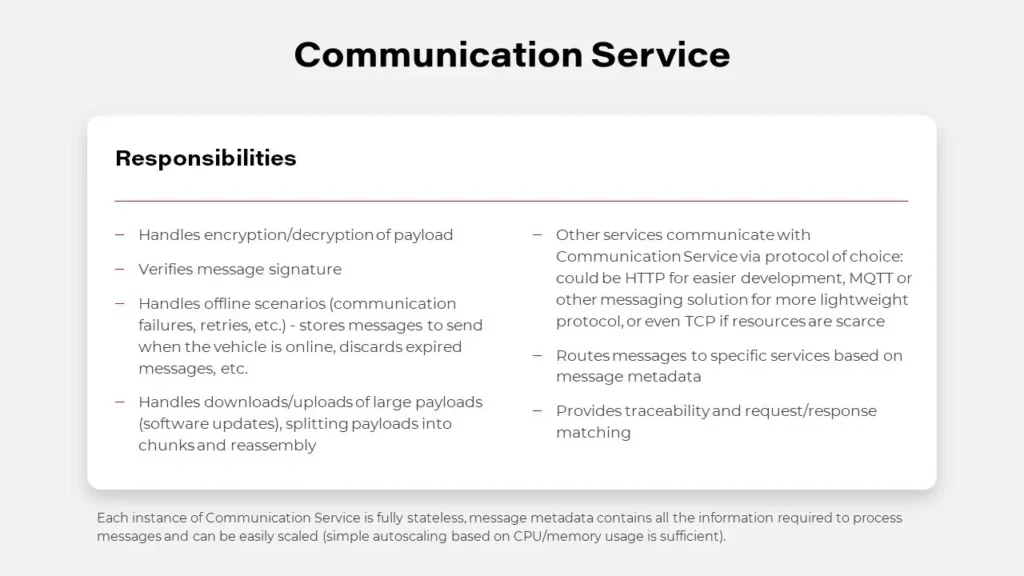
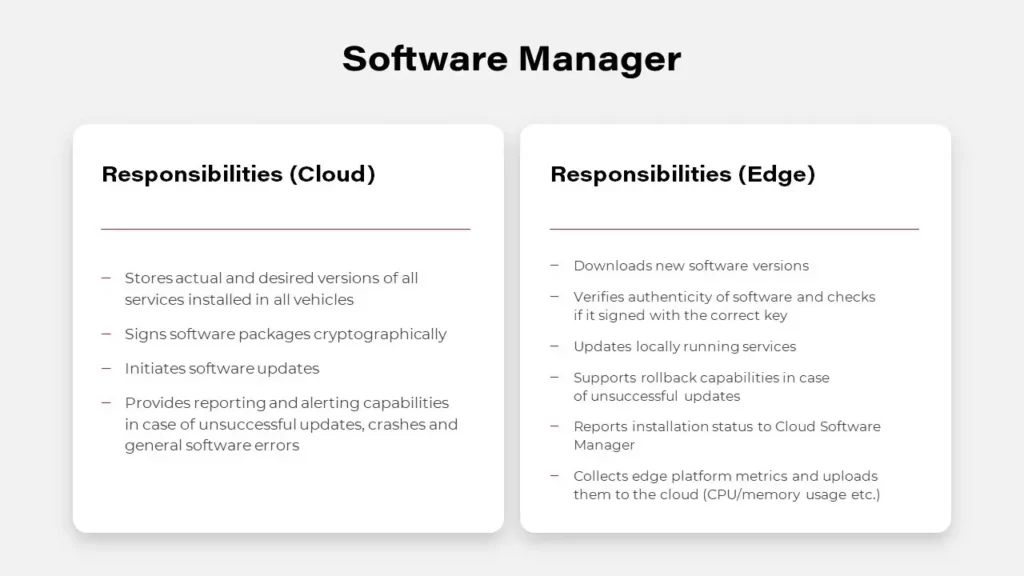
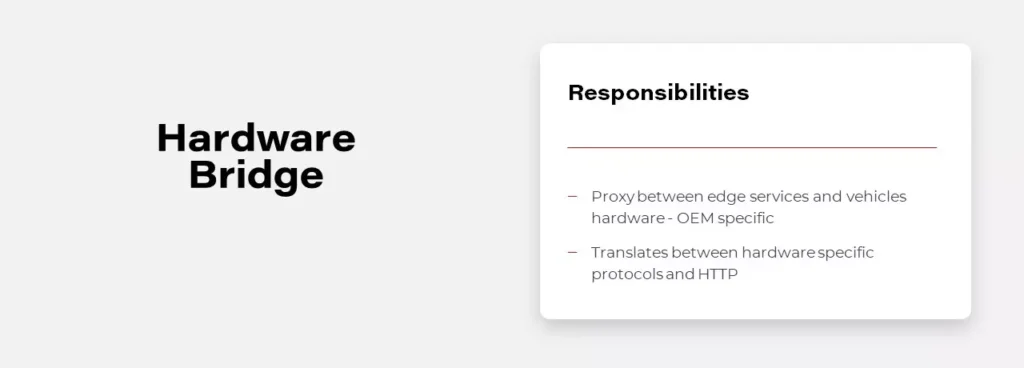
System components
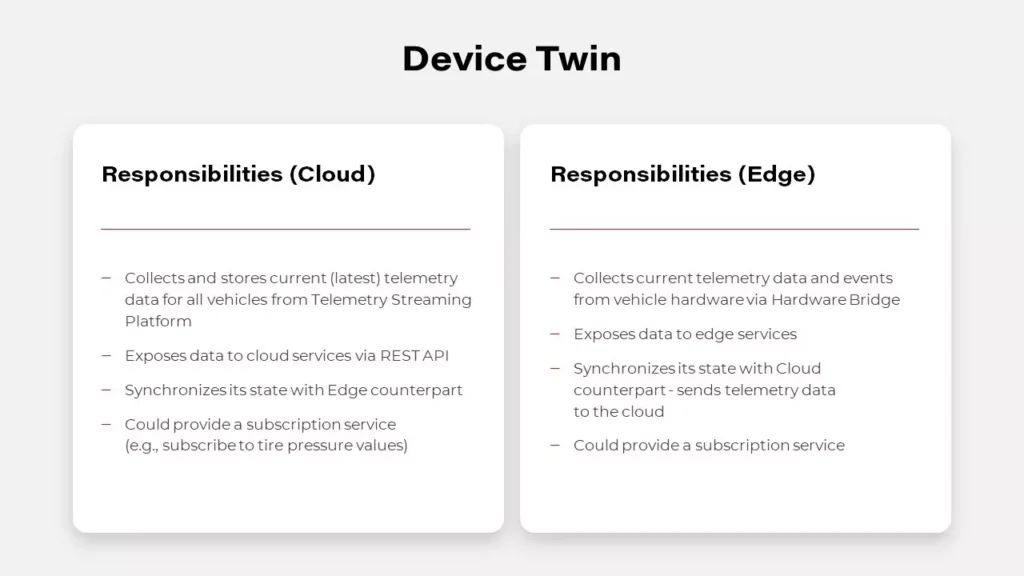
Digital Twin in automotive
A digital twin is a virtual replica and software representation of a product, system, or process. This concept is being adopted and developed in the automotive industry, as carmakers utilize its powerful capabilities to increase customer satisfaction, improve the way they develop vehicles and their systems, and innovate. A digital twin empowers automotive companies to collect various information from numerous sensors, as this tool allows to capture operational and behavioral data generated by a vehicle. Equipped with these insights, the leading automotive enterprises work on enhancing performance and customize user experience, but meanwhile, they have to tackle significant challenges.
First of all, getting data from vehicles is problematic. Hardware built-in vehicles have particular limits, which leads to reduced capabilities in providing software. Unlike software, once shipped hardware cannot be easily adjusted to the changing conditions and works for several years at least. Furthermore, while willing to deliver a customer-centric experience, automakers still have to protect their users from numerous threats. To protect vehicles from denial of service attacks, vehicles can throttle the number of requests. Overall, it’s a good idea but can have a terrible impact when multiple applications are trying to get data from vehicles, e.g., in the rental domain. This complex problem can be simply solved by Digital Twin. It can expose data to all applications without them needing to connect to the vehicle by simply gathering all real-time vehicle data in the cloud.
Implementation of this pattern is possible by using NoSQL databases like MongoDB or Cassandra and reliable communication layers, examples are described below. Digital Twin may be implemented in two possible ways, uni- or bidirectional.
Unidirectional Digital Twin
Unidirectional Digital Twin is saving only values received from the vehicle, in case of conflict it resolves the situation based on event timestamp. However, it doesn’t mean that the event causing the conflict is discarded and lost, usually every event is sent to the data platform. The data platform is a useful concept for data analysis and became handy when implementing complex use cases like analyzing driver habits.
Bidirectional Digital Twin
The Bidirectional Digital Twin design is based on the concept of the current and desired state. The vehicle is reporting the current state to the platform, and on the other hand, the platform is trying to change the state in the vehicle to the desired value. In this situation, in case of conflict, not only the timestamp matters as some operations from the cloud may not be applied to the vehicle in every state, eg., the engine can’t be disabled when the vehicle is moving.
However, meeting the goal of developing a Digital Twin may be tricky though as it all depends on the OEM and provided API. Sometimes it doesn’t expose enough properties or doesn’t provide real-time updates. In such cases, it may be even impossible to implement this pattern.
API
At first, designing a Connected Car API isn’t different from designing an API for any other backend system. It should start with an in-depth analysis of a domain, in this case, automotive. Then user stories should be written down, and with that, the development team should be able to find common parts and requirements to be able to determine the most suitable communication protocol. There are a lot of possible solutions to choose from. There are several reliable and high-traffic oriented message brokers like Kafka or hosted solutions AWS Kinesis. However, the simplest solution based on HTTP can also handle the most complex cases when used with Server-Sent Events or WebSockets. When designing API for mobile applications, we should also consider implementing push notifications for a better user experience.
When designing API in the IoT ecosystem, you can’t rely too much on your connection with edge devices. There are a lot of connectivity challenges, for example, a weak cellular range. You can’t guarantee when your command to a car will be delivered, and if a car will respond in milliseconds or even at all. One of the best patterns here is to provide the asynchronous API. It doesn’t matter on which layer you’re building your software if it’s a connector between vehicle and cloud or a system communicating with the vehicle’s API provider. Asynchronous API allows you to limit your resource consumption and avoid timeouts that leave systems in an unknown state. It’s a good practice to include a connector, the logic which handles all connection flaws. Well designed and developed connectors should be responsible for retries, throttling, batching, and caching of request and response.
OEM’s are now implementing a unified API concept that enables its customers to communicate with their cars through the cloud at the same quality level as when they use direct connections (for example using Wi-Fi). This means that the developer sees no difference in communicating with the car directly or using the cloud. What‘s also worth noting: the unified API works well with the Digital Twin concept, which leads to cuts in communication with the vehicle as third-party apps are able to connect with the services in the cloud instead of communicating directly with an in-car software component.
What’s next for connected car technology
Once the challenges become tackled, connected vehicles provide automakers and adjacent industries with a chance to establish beneficial co-operations, build new revenue streams, or even create completely new business models. The possibilities delivered thanks to over-the-air communication (OTA) allowing to send fixes, updates, and upgrades to already sold cars, provide new monetization channels, and sustain customer relationships.
As previously mentioned, the global connected car market is projected to reach USD 215.23 billion by 2027. To acquire shares in this market, automotive companies are determined to adjust their processes and operations. Among key factors that impact the development of connected car technology, we can point out a few crucial. The average lifecycle of a car is about 10 years. Today, automakers make decisions regarding connected cars that will go into production two to four years from now. For the cellular connectivity strategy to remain relevant over 12 to 15 years, significant challenges and assumptions need to be collaboratively addressed by OEMs, telematics control unit suppliers, and service providers.
Automakers must manage software in the field reliably, cost-efficiently, and, most importantly, securely – not just patch fixes, but also continually upgrade and enhance the functionality. The availability of OTA updates reduces the burden on dealerships and certified repair centers but requires better and more extensive testing, as the breakage of critical features is not an option.
Cellular solutions need to be agile to be compatible with emerging network technologies over the vehicle lifetime, e.g., 5G to be the industry standard in the next few years. The chosen solution must deliver reliable, seamless, uninterrupted coverage in all countries and markets where the vehicles are sold and driven.
Solution developers must offer scalable, cost-effective ways to develop upgradeable software that can be universally deployed across technologies, hardware, and chipsets. A huge focus must be put on testing the changes automatically on both the cloud platform side and the vehicle side.
As Connected Vehicles proliferate, the auto industry will need to adapt and transform itself into the growing technological dependency. OEMs and Tier-1 manufacturers must partner with technology specialists to thrive in an era of software-defined vehicles. As connectivity requires skills and capabilities outside of the OEMs’ domain, automakers will necessarily have to be software developers. An open platform environment will go a long way to encourage external developers to design apps for vehicle connectivity platforms.

Data powertrain in automotive: Complete end-to-end solution
We power your entire data journey, from signals to solutions
Check related articles
Read our blog and stay informed about the industry's latest trends and solutions.
Developing software for connected cars - common challenges and how to tackle them
Automotive is transforming into a hyper-connected, software-driven industry that goes far beyond the driving experience. How to build applications in such an innovative environment? What are the main challenges of providing software for connected cars and how to deal with them? Let’s dive into the process of utilizing the capabilities of the cloud to move automotive forward.
People have always aimed for the clouds. From Icarus in Greek mythology, first airplanes and spaceships to dreams about flying cars – our culture and history of technology development express a strong desire to go beyond our limits. Although the vision from Back to the Future and other Sci-Fi movies didn’t come true and our cars cannot be used as flying vehicles, our cars actually are in the cloud.
Meanwhile, the idea of the Internet of Things came true; our devices are connected to the Internet . We have smartphones, smartwatches, smart homes and, as it turns out, smart cars. We are able to communicate with them to gather data or even remotely control them. The possibilities are only limited by hardware, but even it is constantly improving to follow the pace of rapid changes triggered by software development.
Offerings on the automotive market are developing rapidly with numerous features and promised experiences to the end customer. By using cutting-edge technologies, utilizing cloud platforms, and working with innovative software developers, automakers provide solutions to even the most demanding needs . And while our user experience is improving at an accelerated pace, there is still a broad list of challenges to tackle.
In this article, we dive into the technology behind the latest trends, take into account the most demanding areas of developing software in the cloud, and explain how proper solution empowers the change that affects us all.
Challenging determinants of the cloud revolution in automotive
Connecting with your car through a smartphone or utilizing information about traffic provided to your vehicle thanks to the platforms that accumulate data registered by other drivers is extremely useful.
Those innovative changes wouldn’t be possible without cloud infrastructure . And as there is no way back from moving to the cloud, the transition creates challenges in various areas: safety, security, responsiveness, integrity , and more.
Safety in the automotive sector
How to create a solution that doesn’t affect the safety of a driver? When developing new services, you cannot forget about the basics. Infotainment provided to vehicles is more advanced for every new release of a car and can be really engaging. The amount of delivered information combined with increasingly larger displays may lead to distraction and create dangerous situations. It’s worth mentioning that some of the colors may even impair the driver’s vision!
Integration with the cloud usually enables some of the remote commands. When implementing them, there are a lot of restrictions that need to be kept in mind. Some of them are obvious, such as you don’t want to disable the engine when a car is being driven 100km/h, but others may be much more complicated and unseen at first.
Providing security for car owners
Enabling services for your vehicle in the cloud, despite being extremely helpful to improve your experience, creates another way to break into your car. Everyone would like to open a car without using keys, but using a mobile phone, voice, or a fingerprint instead. And as these solutions seem modern and fancy, there is a big responsibility on the software side to do it securely.
Responsiveness enabling the seamless user experience
Customer-facing services need to deliver a seamless experience to the end-user. The customer doesn’t want to wait a minute or even ten seconds for unlocking a car door. These services need to do it immediately or not at all, as an issue with opening the doors just because the system had a ‘lag’ is not acceptable behavior.
Data integrity is a must
Another very important concept associated with providing solutions utilizing cloud technologies is data integrity. Information collected by your vehicle should be useful and up to date. You don’t want a situation when the mobile application says that the car has a range of 100km, but in the morning, it turns out that the tank is almost empty, and you need to refuel it before going to work.
How to integrate and utilize mobile devices to connect with your vehicle?
When discussing how to use mobile phones to control cars, a very important question occurs; how to communicate with the car? There is no simple answer, as it all depends on what model and version of a car it is, as depending on a provider, the vehicles are equipped with various technologies. Some of them are equipped with BLE, Wi-Fi Hotspots, or RFID tags, while others don’t offer a direct connection to the car, and the only way is to go through the backend side. Most of the manufacturers will expose some API over the Internet without providing a direct connection from mobile to the car. In such cases, usually, it’s a good practice to create your own backend which handles all API flaws. To do so, your system will need a platform to have a reliable solution.
When the limitation of hardware is met, there is always an option to equip the car with a custom device, which will expose a proper communication channel and will be integrated with the vehicle. To do so, it may use the OBD protocol. It gives us full control over the communication part, however, it’s expensive and hard to maintain the solution.
Building a platform to solve the challenges
There is no simple answer on how to solve the mentioned challenges and implement a resilient system that will deliver all necessary functionalities with the highest quality. However, it’s very important to remember that such a solution should be scalable and utilize cloud-native patterns. When designing a system for connected cars, the natural choice is to go with the microservice architecture. The implementation of the system is one thing, and partly this topic was covered in the previous article , but on the other hand, the very important aspect is a runtime, the platform. Choosing the wrong setup of virtual machines or having to deploy everything manually can lead to downtime of the system. Having a system that isn’t available for the customer constantly can damage your business.
Kubernetes to the rescue! As probably you know, Kubernetes is a container orchestration platform, which allows running workload in pods. The platform itself helped us to deliver many features faster and with ease to our clients. Nowadays, Kubernetes is so easily accessible that you can spin up a cluster in minutes using existing service providers like AWS or Azure. It allows you to increase the speed of delivery of new features, as they may be deployed immediately! What’s very important with Kubernetes, is its abstraction from infrastructure. The development team with expertise in Kubernetes is able to work on any cloud provider. Furthermore, mission-critical systems can successfully implement Kubernetes for their use cases as well.
Automotive cloud beyond car manufacturers
Automotive cloud is not only a domain of car manufacturers. As mentioned earlier, they offer digital services to integrate with their cars, but numerous mobility service providers integrate with these APIs to implement their own use cases.
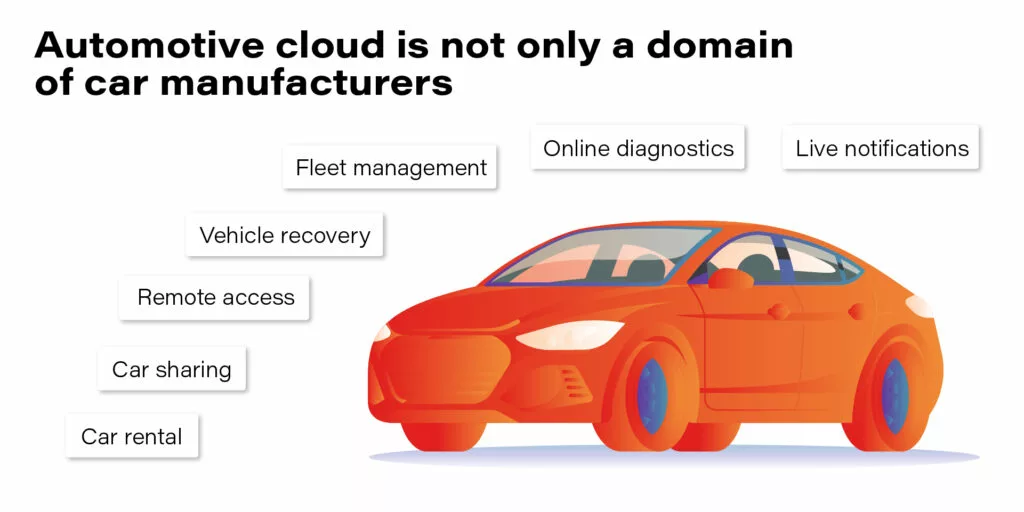
- Live notifications
- Online diagnostics
- Fleet management
- Vehicle recovery
- Remote access
- Car sharing
- Car rental
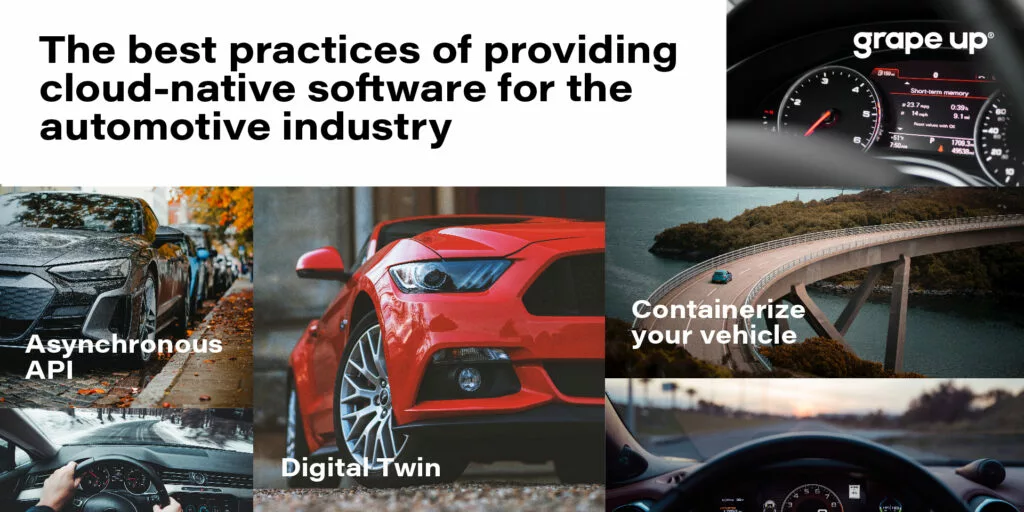
The best practices of providing cloud-native software for the automotive industry
Working with the leading auto motive brands and being engaged in numerous projects meant to deliver innovative applications. Our team have collected a group of helpful practices which make development easier and improve user experience. There are some must-have practices when it comes to delivering high-quality software, such as CI/CD, Agile, DevOps, etc., – they are crucial yet well-known for the experienced development team and we don’t focus on them in this article. Here we share tips dedicated for teams working with app delivery for automotive.
Containerize your vehicle
One of the things we’ve learned collaborating with Porsche is that vehicles are equipped with ECUs and installing software on them isn’t easy. However, Kubernetes helps to mitigate that challenge, as we can mock the target ECU by docker image with specialized operating systems and install software directly in it. That’s a good approach to create an integration environment that shortens the feedback loop and helps deliver software faster and better.
Asynchronous API
In the IoT ecosystem, you can’t rely too much on your connection with edge devices. There are a lot of connectivity challenges, for example, a weak cellular range. You can’t guarantee when your command to the car will be delivered and if the car will respond in milliseconds or even at all. One of the best patterns here is to provide the asynchronous API. It doesn’t matter on which layer you’re building your software if it’s a connector between vehicle and cloud or a system communicating with the vehicle’s API provider. Asynchronous API allows you to limit your resource consumption and avoid timeouts that leave systems in an unknown state.
Let’s take a very simple example of a mobile application for locking the car remotely.
Synchronous API scenario
- A customer presses a button on the application to lock the car.
- The request is sent and is waiting for a response.
- The request needs to be delegated to the car which may take some time.
- The backend component crashes and starts without any knowledge about the previous request.
- The application gets a timeout.
- What now? Is the car locked? What should be displayed to the end-user?
Asynchronous API scenario
- The customer presses a button on the application to lock the car.
- The request is sent and ended immediately.
- The request needs to be delegated to the car which may take some time.
- The backend component crashes and starts without any knowledge about the previous request.
- The car sends a request with the command result through the backend to the application.
- Application displays: “Car is locked.”
With asynchronous API, there’s always a way to resend the response. With synchronous API, after you lose connection, the system doesn’t know where to resend response out of the box. As you may see, the asynchronous pattern handles this case perfectly.
Digital Twin
DigDigital Twin is a virtual model of a process, a product or a service, in case of automotive – a digital cockpit of a car. This pattern helps to ensure the integrity of data and simplify the development of new systems by its abstraction over the vehicle. The concept is based on the fact that it stores the actual state of the vehicle in the cloud and constantly updates it based on data sent from a car. Every feature requiring some property of vehicle should be integrated with Digital Twin to limit direct integrations with a car and improve the execution time of operations.
Implementation of Digital Twin may be tricky though, as it all depends on the vehicle manufacturer and API it provides. Sometimes it doesn’t expose enough properties or doesn’t provide real-time updates. In such cases, it’s even impossible to implement this pattern.
Software for Connected Cars - Summary
We believe that the future will look more futuristic than we could have ever imagined. Autonomous cars, smart cars, smart homes, every device tries to make our lives easier. It’s not known when and how these solutions will fully utilize Artificial Intelligence to make this experience even better. Everything connects as numerous IoT devices are connected which provides us with unlimited possibilities.
T he automotive industry is currently transforming, and it isn’t only focusing on the driving experience anymore. There is a serious focus on connected mobility and other customer-oriented services to enhance our daily routines and habits. However, as software providers, we should keep in mind that automotive is a mature industry. The first connected car solutions were built years ago, and it’s challenging to integrate with them. These best practices should help focus on customer experience. Unreliable systems won’t encourage anyone to use it, and bad reviews can easily destroy a brilliant idea.
The automotive industry is experiencing a challenging transformation. We can notice these changes with every new model of a car and with every new service released. However, to keep up with the pace of the changing world, the industry needs modern technologies and reliable solutions, such as Kubernetes. And on top of that cloud-native application, software created with the best practices by experienced engineers who use the customer-first approach.
Beyond Spotify and Netflix- the future of in-vehicle infotainment systems in connected cars
It cost a staggering $200 for that time. The antenna took up almost the entire roof of the car, the batteries barely fit under the front seat, and the huge speakers had to be fixed to the back of the seat backrest. The year was 1922, just over 20 years after the launch of the first mass-produced Oldsmobile Curved Dash car. Entertainment had just made its entrance into the car industry - Chevrolet introduced the first car radio. From then on it only got more exciting.
Nowadays, 100 years on from that event, we can no longer envisage a car without radio, music, or news. In fact, we can no longer imagine a car without entertainment in the broadest sense of the word. Because the radio - at least in its traditional form - is slowly becoming obsolete. It's being replaced by a "personal radio station" created by the driver - streaming music, favorite podcasts, audiobooks, and even video content.
Although we are still a far cry from the catchy phrase "a smartphone on wheels" , first uttered in 2011 by Akio Toyoda, the automotive industry is indeed heading in this direction. Cars are ceasing to be vehicles designed to take us from A to B. Like any other device connected to the Internet, they are becoming a gate to new worlds of entertainment, shopping, learning, or gaming.

When finishing shopping or listening to an audiobook on one device, we want to seamlessly continue the activity on a laptop or desktop computer. Whether we like it or not, the car is becoming another medium that will allow us to stay virtually connected all the time.
Akio Toyoda was wrong. A car is much more than a "smartphone" on wheels!
A potentially larger screen than a smartphone (not only the touchscreen in-vehicle infotainment system panel, but the windscreen too, which can also be used to display content), at least 4 seats that can be independently paired with the in-car entertainment system, and, ironically, much more mobility than mobile devices.
As we look at the development of V2X (vehicle-to-everything) technology, which will turn vehicles into the Internet of Things devices, the opportunities that lie ahead for the automotive industry in the entertainment field are hard to estimate.
One thing is certain. This process cannot be stopped. Every company in the automotive industry must be aware of the upcoming changes.
According to IHS Markit data, in 2014 only 53% of cars in the USA had a dashboard touch screen, while today this percentage has already reached 82%. These types of solutions can bring automotive companies entirely new revenue streams, and most importantly they will be less dependent on vehicle production cycles and with much higher margins.
The in-vehicle infotainment system market is estimated to be worth $78.9 billion by 2025. [Allied Market Research].
Quo Vadis in-vehicle infotainment systems?
In-vehicle voice assistants for infotainment control
Siri, Alexa, or Google Now are names that have become part of the consumer market and make life easier for most of us, allowing us to make phone calls, send messages or manage our own calendars. While sending voice commands to our phone or the speaker in our home or office is nothing new, communicating with our own car is still some kind of novelty.
And it is here while driving when we need to focus on the road and have our hands free, that voice technology can be of the most benefit and make driving more efficient and smooth. And of course, more fun.
Navigant Research (Guidehouse) predicts that by 2028, 90% of vehicles will be equipped with a voice assistant. Already today - looking at Voicebot.ai data - a large proportion of commands given by drivers are entertainment-related. Playing music, listening to podcasts, finding out about movies, ordering food, or making purchases directly from behind the wheel is becoming increasingly popular among drivers with enhanced IVI systems.
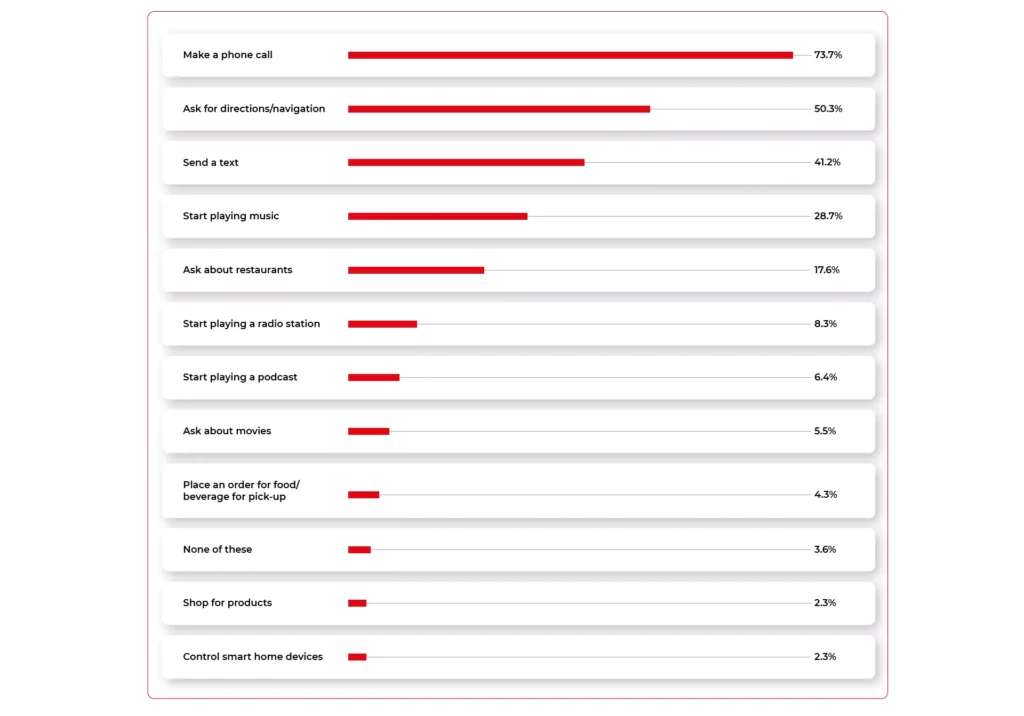
The main players in this section are certainly the manufacturers already known for their other platforms, namely Google and Apple, which are integrating their Android Auto and Carplay technologies in partnership with major OEMs. Hot on its heels is Amazon, which has not only begun collaborating to bring Alexa into Toyota, Ford, and BMW vehicles but also released an Amazon Echo device that any driver can install in their car themselves (as long as it meets the manufacturer's technical requirements).
Vehicle manufacturers, however, are no longer just waiting for the offers of the largest players in this market, but are developing their systems or working with smaller business partners to help them develop such solutions.
Korea's Hyundai has entered into an operation with Saltlux, a company specializing in semantic networks. Honda, Kia Motors, and Daimler are working with the SoundHound start-up. And Volkswagen has invested $180 million in the Chinese start-up Mobvoi.
Gesture-recognition
Voice command in the car is a trend that will continue to grow every year. Yet, there are situations in which gestures are much better than voice commands - for example when you are on a call or have a cold and don't want to strain your throat. Gestures are universal for every driver, while voice assistant applications are often still hampered by technological limitations, for example, due to the variety of accents or the system's adaptation to the driver's language.
As the system recognizes a gesture made with the palm of your hand, fingers, or even your head, you can stay focused on your driving and at the same time activate a specific function when you cannot use your voice command. Scrolling through songs on the radio, raising or lowering the temperature in the car, launching a text message application - all these actions can be configured using gestures. Instead of clicking and scrolling through a touchpad, which always entails taking your eyes off the road, gestures will allow you to boost safety and easily manage the entire system.
Virtual reality & Augmented reality
While currently the introduction of virtual reality in vehicles only makes sense for passengers who do not need to focus on driving, augmented reality technologies are already being successfully implemented in vehicles. Unlike VR, augmented reality does not distract drivers from reality and allows them to concentrate on driving. And they can even increase safety.
Although today this type of technology can only be found in the most innovative and prestigious IVI systems (one of the first cars in which this technology was used was Mercedes-Benz GLE 2020), we should expect this type of solution to develop in the near future, as it brings a whole new quality to in-car entertainment.
Their direct equivalent to the automotive field is the heads-up display system, which is an additional head-up display integrated into the vehicle's windscreen in addition to the IVI control panel. This screen can be used to display destination-related information, traffic warnings, or information about other vehicles on the road (so-called intelligent terrain mapping).
In the near future, these technologies may also be applied in entertainment itself - for instance in the form of augmented marketing. The windscreen will then display interesting offers and discounts from the restaurants, shops or shopping malls we have just passed. The displayed images will of course adapt to our driving speed, and we can decide for ourselves what kind of messages we wish to see.
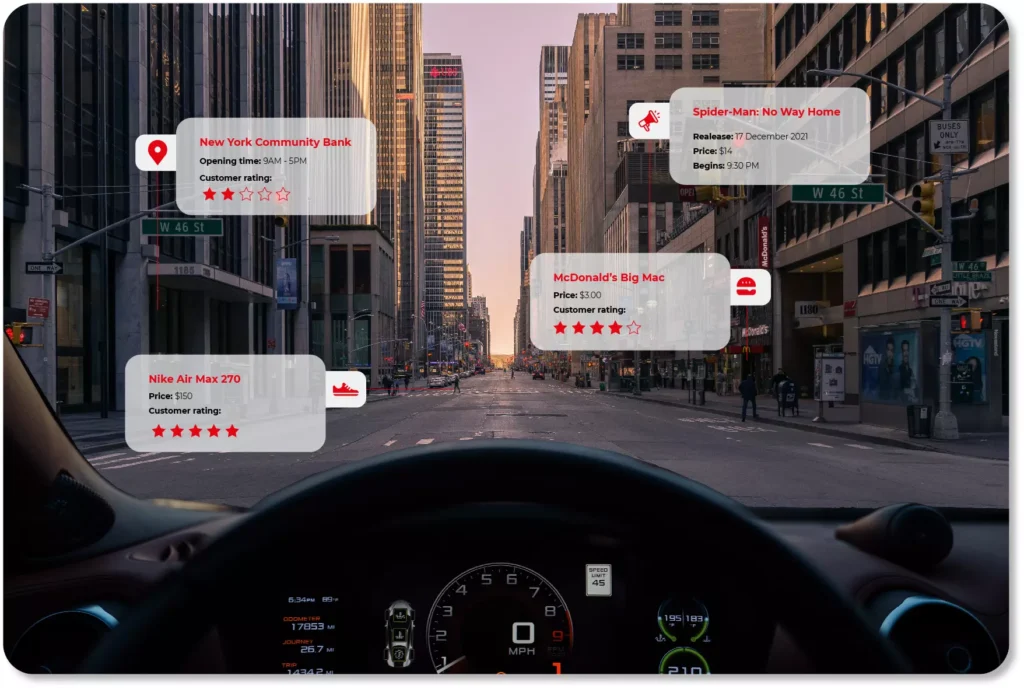
On-demand in-car services
In-vehicle infotainment systems are the point of contact between different parties: customers, internet providers, companies producing vehicles, making entertainment, or electronic equipment (e.g. smartphones).
In most cases, drivers already have their favorite apps (Google and Apple being in the lead, of course) and use their favorite streaming services. Competing with platforms like Spotify, Netflix, Pandora or Slacker may not necessarily be the best strategy for automotive companies. It is much better to make use of the recognisability of brands that provide entertainment content and, based on this, extend it with a unique offer for their own clients. Opening up to partnerships with third-party platforms is the best way to address customer needs and create a stream of data that can be monetized .
One of the interesting market examples of this type are the efforts of the GM concern, which has created its own car application in the form of a marketplace, from which the driver can make purchases at Starbucks or Dunkin' Donuts, pay for the fuel at selected petrol stations, and book a hotel or a table at a restaurant.
We should expect that the trend of shopping straight from the car and making the most of the time we have on our commute to/from work while being stuck in traffic jams will not be limited to listening to music and podcasts only. With the development of the Internet of Things, drivers will also be able to control other devices within their "smart" network from their vehicles.
Samsung is already creating solutions that allow the driver to look into their own fridge and decide whether they need to go shopping, turn up the thermostat to prepare the perfect temperature for the return home, activate the alarm when going on holiday, or open the gate automatically.
Rear seat entertainment
Most modern IVI systems are not just an integrated head-unit, i.e. a touch panel on the vehicle dashboard for the driver, but more and more often, interactive panels dedicated to the passengers. These offer practically endless opportunities for entertainment. And we don't just mean the extensive range of streaming video services that can be subscribed to in the vehicle.
After all, the interactivity of the screens makes it possible to implement various applications and gamification elements in the car. These can take the form of quizzes, common picture drawing, shopping via third-party applications, or even karaoke singing, which can also engage the driver.
But what if the sound or type of music doesn't suit the driver, who wants to concentrate on driving? There are already solutions that direct the sound from different areas of the vehicle so that each passenger can listen to different music without wearing headphones.
This is how, for example, the Separated Sound Zone (SSZ) works in KIA cars. Based on multiple loudspeakers and the physical wave acoustics principles, the sounds do not overlap but instead reach their intended audience. Even if powerful beats dominate in the back seat, you can still relax while listening to calmer music in the driver's seat.
In-vehicle infotainment enters a new era
In-car entertainment has a long history. Ever since mobile devices became part of our lives, it is nothing new to connect a smartphone to a Bluetooth radio or for passengers to watch videos on their own smartphones/tablets. The only difference was that, until recently, in-vehicle infotainment was just an accessory, an element that makes a difference and highlights a brand. Today it is a factor on which customers often rely when buying a new vehicle.
In-vehicle infotainment is increasingly rarely limited to a touch screen panel on the dashboard. Right before our eyes, it is growing to be omnipresent and taking precedence over other vehicle functions. Brands that miss this moment and, like Blockbuster in the video content market or Nokia in the mobile market, may find themselves in a completely new reality. A reality in which totally different companies will be on top of the bunch.
How to build software architecture for new mobility services - connected vehicle remote control
Remote control over a vehicle is not a new idea; it has become a trend in the modern world. The idea of vehicle remote control is highly connected with vehicle telematics , which is used to gather data using GPS technology, sensors, and onboard diagnostics codes. Managed data can include vehicle location, driver behavior, vehicle activity, and real-time engine diagnostics. Further, the technology is managed on software platforms that help fleet owners manage their assets remotely.
The data collected often includes vehicle location, fuel consumption, speeding, and maintenance information. But what if a car got stolen? It would be helpful not only to have the current location but also to send a command to a vehicle to turn the engine off or enable signalization. A huge problem in this case is to have a platform that will be independent of the Original Equipment Manufacturer (OEM). The best option here is to move the solution to the Cloud and introduce a single point of work with vehicles and integration with different OEMs.
Such telematics remote control gives a powerful opportunity to car-rental or car-sharing services like CityBee or SnapCar. They now can track their cars and also offer customers a no-human way to reserve a car using just a mobile application and know the current vehicle state when it is in use.
Vehicle connection
To establish connection to a car it’s necessary to equip the vehicle with an Internet-connected telemetry device. Some companies provide such a device as part of machine installation, but third-party tools like Geotab can be used for custom installation as well. It is important to have a device intended for two-way connection with a vehicle, as some solutions were created only for tracking purposes. Remote vehicle controllers like Mobokey offer the following commands on a vehicle:
- Lock/Unlock
- Turn engines on/off
- Klaxon sound
- Turn flash-lights on/off
- Wake up/sleep
- Connect/Disconnect the vehicle
Some manufacturers require their cars to be woken up explicitly before executing actual commands. It is intended to prevent the continuous connection or in case of low battery level.
Software solution
Once the two-way connection with a vehicle is established, we need a solution to track the actual status of a car and send commands. To do that, it is required:
- To make sure integration with a vehicle is completed successfully
- That the connection is secure
- That the command can be sent by us – it may differ depending on the manufacturer and model
and that we prepared:
- Dashboard to send commands
- Response handling - to be aware if command execution was successful
The damage caused by a successful attack on a vehicular telematics system because of an unsecured connection may range from mild to disastrous - to the extent of serious casualties and property losses. To enforce the security objectives for deployed and developing vehicular monitoring systems, embodiments of the disclosed technology include a stack of security approaches, both on physical and software levels.
As vehicle commands are sent over the Internet, it is important to have a network and infrastructure security built. The software solution stack must be enclosed in a Virtual Private Cloud (VPC). Apart from that, it is highly recommended to apply some best practices such as Static Application Security Testing (SAST), Interactive Application Security Testing (IAST), and Software Composition Analysis (SCA) to find vulnerabilities.
Another challenge in software solutions relates to the need for integration with different OEMs . Each OEM provides an API to integrate with and different ways of communication with vehicles - it may be a synchronous way, for example, HTTP request to REST API, or an asynchronous way, for instance, using queue-based protocols like MQTT.
Another issue is handling command execution responses or callbacks . The easiest way to implement this is when the OEM API synchronously responds with a command execution result, but in most cases, the OEM system may notify us about the execution result eventually in some time.
In this case, it is necessary to find a way to map a command request to a vehicle via OEM API and an execution response as it is used for retry policy, error handling, and troubleshooting.
Software architecture
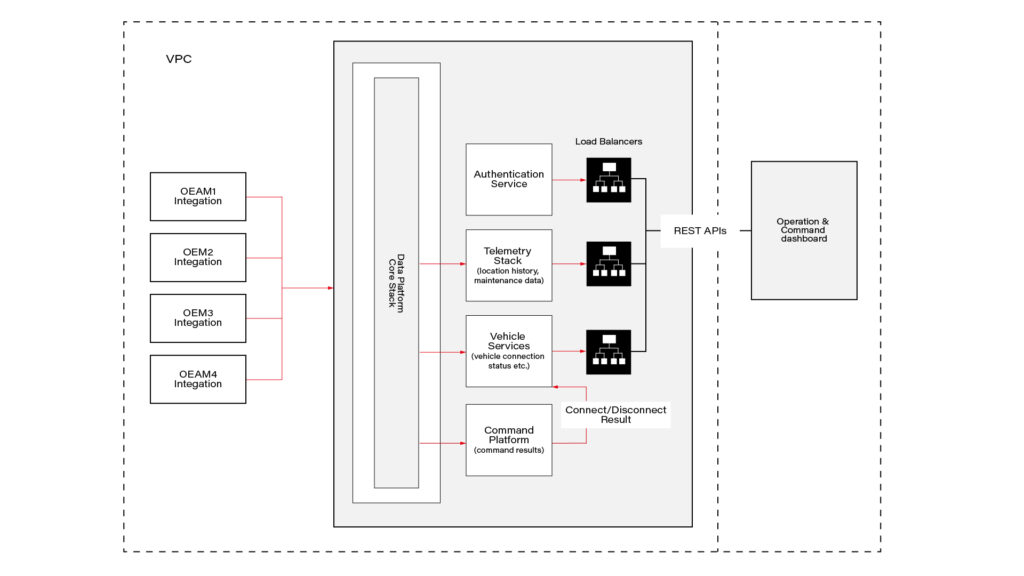
This connected vehicle solution uses the IoT platform, which authenticates messages from connected vehicles and processes data according to business rules. It leverages a set of main services, including Vehicle Services to connect vehicles and store vehicle-related data, a Telemetry stack to collect a delivery stream of input events and write them into Database, Command Services to send commands to the car and combine execution responses; and a queue-based topic which is intended for inter-communication between different parts of the system.
The solution also includes integration with OEM APIs. When IoT receives a message, it authenticates and authorizes the message, and the Command Platform executes the appropriate rule on the message, which routes the message to the appropriate OEM integration.
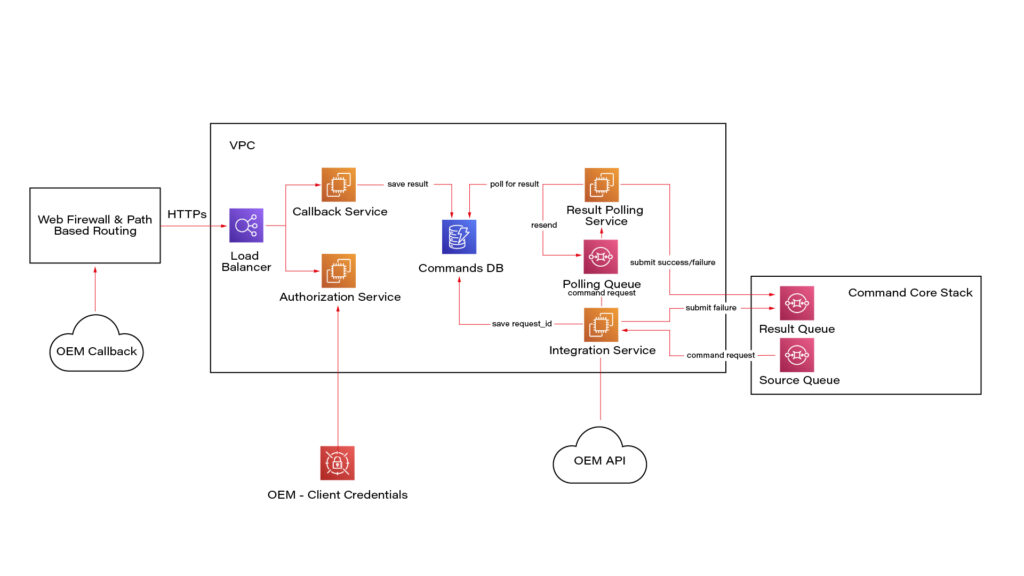
Here we see a potential OEM integration with the IoT Platform. It has authorization integration to allow us to send request OEM API securely; Callback integration to keep OEM response data regarding command execution; Database to keep mapping and consistent result - command request vs response; retry mechanism implementation using polling results from the database.
Once the system is authenticated, requests can be submitted to the connected vehicle solution’s OEM APIs. Based on the request identification data, the system eventually waits for the command result using a callback mechanism.
Conclusion
As highly-equipped connected vehicles increasingly rely on data exchanged with the infrastructure, it is required to have sustainable infrastructure, well-built cyber-security, privacy, and safety taken into account. The proposed solution also pays respect to the need to enroll in this process vehicle from different manufacturers.
This solution with remote vehicle control may be extremely useful for car-sharing systems, and apart from that, it can cover a solution for such use cases as autonomous and semi-autonomous vehicle driving, usage-based insurance, and customized in-vehicle experience . The solution also includes two-way communication.
Interested in our services?
Reach out for tailored solutions and expert guidance.