
About us
Our services

Capabilities

Legacy Modernization
Data Platforms
AI & Advanced Analytics

Industries

Automotive
Finance
Manufacturing
Aviation

Solutions

Databoostr

Data Sharing & Monetization Platform

Cloudboostr

Multicloud Enterprise Kubernetes

Looking for something else?

Contact us for tailored solutions and expert guidance.

Contact
Case studies
Resources

Resources

Blog

Read our blog and stay informed about the industry’s latest trends and technology.

Ready to find your breaking point?

Stay updated with our newsletter.

Subscribe

Insights

Ebooks

Explore our resources and learn about building modern software solutions from experts and practitioners.

Read more
Careers
Contact
Blog
Our experts

How to explain your tech job to your family?

Grape up Expert
August 8, 2018
•
5 min read

Table of contents

Heading 2
Heading 3
Heading 4
Heading 5
Heading 6

Schedule a consultation with software experts

Contact us

With new positions popping up all over the place on the IT job market, it might not be a piece of cake to explain what your tech job is about to your parents – people who aren’t necessarily die-hard fans of new technologies. Unless, of course, your mom or dad are avid tech geeks, chances are they have just, much to their excitement, discovered Facebook. Occassionally and unfortunately, they also happily take to social media to comment their children’s pictures.

So how do you explain what you do?

„No one knows what I really do.”, or „It’s actually pretty complicated.” are probably the worst explanations you can come up with. First, by saying that you come across as nonchalant. Second of all, you’re wasting a great chance to practice explainig it to a person that doesn’t have the slightest clue about it.

Try to understand them

If they usually don’t understand what you do, maybe it’s because you expect them to understand too much. Luckily, there is a way to explain almost anything to anyone, but before you do so, make sure to know your listener.

Some people may simply ask about your job to be polite, for example an uncle who’s just trying to break the awkward silence in between meals. However, who also work in IT may be genuinely interested in your position. Treat it as an elevator pitch. Once you know it, you will be able to adapt the pitch to the listener’s level of interest. And before you know it, you will have mastered a 1-minute description of your skills. Whether it’s going to be an extended description of your day at work with all your responsiblities, or a simple, one-sentence explanation of what you do in general.

For instance:  I develop software for international companies.

This sentence doesn’t really say it all, but for some it might be just good enough. Good enough for those who want to make sure that you’re clearly doing SOMETHING and making ends meet and footing your bill at the end of the month.

Try not to sound condescending

If you don’t really know how much someone else is into technology and how well-informed they are, it can be easy to cross the line between smart and awfully patronizing. The whole point here is not to make the other person feel any less intelligent.

It’s best to take into consideration your relative’s education and age. A good idea is to start off by sparking an interest in them by asking if they use a certain type of app or be it a website which perfectly relates to your professional field. You can also mention a story that recently went viral. Chances are they have heard of it. Either way, it’s a good starting point.

If by any chance you need to fully explain your field of expertise, try to do it as simple as possible.

Just like that:

    You:    Think of the news website that you visit every day…
    Your relative:    What about it?
    You:    I make sure that every piece of content on it is always up to date.

But don’t narrow it down to only one thing such as:

    You:    I spend ALL DAY coding like a madman.
    Your relative:    All day? Every day?
    You:    Correct.

Reality check – developers don’t spend eight hours a day producing lines of code. They fix bugs, go to meetings, and learn new things too.

Keep it simple and tell stories

The KISS method, also known as Keep It Stupid Simple is all about getting your message across as if you were talking to a five year old. Believe it or not, but some kindergartners are more savvy than adults. I mean, who hasn’t seen a child use an iPad? Let’s say you’re a marketing specialist. Instead of reducing it all to „I do marketing. Global marketing.” like the example above, go for something that’s fully-fledged:

„I am the person responsible for marketing, branding and all activities around it. I write social media posts – on Facebook and Twitter and organize events which my company attends in order to advertise or hire new employees. I also come up with new ideas on how to advertise our services and offer, and make sure that everything is in line with our business goals.”

This is no rocket science!

The key to success is to really just keep it simple. First of, your relatives aren’t your co-workers at your daily stand-ups. Your mom, dad, aunt, grandma… they might still use a flip phone and be strictly against upgrading it and avoid anything that has to do with a smartphone like the plague.

I hope those simple strategies work for you and make conversations with your family a tiny bit less awkward. After all, nobody is an expert on everything and even the most highly analytical minds need something explained if it’s not their cup of tea.

Grape Up guides enterprises on their data-driven transformation journey

Ready to ship? Let's talk.

Check our offer
Blog

Check related articles

Read our blog and stay informed about the industry's latest trends and solutions.

Our experts

The love-hate relationship between testers and developers

Admit it. Every time we think of the major forces that shape the world such as tech or science, we think of rocket launches, medicine, or even media that form our perceptions. Not many of us think of the people behind the scenes, the relationships between them, what inspires them and makes them drive it all forward. We just assume that things ”get done”.

Back in the day, people responsible for software development were usually hidden in their garages, they were a bunch of data geeks and brainy visionaries. The division between developers and testers was… non-existent. It truly is mind-blowing how much has changed since then! We literally hold the entire Internet in our palms. Apps and software play key roles in our daily lives. They teach, entertain, inform, and enhance our lives in so many ways. So why is the dependency between testers and developers so essential to that immense progress?

Most testers love their jobs, and they get paid to simply ”break stuff” and be annoying. The pickier you are about those bugs, the better. The problem is that nobody wants to hurt anyone’s feelings and no one wants to be pointed for their mistakes. The whole relationship between QA teams and developers is based on testers trying to spot errors made by developers who take so much pride in their work. So it all boils down to being professional, precise, but still polite. And that’s how the story begins.

No outcome is good enough

Both testers and developers work towards a common goal — to build a high-quality and bug-free product. They are equally responsible for the final outcome. However, since testers are solely responsible for catching bugs and stopping the bug infested code from being released, there are two, very common situations that QA teams find themselves in:

  •  The tester has found a bug
  •  The tester hasn't found a bug

 Conclusion: neither situation is perfect

In the first case, usually, it goes the same old way. After a bug has been found, developers ask testers whether it really is their problem. Perhaps, they can put the blame on something else and not have to deal with the problem at all ;)? Or they will ask way in advance about the number of bugs they should expect as if testers had superpowers and predicting the future was one of them. And they really DO expect a precise number. The answer is very simple – as many as you have done in the code.

The second scenario creates the perfect opportunity for developers to start an open discussion with testers. If there is a leftover bug that hasn’t been pointed out before, some will say  well, this may actually be your fault, this bug was so painfully obvious!
But no hard feelings. Even if such situations take place, it's all for the greater purpose.

It works for me!

There is a certain saying that is often used by some developers. Not all of them, just some. They say it when customers encounter bugs. They say it when QA says that something still doesn’t work.

    It works on my machine!  
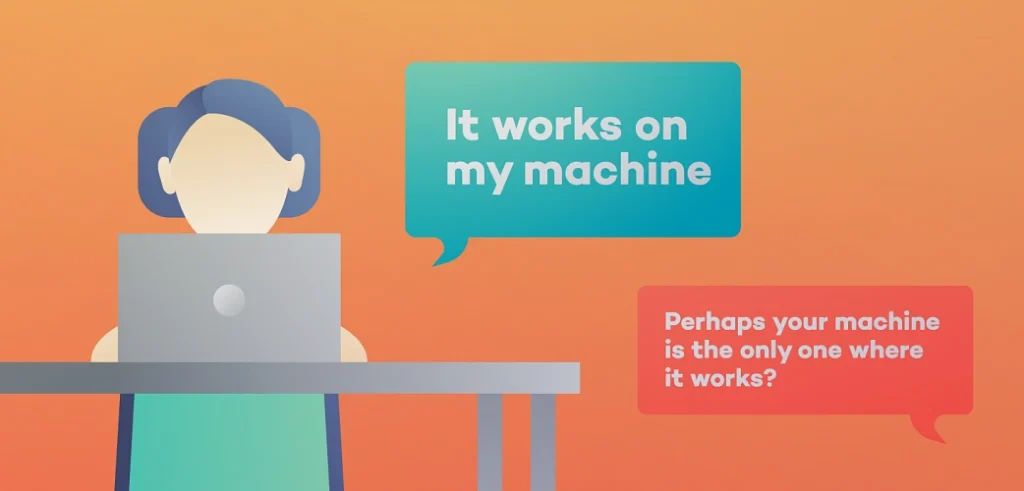
Perhaps everyone has come across it on the Internet, or at work. That’s the all too famous excuse that developers say when confronted with a defect in the production environment. However, anyone who has been in IT for a while or scrolls through memes on a regular basis knows that developers say it as a joke. And that's a fact!

If testers could share one expert tip with all developers, it would be to push all updates before handing over the task to QA. It avoids releasing things that don’t work to production. It saves developers the embarrassment when telling someone they are wrong, while in reality that are actually right.

    Let’s go, give it another try to see what you’re doing wrong … Oh, I see!  

However, that isn’t something what experienced engineers say. As they progress in their careers, most of them come to realize how valuable QA feedback is. Senior developers know that testers want the best for them and that they’re not a bunch of manipulative liars. They cooperate with QA to iron out any bugs before they get to production. Most often, it is the matter of pride and admitting that no one is perfect, and we all make mistakes – even in the precious code. And it comes with time. At Grape Up, we seek to maintain a healthy cooperation between testers and developers every day.

What does it take to be a good tester?

Not just anyone can be an exceptional tester. QA team members wear many hats: they must have an eye for detail, but also think outside the box like a user. They must know how to prioritize and put on a brave face in all situations. Perfect communication skills are a must while it is highly appreciated that they learn from their own mistakes – and from others too. Being objective and professional is also a nice-to-have. Last but not least, every tester should know how to say “no” to the developer and that something isn’t their job.

This is important as sometimes QA members, after having identified an issue, get asked to fix bugs themselves. This, of course, should always be done by a developer – not a tester. Therefore, assertiveness above all! That’s just the tip of the iceberg of what employees require from testers. But with practice, QA teams learn to harness their inner Sherlock Holmes and hunt down every bug to build an impeccable piece of software.

After all, love is in the air

Putting everything aside, developers and testers do love each other. These two groups come together in symbiosis to  create a product that works     for the end user   . Symbiosis by definition, is a relationship of mutual benefit for both sides. And just like in the case of developers and testers: both groups give and take. Testers give feedback, developers take that feedback, give their time to eradicate bugs and give back a bug-free product. Because after all, we’re all in this together, right?

Read more
Our experts

Main challenges while working in multicultural half-remote teams

We know that adjusting to the new working environment may be tough. It’s even more challenging when you have to collaborate with people located in different offices around the world. We both experienced such a demanding situation and want to describe a few problems and suggest some ways to tackle them. We hope to help fellow professionals who are at the beginning of this ambitious career path. In this article, we want to elaborate on working in multicultural, half-remote teams and main challenges related to this. To dispel doubts, by “half remote team” we mean a situation in which part of the group works together on-site when other part/parts of the crew work in other places, single or in a larger group/groups. We've gathered our experiences during our works in this kind of teams in Europe and the USA.

It’s nothing new that some seemingly harmless things can nearly destroy whole relations in a team and can start an internal tension. One of us worked in a team where six people worked together in one office and the rest of the team (three people) in the second office. We didn’t know why, but something wrong started to happen, these two groups of people started calling themselves “we” and “them”. One team, divided into two mutually opposing groups of people.

Those groups started to defy each other, gossip about yourself, and disturb yourself at work. What's more, there was not a person who tried to fix it, conflicts were growing, and teamwork was impossible. The project was closed. One year later, we started to observe this in our another project. In that project situation was different. There were 3 groups of people, a larger group with 4 people, and 2 smaller with 2 people each. We had delved into the state of things, and we discovered the reasons for this situation.

Information exchange

One of the reasons was the information exchange. The biggest team was located together, and they often discuss things related to work. Often the discussion turned into planning and decision-making, as you can guess, the rest of the team did not have the opportunity to take part in them. The large team made the decision without consulting it, and it really annoyed the rest…

What was done wrong, how can you avoid it in your project? The team should be team, even if its members don’t work in the same location. Everyone should take an active part in making decisions. Despite the fact that it is difficult to achieve, all team members must be aware of this, they must treat the rest of the team in the same way, as if they were sitting next to them.

Firstly, if an idea is developed during the discussion, a group of people must grab it and present it to the rest of the team for further analysis. You should avoid situations where the idea is known only to a local group of people. It reduces the knowledge about the project and increases the anger of other developers. They do not feel part of the team, they do not feel that they have an impact on its development. What's more, if the idea does not please the rest, they begin to treat authors hostile which create conflicts and leads to a situation where people start to say “we” and “them”. Part of the team should not make important decisions, it should be taken by the whole team, if a smaller group has something to talk about everyone should know about it and have a chance to join them (even remotely!).

Secondly, if a group notices they are discussing things which other people may be interested in, they should postpone local discussion and create remote room when discussion can be continued. Anyone can join it as if sitting next to them.

Thirdly, if it was not possible to include others in the conversation the conversation summary should be saved and made available to all team members.

Team integration

The second reason We found was an integration of the parts of the team. The natural thing was that people sitting together knew each other better, thus, a natural division into groups within the team was formed. Sadly, this can not be avoided… but we can reduce the impact of this factor.

Firstly, if possible, we should ensure the integration of the parts of the team. They have to meet at least once, and preferably in regular meetings not related to work, so-called integration trips.

Secondly, mutual trust among the team should be built. The team should talk about difficult situations in full composition, not in local groups over coffee. And if a local conversation took place, the problem should be presented to the whole team. Everyone should be able to speak honestly and feel comfortable in the team, it is very important!

Language and insufficient communication

Another obstacle is a different culture or language. If there are people who speak different languages in the team, they will usually use English which will not be a native language for a part of the team… Different team members may have different levels of English speaking skills, less skilled team members may not understand intricate phrases.

It is very important to make sure everyone understands the given statement. If you know that you have some people in your team whose English is not so fluent, you can ask and make sure they understood everything. Confidence should be built inside the team, everyone should feel that they can ask for an explanation of the statement in the simplest words without taunting and consistency. We have seen such a problem many times in teams especially multicultural. A lack of understanding leads to misunderstandings and the collapse of the project. Each of the team members should learn and improve their skills, the team should support colleagues with lower language skills, politely correcting them and communicating that they use some language form incorrectly. We recommend doing it in private unless the confidence in the team is so large that it can be done in a group.

Communication can also lead to misunderstandings, at the beginning of our careers our language skills were not the best. Our statements were very simple and crude. As a result, sometimes our messages were perceived as aggressive… We did not realize it until We started to notice the tension between us and some of the team members. It is very difficult to remedy this, after all, we do not know what others think. Therefore, small advice from us - talk to each other, seriously and try to build a culture of open feedback in the team, address even uncomfortable topics. Even if you have a language problem it is sometimes better to try to describe something in 100 simple sentences than not to speak at all...

Time difference

Let’s focus on one more challenging difficulty that may cause a lot of troubles while working in half-remote teams. While working in teams distributed over a larger area of the world, the time difference between team member’s locations might cause an issue that is very hard to overcome. We have been working in a team where team members were located in the USA (around both eastern and western coasts), Australia and Poland. As per our experience, it is nearly impossible to gather all team members together because of working hours in those locations. We have observed some common issues that such a situation may cause.

Team members working in different time zones have limited capabilities of teamwork. There is often not enough time for team activities like technical or non-work-related discussions over a cup of coffee that build team spirit and good relations between members. It is impossible to integrate distributed teams without cyclic meetings in one place. We have seen how such odds and ends lead to team divisions on “we” and “they” mentioned before. It is also a blocker when it comes to applying good programming practices in the project like pair programming and knowledge sharing.

Distributed teams are more difficult to manage, and some of the Agile work methodologies are not applicable at all, as it often requires the participation of all team members. In the case of our team, Scrum methodology did not work at all, because we could not organize successful planning sessions, sprint reviews, retrospectives and demos on which everyone’s input matters. It was a common situation where after planning team members did not know what they are supposed to do next, and at first, they needed to discuss something with absent teammates.

If we take a look at distributed team performance, it will usually seem to be lower than in the case of local teams. That is mainly because of inevitable delays when some team member needs assistance from another. Imagine that you start working and after an hour you encounter a problem that requires your teammate’s help, but s/he will wake up no sooner than in 7 hours. You have to postpone task you were working on, and focus on some other - what usually slows your job down. Of course, it is a sunny day scenario, because there might be more serious issues where you cannot do anything else in the meantime (i.e. you have broken all environments including production, backup was “nice to have” on planning - and your mate from Australia is the only one who can restore it). It also takes more time to exchange information, process code reviews and share knowledge about a project if we cannot reach other team members immediately when they are needed.

On the other hand, distributed teams have some advantages. There are many projects or professions that require client support for 24/7 - and in this case, it is much easier for such time coverage. It can save a team from on-calls and other inconveniences.

We have learned that there is no cure for all the problems that distributed teams struggle with, but the impact of some of them can be reduced. Companies that are aware of how time difference impacts team performance often offer possibilities to work remotely from home in fully flexible hours. In some cases, it works and it is faster to get things done, but it does not solve all problems on a daily basis, because everyone wants to live their private life as well, meet friends on the evening or grab a beer and watch TV series rather than work late at night. Moreover, team integration and cooperation issue could be solved by frequent travels but it is expensive and the majority of people do not have the possibility to leave home for a longer period of time.

Summary

To sum it up, multicultural half-remote teams are really challenging to manage. Distributed teams struggle with a lot of troubles such as information exchange, teamwork, communication, and integration - which may be caused by cultural differences, remote communication and the time difference between team members. Without all this, there is just a bunch of individuals that cannot act as a team. Despite the above tips to solve some of the problems, it is hard to avoid the lack of partnership among team members, that may lead to divisions, misunderstandings and team collapse.

And while the struggles described above are real, we can't forget why we do it. Building a distributed team allows a company to acquire talent often not available on the local market. By creating an international environment, the same company can gain a wider perspective and better understand different markets. Diversification of the workforce can be a lifesaver when it comes to some emergency issue that may be a danger for a company that the entire team works in one location. We at Grape Up share different experiences, and thanks to knowledge exchange, our team members are prepared to work is such a demanding environment.

Read more
Our experts

A slippery slope from agile to fragile: treat your team with respect

„Great things in business are never done by one person, they’re done by a team of people.”

said Steve Jobs. Now imagine if he didn’t have such Agile approach. Would the iPhone ever exist?

Agile development, a set of methods and practices where solutions evolve thanks to the collaboration between cross-functional teams . It is also pictured to be a framework which helps to ‘get things done’ fast. On top of that, it helps to set a clear division of who is doing what, to spot blockers and plan ahead. And we’ve all heard of this. Most of us even know the definition of Agile by heart. In the last few decades, Agile has become the approach for modern product development. But despite its popularity, it is still misinterpreted quite often and its core values tend to get abused. This misinterpretation has become so common that it has developed a name for itself, frAgile. In other words, it is what your product and team become if you don’t follow the rules.

The thin line between Agile and frAgile

Working by the principles of Agile means you are flexible and you’re able to deliver your product the way the customer wants it and on time. By and large, Agile teaches u how to work smarter and how to eliminate all barriers to working efficiently. However, there are times when the attempt to follow Agile isn’t taken with enough care and the whole plan fails. Just like trying to keep balance when it’s your first time on ice skates.

With that said, I will step-by-step explain a few examples of how Agile can quickly and irreversably become something it should never be in the first place. Later on, I will list the tips on how to avoid stepping on that slippery slope. So let’s take a look at the examples:

Your technical debt is going through the roof

Just like projects, sprints are used to accomplish a goal. Quite often though, when the sprint is already running, new decisions and changes keep flowing in. As a result, your team keeps restarting work over and over again and works all the time. Does it sound familiar?

Unfortunately, if this situation continues, everyone gets used to it and it becomes the norm. It usually leads to a huge pile of technical debt you could ever imagine. Combine it with an endless list of defects caused by the lack of stability to nurture the code and you are doomed for failure.

You should always respond to change wisely. Despite the fact that the Agile methodology embraces changes and advocates flexibility, you shouldn’t overdo it. Especially not the changes that impact your sprint on a daily basis. Every bigger change ought to be consulted between sprints, and be based on the feedback received from users.

A big fish leaves the team and the project falls apart

Another, not so fortunate thing that can happen is a team member leave your team in the middle of a long-term, complex project that consists of more unstructured processes than meets the eye. With the job rotation in the contemporary world of IT, it happens all the time.

Once a Product Owner or a Team Leader is gone, none of the team members will be able to propoerly describe the system behavior and what should be delivered. As a result, deadlines will fail to be met and you will be chasing dreams about the quality of your product.

Find the balance between individuals and processes. And most importantly, never underestimate how your scope of work is documented and the team is managed. Otherwise, after an important team member is gone, the rest will be left in a difficult position. So prepare them for such events. Take your time to estimate what might hold back your team and what is absolutely necessary for the fast-paced of world-class engineering.

The project is nearly finished but your customer is nowhere near Agile

You would be surprised at how many companies out there are Agile… in their dreams. By appreciating the flexibility that Agile gives, they often confuse Agile working with flexible working and still work with the waterfall methodology in their minds. This can be spotted especially when someone overuses terms like sprint or scrum all the time. In reality, actions speak louder than words and one doesn’t have to show off their „rich” vocabulary.

Therefore, if you agree on a strict scope of delivery in your contract, you might regret it later on. We all know that the reason why IT is all about Agile is because plans tend to change. The only problems is that the list of features on the contract doesn’t. If the customer doesn’t fully understand the values of Agile, the business relationship can be put at risk.

Prioritize the collaboration with your client over contract negotiations. Focus on clear communication from the beginning and make sure that your client grasps the principles of Agile. Also, if along the way any unexpected changes to the established scope of work appear, make sure to carry them out in front of your client’s eyes.

Save me from drowning in frAgility

With all the above, here is how you can avoid messing up your work environment:

  • Prepare user stories before planning the sprint. You will thank yourself later. If written collaboratively as part of the product backlog grooming proces, it will leverage creativity and the team’s knowledge. Not only will it reduce overhead, but also accelerate the product delivery.
  • Be careful with changes during the sprint. Or simply - avoid abrupt changes. Thanks to this, your code base will have its necessary stability for performance.
  • Turn yourself into a true Agile evangelist. Face reality that not everyone understands the core values of the world’s most beloved methodology – not even your customers. So even if someone tells you that they use Agile, take it with a pinch of salt. Strong business partnerships are built upon expectations that are clear to both sides.

At Grape Up, we follow the principles behind the Agile Manifesto for software development. We believe that business people and developers must work together daily throughout the project. It helps us and our clients achieve mutual success on their way to becoming cloud-native enterprises .

Read more
View all
Connect

Interested in our services?

Reach out for tailored solutions and expert guidance.

Stay updated with our newsletter

Subscribe for fresh insights and industry analysis.

About UsCase studiesContactCareers
Capabilities:
Legacy ModernizationData PlatformsArtificial Intelligence
Industries:
AutomotiveFinanceManufacturingAviation
Solutions:
DataboostrCloudboostr
Resources
BlogInsights
© Grape Up 2025
Cookies PolicyPrivacy PolicyTerms of use
Grape Up uses cookies

This website uses cookies to improve its user experience and provide personalized content for you. We use cookies for web analytics and advertising. You can accept these cookies by clicking "OK" or go to Details in order to manage your cookies preferences more precisely. To learn more, check out our Privacy and Cookies Policy

Accept allDetails
Grape Up uses cookies

Essential website cookies are necessary to provide you with services available through the website, autosave your settings and preferences, and to enhance the performance and security of the website - you have the right not to accept them through your web browser's settings, but your access to some functionality and areas of our website may be restricted.

Analytics cookies: (our own and third-party : Google, HotJar) – you can accept these cookies below:

Marketing cookies (third-party cookies: Hubspot, Facebook, LinkedIn) – you can accept these cookies below:

Ok