
How automotive open source technologies accelerate software development in the automotive industry


The driving properties or the external appearance of cars, which used to serve as a differentiator between manufacturers, no longer play a key marketing role today. It is the car's software that has become the new growth engine for the automotive industry. Yet, the question remains where this software should come from and whether it pays to use a free-access license. Here we compare the most popular automotive open-source solutions.
What exactly is Open Source Software in the automotive industry?
Most of the software developed by the major automotive companies is copyrighted to other players in the market. Does this mean that being a less well-resourced player, it is impossible to thrive in the SDV sector? Not necessarily, and one of the solutions may be to take advantage of open-source software (OSS).
A characteristic of such access is that the source code is freely available to programmers under certain licensing conditions.
Flexible customization to meet your needs
It is important to know that OSS does not necessarily entail that a given vehicle manufacturer is "doomed" to certain functionalities. After all, the operating system, even if based on publicly available code, can then be developed manually.
The programmer is therefore authorized to benefit from free libraries, and cut and paste individual values into the code at will, modifying the content of the whole .
OSS is gaining ground
According to Flexera's research, more than 50% of all code written globally today runs on open source. That's a large percentage, which reflects the popularity of free software.
The OSS trend has also gained importance in the automotive industry in recent years, with OEMs trying with all their might to keep up with technological advances and new consumer demands. According to the same study, between 50% and 70% of the automotive software stack today comes from open source.
In contrast, Black Duck software audits of commercial applications demonstrate that open-source components are predicted to account for 23% of automotive applications.
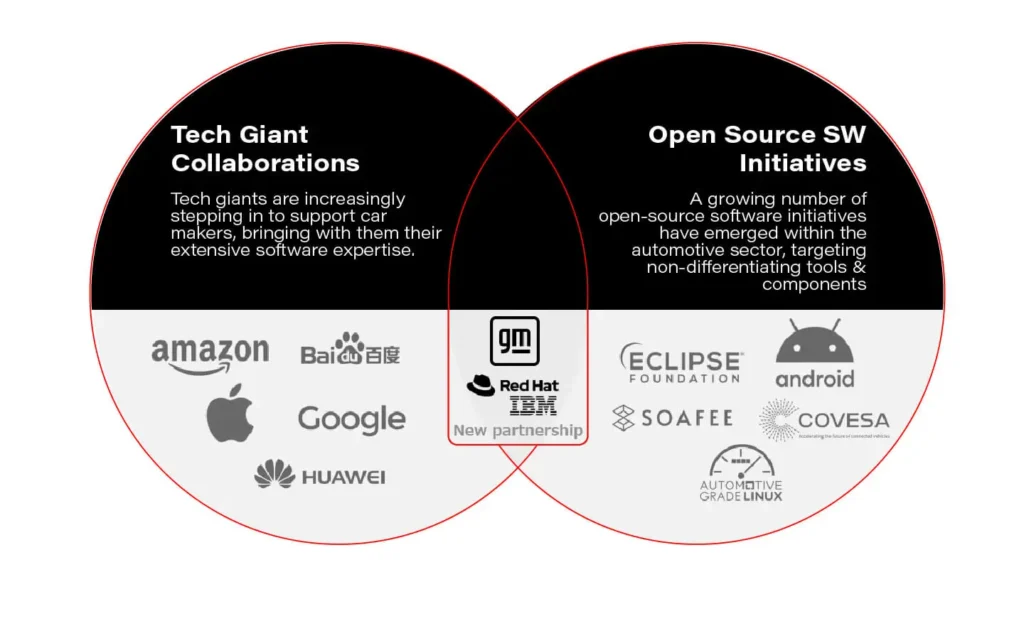
Automotive Open-Source Software implies a number of benefits. But can we already talk about a revolution?
Why is the mentioned solution so popular nowadays? In fact, there are several reasons.
- Allows minimizing costly investments (budget saved can be used as a way of developing other solutions).
- Enables vehicle manufacturers to offer consumers a fresh and compelling digital experience .
- Contributes to faster business growth due to reduced expenses and "tailor-made" software development teams.
- Provides benefits to consumers by making cars safer with more reliable data.
- It is used to maximize product agility cost-effectively.
Clearly, these arguments are quite strong. Yet, to be able to talk about a revolution and a complete transition to OSS in the automotive industry, it will still take some more time. After all, at present, this is applied mainly to selected vehicle functions, such as entertainment.
Nevertheless, some companies are already embracing free licensing, seeing it as a new business model. The potential is certainly substantial, although not yet fully harnessed. For instance, it is said to be very difficult to meet all the requirements of SDV, including those related to digital security issues, as we write later in the article.
Examples of open-source solutions in the auto industry
Automotive Grande Linux
The Linux operating system is a prime example of the power of an open-source solution. The base of this tech giant ranks among the top operating systems worldwide, especially when talking about automotive.
The Automotive Grade Linux (AGL) project is particularly noteworthy here, as it brings together manufacturers, suppliers, and representatives of technology companies. AGL platform, with Linux at its core, develops an open software platform from the ground up that can serve as the de facto industry standard, enabling the rapid development of the connected car market. Automotive companies, including Toyota, already leverage Linux open-source for automotive.
As of today, AGL (hosted by the Linux Foundation, the world's) is the only organization that seeks to fully aggregate all the functionalities of modern vehicles into Open-Source software. This includes such areas as:
- Infotainment System – UCB 8.0 currently available, SDK available.
- Instrument Cluster – device profile available with UCB 6.0 (Funky Flounder).
- Telematics – device profile available with UCB 6.0 (Funky Flounder).
- Heads-up Display (HUD).
- Advanced Driver Assistance Systems (ADAS).
- Functional Safety.
- Autonomous Driving.
The founders of the project assume that in the current reality it is becoming obvious that the amount of code needed to support autonomous driving is too large for any one company to develop it independently. That's why they are the first in the world aiming to create a coherent OSS ecosystem for the automotive industry.
Red Hat In-Vehicle Operating System
A competitive approach is being adopted by Red Hat, which has also mushroomed into a group of free software innovators in connected cars. Their proprietary solution, Red Hat In-Vehicle Operating System, is designed to help automakers integrate software-defined vehicle technology into their production line faster than ever.
General Motors and Qualcomm Technologies Inc. have already declared their interest in such an approach.
Part of the mission of the above-mentioned company is to develop certified functional safety systems built on Linux with functional safety certification (ASIL-B) to support critical in-vehicle applications. IVOS from Red Hat is currently (Fall 2022) being tested on the Snapdragon® Digital Chassis™ . This is a set of cloud-connected platforms for telematics and connectivity, digital cockpit, and advanced driver assistance systems. This collaboration is intended to provide:
- faster implementation of new digital services and innovative new features connected to the cloud,
- new opportunities for more in-depth customer engagement,
- the ability to update services over the vehicle's lifetime via the cloud,
- the option of gaining expanded capabilities to perform simple and efficient vehicle updates and maintain functional safety,
- the ability to redefine the driving experience for customers by ensuring seamless connectivity and enhanced intelligence.
Android Automotive OS
Great opportunities are also offered by the software based on a system featuring a distinctive green robot in its logo.
Android Automotive OS (AAOS), as its name is known, is earning increasing recognition across the globe. This is no coincidence, as it allows car companies to provide customers with the most tailor-made experience. Polestar and Volvo were among the first to introduce Android Automotive OS to their Polestar 2 and XC40 Recharge, andrecently Renault has done this with Megane E-Tech.
Other brands have followed suit. Manufacturers such as PSA, Ford, Honda, and GM have already declared their intention to incorporate AAOS into the vehicles they develop.
Part of the implementations come with Google Automotive Services (GAS): Play Store, Google Maps, Google Assistant, and other parts without, their own app stores, and assistants.
Here are selected capabilities of the above-mentioned software:
- AAOS being an integral part of the car brings ideas about controlling features of a car, or at least reading them and reacting within an application accordingly. Emulation provides just a few options to simulate car state, ignition, speed, gear, parking brake, low fuel level, night mode, and environment sensors(temperature, pressure, etc.).
- There is still a requirement to follow design patterns for automotive, and Google is providing a whole design system page.
- Applications submitted to the store are mandatory for an additional review.
- Right now, the documentation states that supported categories for Android Automotive OS apps are focused on in-vehicle infotainment systems: Media, Navigation, Point of Interest, and Video.
Regrettably, though Android has a lot of potential, it still has limitations in terms of functionality and capabilities. Hence, it cannot be described as an ideal solution at this point. We wrote more about these issues and possible solutions to AAOS .
Meanwhile, if you are interested in automotive implementation using Android read this guide.
COVESA / Genivi
The embedded Android Automotive system in vehicles requires proper integration with existing software and with other systems found in the car (for safety, car data, etc.). The Android Automotive SIG project, led by GENIVI, was created with large-scale rollouts in mind.
The premise of the AASIG Android Development Platform is that OEMs, their suppliers, and the broader cockpit software ecosystem can easily and successfully identify both the shortcomings and requirements. This is intended to be done in close collaboration with Google's Android Automotive team.
Among the issues addressed are the following:
- safety,
- access to vehicle information,
- responsibility for long-term maintenance,
- multi-display operation,
- audio management,
- extensions for Android in the automotive environment,
- keeping the in-vehicle system updated to support new Android versions,
- outlining the boundaries within which Tier 1/OEM suppliers must take over major responsibility for supporting Google's Android Automotive team.
As can be seen, in the case of Android, there are a number of hot spots that need to be properly dealt with.
What limitations do you need to be aware of?
Ensuring a high level of security in safety-critical automotive environments has always posed a major challenge for Open-Source Software. This is because you have to reconcile customer expectations while also ensuring data protection.
Certainly, open-source software has more vulnerabilities than dedicated software and thus is more susceptible to hacker attacks. Even a single exploit can be used to compromise hundreds of thousands of applications and websites. Obviously, static and dynamic application security testing (SAST and DAST) can be implemented to identify coding errors. However, such testers do not perform particularly well in identifying vulnerabilities in third-party code.
So if you plan to use connected car technology , you need to examine the ecosystem of software used to deliver these functions. It is also critical to properly manage open-source software in your overall security strategy.
OSS opportunities and challenges
All told, until some time ago, OSS was mainly focused on entertainment. Besides, OEMs have historically been forced to choose between only a few software stacks and technologies. But today they are faced with a rapidly growing number of OSS proposals, APIs, and other solutions.
On top of that, they have a growing number of partners and tech companies to collaborate with. And initiatives such as Autoware and Apollo shift their focus toward applications relevant to the safety and comfort of autonomous vehicles. Of course, these opportunities are also coupled with challenges, such as those related to security or license compliance . On the other hand, this still does not negate the enormous potential of open-source software.
It can be hypothesized that in the long term, a complete transition to SDV will require manufacturers to make optimal use of open-source software. And this will include an increasing range of vehicle functionality. This is an obvious consequence of the rapidly changing automotive market (which in a way forces the search for agile solutions) and growing consumer and infrastructure demands.
Sooner or later, major OEMs and the automotive community will have to face a decision and choose: either proprietary comfort (such as CARIAD from Volkswagen) or the flexibility offered by OSS projects.

Data powertrain in automotive: Complete end-to-end solution
We power your entire data journey, from signals to solutions
Check related articles
Read our blog and stay informed about the industry's latest trends and solutions.
AAOS Hello World: How to build your first app for Android Automotive OS
Android Automotive OS is getting more recognition as automotive companies are looking to provide their customers with a more tailored experience. Here we share our guide to building the first app for AAOS.
Before you start, read our first article about AAOS and get to know our review to be aware of what to expect. Let’s try making a simple Hello World app for android automotive. To get an IDE, go to Android Studio Preview | Android Developers and get a canary build:
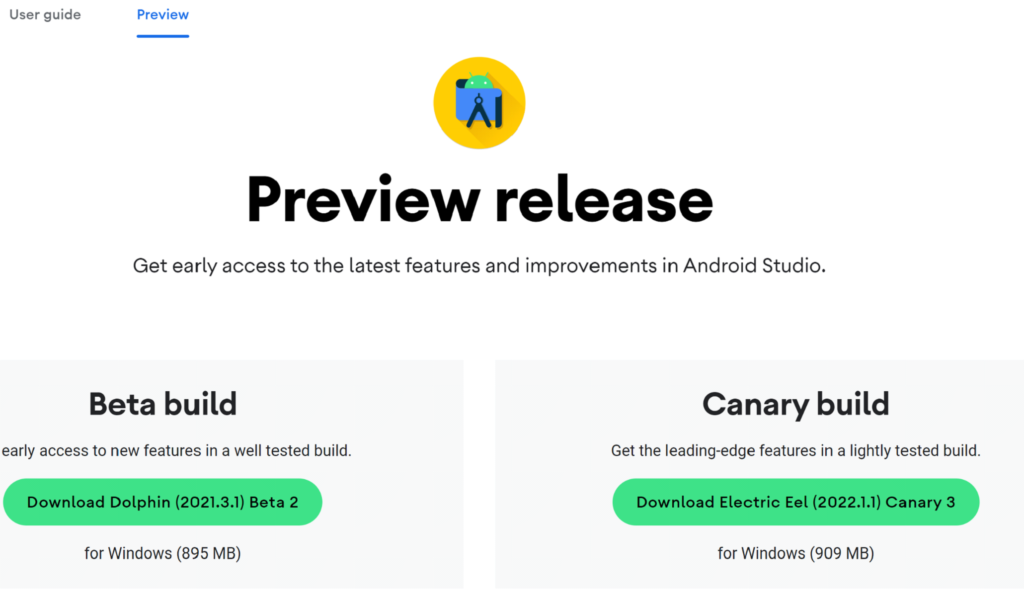
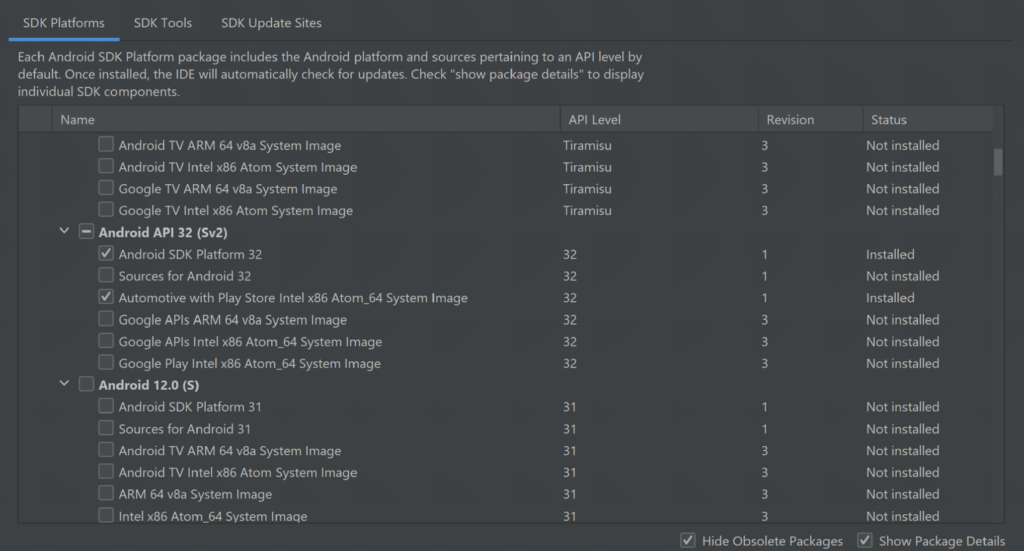
In the next step, prepare SDK, check and download the Automotive system image in SDK manager. You can get any from api32, Android 9, or Android 10, but I do not recommend the newest one as it is very laggy and crashes a lot right now. There are also Volvo and Polestar images.
For those you need to add links to SDK Update Sites:
https://developer.volvocars.com/sdk/volvo-sys-img.xml
https://developer.polestar.com/sdk/polestar2-sys-img.xml
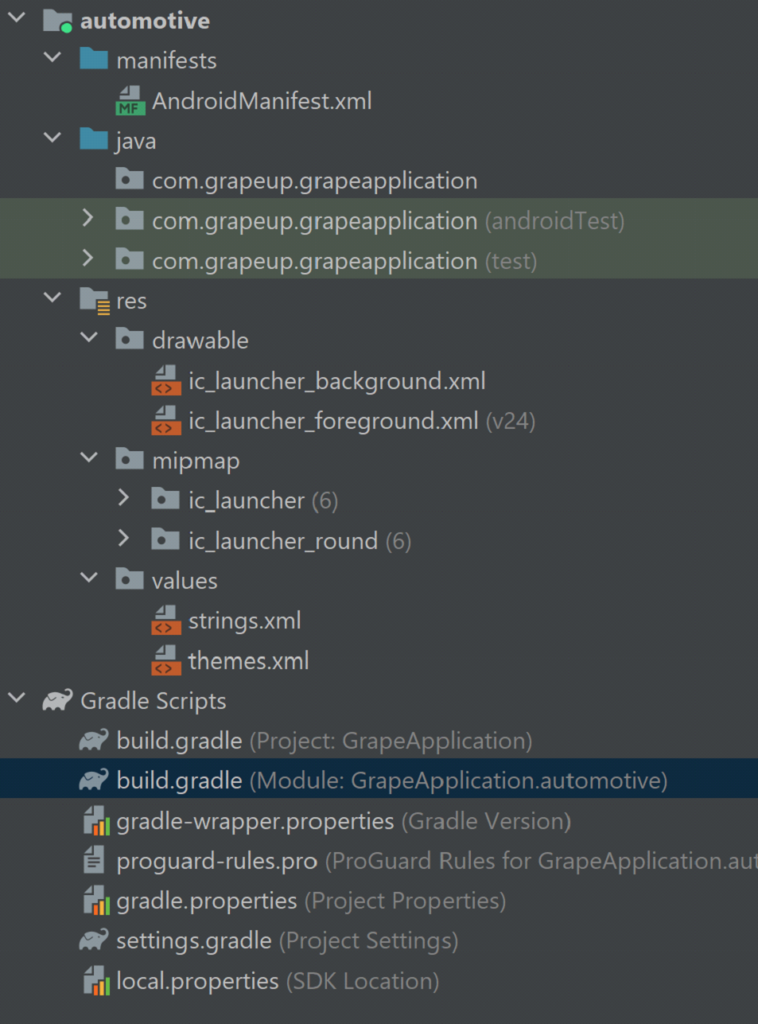
Start a new project, go to File> New Project and choose automotive with no activity
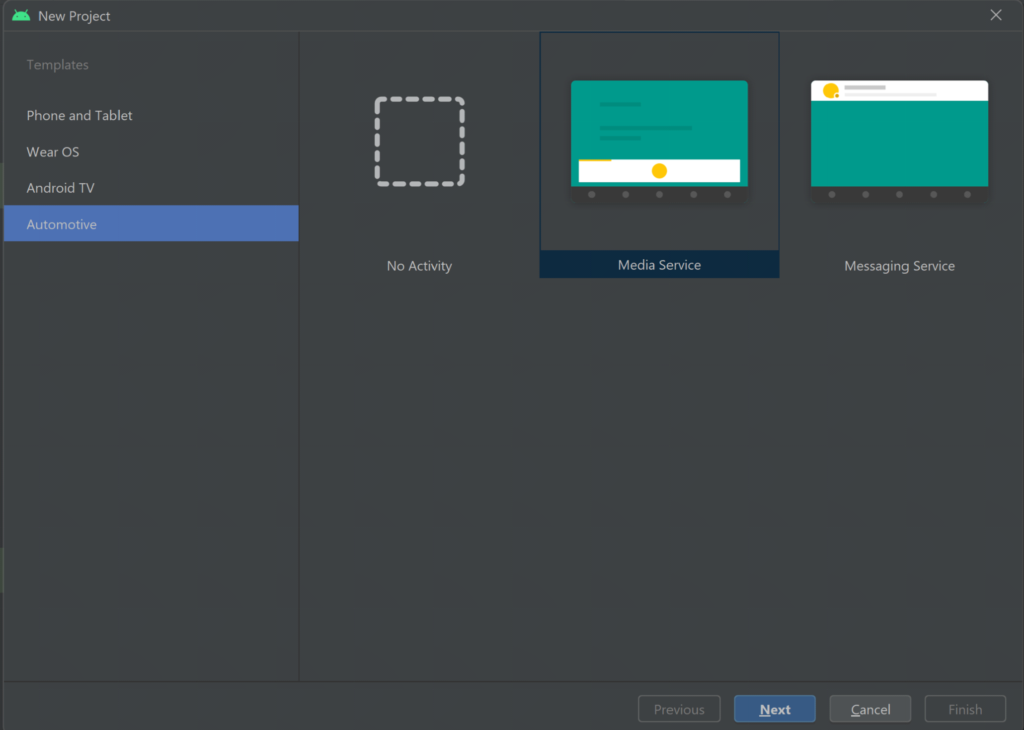
A nice and clean project should be created, without any classes: Go to build.gradle and add the car app library into dependencies, refresh the project to make it get
our new dependency:
implementation "androidx.car.app:app-automotive:1.2.0-rc01"
Let's write some code, first our screen class. Name it as you want and make it extend Screen class from android.car.app package and make it implement required methods:
public class GrapeAppScreen extends Screen {
public GrapeAppScreen(@NonNull CarContext carContext) {
super(carContext);
}
@NonNull
@Override
public Template onGetTemplate() {
Row row = new Row.Builder()
.setTitle("Thats our Grape App!").build();
return new PaneTemplate.Builder(
new Pane.Builder()
.addRow(row)
.build()
).setHeaderAction(Action.APP_ICON).build();
}
}
That should create a simple screen with our icon and title, now create another class extending CarAppService from the same package and as well make it implement the required methods. From createHostValidator() method return a static one that allows all hostnames for the purpose of this tutorial and return brand new session with our screen in onCreateSession() , pass CarContext using Session class getCarContext() method:
public class GrapeAppService extends CarAppService {
public GrapeAppService() {}
@NonNull
@Override
public HostValidator createHostValidator() {
return HostValidator.ALLOW_ALL_HOSTS_VALIDATOR;
}
@NonNull
@Override
public Session onCreateSession() {
return new Session() {
@Override
@NonNull
public Screen onCreateScreen(@Nullable Intent intent) {
return new GrapeAppScreen(getCarContext());
}
};
}
}
Next, move to AndroidManifest and add various features inside the main manifest tag:
<uses-feature
android:name="android.hardware.type.automotive"
android:required="true" />
<uses-feature
android:name="android.software.car.templates_host"
android:required="true" />
<uses-feature
android:name="android.hardware.wifi"
android:required="false" />
<uses-feature
android:name="android.hardware.screen.portrait"
android:required="false" />
<uses-feature
android:name="android.hardware.screen.landscape"
android:required="false" />
Inside the Application tag add our service and activity, don’t forget minCarApiLevel as lack of this will throw an exception on app start:
<application
android:allowBackup="true"
android:appCategory="audio"
android:icon="@mipmap/ic_launcher"
android:label="@string/app_name"
android:roundIcon="@mipmap/ic_launcher_round"
android:supportsRtl="true"
android:theme="@style/Theme.GrapeApplication">
<meta-data android:name="androidx.car.app.minCarApiLevel"
android:value="1"
/>
<service
android:name="com.grapeup.grapeapplication.GrapeAppService"
android:exported="true">
<intent-filter>
<action android:name="androidx.car.app.CarAppService" />
</intent-filter>
</service>
<activity
android:name="androidx.car.app.activity.CarAppActivity"
android:exported="true"
android:label="GrapeApp Starter"
android:launchMode="singleTask"
android:theme="@android:style/Theme.DeviceDefault.NoActionBar">
<intent-filter>
<action android:name="android.intent.action.MAIN" />
<category android:name="android.intent.category.LAUNCHER" />
</intent-filter>
<meta-data
android:name="distractionOptimized"
android:value="true" />
</activity>
</application>
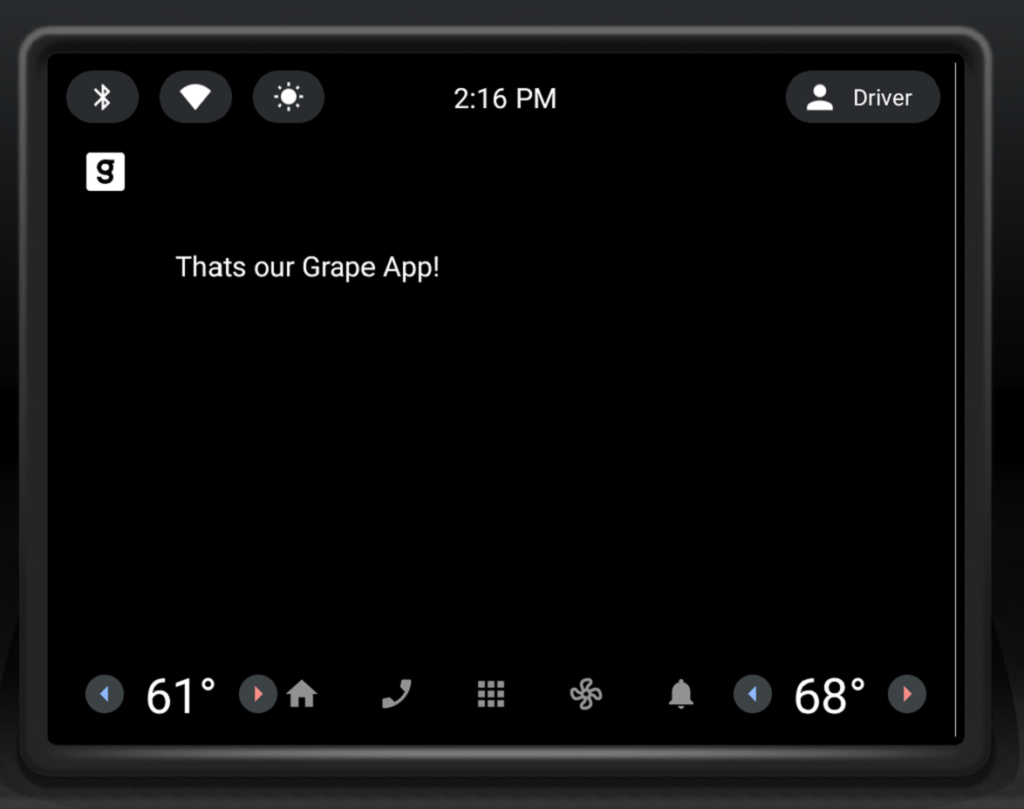
Now we can upload our application to the device, verify that you have an automotive emulator created, use automotive configuration, and hit run. The app is run in Google Automotive App Host, so if it is your first application on this device, it may require you to get to the play store and get it.

That’s how it looks:
The last thing, we’ll add a navigation button that will pop a Toast . Modify onGetTemplate() in Screen class, add Action and ActionStrip :
Action action = new Action.Builder()
.setOnClickListener(
() -> CarToast.makeText(getCarContext(), "Hello!", CarToast.LENGTH_SHORT).show())
.setTitle("Say hi!")
.build();
ActionStrip actionStrip = new
Add it to PaneTemplate:
return new PaneTemplate.Builder(
new Pane.Builder()
.addRow(row)
.build()
) .setActionStrip(actionStrip)
.setHeaderAction(Action.APP_ICON)
.build();
That’s our HelloWorld app:

Now you have the HelloWorld example app up and running using Car App Library. It takes care of displaying and arranging everything on the screen for us. The only responsibility is to add screens and actions we would like to have(and a bit of configuration). Check the Car app library to explore more of what can be done with it, play around with creating your app, and definitely check our blog soon for more AAOS app creation content.
V2X: What needs to be done to accelerate the implementation
Technology that allows vehicles to communicate wirelessly with other vehicles and road infrastructure is the go-to solution of the future. Regrettably, for the time being, the business justification for V2X roll-out by most OEMs remains beyond reach. What are the prospects for the coming years and what can be done to bring the vision of mass V2X implementation closer?
The role of V2X in supporting ADAS and AV
To begin with the basics, let's explore the dynamics of change today when it comes to automation in the automotive industry .
The relationship between ADAS (i.e., the systems that currently prevail) and V2X (new type systems) is best captured in the chart below. It shows that the higher the SAE automation levels are, the more the role of V2X technology is emphasized.
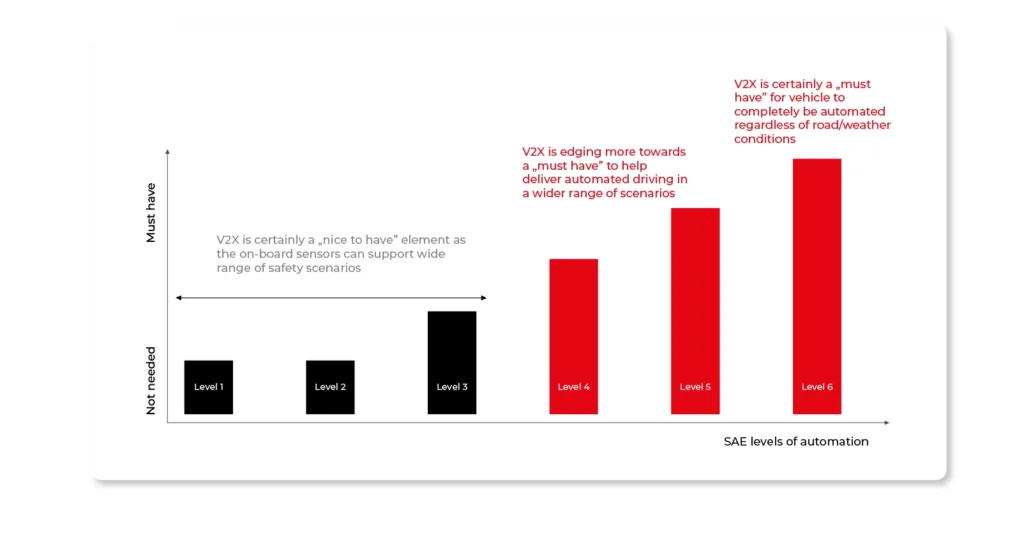
Levels 0 to 2 represent the dominance of old-style, sensor-based security systems. Higher levels of automation are already more oriented toward extensive collaboration:
- Between vehicles,
- Between vehicles and infrastructure.
Advanced Driver Assistance Systems (ADAS) for the past 20 years have relied mainly on elements such as onboard sensors (cameras, radars, ultrasound). Low-level automation worked for a while, but it has its shortcomings. Primarily it is about its maximum range, which is only up to 200 meters. The other thing is its low performance in contact with obstacles, such as blind bends and densely parked vehicles.
Meanwhile, sensing technologies have developed so widely that today it is possible to fully collaborate in such configurations as:
- V2V – Vehicle-to-Vehicle.
- V2D – Vehicle-to-device.
- V2P – Vehicle-to-pedestrian.
- V2H – Vehicle-to-home.
- V2G – Vehicle-to-grid.
- V2I – Vehicle-to-Infrastructure.
The most optimistic scenario assumes, among other things, that most vehicles will be able to connect with each other on highways. And this will markedly increase road safety.
Does this mean that as automotive development continues, V2X will replace existing ADAS solutions? Not necessarily. Yet, it is possible that V2X will greatly expand the applications of current and future driver assistance systems. Thus, it will facilitate reaching greater levels of vehicle autonomy.
V2X: benefits and unique selling points
V2X technology, which enables vehicle-to-vehicle and vehicle-to-infrastructure information exchange, is considered a resource worth having and developing in any automotive company. This is chiefly due to the numerous benefits that can be achieved in terms of traffic efficiency and safety. Here are just some of them.
- Addressing the LoS (Lack of Sight) problem which involves the non-visibility of another object. V2X can even detect elements that are invisible or undetectable by traditional sensors. This includes "blind spots" in the side mirror or objects behind a sharp bend.
- Early warning. Drivers of connected vehicles learn in a timely manner about dangers on multi-lane roads, especially high-speed roads. This allows them to react to the problem at an early stage. It is advisable to know that a vehicle's ABS system is activated within 1 mile of another vehicle equipped with V2X.
- Reducing congestion and streamlining traffic. With the technology described here, such modern fleet management methods as platooning can be successfully applied (see the following paragraphs for more details on this thread).
- Driving assistance even in adverse weather conditions. Fog interferes with " standard" sensors, such as cameras. Meanwhile, the V2X also performs well during limited visibility.
- Efficient alerting. Approaching emergency vehicles can signal their presence from a great distance. Drivers are therefore able to quickly form an emergency lane on the highway.
- Attaining higher levels of vehicle autonomy. Partially autonomous vehicles perform well in a wide range of scenarios on the road (including merging scenarios).
Are there any limitations when implementing V2X?
One of the obstacles facing OEMs at this point is insufficient demand. Although the technology is up and running and there are already many use cases around the world, consumers are reluctant to pay extra for it. This is happening for a good reason.
For example, most customers don't understand why they should pay extra for safety-related functionalities. These are already regulated by law anyway, and besides, they are guaranteed as part of ADAS (and these systems are already included in the basic vehicle price). Let's also bear in mind that a high level of data penetration in a car is not always possible. Most cars are still not high-tech enough. Many features would therefore simply be unavailable. So - why should we incur the cost of it anyway?
Beyond that, there is a long delay between the availability of the technology and the existence of a sufficient number of cars equipped with it. Meanwhile, to talk about V2X on a large scale, these two factors must exist in parallel.
Also, the road infrastructure is not necessarily designed to handle V2X. City authorities still have to focus on "putting out the current fires," so technological development sometimes takes a back seat. Besides, not all of the city's road investment is being carried out at the same time due to limited funds.
Of course, in the long run, safer roads and less congestion are the goal worth achieving, but things can't be done all at once. Examples from specific regions of the world, described in the following paragraphs, in fact, illustrate this point well.
DSRC vs. C-V2X
In the framework of V2X, there are two competing technology solutions:
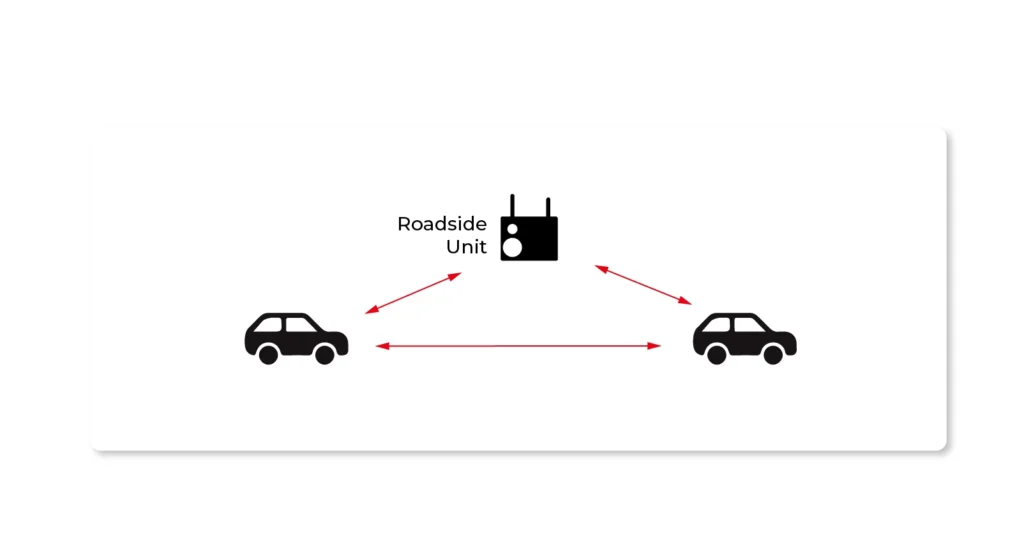
DSRC - Dedicated Short-Range Communication
A form of wireless communication technology defined by the 802.11p standard. It is essentially an amendment to the IEEE 802.11 (WLAN) standard that defines changes and enhancements in order to effectively support Intelligent Transport Systems (ITS).
C-V2X - Cellular – V2X
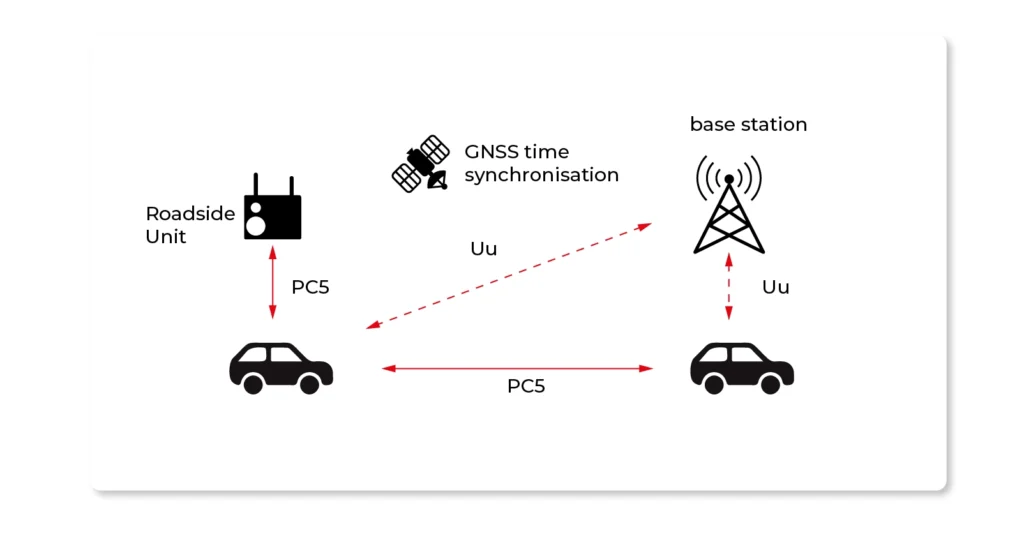
A form of a wireless communication solution using mobile network technology. C-V2X has two modes of operation: PC5 (Direct communication) and Uu (Indirect method of communication using a cellular network).
Implementation of systems in specified regions of the world
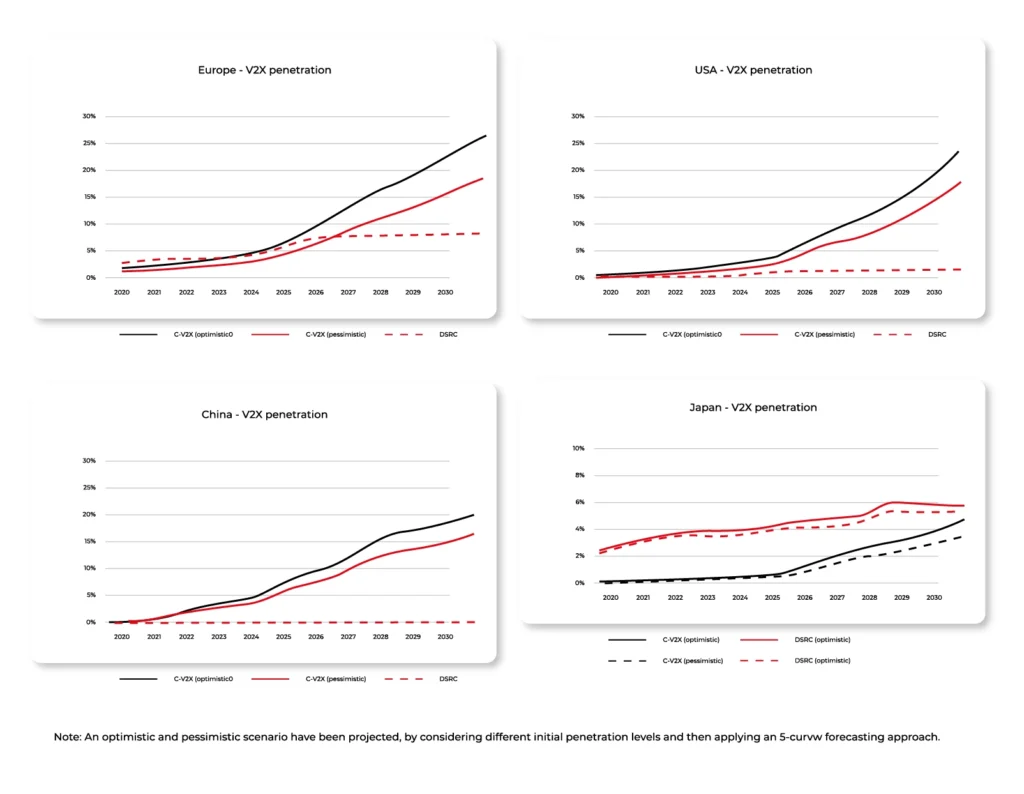
After decades of development of the aforementioned technology, it is slowly becoming apparent that DSRC is giving way to the popularity of C-V2X. Although the former system still dominates in Europe and the US, this will certainly not last forever. According to experts, before long US and European OEMs will prefer C-V2X in their vehicles exclusively. For the time being, however, both solutions are operating equally in these markets.
This is quite different from China, where the use of Cellular V2X has been embraced without question. For what it's worth, the issue is a bit more complicated in another Asian region, namely Japan, where DSRC-based ETC (electronic toll collection) has been under development for many years. In the Land of the Cherry Blossom, there is uncertainty about which way to eventually head. Cautious predictions, however, point to a slow transition to C-V2X.
Fundamentals for developing V2X
One thing to realize with V2X is that the benefits are spread across all traffic users. For this to happen, however, some key driving forces are needed for the introduction and market adoption of this technology. These are:
- Platooning.
- Fuel efficiency.
- Smart cities.
- Driver and pedestrian safety.
- Platooning
Trucks moving in a single formation is an environmentally friendly and commercially viable solution. But what does it have in common with V2X? Quite a lot, because for platooning to take place, advanced communications technology is a must.
V2X allows trucks in a platoon to coordinate braking and acceleration among each other. It also makes it possible to perform many complex maneuvers .
Main beneficiaries
Carriers, fleet operators and the entire logistics industry, in general, would benefit enormously from V2X technology. This would not only optimize the transportation costs themselves but also fit in with increasingly stringent emissions standards.
- Fuel efficiency
Governments around the world strive to reduce their environmental impact by cutting emissions. In Europe, for instance, the EC Strategy on Sustainable and Smart Mobility is being prepared, outlining plans to reduce them by up to 90 (!) percent by 2050. To achieve this goal, policymakers are looking for technologies that help comply with the aforementioned limits. V2X shows huge potential in this regard.
Example? Solutions such as GLOSA (green light speed optimization) minimize the need for a car to come to a complete stop just before traffic lights and then restart the engine or accelerate. Consequently, fuel consumption and harmful gas emissions are reduced.
Main beneficiaries
Environmental policymakers and regulators are (and will be) under mounting pressure related to emissions. V2X can play a key role in this puzzle, and it is up to policymakers to adopt and implement this technology.
The advantages of the aforementioned technology, however, can also be enjoyed by OEMs. Since V2X reduces fuel consumption, the driver spends less on a monthly basis. Such information can be quoted in marketing communications.
- Smart cities
The idea of a smart city is based on interconnected technologies and systems for collecting and using data. So it is quite natural that for functioning, smart cities need V2K solutions.
They enable communication between vehicles and buildings, signals, pedestrians, and other road users. All information is transmitted in real-time, so you gain greater awareness of your surroundings and current needs. More broadly, such intelligent transportation and road infrastructure management systems help reduce congestion. Noise levels, pollution in densely populated areas, and the likelihood of collisions are also curbed.
Automated urban logistics is the future of urbanization - without any doubt.
Main beneficiaries
Connected through VCX, a smart urban area can offer many benefits not only for overall security, but also for local commerce and the quality of life for its residents.
City authorities can plan individual processes more efficiently, resulting in real savings. In a potential scenario, city-funded traffic operators are immediately notified of incidents via V2X and smart cameras. By doing so, they warn other road users of the danger or make an instant decision to set up a detour. If necessary, they prioritize emergency vehicles.
Urban businesses are also enjoying the perks of a V2X-equipped smart city. That's because they benefit from shorter times for transporting goods from the place of manufacture to the point of trade. This is due to less congestion on the roads, intelligent route planning, and fully automated city logistics.
- Driver and pedestrian safety
Traffic collisions, injuries, and deaths not only incur unit costs but also seriously drain the public budget.
The solution to these problems may lie exactly in V2X technology, which makes it possible to identify more hazards on the road than ever before. Drivers can react more quickly to dangerous maneuvers by other road users and make early decisions that could potentially affect someone's health or life.
Main beneficiaries
Consumer purchasing power and public opinion certainly have a bearing on the success of V2X deployment. If road users understand that such solutions actually contribute to safety, they will be eager to push them.
Local politicians will also benefit from the achievements of new connected vehicle technologies. They, in fact, often base their election campaigns on claims related to reducing road accidents in their regions. And V2X is helping to fulfill those promises.
Who will implement first - cities or OEMs?
An important question to be answered is who will ultimately be responsible for the introduction and development of V2X. And who will begin to do it on a large scale. The answer is not straightforward.
From the very outset, cities are faced with the difficult task of making significant infrastructure investments. For this, funds have to be obtained at some point, especially since once implemented solutions still have to be sustained. Certainly, though, the benefits associated with V2X are well worth the funds expended on this technology.
On the other hand, we have OEMs that need a trigger to push their products forward. This must be fostered by the right market environment (a sufficient number of vehicles with V2X capabilities) and the commitment of the authorities responsible for maintaining public infrastructure. At this point, there are also constraints related to consumer reluctance, e.g. in the face of excessively high vehicle data penetration rates.
So, it all boils down to goodwill, openness to change, and the fact that certain technologies need to mature on the market.
Interested in our services?
Reach out for tailored solutions and expert guidance.