
Challenges of EU Data Act in Home Appliance business

As we enter 2026, the EU Data Act (Regulation (EU) 2023/2854), which is now in force across the entire European Union, is mandatory for all "connected" home appliance manufacturers. It has been applicable since 12 September 2025.
Compared to other industries, like automotive or agriculture, the situation is far more complicated. The implementation of connected services varies between manufacturers, and lack of connectivity is not often considered an important factor, especially for lower-segment devices.
The core approaches to connectivity in home appliances are:
- Devices connected to a Wi-Fi network and constantly sharing data with the cloud.
- Devices that can be connected via Bluetooth and a mobile app (these devices technically expose a local API that should be accessible to the owner).
- Devices with no connectivity available to the customer (no mobile app), but still collecting data for diagnostic and repair purposes, accessible through an undocumented service interface.
- Devices with no data collection at all (not even diagnostic data).
Apart from the last bullet point, all of the mentioned approaches to building smart home appliances require EU Data Act compliance, and such devices are considered "connected products", even without actual internet connectivity.
The rule of thumb is: if there is data collected by the home appliance or a mobile app associated with its functions, it falls under the EU Data Act.
Short overview of the EU Data Act
To make the discussion more concrete, it helps to name the key roles and the types of data upfront. Under EU Data Act, the user is the person or entity entitled to access and share the data; the data holder is typically the manufacturer and/or provider of the related service (mobile app, cloud platform); and a data recipient is the third party selected by the user to receive the data. In home appliances, “data” usually means both product data (device signals, status, events) and related-service data (app/cloud configuration, diagnostics, alerts, usage history, metadata), and access often needs to cover both historical and near-real-time datasets.
Another important dimension is balancing data access with trade secrets, security, and abuse prevention. Home appliances are not read-only devices. Many can be controlled remotely, and exposing interfaces too broadly can create safety and cybersecurity risks, so strong authentication and fine-grained authorization are essential. On top of that, direct access must be robust: rate limiting, anti-scraping protections, and audit logs help prevent misuse. Direct access should be self-service, but not unrestricted.
Current market situation
As of January 2026, most home appliance manufacturers (over 85% of the 40 manufacturers researched, responsible for 165 home appliance brands currently present on the European market) either provide data access through a manual process (ticket, contact form, email, chatbot) or do not recognize the need to share data with the owner at all.
If we look at the market from the perspective of how manufacturers treat the requirements the EU Data Act imposes on them, we can see that only 12.5% of the 40 companies researched (which means 5 manufacturers) provide full data access with a portal allowing users to easily access their data in a self-service manner (green on the chart below). 55% of the companies researched (yellow on the diagram below) recognize the need to share data with their customers, but only as a manual service request or email, not in an automated or direct way.
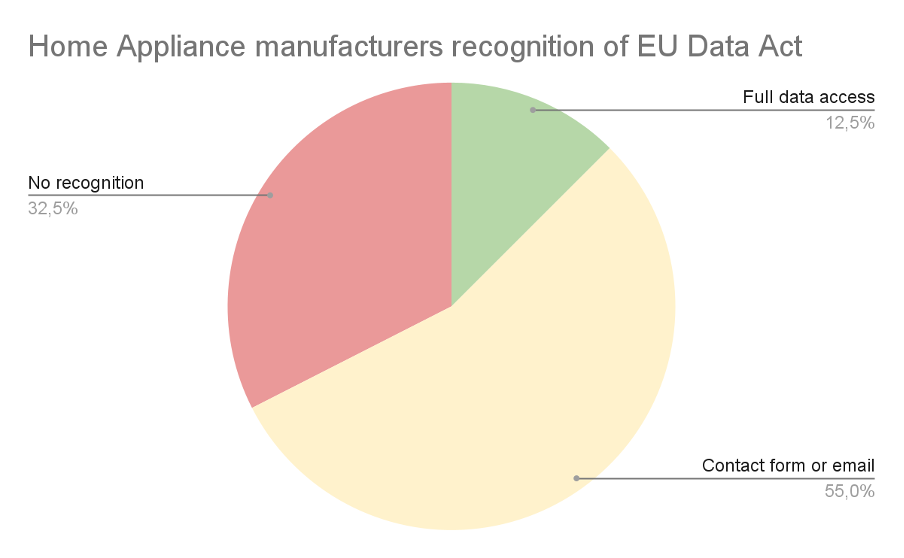
The red group (32.5%) consists of manufacturers who, according to our research:
- do not provide an easy way to access your data,
- do not recognize EU Data Act legislation at all,
- recognize the EDA, but their interpretation is that they don’t need to share data with device owners.
A contact form or email can be treated as a temporary solution, but it fails to fulfill the additional requirements regarding direct data access. Although direct access can be understood differently and fulfilled in various ways, a manual request requiring manufacturer permission and interaction is generally not considered "direct". (Notably, "access by design" expectations intensify for products placed on the market from September 2026.)
API access
We can't talk about EU Data Act implementation without understanding the current technical landscape. For the home appliance industry, especially high-end devices, the competitive edge is smart features and smart home integration support. That's why many manufacturers already have cloud API access to their devices.
Major manufacturers, like Samsung, LG, and Bosch, allow users to access appliance data (such as electric ovens, air conditioning systems, humidifiers, or dishwashers) and control their functions. This API is then used by mobile apps (which are related services in terms of the EU Data Act) or by owners integrating with popular smart home systems.
There are two approaches: either the device itself provides a local API through a server running on it (very rare), or the API is provided in the manufacturer's cloud (most common), making access easier from the outside world, securely through their authentication mechanism, but requiring data storage in the cloud.
Both approaches, in light of the EDA, can be treated as direct access. The access does not require specific permission from the manufacturer, anyone can configure it, and if all functions and data are available, this might be considered a compliant solution.
Is API access enough?
The unfortunate part is that it rarely is, and for more than one reason. Let's go through all of them to understand why Samsung, which has a great SmartThings ecosystem, still developed a separate EU Data Act portal for data access.
1. The APIs do not make all data accessible
The APIs are mostly developed for smart home and integration purposes, not with the goal of sharing all the data collected by the appliance or by the related service (mobile app).
Adding endpoints for every single data point, especially for metadata, will be costly and not really useful for either customers or the manufacturer. It's easier and better to provide all supplementary data as a single package.
2. The APIs were developed with the device owner in mind
The EU Data Act streamlines data access for all data market participants - not only device owners, but also other businesses in B2B scenarios. Sharing data with other business entities under fair, reasonable, and non-discriminatory terms is the core of the EDA.
This means that there must be a way to share data with the company selected by the device owner in a simple and secure way. This effectively means that the sharing must be coordinated by the manufacturer, or at least the device should be designed in a way that allows for secure data sharing, which in most cases requires a separate B2B account or API.
3. The APIs lack consent management capabilities
B2B data access scenarios require a carefully designed consent management system to make sure the owner has full control regarding the scope of data sharing, the way it's shared, and with whom. The owner can also revoke data sharing permission at any time.
This functionality falls under the scope of a partner portal, not a smart home API. Some global manufacturers already have partner portals that can be used for this purpose, but an API alone is not enough.
If an API is not enough - what is?
The EU Data Act challenge is not really about expanding the API with new endpoints. The recommended approach, as taken by the previously mentioned Samsung, is to create a separate portal solving compliance problems. Let's also briefly look at potential solutions for direct access to data:
- Self-service export - download package, machine-readable + human-readable, as long as the export is fast, automatic, and allows users to access the data without undue delay.
- Delegated access to a third party - OAuth-style authorization, scoped consent, logs.
- Continuous data feed - webhook/stream for authorized recipients.
These are the approaches OEMs currently take to solve the problem.
Other challenges specific to the home appliance market
Home appliance connectivity is different from the automotive market. Because devices are bound to Wi-Fi or Bluetooth networks, or in rare cases smart home protocols (ZigBee, Z-Wave, Matter), they do not move or change owners that often.
Device ownership change happens only when the whole residence changes owners, which is either the specific situation of businesses like Airbnb, or current owners moving out - which very often means the Wi-Fi and/or ISP (Internet Service Provider) is changed anyway.
On the other hand, it is hard to point to the specific "device owner". If there is more than one resident - effectively any scenario outside of a single-person household - there is no way to effectively separate the data applicable to specific individuals. Of course, every reasonable system would include a checkbox or notification stating that data can only be requested when there is a legal basis under the GDPR, but selecting the correct user or admin to authorize data sharing is challenging.
From a business perspective, a challenge also arises from the fact that there are white-label OEMs manufacturing for global brands in specific market segments. A good example here is the TV market - to access system data, there can be a Google/Android access point, while diagnostic data is separate and should be provided by the manufacturer (which may or may not be the brand selling the device). If you purchase a TV branded by Toshiba, Sharp, or Hitachi, it can all be manufactured by Vestel. At the same time, other home appliances with the same brand can be manufactured elsewhere. Gathering all the data and helping users understand where their data is can be tricky, to say the least.
Another important challenge is the broad spectrum of devices with different functions and collecting different signals. This requires complex data catalogs, potentially integrating different data sources and different data formats. Users often purchase multiple different devices from the same brand and request access to all data at once. The user shouldn't have to guess whether the brand, OEM, or platform provider holds specific datasets - the compliance experience must reconcile identities and data sources to make it easy to use.
Conclusion
Navigating the EU Data Act is complicated, no matter which industry we focus on. When we were researching the home appliance market, we saw very different approaches—from a state-of-the-art system created by Samsung, compliant with all EDA requirements, to manufacturers who explain in the user manual that to "access the data" you need to open system settings and reset the device to factory settings, effectively removing the data instead of sharing it. The market as a whole is clearly not ready.
Making your company compliant with the EU Data Act is not that difficult. The overall idea and approach is similar regardless of the industry you represent, but building or procuring a new system to fulfill all requirements is a must for most manufacturers.
For manufacturers seeking a faster path to compliance, Grape Up designed and developed Databoostr, the EU Data Act compliance platform that can be either installed on customer infrastructure or integrated as a SaaS system. This is the quickest and most cost-effective way to become compliant, especially considering the shrinking timeline, while also enabling data monetization.
Data Sharing & Monetization Platform
Databoostr - your customized solution for handling data sharing challenges
Check related articles
Read our blog and stay informed about the industry's latest trends and solutions.
Interested in our services?
Reach out for tailored solutions and expert guidance.