

Szymon writes about digital transformation, cloud-native technologies, open source, and DevOps.
Read articles
Kubernetes supports Windows workloads - the time to get rid of skeletons in your closet has come
Enterprises know that the future of their software is in the cloud. Despite keeping that in mind, many tech leaders delay the process of transforming their core legacy systems. How will the situation change with Kubernetes supporting Windows workloads? Can we assume that companies will leverage the Kubernetes upgrade to accelerate their journey towards the cloud?
How can this article help you?
- You can see what Kubernetes supporting Windows workloads provides for enterprises.
- We remind you why going to the cloud is crucial for your business excellence.
- You can get to know the main reason stopping enterprises from transforming their legacy systems.
- We describe the main risks that come with delaying the transition towards the cloud.
- You learn how to leverage Kubernetes supporting Windows workloads.
Technical debt is an unpleasant legacy you often come into money while taking charges of critical systems or enterprise software older than you. Laying under the cache layer and various interfaces, legacy systems encourage you to forget them. And you are good with it - you have enough tasks to perform and things to manage on a daily basis. Sprint after sprint, your team deals with developing applications and particular features to meet increasing customer demand and sophisticated needs. Initiating a tremendous venture, which may transform into opening Pandora's box, it's not exactly what you want to add to your checklist.
The bad news is that if you're willing to be successful at your job, the clock is ticking. The problem with legacy systems is that you don't know when they break down, causing disaster. You will justify yourself, but the impact on your work will be nightmarish. What you know for sure, legacy systems under applications built by your talented teams hinder further development and make your job harder than it already is.
Whatever you are going to go for it all or don't want to throw yourself in at the deep end - Kubernetes supporting Windows workloads is the news you needed. See how it can accelerate your transition towards the cloud.
What's the deal with Kubernetes supporting Windows workloads
Kubernetes was designed to run Linux containers. Such an approach complicated the transition towards the cloud for enterprises with Windows Server legacy systems. And while over 70% of the global server market is Windows-based (according to Statista), we can see why so many legacy apps are in the closets. If you work at a large enterprise, the chances that you have a few of them hidden carefully are very high.
How supporting Windows workloads by Kubernetes is changing the game? In the - not so much - olden days, Windows-based applications were immovable - they needed to be run on Windows, required Windows server, and access to numerous related databases and libraries. Such a demanding environment encouraged enterprises to wait for better days. And now they have come. Kubernetes, with production support for scheduling Windows containers on Windows nodes in the platform cluster, allows for running these Windows applications, enabling enterprises to modernize and move their apps to the cloud.
It’s believed that with this release, Kubernetes provides enterprises with the opportunity to accelerate their DevOps and cloud transformation . In case you missed 1 mln publications about cloud advantages, we will write up the main points.
Why do enterprises move their legacy applications to the cloud
As promised above, let’s keep it short:
- Scalability - the cloud allows you to easily manage your IT resources, data storage capacity, computing power, and networking (in both ways) without downtimes or other disruptions. Such flexibility supports business growth, product/service development, and better cost management.
- Security - the right set of strategies and policies allow enterprises to build and manage secure cloud environments. Decentralization and support for your cloud stack provide solutions to common challenges in maintaining on-premise infrastructure.
- Maintenance - using cloud services delivered by trusted providers, you don't have to maintain many things on your own, just leveraging available services.
- Accessibility - the pandemic showed us how crucial is remote access to our IT resources, and the cloud provides your remote or distributed teams with easy access regardless of your team members' localization - that is priceless.
- Reliability - cloud providers ensure easier and cheaper data backups, disaster recovery, and business continuity as they use the economy at scale.
- Performance - as the cloud service market is blooming and service providers are competing about increasing revenues, the quality and performance of cloud infrastructure are top-notch.
- Cost-effectiveness - with cloud computing, your enterprise can cut off numerous spendings from your books - including infrastructure, electricity, and IT experts responsible for managing resources.
- Agility - forget about capacity planning while your computing provisioning can be done within a few clicks leveraging self-service.
Sounds convincing? If everything is obvious, why are there still so many legacy apps?
Why do enterprises delay with moving apps to the cloud
Legacy systems are long-time friends with procrastination. If you are long enough in this business, you have definitely heard a few of these excuses:
- We cannot do it now. We have too many things on the list. A better day will come.
- It’s risky. It’s critically risky. Why do you even ask? Do you want to see the world burning?
- Ok, let’s do it! But wait….who knows how to do it?
- We can cover it with our UI or cache layer, and nobody will ever notice.
- It’s our core system. You touch it, everything will go bad.
- Why change it if it works well?
- It’s a too huge project for me to decide and take responsibility for the never-ending process.
These are some examples from the top of the iceberg. Diving into the process of moving legacy apps to the cloud , you can stumble upon numerous points convincing you to stay out of them. But can it last forever? What if the “zero hour” strikes?
Playing a risky game: what can happen if you don’t migrate to the cloud
Many of our business challenges wouldn’t have existed if we, at some point, tackled the underestimated issues. The excuses highlighted above can convince you to leave things as they are. But what if your real problems are just ahead of you? Let’s name some threats that may occur at enterprises that delay transition towards the cloud.
- Maintaining legacy systems becomes more expensive with time as your company has to pay for computing power supporting these solutions.
- Your enterprise may face a huge challenge to find experts understanding your legacy systems. The longer you postpone the process, the harder it will be to look for people working with frameworks and tools that are outdated.
- By allowing for increasing your technical debt, your enterprise acts against your willingness for innovation. Your legacy systems suppress the development of new products and services, undermining your competitive advantage.
- You can face a challenge to provide services to your customers because of downtimes and distractions caused by inefficient systems.
- Technology develops fast. Legacy systems stop you from participating in the movement and may generate new issues in the future, especially in the time you will need to be flexible.
- Most established enterprises work on highly regulated markets and have to meet challenging conditions. One of our business partners had to rebuild one of its core systems because of new regulations regarding data management. Such a situation can lead to enormous costs.
- There appears a serious security threat as legacy systems are prone to attacks, and without upgrades, your system may become insecure.
The list above can be expanded to many additional issues. But instead of describing challenges, let’s discuss how they can be addressed using Kubernetes .
How to leverage Kubernetes supporting Windows workloads
There is a ton of code written on Windows. With the Kubernetes update, you don’t have to think about rebuilding your applications from scratch, so myriads of working hours spent by your team are secured. Most of the code can be moved to the Kubernetes container and there developed. It’s safer and cheaper.
Kubernetes supporting Windows workloads gives you time to navigate your journey to the cloud properly. First of all, it ends the discussion for all those excuses mentioned above. The moment is now. Secondly, you can now utilize an evolutionary approach by developing and upgrading your systems instead of building them from ground zero. Furthermore, with your key legacy systems moved to the cloud, you can accelerate the overall transformation at your enterprise towards an agile, DevOps-oriented organization open to innovation and developing highly competitive software.
What should be your next move?
By supporting Windows workloads, Kubernetes makes the life of many tech teams easier. But it would be too easy if everything worked by itself. Configuration of the Kubernetes cluster to utilize Windows workloads is demanding and time-consuming. Instead of doing it on your own, you can leverage the ready-to-use solution provided by Grape Up. Cloudboostr , our Kubernetes stack, enables you to move your Windows-based apps to the cloud. Consult our expert on how to do it properly!
The state of DevOps – main takeaways after DOES London
DevOps is moving forward and influences various industries, changing the way companies of all sizes deliver software. Few times a year, the community of DevOps experts and practitioners gathers at a conference to discuss the latest trends, share insights, and exchange best practices. This year’s DevOps Enterprise Summit in London was one of these unique chances to participate in this uplifting movement.
When our team got back after DevOps Enterprise Summit in London, we set an engaging, internal discussion. It’s probably a common attitude for every company valuing knowledge exchange, that once attending some interesting conference, your representatives share insights, their thoughts, and news regarding the topics covered during the event. The discussion arose when members of our team had started sharing their takeaways regarding keynotes, speeches, and ideas presented at the conference.
That opened the stream of news and opinions shared by those of our teammates who also follow the latest trends in the industry by attending various meetups, listening to podcasts, etc. Here is the list of the main topics.
DevOps 2nd day – introduction
DevOps is no longer one of these innovative ideas for early adopters, which everyone has heard about but is not aware of how to start with adopting it. Now, it’s a must-have for every organization that intends to stay relevant in competitive markets. When you ask enterprises about using DevOps in their organizations, their representatives will tell you that they have already implemented this culture or are in the process of doing that. On the other hand, if you ask them if they are already satisfied with the adoption, the answer would be no – there are so many practices and principles, what makes the process demanding and it lasts a while.
Nowadays, discussions from “How to implement DevOps in our organization” have evolved into “How can we improve our DevOps practices.” The truth has been told - tech advanced companies need this agile culture to build a successful business. But simultaneously, once they introduce DevOps to their teams, new challenges occur. It’s a natural way of technology/culture adoption. As a person responsible for the cultural shift, you have to communicate it clearly – DevOps wouldn’t solve all your issues. In some cases, it may seem like a reason for some new struggles. The answer to these concerns is simple, your organization is growing, evolution is never done, and change is a constant way of managing things.
Facing DevOps 2nd Day issues is rather the rich man’s problem – you should be there, and you have to tackle them. All the new challenges appear after making an advanced step forward.
Scaling Up - from a core tech team to the entire organization working globally
Core tech teams are the first to adopt the newest solutions, but they cannot work properly without supportive teams (HR, Sales, Marketing, Accounting, etc.). After going through the successful implementation, the next step is to encourage cooperating teams to this mindset and ways of running projects.
As the enterprises that consist of thousands of employees and hundreds of teams cannot provide their crew with the flexibility in designing their very own working culture, there is a need to encourage all teams to once implemented practices.
For tech leaders, responsible for introducing DevOps in their teams, it means that their job evolves to being a DevOps advocate, who presents its value to the whole organizations and makes it a commonly known and used approach. The larger the company is the more complex the entire change becomes, but it's unavoidable when you intend to get the most out of it.
Along with advocating for expanding DevOps in the entire organization, also the very challenging job is to determine the right tech stack. New tools come and go, being responsible for selecting to the most useful toolset that will be in use for a significant period is tough and requires overall knowledge, strategy, and deep understanding of tech processes. Once determined toolset should be recommended to cooperating teams and that may provoke new issues, but is unavoidable. Should you leverage the same tech stack for all teams? When is the right time to adopt new tools? Should you leave it all to the team? Well, there is no right answer to any of these questions, and it highly depends on the situation.
DevOps is changing various industries and not limit itself to tech companies
Attending DOES in London was a great opportunity to learn more about how DevOps influences the world’s coolest companies, not often associated with technology. Let’s look at the two of the most recognized sportswear retailers - Adidas and Nike. Both these brands are synonyms to heroism, activity, sports achievements. But, as their representatives presented, both companies can overshadow many of tech brands, with their DevOps maturity and advanced approach to using technology in growing their businesses.
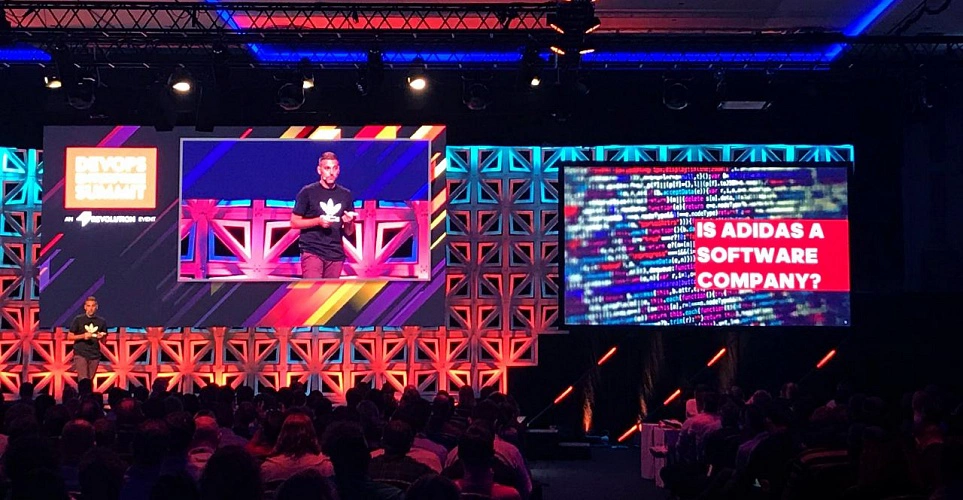
Following these business cases, we can agree that the time when cutting-edge technologies and methodologies often paired with them are limited to IT companies is officially over. Nowadays, industry by industry is convincing themselves to the latest solutions as developing software for internal processes is a natural competitive advantage.
Continuous adaptation and life-long learning
The best thing about working in a DevOps culture is that you just cannot say that the process has finished, that a company has transformed, and that a team has mastered the way of delivering software. Taking into account how creative the community gathered around DevOps is, how fast new ideas arise, how often its fundamentals are improved, you have to keep learning about new things.
It would be extremely comfortable if a company could once undergo digital transformation and treat the process as a completed. But if we take a look at the evolution of technology and methodologies designed to take full advantage of its capabilities, it’s obvious that it cannot be finished. Adoption of a DevOps mindset is the beginning of a change and should be conducted as a never-ending evolution.
You can’t be good at everything, which is fine, but you have to know your pain points
Excluding enterprises with enormous budgets, all organizations have limitations that obligate them to focus only on some aspects of conducting business processes. As an expert, a professional who works in a highly competitive market, you have to follow the latest trends, be aware of upcoming solutions, and cutting-edge technologies that are reshaping the business.
Being up to date is extremely important, but almost equally essential is the ability to decide on which things you cannot engage, as your time and resources are not flexible. Being responsible for your company means being aware of pain points and focusing only on the things that matter. Technology is developing extremely fast, you cannot afford to be an early adopter of every promising solution. Your job is to make responsible decisions, based on your deep understanding of the current state of technology development.
If you don’t know what to choose, think about what’s better for your business
DevOps came to being as an efficient solution to the common challenge - how to sync software development and IT operations processes to help companies thrive. Built with business effectiveness in mind, this culture has the right foundations. Choosing approaches that were designed to resolve not only internal issues but also to enable revenue growth is good for your overall success.
Anytime you face a situation when you have to decide between different solutions, always consider your company's long term perspective. When you are focused only on your goals, you may contribute to building siloses. The key to determine which ideas are the right to choose is their overall usability. We all, as professionals in our niches, may tend to prefer idealistic solutions. It’s important that we don’t work in an ideal world and our job is verified by the market.
Adopting new tools and technologies is challenging, but the real quest appears when it comes to change people's habits and company culture
If you want to make your colleagues angry, implement new toolset and new technologies in your team. Apart from tech freaks and beta testers, people are rather skeptical when it comes to learning new features and new UI. Things change when you provide them with solutions that make their work easier and more efficient.
But the real trouble occurs when you are trying to change your company's culture. It’s nothing new that we protect what we know, don’t want to change our habits, or even feel in danger when someone is trying to reshape the way we have been doing our job for ages. Your colleagues defend themselves which is natural, you cannot change it. You have to take this into account and make sure that the process will be smooth enough to help everyone adjust to the new reality. Start with small steps, be the example, discuss the issues, and explain potential opportunities. Shock therapy as a path to the cultural shift is not the way to go.
As a team developing our product - Cloudboostr - multicloud, enterprise-ready Kubernetes, we help companies adopt a complete cloud-native stack, built with proven patterns and best practices, so they could focus their resources on improving their working culture. The feedback we’re receiving is that our customer’s teams are more open to start using new toolset then to change the approach to software delivery.
Being a DevOps Pprofessional is hot now
DevOps practitioners are much in demand. It’s a great time to master the skills required to be a specialist in DevOps as companies of all sizes are looking for help in modernizing their businesses. There are various ways of approaching it - by building an in-house team, outsourcing processes, collaborating with external consultants. Companies choose preferred manner accordingly to their needs and budget.
No matter if you work in a dedicated team at a huge enterprise, developing startup with your colleagues, or providing consulting services for global brands, being a DevOps expert is a strong competitive advantage on the talent market.
DOES London - sum up
DevOps is moving forward and is great to be among teams that contribute to its evolution. We are willing to share our expertise , exchange knowledge, and learn from the best in the business, and conferences like DevOps Enterprise Summit are the best platforms to do it.
Highlights from KubeCon + CloudNativeCon Europe 2019 – Kubernetes, Service Mesh Interface, and Cloudboostr
This year’s KubeCon was a great occasion to sum up 5 years of Kubernetes and outline its future. It was also a great place to make some important announcements, and we got it. Our team spent those days not only on learning about new features and networking with this amazing community but also talking about how Cloudboostr can impact the adoption of cloud-native technology .
Grape Up team joined 7,700 attendees, top enterprises, media and analysts in Barcelona, Spain at KubeCon + CloudNativeCon Europe 2019 to discuss what’s new in Kubernetes, open source and cloud-native, learn from the most inspiring people in the industry, network with peers from different projects and together work on developing the community gathered around the Cloud Native Computing Foundation.

KubeCon + CloudNativeCon Europe 2019: Kubernetes is thriving
This year’s KubeCon provided us with many promising news and announcements. From the very first keynote to the last workshop, a strong focus was on leading technologies, mainly Kubernetes, and its improvements. Dan Kohn, Executive Director at CNCF, in his opening keynote, presented the Kubernetes place in the cloud-native environment and explained why Kubernetes, like many technologies and applications before, is winning the race called simultaneous invention.
Dan Kohn used engaging storytelling, to present that from ages people have been working on similar ideas at the same time, taking advantage of works done before them. He stressed the fact that there wouldn’t be Kubernetes without technologies, that had built the foundations. He gave us a glimpse of what, in his opinion, makes Kubernetes standing from the crowd:
- It works really well!
- Vendor-Neutral Open Source and Certified Partners.
- The People that develop and promote it.
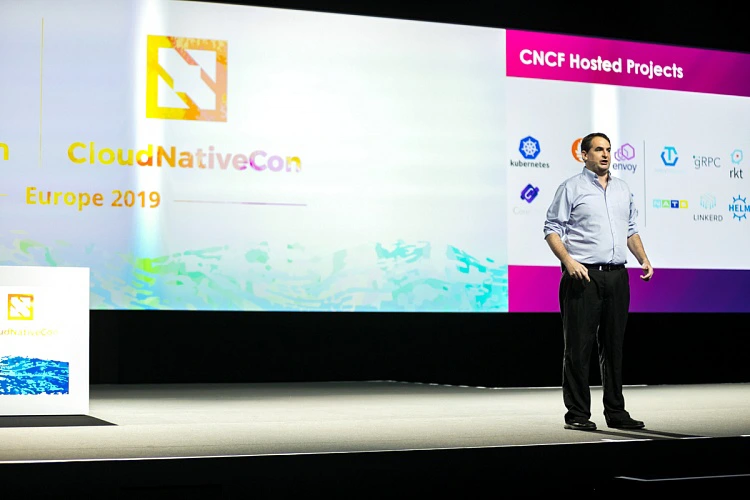
The end of the opening keynote was strong – all the members of the community gathered around Kubernetes and CNCF have an impact on the technology improvements, as Kubernetes is a foundation on which many new technologies arise.
Hot news: Service Mesh Interface
Microsoft stole the show announcing the launch of Service Mesh Interface, an open project that defines a set of common APIs that provide developers with interoperability across different service mesh technologies.
The Service Mesh Interface includes:
- A standard interface for meshes on Kubernetes.
- A basic feature set for the most common mesh use cases.
- Flexibility to support new mesh capabilities over time.
- Space for the ecosystem to innovate with mesh technology.

This announcement from Microsoft led to many discussions during the conference. As the service mesh is a technology at the early stage of its development, an environment designed for growth should impact its further evolution. SMI is supposed to provide interoperability that will help the emerging ecosystem of tools integrate with existing mesh providers, and instead of doing it individually, gain cross-mesh capabilities through SMI. We’re looking forward to seeing how it will affect the developers' job and help to solve customer problems in the nearest future.
Cloudboostr – an enterprise-grade Kubernetes
What makes KubeCon + CloudNativeCon a special event is an incredible capability of CNCF to engage so many people representing multiple tech and business areas to collaborate together on developing a brighter future for the cloud-native ecosystem. As Dan Kohn said at the beginning of the conference, Kubernetes and parts of the cloud-native landscape build the foundation for the technologies of the future. We at Grape Up also want to participate in this process of developing cloud-native technology and helping various companies implementing Kubernetes.
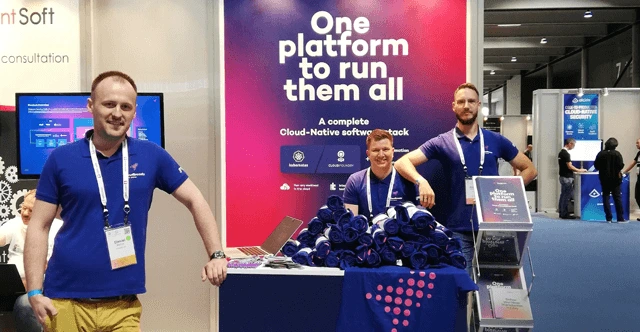
This is why KubeCon + CloudNativeCon was a great occasion to talk with the end users and developers about their adoption of cloud-native tools. They had a chance to learn more about Cloudboostr, our cloud-native software stack, built with Kubernetes at its core , and allowing companies to stand up a complete cloud-native environment in a couple of hours. Our experts spent those days in Barcelona on discussing the evolution of Kubernetes, its business use cases, and ways to get the most of its capabilities. Our team value this kind of events the most – it's crucial for our product development and a better understanding of people’s challenges and business needs.
Seeing companies highly interested in Cloudboostr capabilities, we are encouraged to work even harder on new improvements. And this the clue to the Kubernetes success – by building a community that inspires other members to grow and connecting them to accelerate the development of associated services, CNCF has created a self-engaging mechanism that helps Kubernetes thrive and acquire new users. This strategy makes Kubernetes an important part of the technology development as a whole, which with every year becomes even more impressive.