
Sybase migration to Azure: What nobody tells you before you start

If you’re running Sybase in 2026, you already know the uncomfortable truth: the platform still works, but the ecosystem around it is quietly contracting: SAP patches ASE, yet engineering investment, tooling innovation, and community momentum are all flowing toward HANA and the cloud. ASE gets maintenance. Everything else moves on.
For most IT managers and DBA teams, the question is no longer whether to migrate. It’s how to do it without breaking things that have run reliably for 20 years.
The migration is bigger than “move the database”
When leadership hears “database migration”, they picture moving tables. What’s actually in a Sybase estate looks more like this:
.jpg)
- Database logic - Business logic written in T-SQL or Watcom SQL (SQL Anywhere), deeply embedded across stored procedures, functions and other database structures is the largest workstream.
- Connected applications - Every app querying data, and other Sybase products like IQ, and PowerBuilder. Each carries a distinct risk profile and should be scoped independently.
- Integration layer - CIS federation, proxy tables, driver stacks, ETL pipelines, BI connections: the glue between systems, frequently undocumented.
- Sync and replication - Replication Server is its own infrastructure layer, SQL Anywhere adds niche sync tools like SQL Remote and MobiLink. None of it has a modern equivalent - this requires redesign, not conversion.
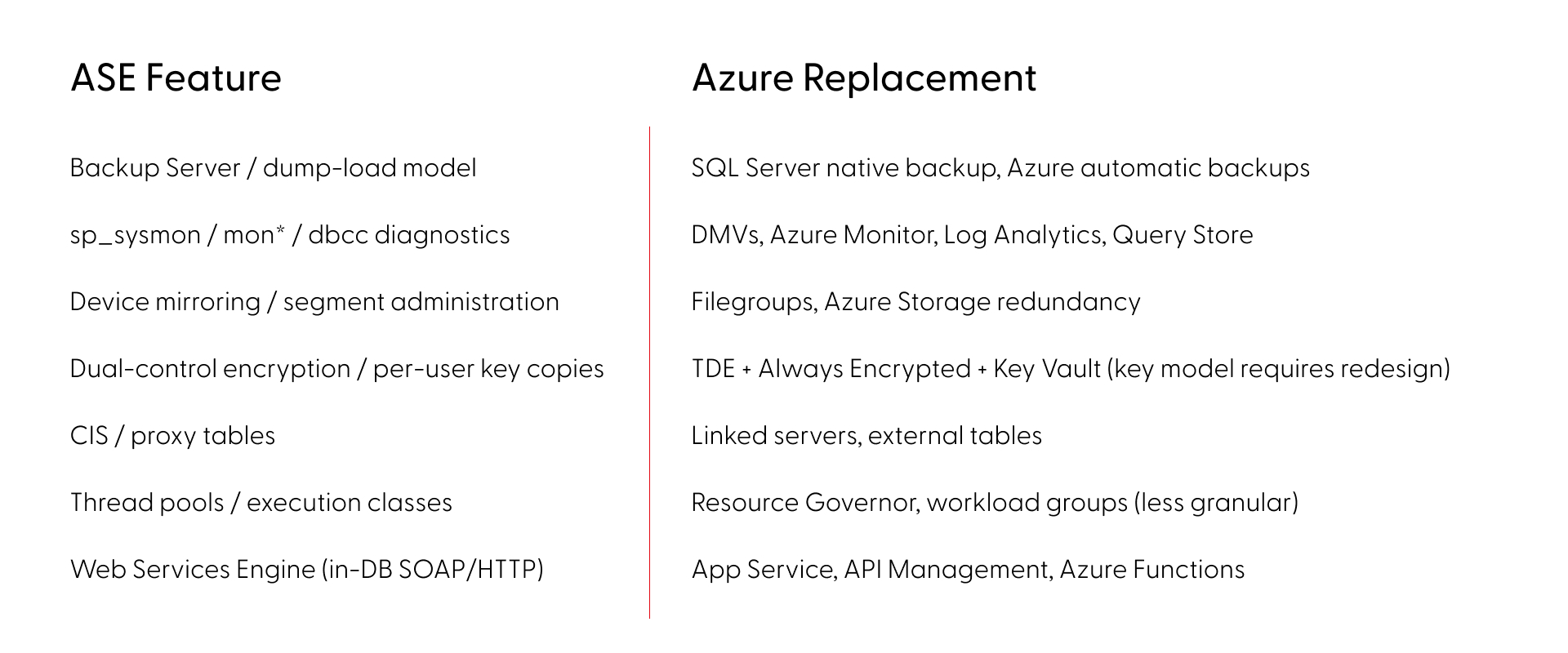
- Operations and monitoring - scheduled jobs, alert rules, maintenance, performance monitoring, and backup strategies built on sp_sysmon, mon* tables, Backup Server, and dbcc. The knowledge transfers, the implementation doesn't.
- In-database services - Extended stored procedures, encryption, LOB handling, and in some estates SOAP endpoints or Java-in-DB. Most need external replacements on the target platform.
Where Sybase ASE migrations to Azure break
The most dangerous category isn’t missing features - it’s features that look identical but behave differently across platforms. ASE and SQL Server share a T-SQL lineage, which creates a false sense of safety. The syntax compiles - but the runtime behavior diverges in ways that pass testing and surface under production load. Here are some of the most common examples:
- Transactions: ASE's chained mode and nested transaction semantics differ from both SQL Server and Oracle. Error handling, rollback behavior, and transaction scoping each work differently across all three platforms.
- Identity: ASE isolates @@identity inside stored procedures and triggers. SQL Server's @@identity leaks across scopes, potentially returning wrong values from nested calls.
- Locking: ASE's per-table locking schemes (allpages, datapages, datarows) and lock promotion thresholds have no equivalent on SQL Server or Oracle. Concurrency patterns tuned for ASE risk deadlocks post-cutover.
- LOB access: Data types map cleanly (unitext to nvarchar(max) or NCLOB). The pointer-based access model (readtext, writetext, textptr) does not and must be rewritten.
- NULLs: In Oracle, an empty string is NULL. Code checking for empty strings silently returns wrong results without any error.
- Collation: ASE sets sort order at server level only and defaults to case-sensitive binary. SQL Server and Oracle support multiple collation levels with different defaults, changing JOIN cardinality, GROUP BY grouping, and UNIQUE constraint behavior.
Beyond syntax, cross-database patterns compound the problem: USE, db..object references, and CIS passthrough are everywhere in ASE estates and break the moment the engine changes. Migration tools like Microsoft's SSMA handle syntax conversion, but they don't detect behavioral divergence. The dangerous gaps aren't in what fails to convert - they're in what converts cleanly but runs differently.
The actual risk picture (by the numbers)
A full feature mapping of ASE (versions 15,16) against SQL Server and Oracle on Azure across all deployment tiers gives a clearer picture: (Based on Grape Up G.Tx internal analysis across enterprise migration assessments.)
- ~90% of ASE features have a clear migration path - low or medium risk
- SQL Server carries ~20% fewer high-risk items than Oracle across every ASE version - the shared T-SQL lineage makes a measurable difference
- PowerBuilder pushes the high-risk share to ~19% and should be scoped and phased independently
In ASE alone, roughly 30 features have no direct equivalent or workaround, but every one of those has a modern replacement approach on Azure, although some require significant architectural redesign rather than direct substitution.
SQL Server or Oracle on Azure - how to choose
The right target depends on what’s actually in your codebase.
SQL Server has the shorter path for most ASE estates. The T-SQL lineage reduces rewrite volume, and the platform carries fewer high-risk items across the board. Thirty years of divergence still mean real work, particularly around transaction semantics and locking behavior.
Oracle carries higher effort by default - PL/SQL vs. T-SQL is a language rewrite, NULL handling differs, and no direct replace for ASE’s nested transaction rollback semantics.
Deployment tier matters too. Azure VM, Managed Instance, and SQL Database each involve different trade-offs on compatibility, operational overhead, and cost. The right answer depends on your specific feature usage.
The operational risk of waiting
The engineers who know the platform deeply - who understand the undocumented behaviors, the operational quirks, the edge cases in the locking model - are retiring. That institutional knowledge compounds the migration effort every year it walks out the door.
Starting your Sybase migration to Azure: assessment before assumptions
A reliable migration starts with knowing exactly what you have. That means automated discovery across your live codebase - versions, features, dependencies, behavioral edge cases - not a manual audit based on what the team remembers.
This is what Grape Up’s G.Tx platform does in the assessment phase. G.Tx runs automated inventory against your environment, maps features against the target platform, identifies behavioral differences that won’t surface in standard testing, and produces a high-level risk report. The same platform then powers execution - code conversion, schema migration, test generation, and validation - so the assessment and the migration run on a single consistent picture of your estate, not on handover documents.
The engagement runs in four phases. Each ends with a deliverable and a client sign-off before the next begins:
- Assessment (1–2 weeks) - free, no commitment. Automated discovery of your system, delivered as a risk report with a next steps recommendation.
- Feasibility (2–4 weeks) - full migration plan with identified blockers, mitigations, and timeline.
- Proof of Concept - a representative subset of your codebase migrated on real data, against agreed acceptance criteria.
- Scale- full migration, AI-accelerated, with phased cutover and operational handover.
You control the pace. Nothing moves to the next phase without your approval.
Frequently Asked Questions: Sybase Migration to Azure
Is migration to another SQL database the only option?
For most estates, a like-for-like migration is the most pragmatic path — it preserves existing logic and minimizes rewrite scope. But depending on your goals and architectural dependencies, a full redesign may be the better long-term investment. This means decomposing the monolithic database into independent components that communicate with each other rather than relying on shared database logic. The result is a more flexible, extensible, and maintainable architecture that is no longer constrained by the boundaries of a single database engine. The best approach can be decided during the Feasibility phase.
What is the best migration target for Sybase ASE - SQL Server or Oracle on Azure?
SQL Server on Azure is the recommended target for most Sybase ASE estates. The shared T-SQL lineage reduces rewrite volume and lowers the share of high-risk migration items by approximately 20% compared to Oracle. Oracle remains viable for estates where PL/SQL integration or Oracle-specific features are already part of the architecture, but it carries higher baseline effort. The final choice depends on your codebase - a G.Tx assessment will map your specific feature usage against both targets before you commit.
How long does a Sybase migration to Azure take?
Timeline depends on estate size and complexity, but the structured phases give reliable checkpoints: Assessment runs 1–2 weeks, Feasibility 2–4 weeks, Proof of Concept varies by scope, and full scale migration is planned during Feasibility. The phased approach is designed to migrate and validate the most business-critical functionality first, progressively offloading the original system only as each phase proves stable on the target platform. Feasibility analysis is the most reliable way to get an accurate estimate for your specific environment.
What are the biggest risks in a Sybase ASE migration?
The highest-risk category is not missing features - it's behavioral divergence: code that converts cleanly but runs differently in production. Transaction semantics, identity scoping, locking behavior, NULL handling in Oracle, and collation defaults are examples of gaps that may not be caught in testing and only surface under real load. Standard migration tools like SSMA automate schema conversion but are not designed to detect behavioral differences. Automated analysis of your codebase can surface these discrepancies early, making sure they never reach production.
Is Sybase ASE still supported in 2026?
SAP ASE 16.0 reached End of Mainstream Maintenance on December 31, 2025, meaning SAP no longer provides new security patches or fixes for this version. ASE 16.1 retains mainstream support until December 31, 2030, giving organizations on that version more runway, but there are no new ASE versions on SAP's roadmap. New capabilities, cloud-native features, and tooling investment are being directed at HANA and cloud products. The surrounding ecosystem is contracting in measurable ways. The practical risk is not that ASE will stop working, but that maintaining it becomes increasingly expensive as the specialist talent pool shrinks, integration tooling is deprecated, and the burden of filling those gaps falls on internal teams — as unpatched vulnerabilities quietly accumulate.
How do Sybase ASE stored procedures migrate to SQL Server?
ASE stored procedures are written in T-SQL, which shares a lineage with SQL Server T-SQL - but decades of platform divergence mean direct conversion is rarely clean. Syntax differences are mostly handled by automated tools. The harder problems are behavioral: code that converts cleanly can still run differently in production, and standard conversion tools are not designed to catch them. Stored procedures rarely exist in isolation — understanding their true migration scope requires analysis in the context of the full system.
What does a Sybase migration assessment include?
An initial assessment covers automated discovery of a representative part of your system — architectural overview, feature usage, stored procedures, connected applications mapped against your target platform. The result is a report covering system health (including security findings), AI transformation feasibility, and top risks ranked by severity and impact — identifying behavioral differences that standard tools miss, with concrete next steps and PoC proposals. Grape Up’s G.Tx Assessment runs in 1–2 weeks, is free with no commitment, and becomes the foundation for all subsequent migration phases.

Scale your legacy modernization 5x faster without business disruption
Legacy transformation services powered by Agentic AI-driven G.Tx Platform
Check related articles
Read our blog and stay informed about the industry's latest trends and solutions.
Interested in our services?
Reach out for tailored solutions and expert guidance.