


Break down barriers to your data
Enable secure, real-time, permission-controlled data access for partners and internal teams through a single unified layer.

Why unified access matters
Clear the path to data
Unify access to information stored across disparate systems by exposing it through a single, consistent interface.
Accelerate innovation across ecosystems
Open your data to partners, providers, and third-party platforms through standardized, secure APIs enabling new services, streamlined automation, and advanced AI use cases.
Reduce integration overhead
Replace custom, point-to-point integrations with a central access layer that significantly reduces the cost and complexity of connecting new partners or applications.
Databoostr: A platform for unified data access
A single abstraction layer that standardizes how distributed data is accessed, shared, and governed — enabling consistent, secure, and scalable data usage across your entire ecosystem.
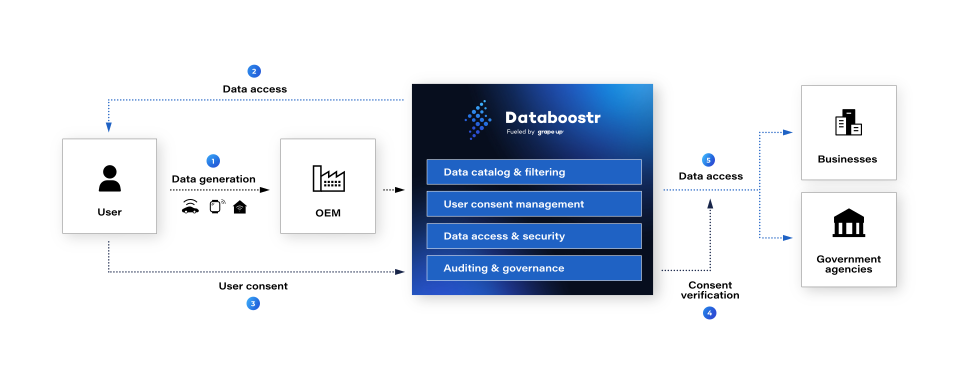
The foundation for trusted data exchange
Data exchange orchestration
Enable seamless data discovery, request handling, routing, and execution of data exchanges across all systems and partners.
Data security & access control
Enforce end-to-end protection with encryption, authentication, and zero-trust access controls.
Interoperable interfaces
Expose standardized APIs that abstract away system differences and unify access across heterogeneous environments.
Granular permissions & consent management
Apply fine-grained, role-based permissions to control exactly who can access each data element.
Real-time & historical data access
Deliver instant insights by streaming live data and retrieving archived records on demand.
Compliance-ready governance
Strengthen oversight with centralized auditing, access logging, and automated policy enforcement.
No disruption to existing systems
Integrate seamlessly without modifying legacy infrastructure or interrupting operational workflows.
Partner onboarding framework
Accelerate collaboration by enabling partners to connect through stable, versioned interfaces.
Solving data access challenges in key sectors
Every industry faces the same challenge: valuable data locked in silos, inaccessible to those who need it most. Here's how unified data access transforms operations across sectors.

Healthcare: Integrated access to patient data
Provide clinicians and care teams with a complete view of patient history across EHR, lab systems, imaging, pharmacy, and device data — all through a unified interface.

Healthcare: Secure data sharing between providers
Enable hospitals, clinics, specialists, and telehealth platforms to access patient data through permission-controlled APIs that simplify interoperability and reduce duplicate testing.

Finance: Consent-driven open finance layer
Support emerging regulations like FIDA by aggregating distributed financial data into standardized, consent-driven APIs for account data, transactions, credit profiles, and more.

Mobility: Partner ecosystem enablement
Offer insurers, repair networks, EV charging operators, and fleet partners secure access to standardized vehicle and driver data — accelerating maintenance, risk assessment, and operational efficiency.
Discover how we activate secure data sharing
Business meets technology through engineering excellence.
How two automotive OEMs turned regulatory pressure into business opportunity.
Insights on data sharing challenges
Learn more about how we activate data sharing
Data stuck in silos? Let's talk about removing the bottleneck.
Reach out for tailored consultancy.
FAQ
Databoostr and unified data access
Unified data access is the ability to reach data stored across multiple disparate systems through a single, consistent interface. For enterprises, valuable data is typically distributed across silos that different teams, partners, and systems cannot easily reach. Databoostr provides a single abstraction layer that standardizes how distributed data is accessed, shared, and governed across an entire ecosystem — reducing the cost and complexity of connecting new partners or applications.
Databoostr supports both. The platform delivers instant insights by streaming live data and retrieving archived records on demand — within the same unified access layer.
Point-to-point integrations create custom, direct connections between each data consumer and each data source. Databoostr replaces this model with a central access layer that significantly reduces the cost and complexity of connecting new partner sor applications — and exposes standardized APIs that abstract away system differences across heterogeneous environments.
Databoostr addresses unified data access use cases across four sectors. In healthcare, it gives clinicians a complete view of patient history across EHR systems, lab results, imaging, pharmacy, and device data — and enables hospitals, specialists, and telehealth platforms to share patient data through permission-controlled APIs. In finance, it supports emerging open finance regulations like FIDA by aggregating distributed financial data into consent-driven APIs for account data, transactions, and credit profiles. In mobility, it provides insurers, repair networks, EV charging operators, and fleet partners with standardized access to vehicle and driver data for maintenance, risk assessment, and operational planning.
By opening data to partners, providers, and third-party platforms through standardized, secure APIs, Databoostr enables new services, streamlined automation, and advanced AI use cases — without requiring changes to the underlying systems that hold the data.
Databoostr integrates seamlessly without modifying legacy infrastructure or interrupting operational workflows. It exposes standardized APIs that abstract away system differences, allowing organizations to connect new partners and enable new data use cases without touching the systems that power day-to-day operations.
Databoostr enforces end-to-end protection through encryption, authentication, and zero-trust access controls. Access control is fine-grained and role-based, allowing organizations to define exactly which data elements each partner, team, or application can reach. All access events are logged through centralized auditing, providing transparency for both internal governance and regulatory oversight.
Databoostr includes a partner onboarding framework that enables partners to connect through stable, versioned interfaces. Partners interact with standardized APIs rather than source-system-specific endpoints, making onboarding a repeatable process regardless of which data sources are involved.
Databoostr applies fine-grained, role-based permissions to control exactly who can accesse ach data element. In finance use cases, the platform supports consent-driven APIs for account data, transactions, and credit profiles — enabling compliance with emerging open finance regulations such as FIDA.
Databoostr includes compliance-ready governance features: centralized auditing, access logging, and automated policy enforcement. These mechanisms strengthen oversight of data exchanges across all systems and partners, and are built into the platform alongside operational capabilities — not added as a separatel ayer.