Case study
From telematics to intelligence:
The platform that turned sensors into revenue
We proved that connected vehicle data becomes valuable not when collected, but when normalized, streamed in real-time, and integrated into operational systems where fleet managers make daily decisions.
Starting point
One of the largest global car rental companies operated fleets of connected vehicles generating continuous streams of telemetric data - location coordinates, fuel levels, battery status, operational diagnostics. This data existed, but it wasn't being systematically leveraged to optimize operations or enhance customer experience.
The company recognized the opportunity: telemetric data could enable theft prevention, improve fuel reading accuracy, automate fleet management processes, and create unique customer services. After conducting a Proof ofConcept and initial analysis, the focus crystallized on reducing costs through car localization monitoring, theft prevention, and improving billing accuracy, among other use cases.
The challenge lay in building a platform that could consume vehicle data from various OEMs, normalize it into usable formats, and make it available through applications that fleet management teams could actually use in day-to-day operations.
From proof to production platform
Approach
Real-time data streaming architecture
We designed and implemented a real-time data streaming platform that normalizes telemetric data before making it available to consumers through applications. This architecture allows the fleet management team to leverage connected car telematics capabilities for operational decisions. The platform consumes vehicle data and provides authenticated remote access to vehicles while standardizing data from different OEMs across various fleet locations.
Modern cloud and big data foundation
We chose a modern approach leveraging cloud computing and big data capabilities, avoiding legacy code while ensuring seamless integration with existing client systems to create a unified platform. AI-based algorithms monitor processed data, identifying patterns and anomalies that inform operational decisions.
Full product lifecycle ownership
We've been responsible for the entire product lifecycle, from Proof ofConcept to production software and maintenance. Our team built both back-end and front-end from scratch, ensuring smooth integration with vehicles and the client's internal systems and applications.
Multi-region data management
At the client's request, we provided support with data migration to different regions, including EU and APAC, which became a key element of the project. This enabled consistent fleet management capabilities across global operations.
Ongoing consulting partnership
Beyond development, we provide ongoing consulting services, advising on the technological aspects of the project and focusing on improving business case benefits as new opportunities emerge from the data.
Breaking The Linear
Traditional fleet management treats vehicle data as post-trip reports analyzed in batches. We built a real-time streaming platform where telemetric data flows continuously into operational systems - turning what used to be historical analysis into live operational intelligence that fleet managers act on immediately.
When sensors become strategy
Summary
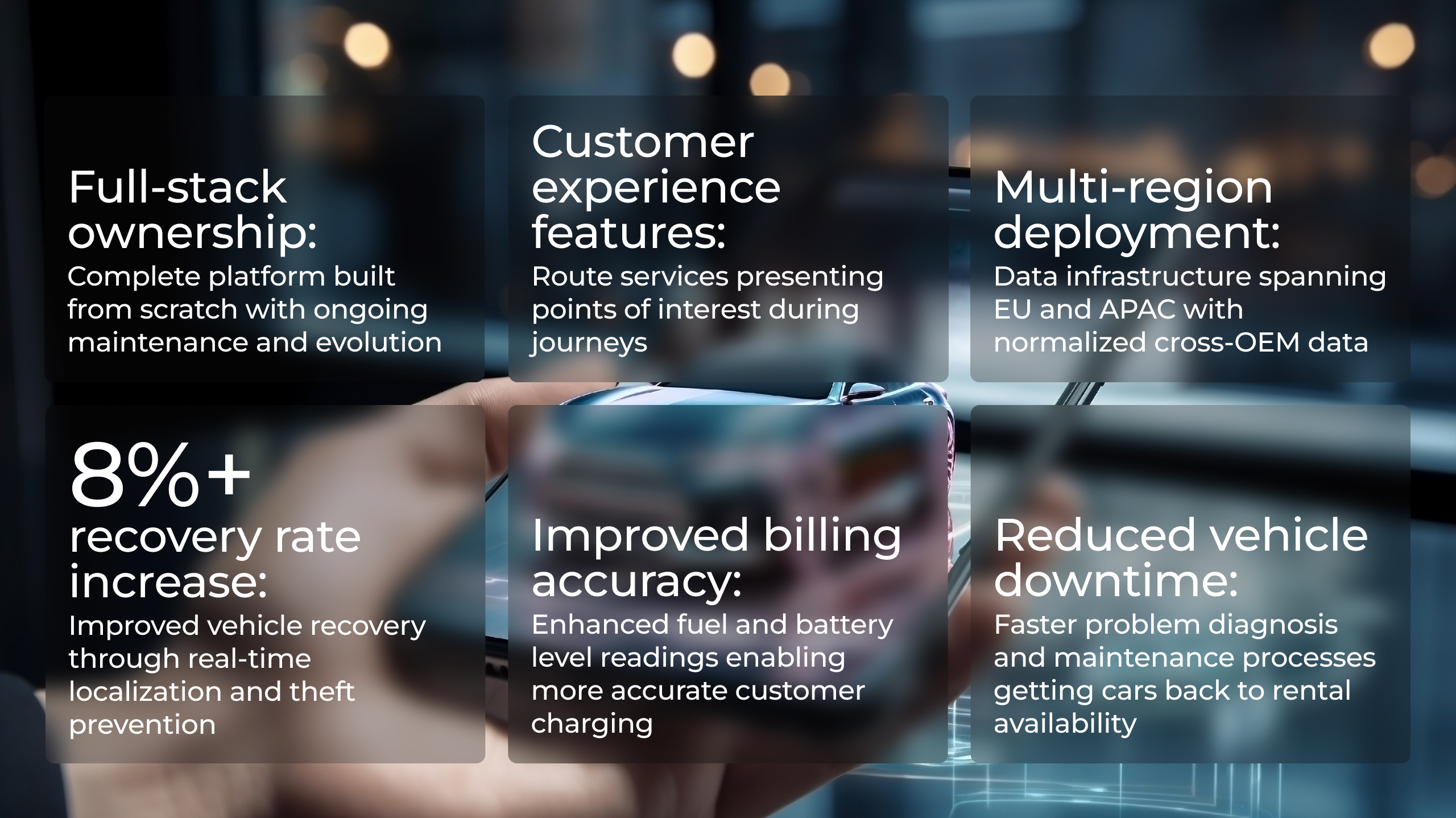
By building a real-time data streaming platform that normalizes telemetric data from connected vehicles, we transformed raw sensor readings into actionable operational intelligence. Fleet management teams moved from reactive problem-solving to proactive optimization - identifying issues before they become breakdowns, preventing theft through continuous monitoring, and billing customers accurately based on actual consumption rather than estimates.
The platform delivered measurable results: at least 8% increase in recovery rates, improved billing accuracy, and reduced vehicle downtime. But the deeper transformation was operational - fleet managers now make decisions based on live vehicle data rather than historical reports. Customer experience improved through services like route optimization with points of interest.
The client moved from having connected vehicles that generated data to having a data platform that generates value. The real-time architecture, multi-region deployment, and normalized cross-OEM data created competitive advantages that compound over time as the fleet grows and new use cases emerge from the telemetric stream.
.webp)