
Case study
When support agents stop searching and start solving
.jpg)
The problem isn't lack of knowledge - it's the gap between questions and answers hidden in organizational silos.
Starting point
Customer support in complex organizations faces a paradox: agents have access to more information than ever before - thousands of documents, regional guidelines, product manuals - yet finding the right answer takes longer than the actual problem-solving. The knowledge exists, but it's scattered across systems that weren't designed to talk to each other.
An automotive company with thousands of employees experienced this challenge firsthand. Their support agents navigated multiple internal systems daily, searching through manuals, region-specific instructions, and dealer-related content. Support agents often struggled to find relevant answers quickly, which slowed down customer service and increased operational costs.
From consultation to proof:
Approach
We partnered with the client through project consulting to identify themost impactful use cases for AI assistance. After selecting the right technology stack to support their needs, we proposed building a proof of concept to demonstrate the solution's potential.
The implementation delivered:
- AI Assistant embedded in agent workflows: Direct integration into the customer's platform
- Multi-source retrieval: Fast and intuitive access to multiple internal data sources
- Contextually accurate responses: Information delivered precisely when agents need it
The proof of concept validated the approach before full-scale deployment, ensuring the solution would deliver real value to support operations.
Breaking The Linear
The AI Assistant doesn't improve search - it eliminates it. Agents ask questions in natural language and receive complete, contextually accurate responses drawn from all relevant systems simultaneously. The AI handles the complexity of multi-source retrieval and synthesis, letting agents focus entirely on customer interaction.
The architecture of instant answers
Summary
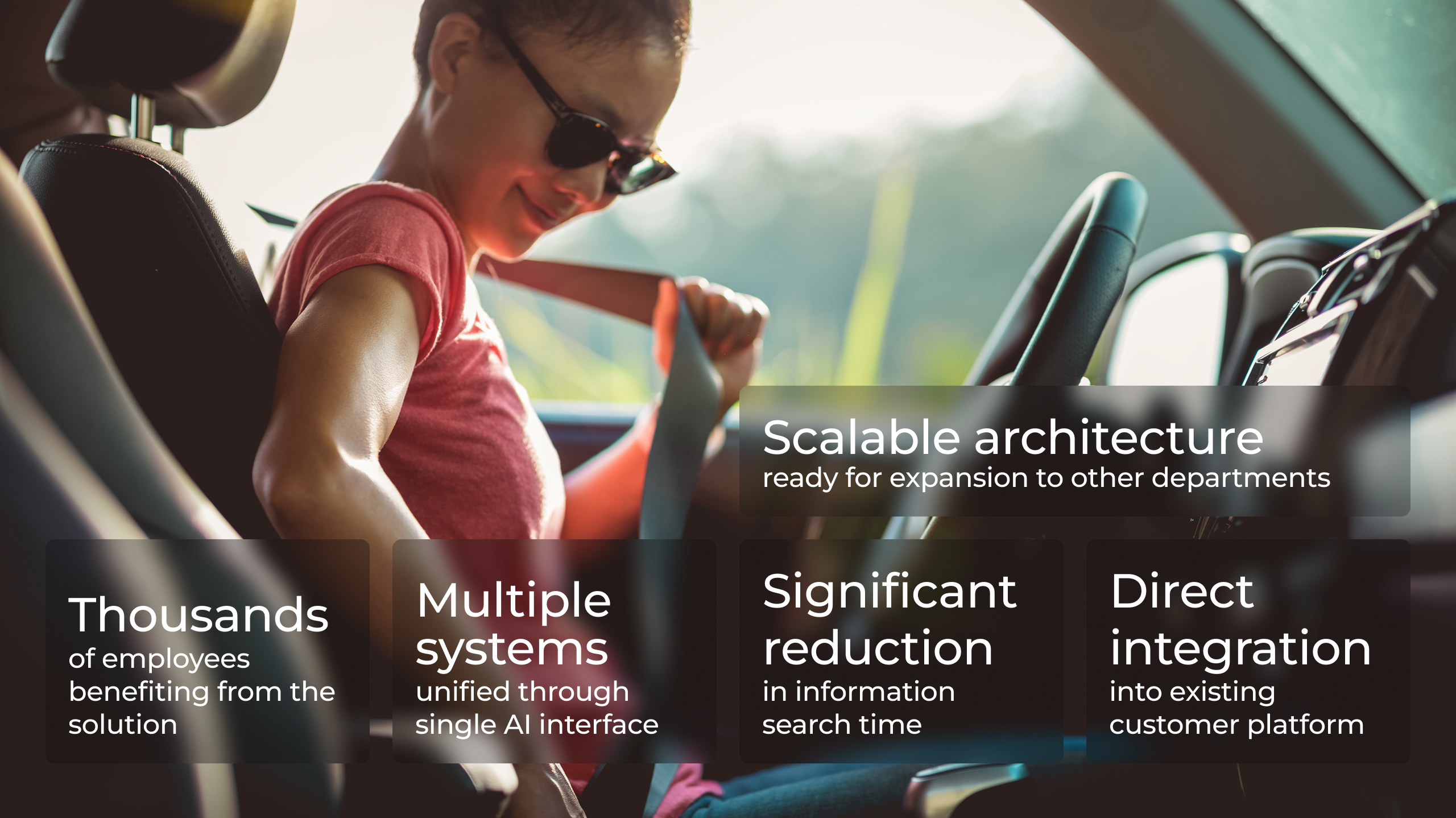
Support agents now retrieve information significantly faster, leading to improved response times and service quality. The AI Assistant integrated directly into their existing platform eliminates the need to search through multiple systems manually - agents get contextually accurate answers drawn from all relevant internal sources.
The reduction in search time translates directly to operational cost savings and better resource utilization. The solution's scalable architecture provides the groundwork for potential future expansion to additional departments or even direct vehicle user assistance, though these remain possibilities rather than implemented features.
.webp)