
Case study
When speed satisfies strategy:
Rewiring an industrial giant
.jpeg)
Transforming delivery velocity isn't about installing DevOps tools - it's about reconstructing the relationship between business strategy and technical execution. For Cummins, we proved that organizational transformation happens fastest when strategy and results move in parallel, not sequence.
Starting point
Global manufacturing leaders face a paradox: their engineering excellence in physical products doesn't automatically translate to software velocity. While startups ship updates daily, established enterprises often measure release cycles in quarters. For Cummins, this gap wasn't just operational - it was existential. In markets where connected products and real-time diagnostics define competitive advantage, the ability to iterate software determines who leads and who follows.
The challenge wasn't technical capability. Cummins had talented engineers and substantial resources. The bottleneck was architectural: legacy systems designed for stability, organizational structures built for control, and workflows optimized for risk avoidance. These foundations, once strengths, had become constraints in an environment demanding continuous innovation.
The parallel transformation engine
Approach
Strategic framework as living document
Rather than prescribing a standard DevOps playbook, we built a diagnostic framework tailored to Cummins' specific context. This mapped the current state across people, processes, governance, and measurement - then defined target states directly connected to business outcomes like time-to-market and platform scalability. The framework wasn't a static document - it evolved continuously as pilot learnings revealed new insights.
Pilot as proof system
Theory doesn't change organizational behavior - results do. We initiated a pilot project pairing with Cummins teams to deliver a real business case using DevOps practices. This created immediate value while serving as a learning laboratory. Teams experienced the actual workflows, encountered real obstacles, and generated concrete evidence of what faster delivery enables. The pilot demonstrated feasibility while building internal champions who understood the transformation firsthand.
Architecture reconstruction
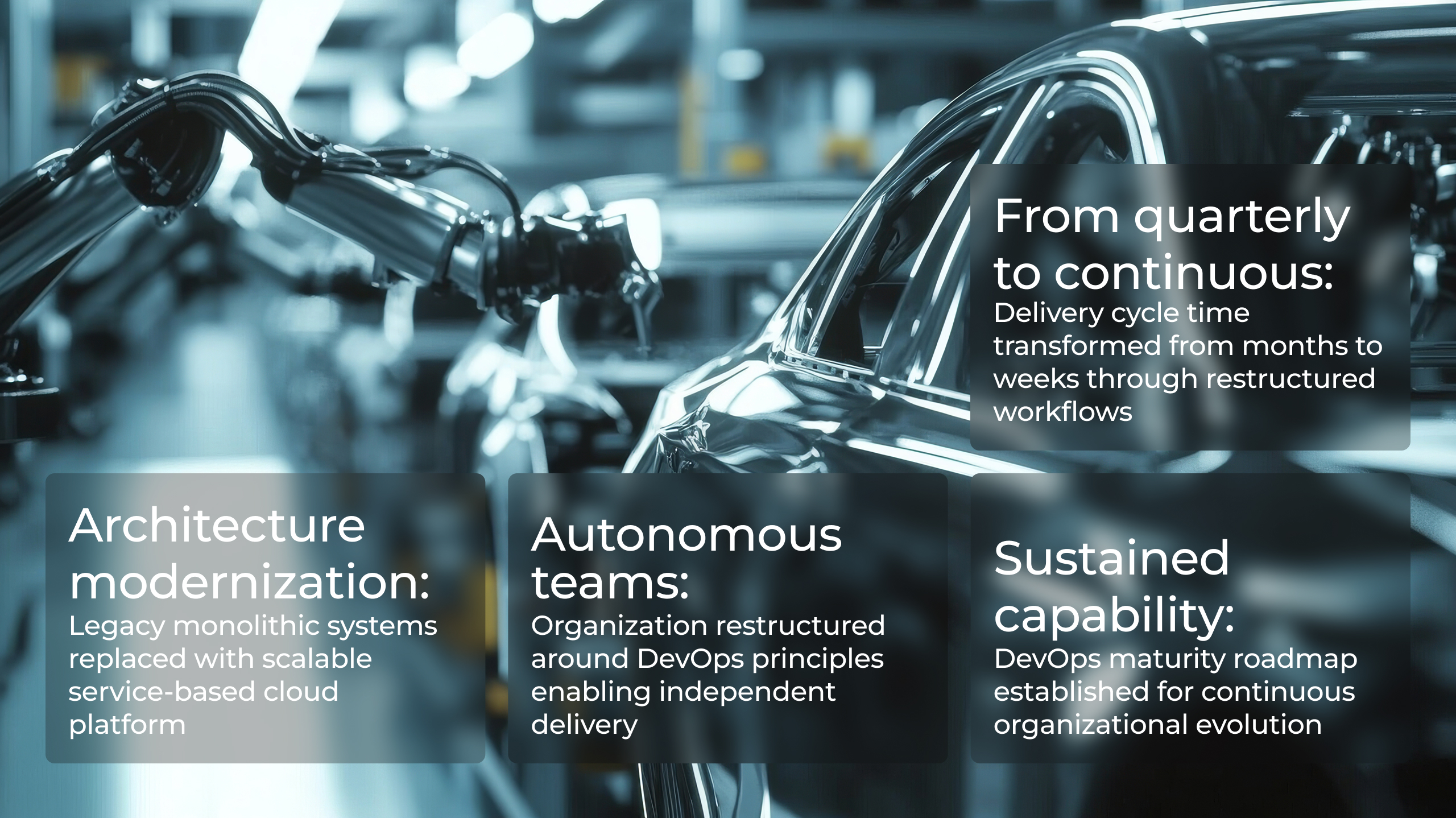
We replaced legacy monolithic systems with service-based cloud architecture. This wasn't simply a technology upgrade - it fundamentally changed what teams could do independently. Loosely coupled services enabled parallel development, reduced deployment risk, and allowed teams to iterate without system-wide coordination. The infrastructure shift created operational flexibility that made continuous delivery technically possible.
Maturity roadmap for sustained evolution
We defined a DevOps maturity roadmap assessing Cummins' state across development practices, infrastructure, and management. This provided actionable steps for continuous improvement beyond the initial transformation, ensuring the organization could evolve its capabilities as market demands shifted.
Breaking The Linear
We recognized that capability transformation requires simultaneous action, not sequential steps. Instead of completing the strategy before seeing results, the pilot project ran in parallel with framework development - each informing the other in real time. This compressed the transformation timeline while building organizational buy-in through demonstrated results rather than promised future benefits.
From control to velocity
Summary
Most organizations approach DevOps transformation as a technical upgrade- new tools, new infrastructure, new processes. We showed Cummins that transformation is fundamentally about changing what's possible. By simultaneously rebuilding architecture, demonstrating value through pilots, and establishing strategic frameworks, we didn't just accelerate delivery - we changed how the organization thinks about software as a competitive instrument.
That shift in perspective - from control to velocity, from stability to learning speed - represents the actual transformation. The technology enabled it. The restructured organization sustains it. The parallel approach made it possible in the timeframe business demanded.
.webp)