Case study
Turning establishment planning into continuous intelligence

Transforming annual crew forecasting into a continuous planning capability - preserving existing business expertise, enabling real-time scenario modeling, and opening a clear path toward predictive intelligence.
Starting point
Airlines plan months ahead. For a major European carrier, that means knowing well in advance whether they'll have enough pilots and cabin crew - withthe right certifications, across the right bases - to operate every scheduled flight next season.
The process is genuinely complex. On one side: current headcount,recruitment pipelines, training schedules that pull crew off operations, maternity leaves, union duties, attrition. On the other: the flight schedule itself, stand-by crew requirements, legal rostering constraints, safety buffers. Balancing these variables is standard practice across the industry - airlines worldwide have built sophisticated planning methodologies to handle exactly this challenge.
These methodologies work. But they share a common limitation: when management asks "what happens if we change this?" - the answer takes days, not minutes. Assumptions are buried in calculation logic, collaboration happens through exported spreadsheets and presentations, and scenario modeling requires significant manual effort every time.
The airline wasn't looking to fix a broken process. They were looking to unlock one.
Capturing logic, building infrastructure
Approach
Starting with understanding, not assumptions
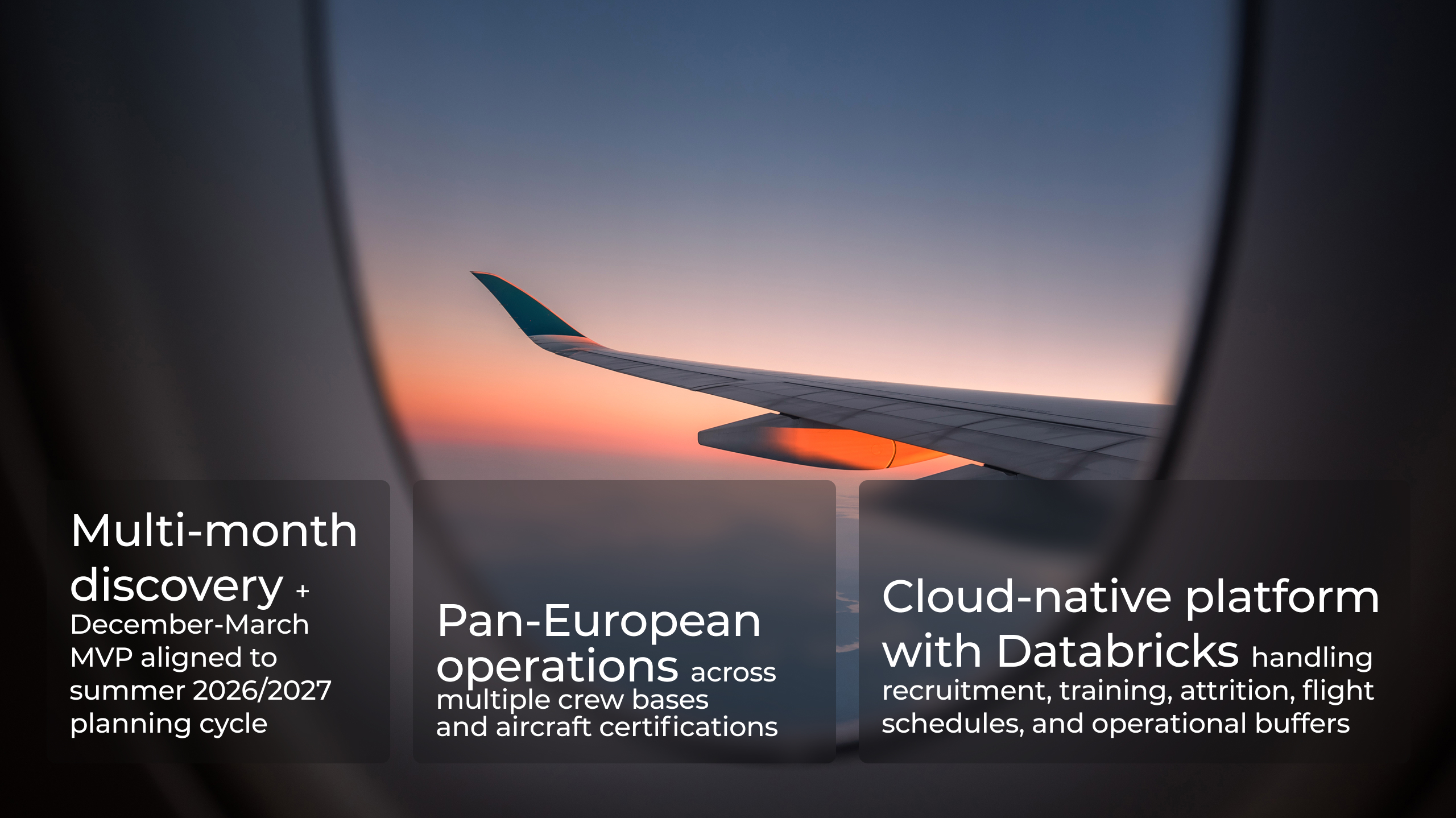
We began with a multi-month discovery phase - not to audit what the airline was doing wrong, but to understand what they were doing right. Their planning team had deep expertise in crew supply and demand modeling. Our job was to capture that logic, understand the variables that mattered most, and identify where the process created friction.
Workshops surfaced the real opportunity: it wasn't the calculations themselves, it was that they were invisible. When a scenario changed, no one could easily trace how it rippled through recruitment, training, availability, and costs across the network.
Building for the planning cycle, not against it
We scoped the MVP around a hard deadline - the airline's summer 2026/2027 season planning cycle. That meant demand-side modeling first: infrastructure to calculate crew requirements based on flight schedules, stand-by needs, rostering buffers, and safety margins, ready before planning began in earnest.
The platform is cloud-native, built on Databricks, with configuration-driven planning at its core. Users define their assumptions - recruitment rates, training durations, attrition patterns - and the system handles every downstream calculation instantly. The initial models intentionally mirror the airline's existing planning approaches, preserving proven business logic while making it transparent, repeatable, and fast.
The architecture is designed to grow -and that growth is already underway. We're actively planning the post-MVP phase with the airline, mapping progression toward machine learning capabilities,AI-assisted recommendations, and expanded stakeholder collaboration.
Breaking The Linear
Where packaged solutions lock every airline into the same feature set, we built infrastructure that starts with the airline's own planning logic and is architected to evolve alongside it.
From annual exercise to real-time capability
Summary
The airline came to us with a planning process that worked - but couldn't easily answer the questions that mattered most. They left with infrastructure that turns "what if" from a days-long exercise into a real-time conversation.
Scenario modeling that required manual recalculation across multiple systems now happens through a single configuration change. Assumptions that were once embedded in logic no one could easily trace are now explicit, transparent, and testable. And a platform built to grow means that as the airline's analytical ambitions develop - toward machine learning, toward broader stakeholder collaboration, toward AI-assisted planning - the foundation is already in place.
Establishment planning stopped being an annual forecast. It became a strategic capability.
.webp)