
Case study
The payment widget that unified fragmented checkout:
One component, multiple providers, zero friction

We proved that payment integration doesn't require separate implementations for each store section - it requires building a flexible widget that functions as a standalone component, providing consistent payment experience wherever it's deployed.
Starting point
A well-known automotive manufacturer's in-vehicle digital product purchase solution faced operational challenges: high costs, slow performance, and limited scalability. Analysis revealed the root issues - ambiguous business requirements and subpar user experience. The development team needed improved business skills and efficient dependency management for better project planning.
Among several improvement initiatives, one critical goal emerged:creating a new payment solution that would integrate the most popular payment systems into the client's digital sales ecosystem. The challenge lay in building a universal payment system that could work seamlessly across different sections of the online store while supporting multiple payment providers, each with specific data requirements and authentication processes.
Widget as universal payment layer
Approach
Domain-driven development foundation
During the initial phase, we focused on the customer-facing store, developing and integrating front-end components with dedicated microservices. We then transitioned to domain-driven development (DDD), redistributing responsibilities among teams to adhere to DDD principles. This approach ensured the payment system's structure aligned with business domains.
Comprehensive requirements gathering
We worked closely with multiple teams and stakeholders to collect comprehensive functional requirements. Our collaborative approach ensured the payment system would be compatible with different sections of the store where integration would occur, understanding the specific context and needs of each touchpoint.
Flexible payment widget architecture
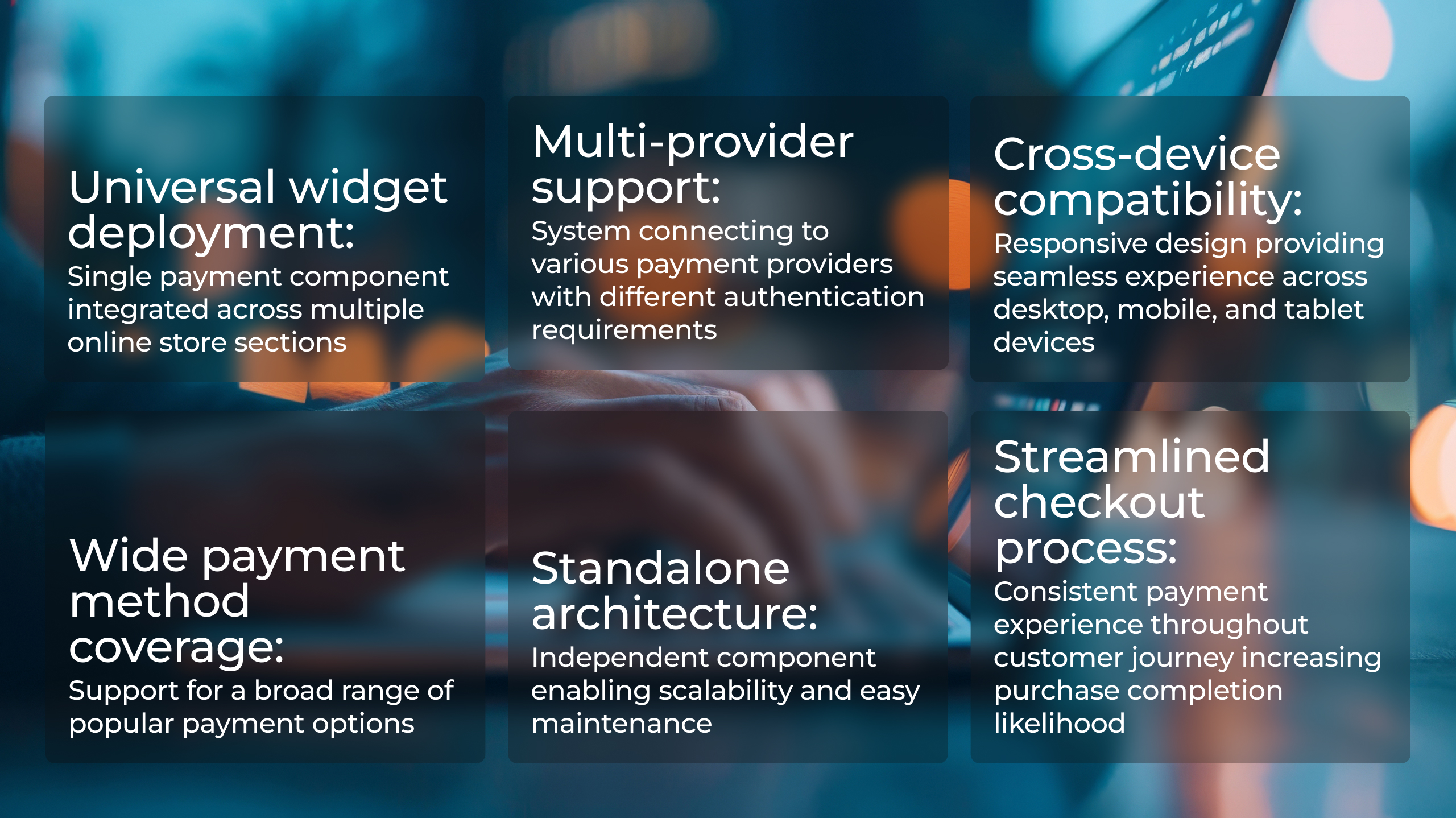
We developed a flexible payment widget that can be seamlessly integrated into various online store sections, providing consistent payment experience throughout the customer journey. The system was designed to support a wide range of transaction types, accommodating diverse business needs.
Multi-provider integration
The system integrates with multiple payment providers, each requiring specific data and authentication processes. This architecture allows the client to offer a variety of payment methods to customers while maintaining a unified integration approach on their side.
Standalone component design
Through close collaboration with the client, we developed robust architecture enabling the payment system to function as a standalone component. This design provides scalability, reliability, and easy maintenance - the widget can be deployed independently and evolved without affecting other system components.
Breaking The Linear
Traditional payment integration requires custom development for each store section and separate implementations for each payment provider. We built a standalone payment widget that handles multiple providers internally while presenting a single integration point to the store - turning what used to require repetitive custom work into a reusable component deployed anywhere.
When integration becomes reusable
Summary
By developing a flexible payment widget functioning as a standalone component, we transformed payment integration from a repetitive custom development task into a reusable capability. The widget handles the complexity of multiple payment providers internally while presenting a clean integration interface to different store sections.
The architecture delivered practical benefits: the client can add new payment providers without modifying store implementations, deploy the widget in new sections without rebuilding payment logic, and maintain a consistent customer experience across all touch points. The standalone design ensures the payment system can scale and evolve independently as business needs change.
The client moved from a fragmented payment integration approach requiring custom work for each implementation to a universal widget that works consistently wherever deployed. The solution met project requirements and timeline while establishing a foundation for future payment capability expansion.
.webp)