
Case study
The API that united a manufacturing empire:
From fragmented fleet to unified platform
.jpg)
We proved that unifying a fragmented automotive ecosystem doesn't require replacing existing technologies - it requires building the right abstraction layer that makes differences invisible to service providers and customers.
Starting point
The automotive industry's shift to connected vehicles and IoT-based services demands unified IT infrastructure for managing digital ecosystems. A renowned car manufacturer faced a specific challenge: over the years, the group had implemented different technologies and solutions for software communication between vehicles and the cloud across multiple brands.
Having many technologies deployed in cars complicated integrating third-party and in-house developed services, increased system complexity, and negatively affected performance. To redesign the in-car software architecture, the company needed to build a space where all apps and services could be integrated and connected - creating a unified customer experience through aDigital Twin concept that captures behavioral and operational vehicle data in the cloud.
Radically standardizing software interfaces using a common platform while ensuring software can be updated throughout its lifecycle represented a revolutionary step for the automotive industry.
Gateway as universal translator
Approach
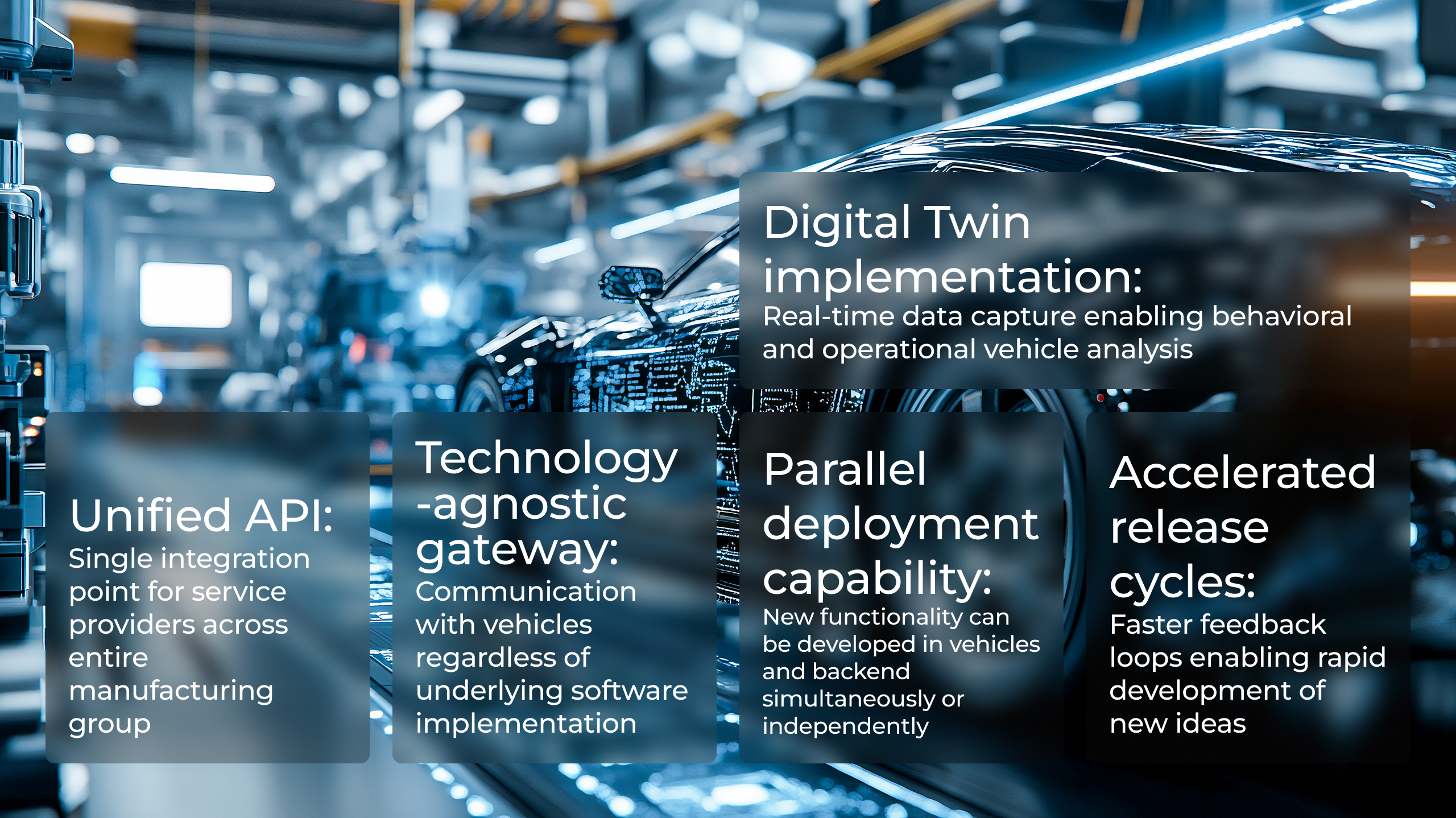
Technology-agnostic gateway component
We developed a gateway component that communicates with vehicles using their existing connected car solutions, regardless of which specific software a vehicle operates. This gateway functions as a universal translator - service providers interact with a single unified API while the gateway handles the complexity of communicating with diverse underlying technologies. The solution enables service providers to deliver new apps faster without needing to understand each brand's specific implementation.
Digital twin as data orchestration layer
We delivered an element of the Digital Twin concept that gathers behavioral and operational data from vehicles and transfers it through the cloud. The Digital Twin captures near real-time vehicle performance data, enabling analysis and personalized service delivery. To make this data accessible, we developed an original query language based on GraphQL and the RSI protocol, empowering customers to request specific information available on the platform.
Cloud Foundry as foundation
We selected OSS Cloud Foundry as the platform foundation for its flexibility and time efficiency. This choice provided a stable environment for developing applications, features, and services while enabling rapid prototyping of various communication patterns between cars and the cloud.
Proof of concept as group-wide validation
The client organized a group-wide PoC involving multiple partners to prototype various scenarios within their digital ecosystem. This approach validated technologies and concepts across different use cases before committing to full-scale implementation. After completing the initial phase and documenting experiences, collaboration shifted to implementing a market-ready solution based on the unified API.
Breaking The Linear
Standard platform projects force technology standardization across all brands - a multi-year migration replacing existing systems. We built an abstraction layer that unified the API while leaving existing vehicle technologies untouched. Service providers got a single integration point. Brands kept their existing implementations. The platform delivered unification without requiring replacement.
When abstraction beats replacement
Summary
Most enterprise platform projects assume unification requires standardization - forcing all business units onto the same technology stack through expensive, risky migrations. We showed this car manufacturer that unification can happen at the API layer while preserving existing implementations underneath.
By building a gateway that abstracts away technological differences, wet urned fragmentation from a liability into an invisible implementation detail. Service providers now integrate once and reach the entire vehicle fleet. Customers experience unified services regardless of which brand vehicle they're using. The manufacturing group can innovate at the platform level without disrupting brand-specific technology investments.
The prototyped automotive cloud provided immediate value - accelerated release pace, faster feedback loops, parallel development capability - while establishing the foundation for market-ready implementation. The client moved from a collection of incompatible brand ecosystems to a unified platform that makes technological diversity strategically irrelevant.
.webp)