Case study
From notebook to platform:
When data tools become data ecosystems
.jpg)
We proved that transforming a data solution into a scalable platform requires starting small, learning continuously, and evolving based on real user feedback - not upfront requirements documents.
Starting point
A sports car manufacturer needed to evolve their existing data management solution into a comprehensive platform. The goal was clear: support multiple projects and use cases, enhance data analysis capabilities, and increase efficiency for data professionals across the organization. The challenge lay in serving a diverse audience - developers, analysts, and non-technical personnel - each with different workflows and requirements.
The project demanded extensive research to identify tools that would be user-friendly, practical, and compatible with these varied workflows while meeting security compliance standards.
From Proof to Platform
Approach
Research-Driven Tool Selection
We conducted extensive evaluations to identify tools and technologies suitable for a diverse audience. The assessment focused on establishing which solutions would be user-friendly, practical, and compatible with different workflows - serving developers, analysts, and non-technical personnel with their distinct needs.
Security Compliance as Foundation
We took a consulting and development approach with security compliance at its core. This involved direct collaboration with the client's security team, infrastructure reviews, and adherence to security protocols throughout the development process - ensuring the platform met necessary standards and requirements from the start.
Proof of Concept as Learning Phase
We conducted a Proof of Concept followed by testing and feedback collection. Initially, we delivered a preconfigured notebook designed for data analysis. This PoC phase generated insights that shaped subsequent development decisions.
Iterative Platform Evolution
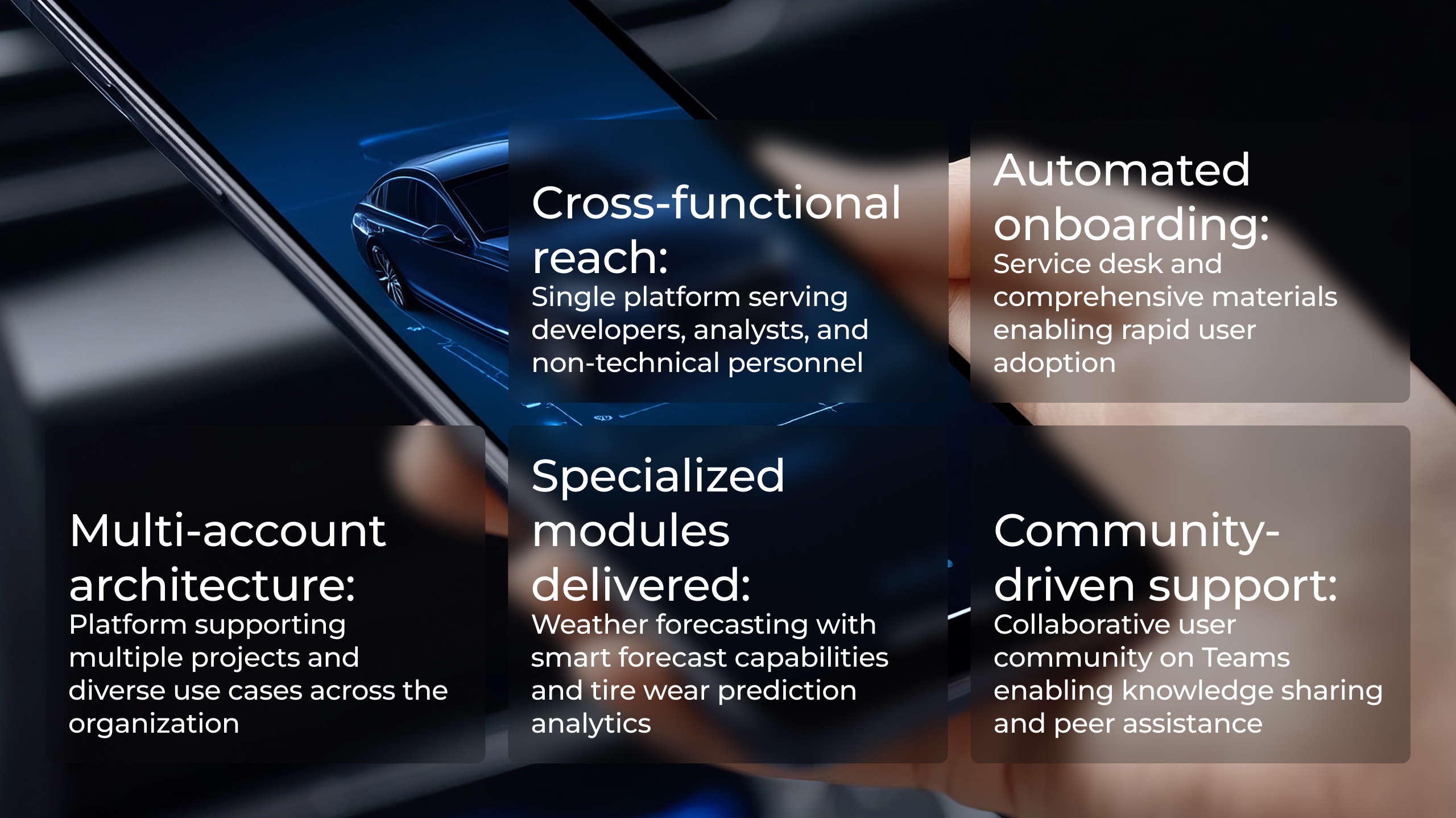
Based on PoC feedback, we expanded to a new product encompassing all original solution features while introducing additional functionalities. We implemented comprehensive onboarding materials, added an automated service desk, and built a collaborative user community on Teams to provide support and foster knowledge sharing.
Breaking The Linear
Traditional platform development defines all requirements upfront, then builds the complete solution. We started with a focused PoC - a preconfigured notebook - gathered real user feedback, then expanded iteratively. The final platform wasn't what we initially specified - it was shaped by insights from actual usage, turning assumptions into validated learnings before full-scale development.
When feedback shapes the platform
Summary
Most data platform projects build everything upfront based on initial requirements, then discover during rollout that users needed something different. We showed this sports car manufacturer that platform evolution works better when driven by continuous feedback loops.
By starting with a PoC that real users could test immediately, we avoided building features nobody needed while discovering capabilities that added genuine value. The platform that launched in mid-2022 encompassed the original solution's features plus new functionalities identified through the testing phase - weather forecasting modules, tire wear prediction, automated support systems, and collaborative tools.
The client moved from an existing data management solution to a comprehensive, scalable platform that increased efficiency and productivity for data professionals. The iterative approach ensured the final product aligned with actual user requirements rather than theoretical specifications.
.webp)